
🐶 Complete Small Dog Puppy Care Guide
Bringing home a new puppy is one of life’s most exciting adventures. It’s also the beginning of a journey filled with important decisions that will shape your puppy’s health, behaviour, and happiness for years to come. Whether you’re welcoming your very first puppy or adding another furry family member to your home, having the right information from the very beginning can make all the difference.
This comprehensive guide has been created specifically for owners of small and toy breed puppies. While all puppies share many basic needs, smaller breeds have unique requirements when it comes to nutrition, exercise, training, socialization, health care, and safety. Understanding these differences will help your puppy grow into a confident, well-adjusted adult while avoiding many of the common challenges new owners face.
Inside this guide, you’ll learn how to prepare your home, choose the right food, establish healthy routines, begin house training and socialization, provide proper veterinary care, and build a strong lifelong bond with your new companion. We’ll also cover common puppy problems, grooming, safe exercise, developmental milestones, and the essential supplies every new puppy owner should have on hand.
At DogPage.us, we believe that responsible dog ownership begins long before a puppy reaches adulthood. The first year of your puppy’s life lays the foundation for everything that follows. By investing time in positive training, proper nutrition, preventive health care, and plenty of love and patience, you’ll give your puppy the very best start in life.
❤️ DogPage Recommendation
Remember that every puppy develops at its own pace. Focus on consistency rather than perfection, celebrate small successes, and enjoy the journey. The time you invest during your puppy’s first year will reward you with a confident, happy, and well-behaved companion for many years to come.
Let’s get started and help your small breed puppy grow into the healthy, confident companion you’ve always dreamed of.
🏡 Preparing for Your New Puppy
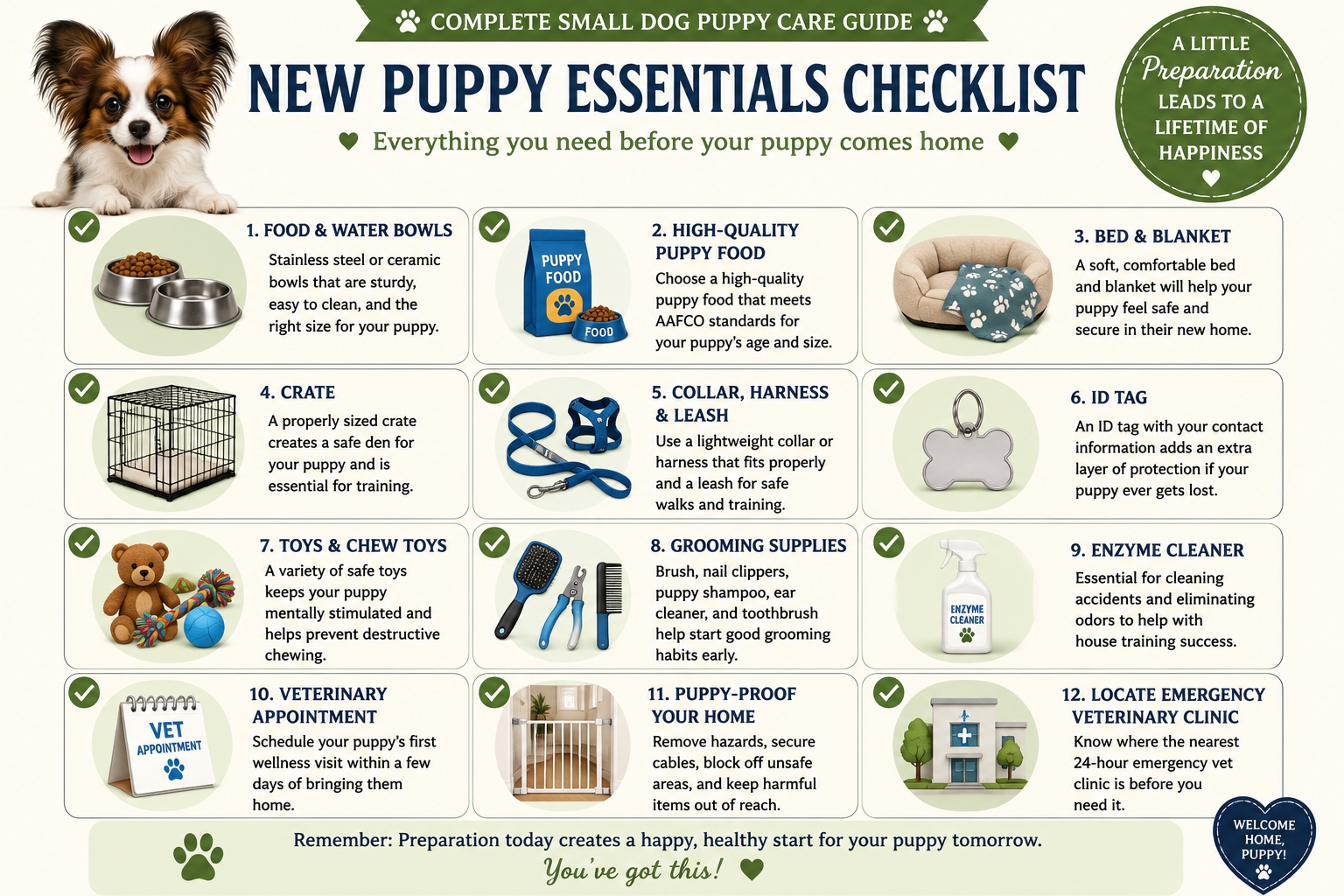
Bringing home a new puppy is an exciting milestone, but a little preparation before your puppy arrives will make the transition much smoother for both of you. Puppies are naturally curious and eager to explore their surroundings, so creating a safe, welcoming environment from day one helps them settle in quickly while reducing stress and preventing accidents.
Before bringing your puppy home, take time to puppy-proof your house much like you would for a young child. Remove electrical cords from reach, secure household cleaners and medications, move toxic plants out of reach, and pick up anything small enough to be chewed or swallowed. Block access to unsafe areas with baby gates if necessary, and ensure fences and gates are secure before allowing your puppy outside.
Having the right supplies ready before your puppy arrives means you can spend your first days together building trust rather than rushing to the pet store. Your puppy will need a comfortable bed, appropriately sized food and water bowls, high-quality puppy food, a properly fitted collar or harness, leash, identification tag, crate, safe chew toys, grooming supplies, and cleaning products designed for inevitable potty accidents.
Choosing a veterinarian before bringing your puppy home is another important step. Schedule your puppy’s first wellness examination within a few days of arrival, even if your breeder or rescue has already provided veterinary care. This allows your veterinarian to establish a health record, answer questions, discuss vaccinations and parasite prevention, and ensure your puppy is off to a healthy start.
Your puppy’s first day at home should be calm and relaxed. Give them time to explore one room at a time rather than overwhelming them with the entire house. Introduce family members gradually, keep young children calm and supervised, and provide plenty of opportunities for rest. Remember that everything your puppy sees, hears, and smells is completely new, so patience and gentle encouragement go a long way toward building confidence.
Most importantly, establish routines from the very beginning. Feeding at consistent times, taking your puppy outside frequently, scheduling naps, and introducing short training sessions will help your puppy understand what to expect each day. Dogs thrive on routine, and beginning these habits immediately lays the foundation for successful training and a happy household.
💡 Did You Know?
Moving to a new home is one of the biggest changes a puppy will ever experience. Keeping the first few days calm, predictable, and positive helps build confidence and makes house training and bonding much easier.
❤️ DogPage Recommendation
Prepare everything before your puppy comes home. Having supplies ready, your home puppy-proofed, and a veterinary appointment already scheduled allows you to focus on what matters most—helping your new companion feel safe, secure, and loved.
⚠️ Common Mistake to Avoid
Don’t invite lots of visitors during your puppy’s first few days at home. While everyone will be excited to meet your new family member, too many unfamiliar people and experiences at once can overwhelm a young puppy. Give your puppy time to settle in before introducing a steady stream of guests.
❤️ Puppy Health Care
Your puppy’s first year is a time of rapid growth and development, making preventive health care one of the most important investments you’ll make. Regular veterinary visits, vaccinations, parasite prevention, proper nutrition, and careful observation all help give your puppy the healthiest possible start in life. Establishing a relationship with a trusted veterinarian early also provides valuable guidance as your puppy grows and develops.
Schedule your puppy’s first veterinary examination within a few days of bringing them home, even if they have already been examined by the breeder or rescue organization. During this visit, your veterinarian will perform a thorough physical examination, review vaccination and deworming records, discuss nutrition, answer your questions, and recommend an appropriate preventive healthcare schedule based on your puppy’s age, breed, and lifestyle.
Vaccinations play a vital role in protecting puppies from serious infectious diseases while their immune systems are still developing. Your veterinarian will recommend a vaccination schedule tailored to your puppy’s individual needs and local disease risks. Regular deworming and year-round parasite prevention for fleas, ticks, and heartworms are also essential parts of maintaining good health.
As your puppy grows, monitor their weight, appetite, energy level, and behaviour. Puppies are naturally playful and curious, so sudden changes in activity, vomiting, diarrhea, coughing, loss of appetite, or unusual lethargy should never be ignored. Young puppies can become seriously ill more quickly than adult dogs, making prompt veterinary attention especially important.
Microchipping provides permanent identification and greatly increases the chances of being reunited if your puppy ever becomes lost. Your veterinarian can also discuss the most appropriate timing for spaying or neutering based on your puppy’s breed, size, and overall health.
💡 Did You Know?
Puppies age much more rapidly than adult dogs during their first year. Regular veterinary examinations allow your veterinarian to monitor growth, detect potential health concerns early, and ensure your puppy is developing normally.
❤️ DogPage Recommendation
Keep a dedicated folder containing your puppy’s vaccination records, veterinary reports, microchip information, and emergency contact numbers. Having everything organized makes routine care—and unexpected emergencies—much less stressful.
⚠️ Common Mistake to Avoid
Don’t wait to see if a young puppy “gets better on their own” when they appear sick. Puppies can become dehydrated or seriously ill much faster than adult dogs. If your puppy seems unusually lethargic, refuses food, has repeated vomiting or diarrhea, or shows difficulty breathing, contact your veterinarian immediately.
📖 Learn More: Read our Complete Small Dog Health Guide → (Coming Soon)
🚽 House Training Your Puppy
House training is one of the first and most important lessons your puppy will learn. While accidents are a normal part of the process, consistency, patience, and positive reinforcement will help your puppy understand where and when it’s appropriate to go to the bathroom. Most puppies want to keep their sleeping area clean, making house training easier when a predictable routine is established from the very beginning.
Take your puppy outside frequently, especially after waking up, eating, drinking, playing, and before bedtime. Young puppies have very small bladders and limited control, so expect to make many trips outdoors during the day. Choose one designated potty area and take your puppy to the same spot each time. The familiar scent helps reinforce good habits and encourages your puppy to eliminate more quickly.
When your puppy successfully goes to the bathroom outside, praise them enthusiastically and immediately reward them with a small treat or affection. Puppies learn best when the reward comes within a few seconds of the desired behavior. Positive experiences help your puppy associate going outside with something enjoyable.
Accidents inside the house should never be punished. If you catch your puppy in the act, calmly interrupt them and immediately take them outside to finish. If you discover an accident after the fact, simply clean it thoroughly using an enzyme-based cleaner that removes odors. Punishment after the event only creates confusion and may cause your puppy to become fearful of toileting in your presence.
Crate training can be one of the most effective tools for house training when used correctly. Most puppies naturally avoid soiling the area where they sleep, making the crate a safe place while you’re unable to supervise. The crate should never be used as punishment, but rather as a comfortable den where your puppy feels secure.
Remember that every puppy learns at a different pace. Some puppies become reliably house trained within a few weeks, while others require several months of consistent practice. Remaining patient, maintaining a regular routine, and celebrating small successes will help your puppy gain confidence and develop lifelong good habits.
💡 Did You Know?
Most puppies need to relieve themselves within 5 to 30 minutes after eating or drinking. Planning potty breaks around mealtimes greatly improves your chances of success.
❤️ DogPage Recommendation
Take your puppy outside on a regular schedule instead of waiting for them to ask. Consistency builds routine, and routine is one of the biggest keys to successful house training.
⚠️ Common Mistake to Avoid
Don’t rub your puppy’s nose in an accident or scold them after the fact. Your puppy won’t understand why they’re being punished. Calmly clean the area, continue your routine, and reward every successful potty break outside.
📖 Learn More: Read our Complete Small Dog Training Guide → (Coming Soon)
🤝 Socializing Your Puppy
Socialization is one of the greatest gifts you can give your puppy. During the first few months of life, puppies are especially receptive to new experiences, making this the ideal time to introduce them to the people, places, sounds, animals, and situations they’ll encounter throughout their lives. Positive early experiences help puppies grow into confident, friendly adults, while poor or limited socialization can increase the risk of fear, anxiety, and behavioural problems later in life.
Effective socialization isn’t about exposing your puppy to as many things as possible—it’s about ensuring those experiences are positive and enjoyable. Introduce new sights, sounds, and experiences gradually, allowing your puppy to explore at their own pace. Offer praise, treats, and reassurance whenever your puppy responds calmly and confidently.
Whenever it’s safe to do so, introduce your puppy to people of different ages, appearances, and abilities, including children, seniors, and people wearing hats, uniforms, or sunglasses. Encourage gentle interactions with friendly, fully vaccinated dogs and, if appropriate, calm cats and other household pets. Supervise every introduction carefully to ensure your puppy feels safe and has a positive experience.
Don’t forget to expose your puppy to everyday sights and sounds such as traffic, bicycles, lawn mowers, vacuum cleaners, elevators, shopping carts, umbrellas, and thunderstorms. Short car rides, visits to pet-friendly stores, walks on different surfaces, and gentle handling of paws, ears, and mouth all help prepare your puppy for everyday life.
Always pay attention to your puppy’s body language. If they appear frightened or overwhelmed, increase the distance from whatever is causing concern and allow them time to relax before trying again. Never force your puppy into situations that cause excessive fear. Building confidence gradually is far more effective than overwhelming your puppy with too much too soon.
Remember that socialization continues beyond puppyhood. Continue introducing your dog to new people, places, and experiences throughout adolescence and adulthood to maintain confidence and reinforce positive behaviour.
💡 Did You Know?
Animal behaviour experts generally agree that the most important socialization period occurs during the first few months of a puppy’s life. Positive experiences during this time can have lifelong benefits.
❤️ DogPage Recommendation
Aim to provide your puppy with several new, positive experiences each week. Keep every experience fun, rewarding, and free from pressure. Building confidence is far more important than checking items off a list.
⚠️ Common Mistake to Avoid
Don’t confuse socialization with overwhelming your puppy. Introducing too many new experiences at once—or forcing interactions with people or dogs—can create fear instead of confidence. Let your puppy set the pace.
📖 Learn More: Read our Complete Small Dog Training Guide → (Coming Soon)
🎓 Basic Puppy Training
Training begins the moment your puppy comes home. Every interaction teaches your puppy something, whether you’re rewarding good behaviour, establishing routines, or simply building trust. The goal during the first few months isn’t perfection—it’s creating positive habits and helping your puppy understand how to succeed in your home.
Keep training sessions short, fun, and rewarding. Young puppies have short attention spans, so five to ten minute sessions several times a day are far more effective than one long lesson. Always end on a positive note and celebrate your puppy’s successes with praise, treats, toys, or play.
Start by teaching a few essential commands that will make everyday life easier and safer. Most puppies can begin learning sit, come, stay, leave it, and drop it using positive reinforcement. These simple commands build communication, improve safety, and provide a solid foundation for more advanced training later.
One of the most important lessons for every puppy is learning bite inhibition. Puppies naturally explore the world with their mouths, but they must learn that human skin is delicate. If your puppy bites too hard during play, calmly stop the game for a few moments before resuming once they’ve settled. Consistency helps puppies develop gentle mouths without the need for harsh corrections.
Loose-leash walking should also begin early. Rather than expecting perfect walks immediately, focus on helping your puppy enjoy wearing a collar or harness, walking beside you for short distances, and checking in with you frequently. These early experiences create the foundation for enjoyable walks throughout your dog’s life.
Remember that training isn’t just about teaching commands—it’s about building trust and communication. Every positive interaction strengthens the bond between you and your puppy while helping them become a confident, polite member of your family.
💡 Did You Know?
Puppies are learning all the time—even when you aren’t actively training them. Consistently rewarding the behaviours you want to see encourages your puppy to repeat them naturally.
❤️ DogPage Recommendation
Keep training enjoyable. Puppies learn fastest when they’re relaxed, having fun, and rewarded for making good choices. Patience and consistency will always produce better results than punishment.
⚠️ Common Mistake to Avoid
Don’t expect your puppy to master every command immediately. Training is a gradual process that requires repetition, patience, and realistic expectations. Celebrate progress rather than striving for perfection.
📖 Learn More: Read our Complete Small Dog Training Guide → (Coming Soon)
🏃 Exercise & Mental Stimulation
Play is your puppy’s work. Through play, puppies build strong muscles, develop coordination, learn social skills, burn energy, and gain confidence. Providing the right balance of physical activity, mental stimulation, and rest is essential for healthy development, especially during the first year of life.
Young puppies don’t need long walks or strenuous exercise. Instead, they benefit from several short periods of activity throughout the day. Gentle games, exploring the garden, supervised play with friendly dogs, and short training sessions provide plenty of physical and mental enrichment without placing unnecessary strain on growing bones and joints.
Mental exercise is just as important as physical activity. Puzzle toys, food-dispensing toys, scent games, simple obedience training, and introducing new experiences all help tire your puppy’s mind while building confidence and problem-solving skills. Many puppies become more settled after a short training session than after a long play session.
As your puppy grows, gradually increase both the duration and variety of activities. Walks should remain enjoyable rather than exhausting, and high-impact activities such as repeated jumping from furniture, long-distance running, or strenuous agility training should wait until your veterinarian confirms your puppy’s bones and joints have fully developed.
Every puppy also needs plenty of uninterrupted sleep. It’s perfectly normal for young puppies to alternate between energetic play and long naps throughout the day. Rest is when much of your puppy’s physical growth and brain development takes place.
💡 Did You Know?
Most puppies sleep between 16 and 20 hours every day during their first few months of life. Those frequent naps are essential for healthy growth, learning, and brain development.
❤️ DogPage Recommendation
Think in terms of several short play sessions rather than one long workout. Mixing gentle exercise with training, exploration, and puzzle toys provides a healthy balance that keeps puppies both physically fit and mentally engaged.
⚠️ Common Mistake to Avoid
Don’t assume a tired puppy is always a happy puppy. Over-exercising a growing puppy can contribute to injuries and place unnecessary stress on developing joints. Allow plenty of opportunities for rest between periods of activity.
📖 Learn More: Read our Complete Small Dog Care Guide →
✂️ Grooming Your Puppy
Regular grooming is about much more than keeping your puppy looking adorable. It plays an important role in maintaining healthy skin and coat, preventing painful mats, detecting health problems early, and helping your puppy become comfortable with being handled. Starting gentle grooming routines during puppyhood makes lifelong grooming much easier for both you and your dog.
Begin with short, positive grooming sessions lasting just a few minutes at a time. Use plenty of praise, treats, and gentle encouragement so your puppy learns that brushing, bathing, nail trimming, and handling are enjoyable experiences rather than something to fear. Patience during these early weeks will pay dividends for years to come.
Brush your puppy regularly using tools appropriate for their coat type. Even breeds that require only moderate grooming benefit from frequent brushing because it removes loose hair, prevents tangles, distributes natural skin oils, and provides an opportunity to check for lumps, parasites, or skin irritation.
Bathing should only be done when necessary using a shampoo formulated specifically for puppies. Over-bathing can strip natural oils from the skin and coat, so most puppies only need occasional baths unless they become particularly dirty. Always dry your puppy thoroughly, especially during cooler weather.
Dental care should begin as early as possible. Introduce a soft toothbrush and dog-safe toothpaste gradually, allowing your puppy to become comfortable with having their mouth handled. Regular tooth brushing is one of the best ways to prevent dental disease later in life, particularly in small breeds that are more prone to dental problems.
Don’t forget your puppy’s nails and ears. Trim nails regularly so they don’t become overgrown and uncomfortable, and check ears weekly for redness, unpleasant odors, or excessive wax. Gentle handling of paws, ears, and mouth during everyday cuddle time also helps prepare your puppy for future veterinary examinations and professional grooming appointments.
💡 Did You Know?
Many adult dogs dislike grooming simply because they weren’t introduced to it positively as puppies. A few enjoyable minutes each week can prevent years of stress and anxiety.
❤️ DogPage Recommendation
Handle your puppy’s paws, ears, tail, and mouth every day, even when you’re not grooming. Gentle daily handling helps your puppy become comfortable being examined by veterinarians, groomers, and family members.
⚠️ Common Mistake to Avoid
Don’t wait until your puppy’s coat becomes tangled or their nails become overgrown before introducing grooming. Short, frequent sessions are far easier and much more enjoyable than occasional long grooming sessions.
📖 Learn More: Read our Complete Small Dog Grooming Guide → (Coming Soon)
😴 Sleep & Daily Routine
New puppy owners are often surprised by just how much their puppy sleeps. During the first few months of life, puppies typically sleep between 16 and 20 hours each day. Those long naps aren’t a sign of laziness—they’re essential for healthy growth, brain development, learning, and emotional well-being. Providing plenty of opportunities for uninterrupted rest is just as important as feeding, training, and exercise.
Creating a predictable daily routine helps your puppy feel safe and secure while making house training, feeding, and bedtime much easier. Dogs thrive on consistency, and puppies quickly learn what to expect when meals, potty breaks, playtime, training sessions, and bedtime occur at roughly the same times each day.
Your puppy should have a quiet, comfortable place to sleep where they can rest without constant interruptions. Many owners find that a properly introduced crate provides a secure den-like environment, while others choose a puppy bed placed in a quiet area of the home. During the first few nights, it’s perfectly normal for puppies to whine as they adjust to being away from their mother and littermates. Patience, reassurance, and maintaining a calm bedtime routine will help your puppy settle more quickly.
Balance periods of activity with regular naps throughout the day. An overtired puppy can become overexcited, mouthy, or difficult to settle, much like an overtired child. If your puppy suddenly seems unable to listen, becomes unusually hyperactive, or starts nipping excessively, they may simply need a nap rather than more playtime.
As your puppy matures, they’ll gradually spend more time awake and require fewer naps. However, maintaining a predictable daily routine throughout adulthood continues to support good behaviour, confidence, and overall well-being.
💡 Did You Know?
Many behaviour problems in young puppies are actually caused by overtiredness. Providing enough quiet time for rest often results in a calmer, happier, and more cooperative puppy.
❤️ DogPage Recommendation
Try to keep feeding times, potty breaks, walks, training sessions, and bedtime as consistent as possible each day. A predictable routine helps puppies learn faster and feel more secure in their new home.
⚠️ Common Mistake to Avoid
Don’t keep your puppy awake simply because you want to play. Young puppies need frequent naps throughout the day to support healthy growth and development. An exhausted puppy is often more difficult to manage than a well-rested one.
⚠️ Common Puppy Problems
Every puppy goes through a learning process, and it’s completely normal to encounter a few bumps along the way. Chewing, nipping, barking, accidents in the house, and moments of overexcitement are all part of growing up. Understanding why these behaviours occur—and responding with patience and consistency—will help your puppy develop into a confident, well-mannered adult.
Puppy Biting & Nipping
Puppies naturally explore the world with their mouths and often nip during play, especially while teething. Redirect your puppy to appropriate chew toys, end play briefly if biting becomes too rough, and reward calm, gentle behaviour. Avoid rough games that encourage chasing hands or clothing.
Chewing
Chewing is a healthy and necessary behaviour that helps puppies explore their environment and relieve discomfort during teething. Provide a variety of safe chew toys and keep valuable household items out of reach. Rotate toys regularly to keep them interesting.
Barking
Puppies bark to communicate excitement, curiosity, fear, boredom, or a desire for attention. Rather than punishing barking, identify the cause and teach your puppy alternative behaviours through positive reinforcement.
Separation Anxiety
Most puppies need time to learn that being alone is safe. Begin with very short absences and gradually increase the amount of time your puppy spends alone. Leave safe toys or food puzzles to create positive associations with your departure and return calmly without making a big fuss.
Fear Periods
Many puppies experience temporary fear periods as they develop. During these times, they may suddenly become cautious around people, objects, or situations that never bothered them before. Stay calm, avoid forcing interactions, and continue building confidence through gentle encouragement and positive experiences.
Jumping Up
Puppies often jump up to greet people because it earns attention. Teach your puppy that sitting politely earns greetings instead. Ask family members and visitors to ignore jumping and reward calm behaviour consistently.
💡 Did You Know?
Many so-called “behaviour problems” are simply normal stages of puppy development. Understanding what to expect helps owners respond calmly and confidently instead of becoming frustrated.
❤️ DogPage Recommendation
Whenever your puppy displays a behaviour you’d like to change, ask yourself why they’re doing it. Addressing the underlying cause is usually far more effective than correcting the behaviour itself.
⚠️ Common Mistake to Avoid
Don’t expect perfect behaviour from a young puppy. Learning takes time, and occasional setbacks are completely normal. Consistency, patience, and positive reinforcement will always produce better long-term results than punishment.
📖 Learn More: Read our Complete Small Dog Training Guide → (Coming Soon)
📅 Puppy Development Timeline
Your puppy’s first year is filled with remarkable physical, emotional, and behavioural changes. Understanding what to expect during each stage of development helps you set realistic expectations, recognize important milestones, and provide the guidance your puppy needs to become a happy, well-adjusted adult dog. While every puppy develops at their own pace, the following timeline offers a general guide for most small and toy breeds.
🐾 8–10 Weeks: Settling Into a New Home
This is an exciting but overwhelming time for your puppy. Everything is new, including people, sounds, smells, and routines. Focus on helping your puppy feel safe, begin house training, establish a daily routine, schedule a veterinary visit, and start gentle socialization.
🐾 10–12 Weeks: Building Confidence
Your puppy becomes more curious and confident while continuing to learn about the world. Continue introducing new people, friendly dogs, everyday sounds, and different environments. Begin teaching simple commands using positive reinforcement and encourage gentle handling during grooming sessions.
🐾 3–4 Months: Rapid Learning
This is one of the best times for training. Puppies are eager to learn and can quickly master basic commands, house training, and leash manners. Teething often begins during this stage, making appropriate chew toys especially important.
🐾 5–6 Months: Growing Independence
Your puppy may begin testing boundaries as confidence grows. Continue reinforcing good manners, maintain consistent routines, and provide regular mental stimulation. Adolescence is just around the corner, making patience and consistency especially important.
🐾 6–9 Months: The Teenage Phase
Many puppies become more independent and easily distracted during adolescence. Continue socialization, reinforce training, and avoid becoming discouraged if your puppy temporarily seems to “forget” previously learned commands. This stage is completely normal and usually passes with consistent guidance.
🐾 9–12 Months: Approaching Adulthood
By the end of the first year, many small breed puppies are approaching their adult size and beginning to mature emotionally. Continue providing regular exercise, training, socialization, and veterinary care while strengthening the bond you’ve built throughout puppyhood.
💡 Did You Know?
Small breed dogs often mature physically sooner than large breeds, but emotional maturity continues to develop throughout the first year and beyond. Consistent training and positive experiences remain important even after your puppy reaches adult size.
❤️ DogPage Recommendation
Celebrate every milestone, no matter how small. Every successful potty break, new command learned, and positive experience helps shape your puppy into the confident companion you’re raising.
⚠️ Common Mistake to Avoid
Don’t compare your puppy to others. Every dog develops at a slightly different pace depending on genetics, personality, health, and life experiences. Focus on steady progress rather than perfection.
❤️ Building a Lifelong Bond
The relationship you build with your puppy during the first year will shape your friendship for the rest of your dog’s life. Trust isn’t created through expensive toys or perfect training sessions—it’s built through thousands of small, positive interactions every day. Every meal you serve, every walk you take, every game you play, and every moment you spend together strengthens the bond between you.
Spend quality time with your puppy each day beyond feeding and potty breaks. Play together, practice simple training exercises, explore new places, or simply relax together. Puppies thrive on companionship and quickly learn to see their family as a source of comfort, security, and fun.
Consistency is one of the greatest gifts you can give your puppy. Establish clear rules, reward good behaviour, and respond calmly to mistakes. When your puppy understands what is expected and feels safe in their environment, they develop confidence and trust that lasts a lifetime.
Positive reinforcement is the foundation of a healthy relationship. Rather than focusing on correcting unwanted behaviours, look for opportunities to reward the behaviours you’d like to see more often. Praise, treats, toys, and affection all help your puppy understand they’ve made a good choice while making learning enjoyable.
Remember that your puppy is learning about the world every single day. There will be accidents, setbacks, and challenging moments along the way, but patience and understanding will always strengthen your relationship far more than frustration or punishment. Your puppy doesn’t expect perfection—they simply need your guidance, consistency, and love.
As the months pass, you’ll discover that the trust you’ve built extends far beyond training. A strong bond creates a happier, more confident dog, makes veterinary visits and grooming easier, improves communication, and lays the foundation for years of companionship and unforgettable memories.
💡 Did You Know?
Studies have shown that spending time interacting positively with your dog can increase oxytocin—the “bonding hormone”—in both dogs and humans, strengthening the unique relationship you share.
❤️ DogPage Recommendation
Set aside at least a few minutes every day simply to enjoy your puppy’s company. Put away distractions, play together, cuddle, or practice a few simple commands. These quiet moments often become the foundation of an extraordinary lifelong friendship.
⚠️ Common Mistake to Avoid
Don’t think bonding only happens during formal training sessions. Every positive interaction—from gentle grooming and playtime to quiet evenings together—helps your puppy learn that you’re someone they can trust and rely on throughout their life.
❤️ Building a Lifelong Bond
The relationship you build with your puppy during the first year will shape your friendship for the rest of your dog’s life. Trust isn’t created through expensive toys or perfect training sessions—it’s built through thousands of small, positive interactions every day. Every meal you serve, every walk you take, every game you play, and every moment you spend together strengthens the bond between you.
Spend quality time with your puppy each day beyond feeding and potty breaks. Play together, practice simple training exercises, explore new places, or simply relax together. Puppies thrive on companionship and quickly learn to see their family as a source of comfort, security, and fun.
Consistency is one of the greatest gifts you can give your puppy. Establish clear rules, reward good behaviour, and respond calmly to mistakes. When your puppy understands what is expected and feels safe in their environment, they develop confidence and trust that lasts a lifetime.
Positive reinforcement is the foundation of a healthy relationship. Rather than focusing on correcting unwanted behaviours, look for opportunities to reward the behaviours you’d like to see more often. Praise, treats, toys, and affection all help your puppy understand they’ve made a good choice while making learning enjoyable.
Remember that your puppy is learning about the world every single day. There will be accidents, setbacks, and challenging moments along the way, but patience and understanding will always strengthen your relationship far more than frustration or punishment. Your puppy doesn’t expect perfection—they simply need your guidance, consistency, and love.
As the months pass, you’ll discover that the trust you’ve built extends far beyond training. A strong bond creates a happier, more confident dog, makes veterinary visits and grooming easier, improves communication, and lays the foundation for years of companionship and unforgettable memories.
💡 Did You Know?
Studies have shown that spending time interacting positively with your dog can increase oxytocin—the “bonding hormone”—in both dogs and humans, strengthening the unique relationship you share.
❤️ DogPage Recommendation
Set aside at least a few minutes every day simply to enjoy your puppy’s company. Put away distractions, play together, cuddle, or practice a few simple commands. These quiet moments often become the foundation of an extraordinary lifelong friendship.
⚠️ Common Mistake to Avoid
Don’t think bonding only happens during formal training sessions. Every positive interaction—from gentle grooming and playtime to quiet evenings together—helps your puppy learn that you’re someone they can trust and rely on throughout their life.
👨👩👧👦 Puppy Safety
Puppies are naturally curious and love to investigate the world with their noses, paws, and mouths. While this curiosity is an important part of learning, it can also place them at risk if their environment isn’t properly prepared. Taking a few simple precautions before accidents happen can help keep your puppy safe while giving you greater peace of mind.
Begin by puppy-proofing your home. Keep electrical cords out of reach, secure medications and household cleaners in closed cabinets, and remove small objects that could be swallowed. Many common household items—including chocolate, grapes, raisins, onions, xylitol, and certain houseplants—can be toxic to dogs. When in doubt, assume an unfamiliar item is unsafe until you’ve confirmed otherwise.
Because small breed puppies are especially delicate, it’s important to protect them from falls and other injuries. Avoid allowing your puppy to jump on and off furniture, climb steep staircases unsupervised, or play roughly with much larger dogs. Encourage children to sit on the floor when holding or playing with a puppy, and always supervise interactions between young children and dogs.
Outdoor safety is equally important. Ensure your yard is securely fenced before allowing your puppy outside, and never leave a young puppy unattended outdoors. Keep your puppy on a leash during walks until they have developed reliable recall and are old enough to safely explore more challenging environments. Be mindful of extreme temperatures, as small puppies are more vulnerable to both heat and cold than adult dogs.
Travel safely by securing your puppy in a crash-tested travel crate or dog safety harness whenever riding in a vehicle. Never allow your puppy to ride loose in the car or with their head out of an open window. Safe travel habits established during puppyhood become lifelong habits that protect your dog for years to come.
Finally, prepare for emergencies before they happen. Keep your veterinarian’s phone number, the nearest emergency veterinary clinic, and an animal poison hotline readily available. Having a well-stocked pet first aid kit and knowing where to turn in an emergency can make all the difference when every minute counts.
💡 Did You Know?
Many emergency veterinary visits involve accidents that could have been prevented through simple puppy-proofing and close supervision. A safe environment allows your puppy to explore and learn with confidence.
❤️ DogPage Recommendation
Get down on your hands and knees and look at your home from your puppy’s point of view. You’ll often discover cords, small objects, and hazards that are easy to miss when viewed from an adult’s perspective.
⚠️ Common Mistake to Avoid
Don’t assume your puppy “knows better.” Curiosity is a normal part of development, and puppies will investigate almost everything they encounter. Good supervision and prevention are far more effective than reacting after an accident has already happened.
📖 Learn More: Read our Complete Small Dog Care Guide → (Coming Soon)