
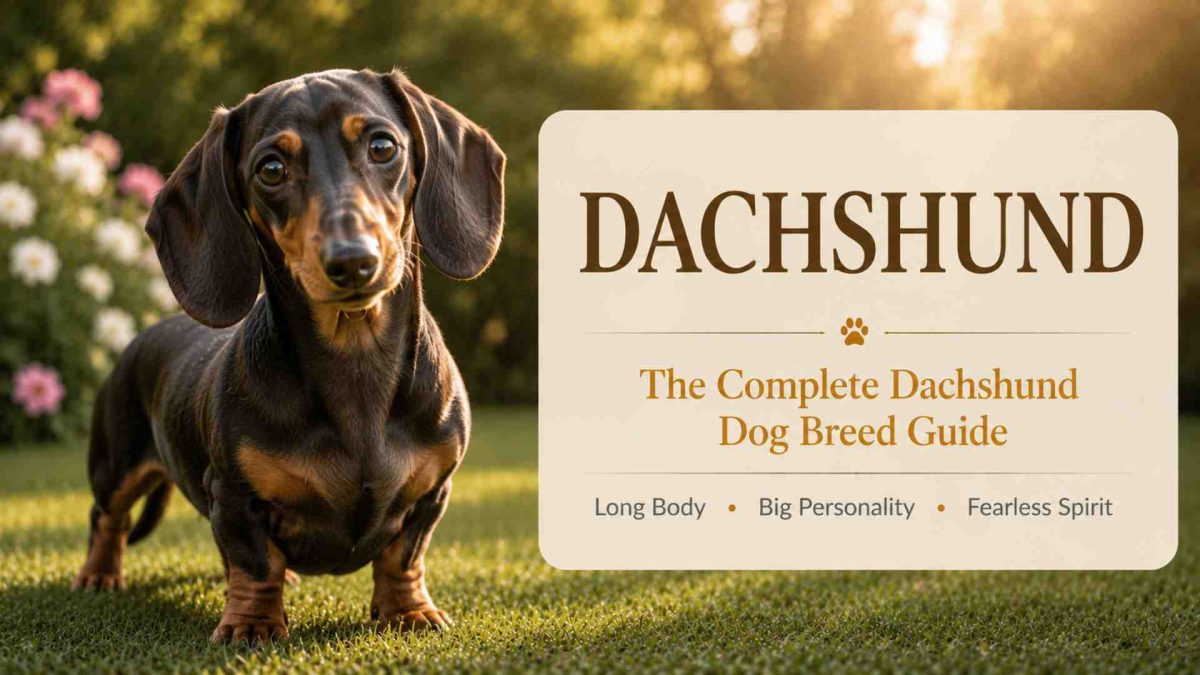
Few dogs are as instantly recognizable as the Dachshund. Long in body, short in leg, bright-eyed and usually convinced that whatever is happening in the house is very much their business, these little hounds combine a distinctive silhouette with a personality far larger than their height would suggest.
Dachshunds are also the dogs millions of people affectionately call wiener dogs, sausage dogs, Doxies, or—very commonly in online searches—weiner dogs. Whatever name brings you here, the breed behind the nickname is the same German hunting hound: a clever, persistent dog developed to work above and below ground, follow scent, dig, bark to communicate with hunters, and make decisions independently.
Today’s Dachshund can be a devoted lap companion, apartment dog, family pet, active senior’s sidekick, scent-game enthusiast, or all of those things in the same week. But the breed is not simply a cute hot-dog-shaped lap dog. Dachshunds can be vocal, determined, surprisingly athletic, slow to forgive inconsistent house-training routines, and deeply attached to their people. Their characteristic long-backed build also makes intervertebral disc disease (IVDD) and spinal health especially important topics for every prospective owner.
This updated Dogs Central guide covers both Standard and Miniature Dachshunds, all three coat varieties, popular colors and patterns, full-grown size and weight, lifespan, temperament, barking, shedding, allergy questions, grooming, training, back care, puppies, breeders, adoption, popular Dachshund mixes, and what living with a wiener dog is actually like.
Written by: Deborah G. Moore
Last updated: August 14, 2026
Dachshund at a Glance
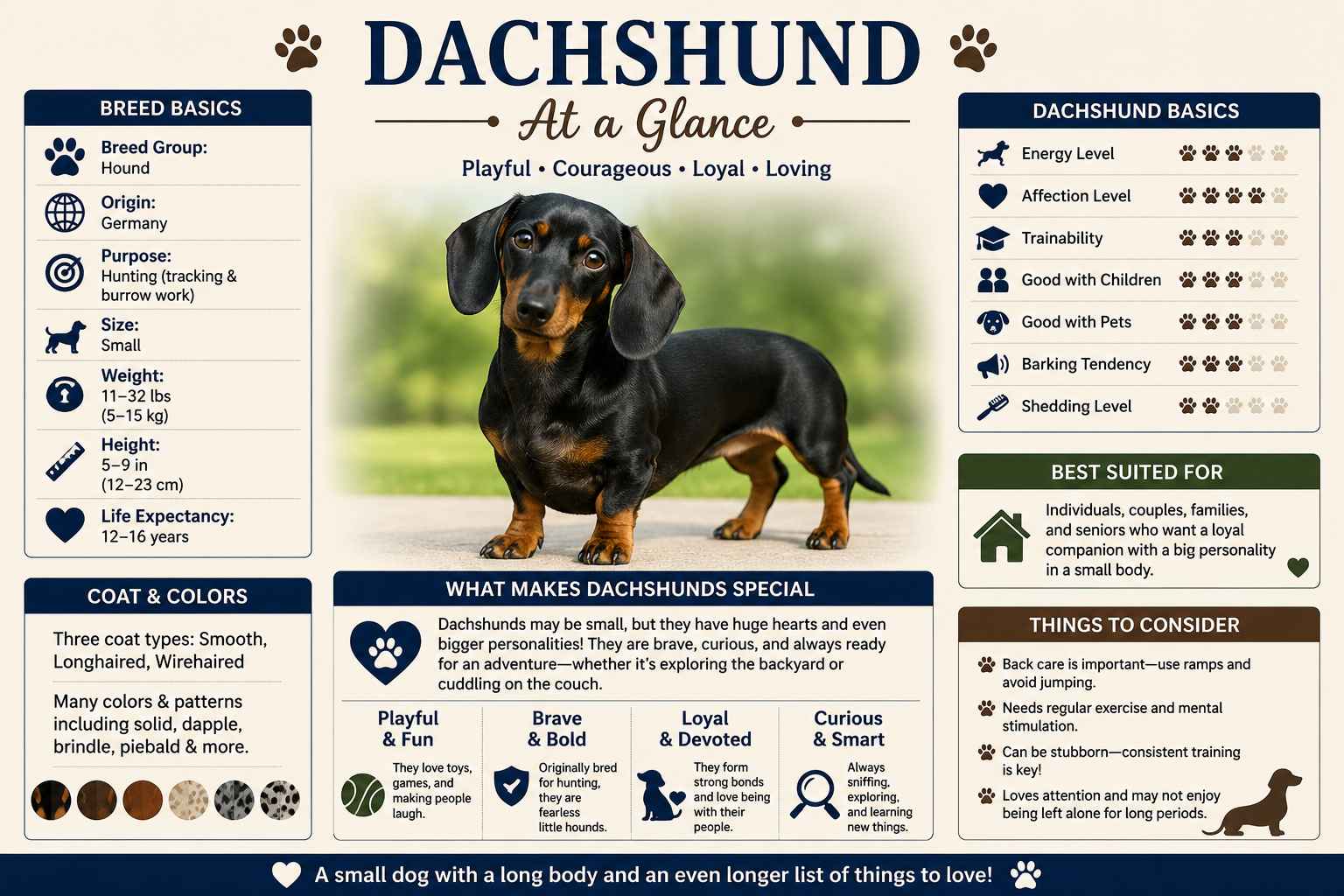
| Breed Group | Hound Group |
|---|---|
| Country of Origin | Germany |
| Other Names | Wiener dog, sausage dog, Doxie, Teckel |
| Sizes in the United States | Standard and Miniature |
| Standard Weight | Usually 16–32 pounds |
| Miniature Weight | 11 pounds and under at 12 months of age and older for AKC class division |
| Typical Height | Standard about 8–9 inches; Miniature about 5–6 inches at the shoulder |
| Coat Varieties | Smooth, Longhaired, Wirehaired |
| Life Expectancy | About 12–16 years |
| Temperament | Clever, lively, courageous, affectionate, alert, persistent |
| Energy Level | Moderate; more athletic than their short legs suggest |
| Exercise Needs | Moderate daily exercise plus sniffing and mental enrichment |
| Trainability | Intelligent but independent; responds best to patient reward-based training |
| Shedding | Yes; amount varies somewhat by coat |
| Hypoallergenic? | No |
| Barking Tendency | Often high |
| Apartment Friendly | Often yes, if barking and exercise needs are managed |
| Major Health Consideration | Intervertebral disc disease (IVDD) and lifelong spinal care |
| Best Suited To | People who want an affectionate, entertaining small companion and appreciate an independent hound personality |
About the Dachshund
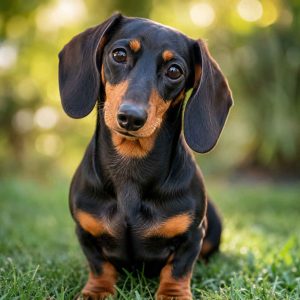
The Dachshund is a true hound in a very unusual package. The official breed standard describes a dog that is low to the ground, long-bodied, short-legged, muscular, alert and equipped for work both below ground and through brush. Those proportions were not designed to make the dog look adorable in photographs; they were developed for a demanding hunting job.
That working history still matters in the modern family dog. A Dachshund’s enthusiasm for digging, sniffing, chasing, sounding the alarm, squeezing under blankets and making its own decisions all make more sense when you remember that this was never intended to be a decorative lap dog.
The breed is shown in two sizes in the United States—Standard and Miniature—and three coat varieties: Smooth, Longhaired and Wirehaired. All six size-and-coat combinations are Dachshunds. A Miniature Longhaired Dachshund, for example, is not a different breed from a Standard Smooth Dachshund; each is a variety of the same breed.
For owners, the most important traits to understand are not merely the short legs and long back. Dachshunds tend to be courageous, people-oriented, alert, persistent and independently intelligent. They can be wonderfully affectionate while still having opinions about whether your instructions are worth following.
Is a Wiener Dog the Same as a Dachshund?
Yes. A “wiener dog” is a Dachshund. “Sausage dog” and “Doxie” are also common nicknames for the breed. People frequently type “weiner dog” online, but the conventional spelling of the nickname is wiener dog.
The nickname comes from the Dachshund’s long, low silhouette, which people naturally compared with a sausage or hot dog. The nickname is so familiar that many people first encounter the dog as a “wiener dog breed” and only later learn the formal name Dachshund.
What is a Doxie?
Doxie is simply an affectionate nickname for a Dachshund. You may also see “Dachsie,” “sausage dog,” “wiener dog,” and the German term “Teckel.” None of these describes a separate breed.
Is a Mini Wiener Dog a Miniature Dachshund?
Usually, yes. “Mini wiener dog” is everyday language for a Miniature Dachshund. The AKC and Dachshund Club of America use the formal size designation Miniature, not “mini wiener dog.”
Using both the proper breed name and the common nickname is useful when researching puppies, health information or rescue listings. Shelters and owners may advertise the same type of dog under different terms.
Dachshund History: Where Wiener Dogs Come From & What They Were Bred to Hunt
The Dachshund was developed in Germany as a hunting dog. The breed name comes from German words associated with badger and dog, which is why “badger dog” is the translation most often given for Dachshund.
German hunters needed a dog capable of following quarry into underground dens. That required a low body, powerful front end, strong digging ability, an excellent nose, enough lung capacity and stamina for hard work, and the nerve to confront dangerous animals in confined spaces. The Dachshund’s unusual shape makes much more sense when viewed as specialized working anatomy rather than a novelty.
What did Dachshunds hunt?
Badger work is the purpose most closely associated with the breed, but Dachshunds were also used for other game and tracking. Their scenting ability, determination and “loud tongue”—the hound tendency to give voice—were useful to hunters working with dogs that could disappear underground or into heavy cover.
Why were Miniature Dachshunds developed?
Miniature Dachshunds developed later for smaller quarry. AKC historical material notes that a rise in Germany’s rabbit population during the 1800s contributed to the development of the smaller Dachshund. In the United States, Standard and Miniature are the recognized size divisions.
What is a Rabbit or Kaninchen Dachshund?
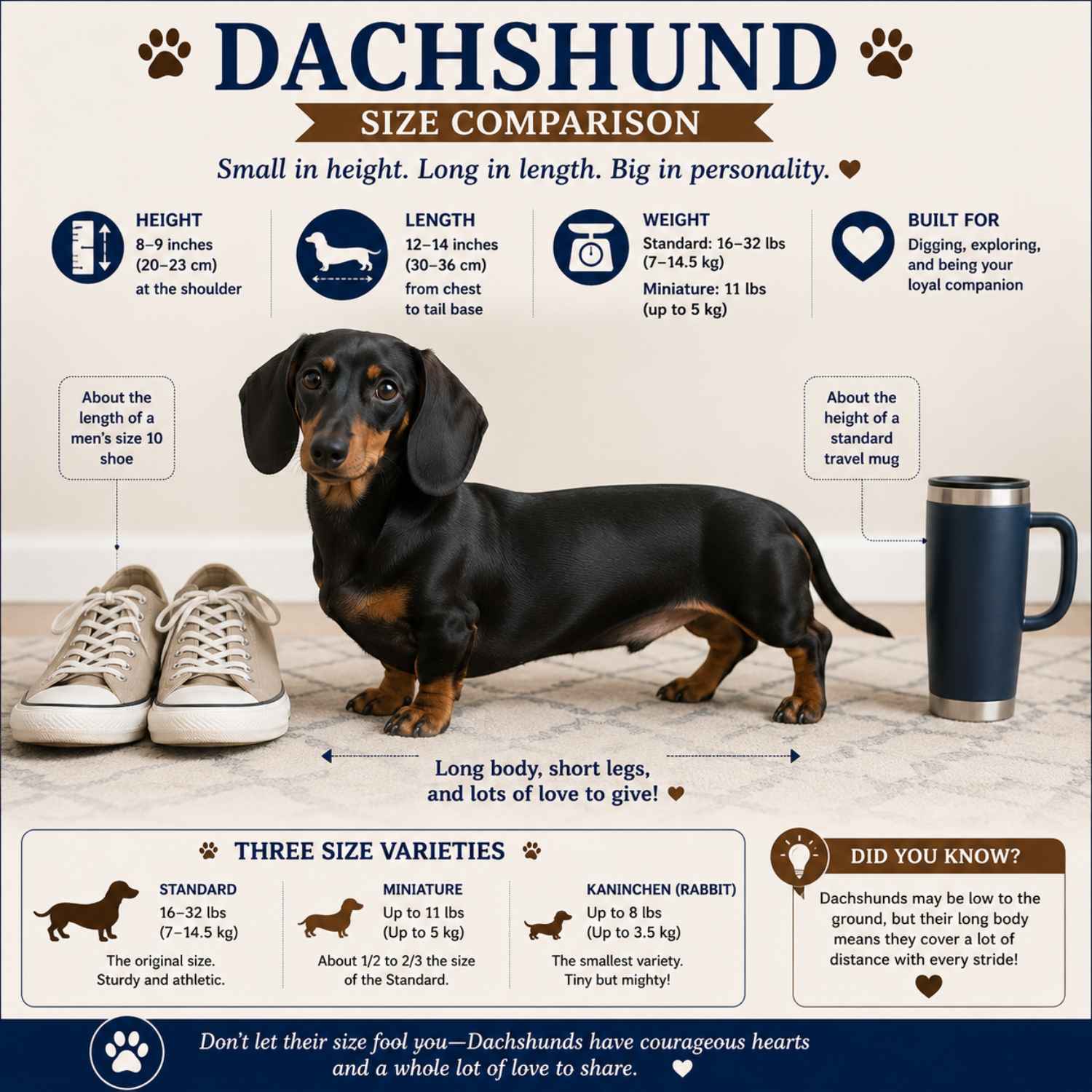
You may encounter searches for Kaninchen Dachshunds or “rabbit Dachshunds.” European classification systems can use a third size category, but Kaninchen is not an AKC Dachshund size division in the United States. American buyers should be cautious when sellers use unfamiliar size terms as a reason to charge more for an unusually tiny puppy.
The modern Dachshund may spend more time tracking crumbs under the kitchen table than badgers underground, but its hunting heritage remains visible in the breed’s courage, persistence, scenting, digging, barking and independent decision-making.
Standard vs. Miniature Dachshund: Full-Grown Size, Weight & Growth
The Dachshund is bred and shown in two sizes in the United States: Standard and Miniature. According to the Dachshund Club of America breed standard, Miniatures compete in a class division for dogs weighing 11 pounds and under at 12 months of age and older. Standard Dachshunds are usually 16–32 pounds.
| Size | Typical Adult Weight | Typical Height | What to Know |
|---|---|---|---|
| Miniature Dachshund | 11 lb and under for the AKC Miniature class division | About 5–6 inches | Same breed and same three coat varieties; especially popular as a small companion |
| Standard Dachshund | Usually 16–32 lb | About 8–9 inches | Substantially more dog than a Miniature while retaining the same low-slung hound type |
| “Tweenie” Dachshund | Often used informally for dogs between common Miniature and Standard weights | Variable | Nickname only; not an official AKC size classification |
How big does a Miniature Dachshund get?
A full-grown Miniature Dachshund should be thought of primarily in terms of weight rather than an exact body length. In U.S. conformation terminology, the Miniature division is based on being 11 pounds or under at 12 months of age and older. Individuals may vary somewhat in build, bone and body length.
If you are choosing a puppy, ask for the adult weights of the sire and dam and, ideally, mature offspring from previous litters. A breeder can give an informed estimate, but no one can guarantee that an eight-week-old puppy will finish at an exact number of pounds.
When does a Mini Dachshund stop growing?
Most Dachshunds achieve most of their height during the first year, then continue to fill out and mature. A puppy may look close to adult height before its chest, muscle and overall body condition have finished developing.
Do not deliberately restrict a puppy’s food to keep it “mini.” Growth should be supported with a complete, balanced puppy diet and monitored for healthy body condition with your veterinarian.
How long is a Miniature Dachshund?
There is no official AKC “nose-to-tail” length requirement for Miniature Dachshunds. Internet length charts can be misleading because dogs differ in neck length, ribcage, topline and tail carriage. For harnesses, clothing, carriers and ramps, measure the actual dog rather than buying solely from a breed label.
What is a Teacup Dachshund?
“Teacup Dachshund” is not an official Dachshund size. It is a marketing term. Prospective owners should be especially cautious when extremely tiny adult size is promoted as the puppy’s most important quality. Sound structure, healthy development, stable temperament and documented health screening matter far more than an unofficial size label.
Dachshund Appearance: Why Are Wiener Dogs So Long?
The Dachshund’s defining outline is long and low, but a well-built Dachshund is not meant to look weak, awkward or incapable of normal movement. The breed standard calls for a muscular, balanced dog with a strong front, long ribcage and free movement.
The famous long body and short legs are tied to the breed’s original work. Short legs helped the dog enter underground passages. A long, developed ribcage protected vital organs and provided room for the heart and lungs needed for endurance. Strong forequarters helped the dog dig and push through earth.
Dachshund ears, eyes and expression
Dachshunds normally have moderately long drop ears that frame the face and an alert, intelligent expression. Their head tapers toward the nose, giving them a distinctly hound-like profile rather than the short muzzle of many other small companion breeds.
Are Dachshunds fragile?
They are not porcelain ornaments. Healthy Dachshunds should be active and capable of normal exercise. The important distinction is that their spinal anatomy creates a meaningful IVDD risk, so sensible body weight, fitness, handling and prevention of needless high-impact habits matter throughout life.
Dachshund Photo Gallery
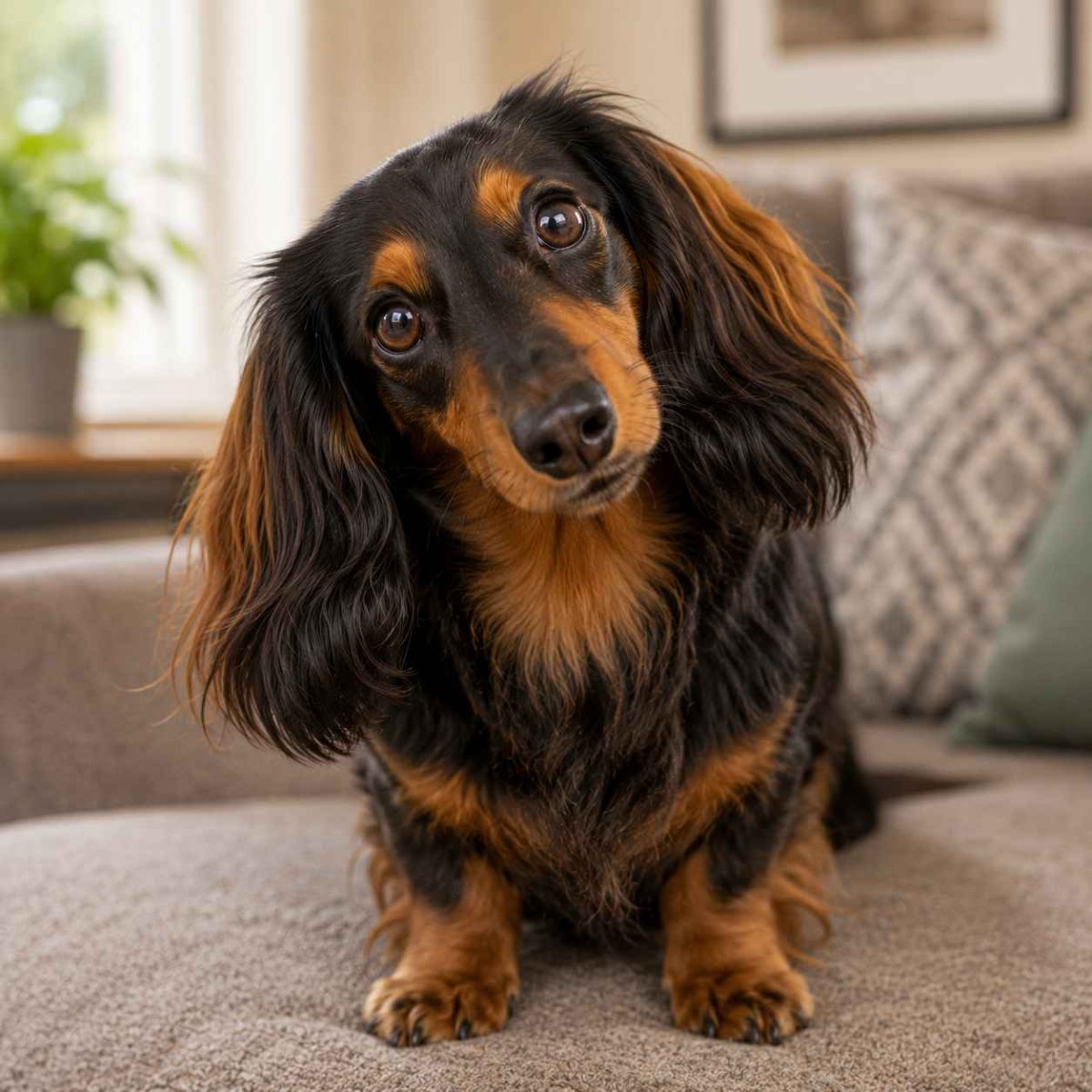
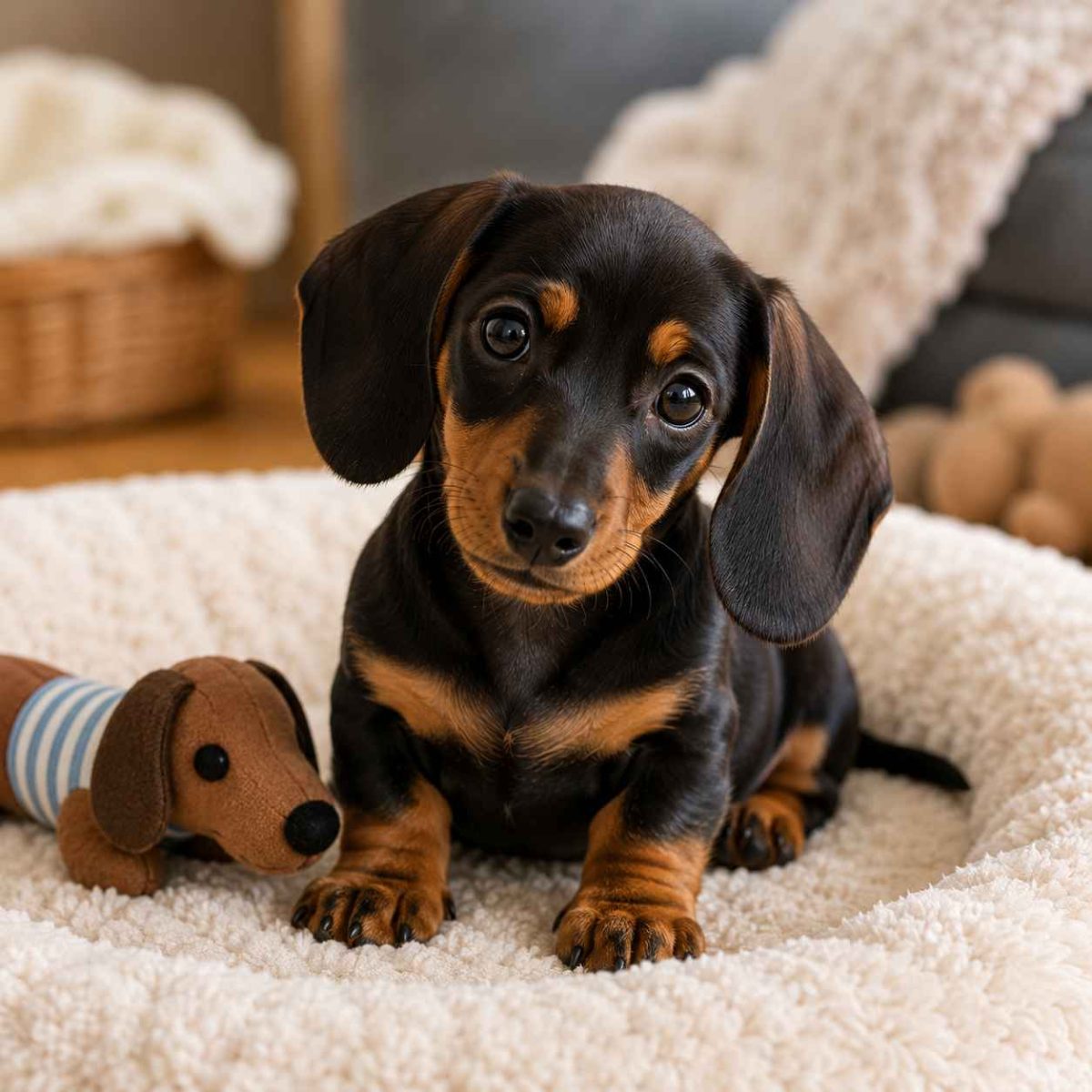
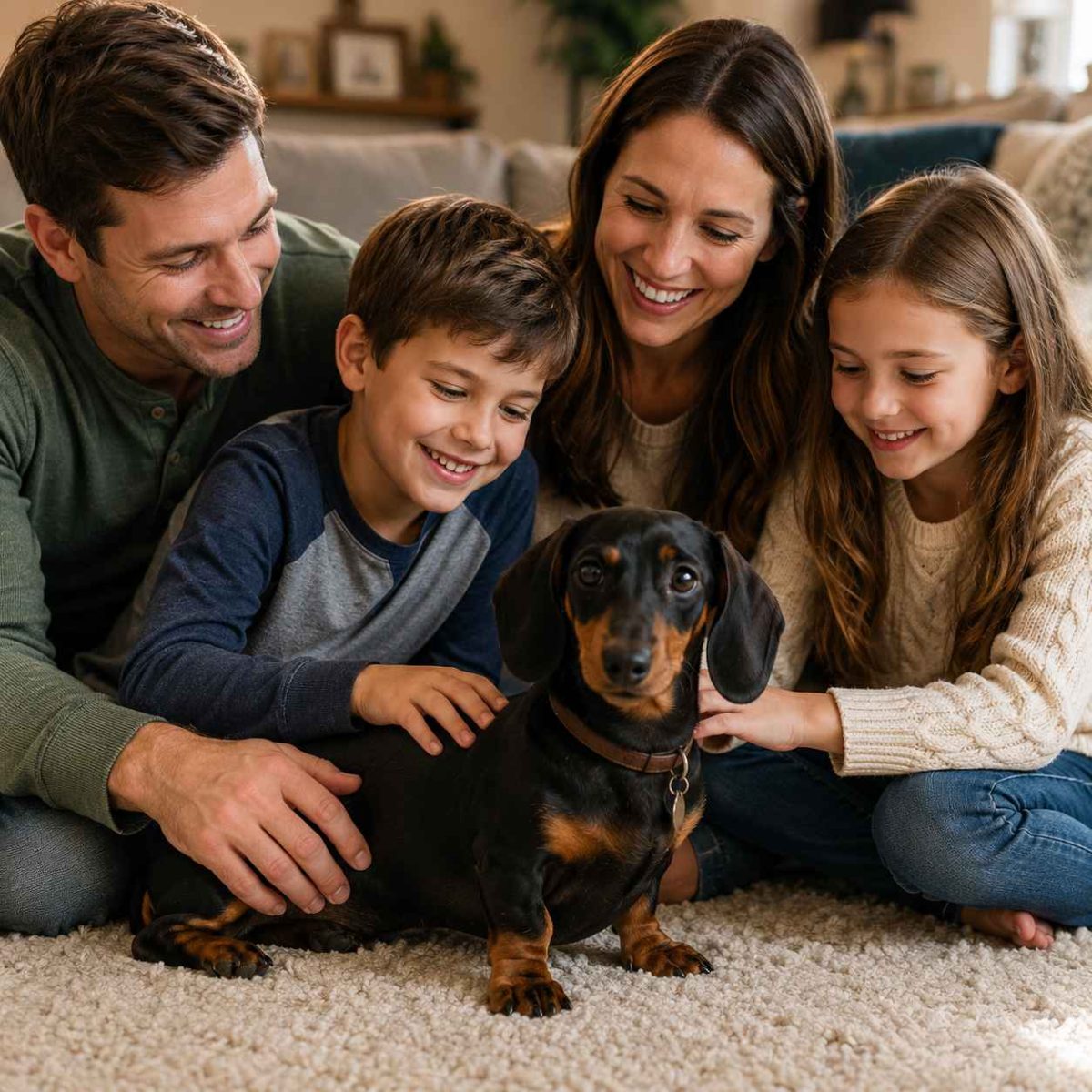
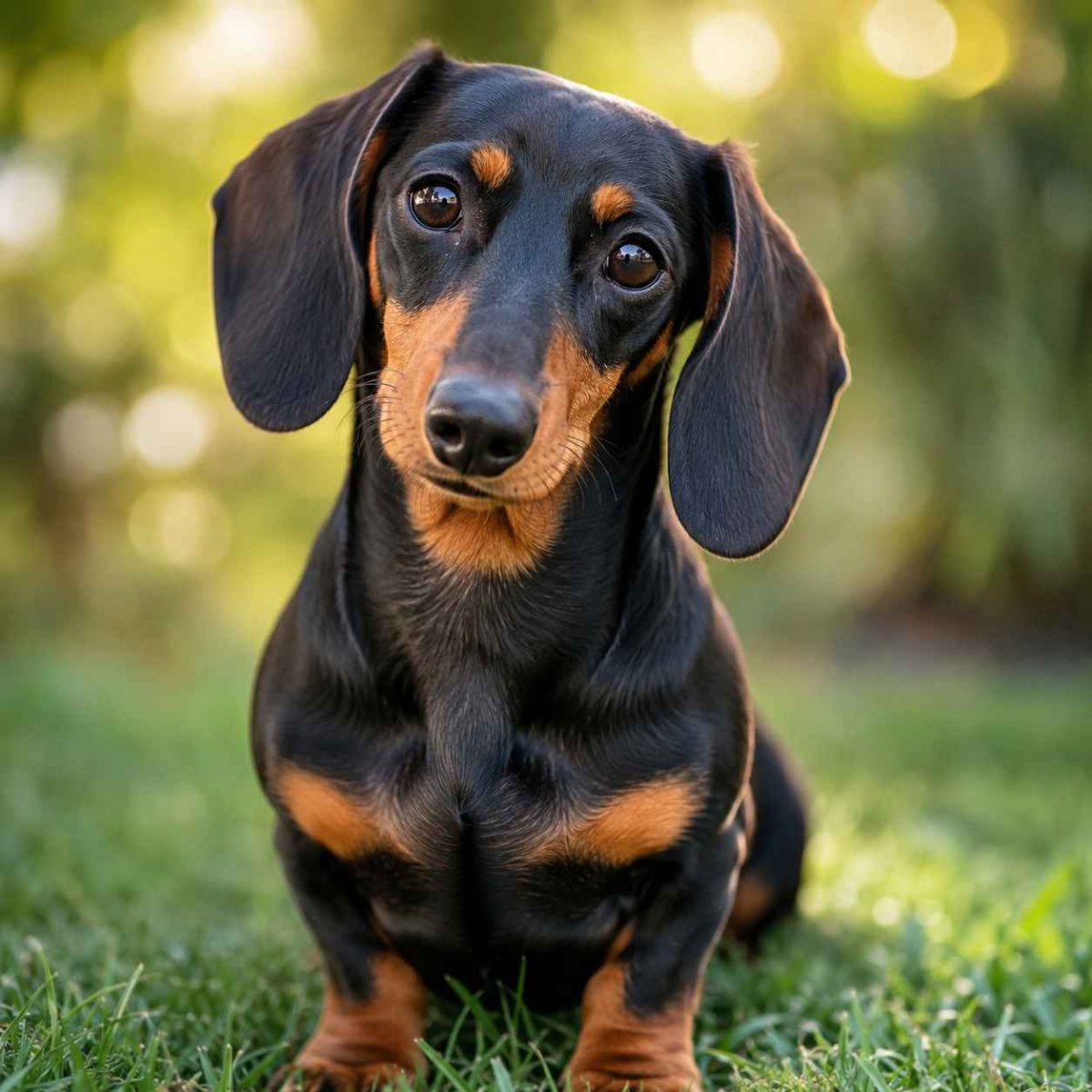
Dachshunds may share the same unmistakable silhouette, but their appearance varies dramatically across two sizes, three coat varieties and numerous colors and patterns. A sleek black-and-tan Smooth can look almost like a different breed from a feathery cream Longhaired or a bearded wild-boar Wirehaired.
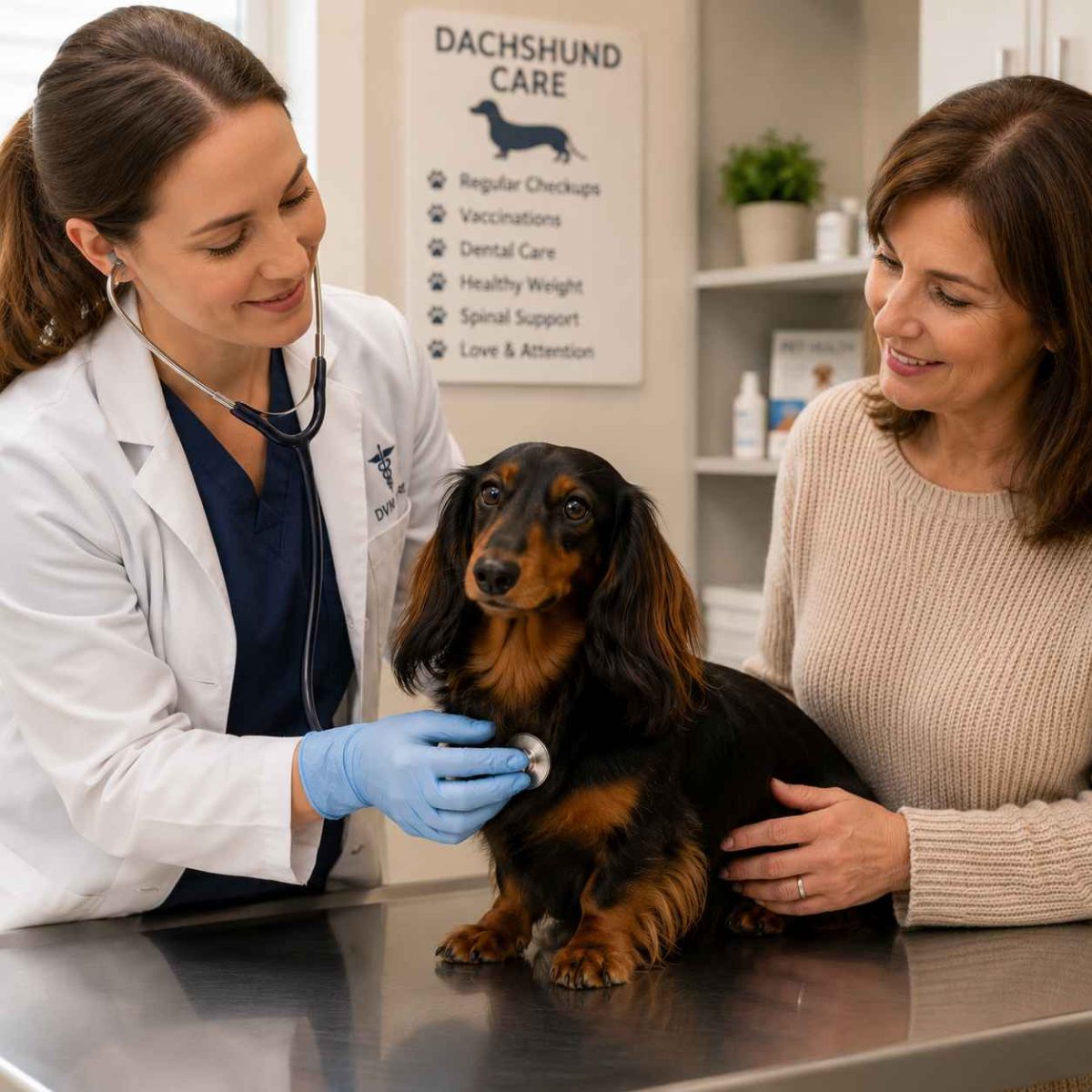
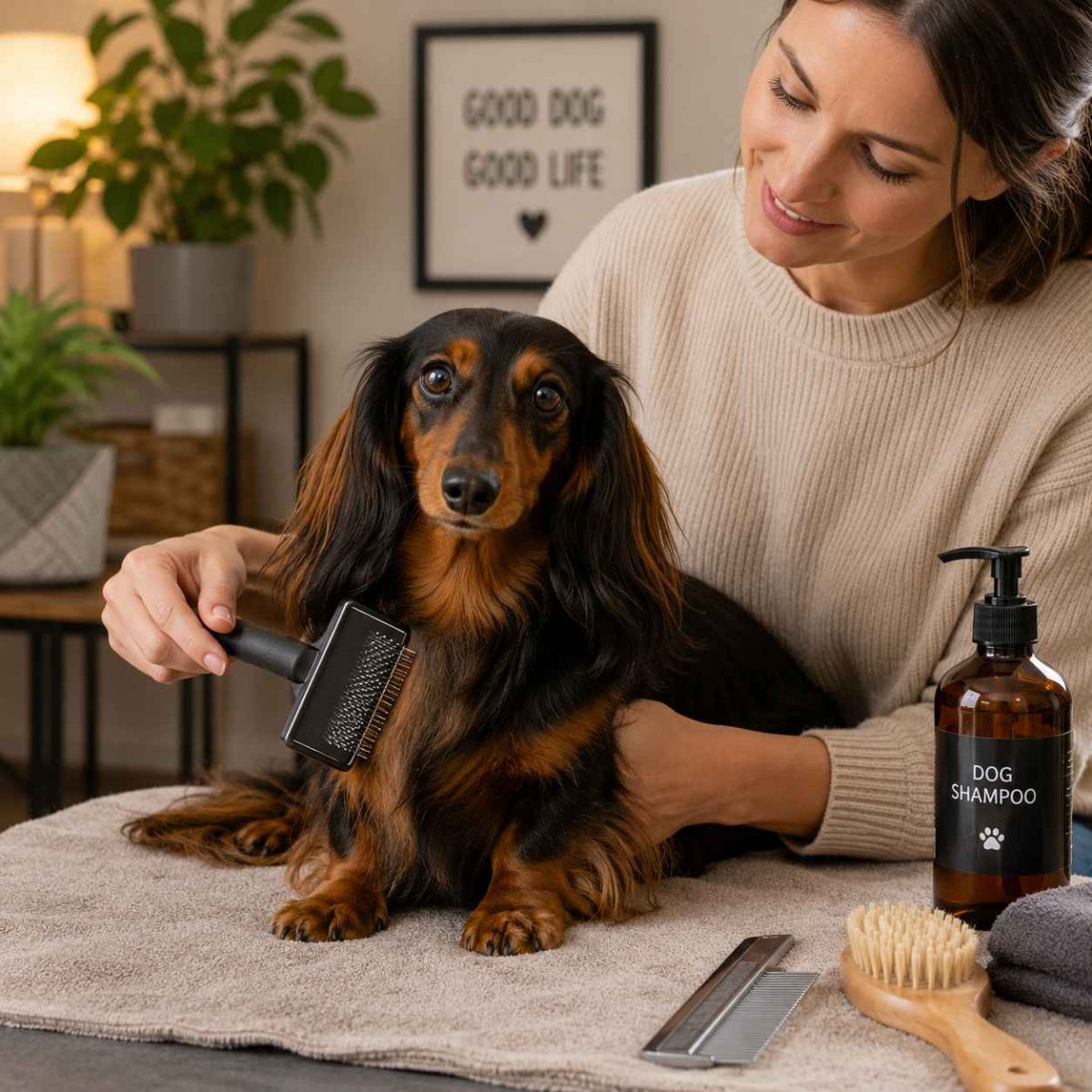
The gallery below shows Dachshunds in everyday life as companions, walkers, learners and family dogs. Notice the common breed features beneath the coat differences: the long ribcage, short legs, drop ears, powerful front and alert hound expression.



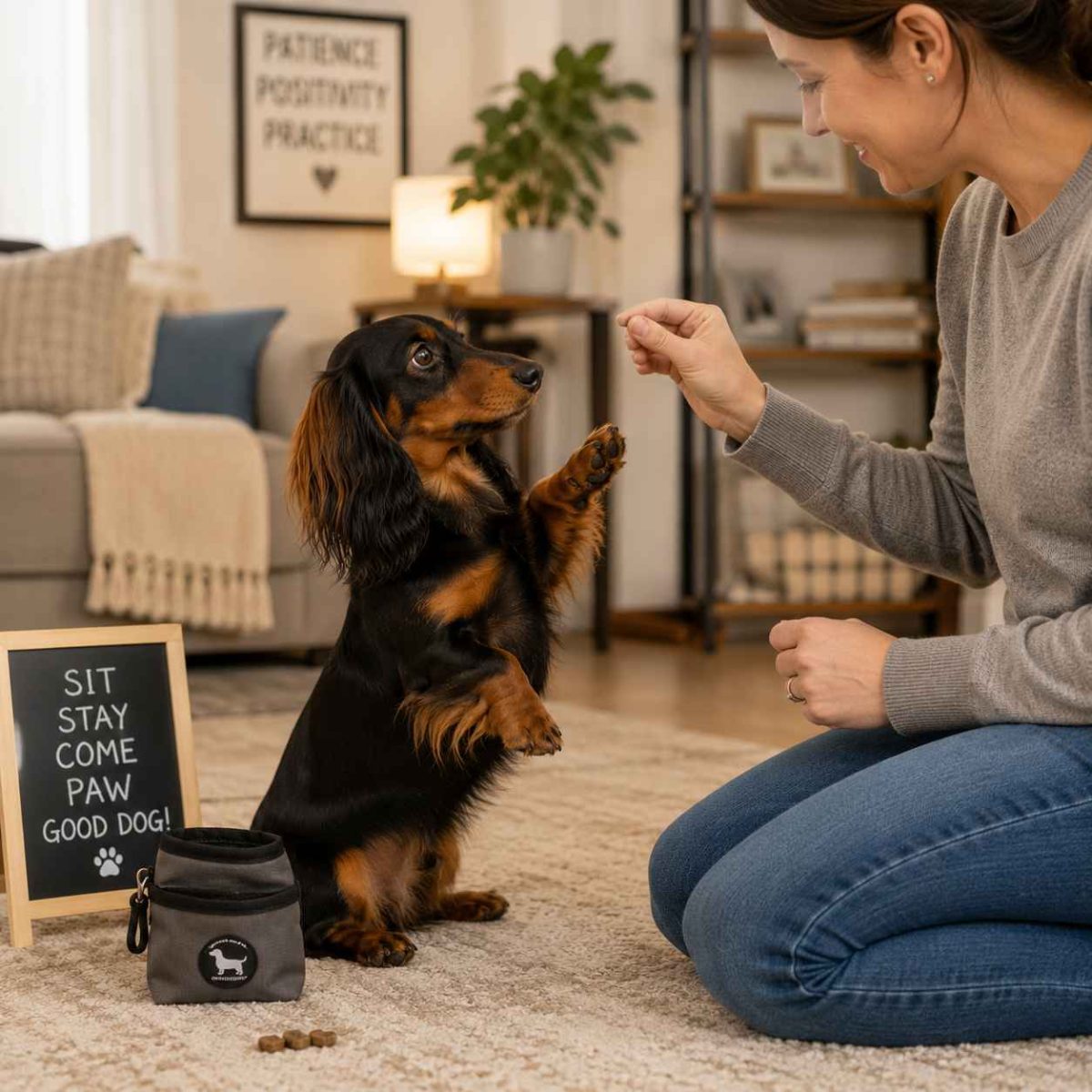
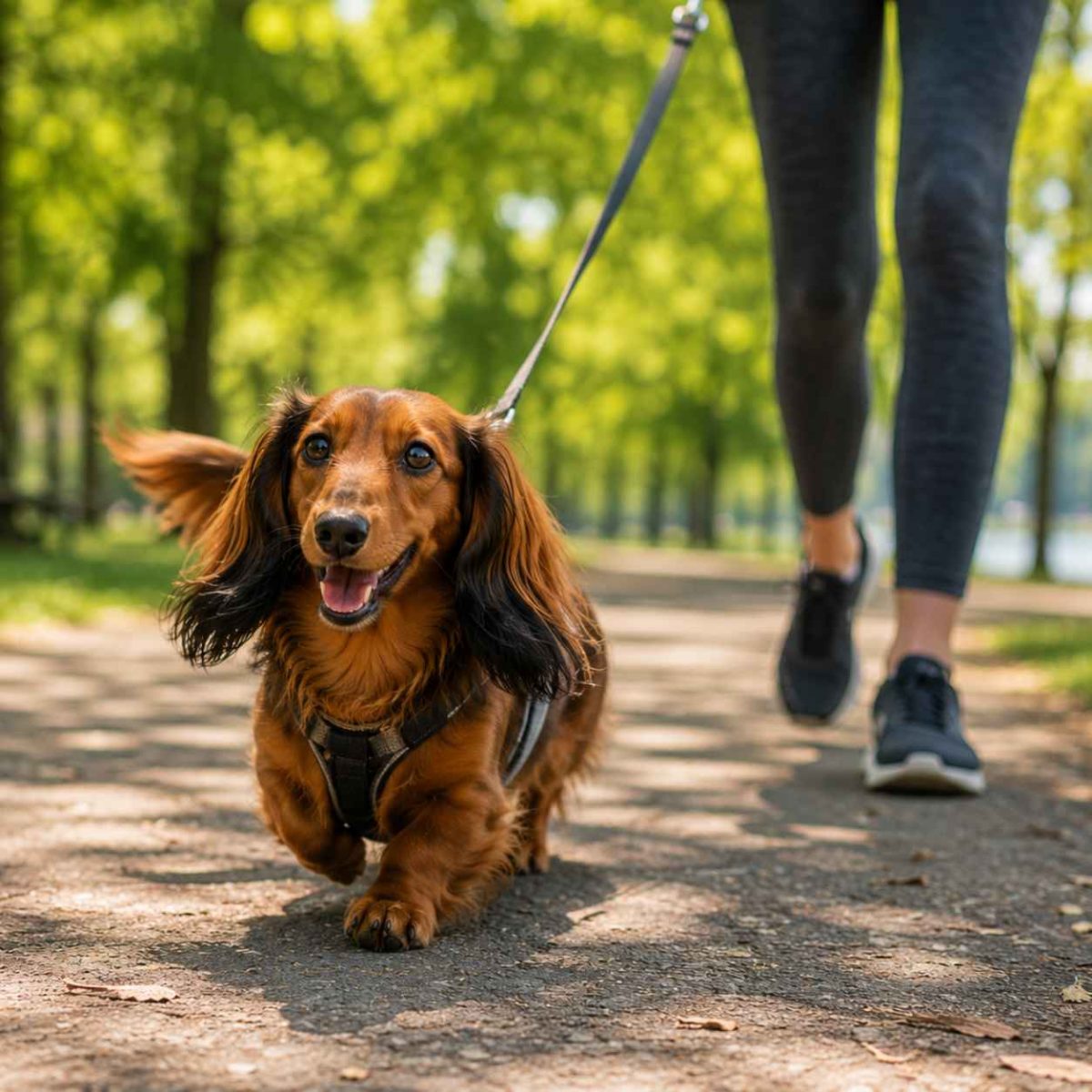
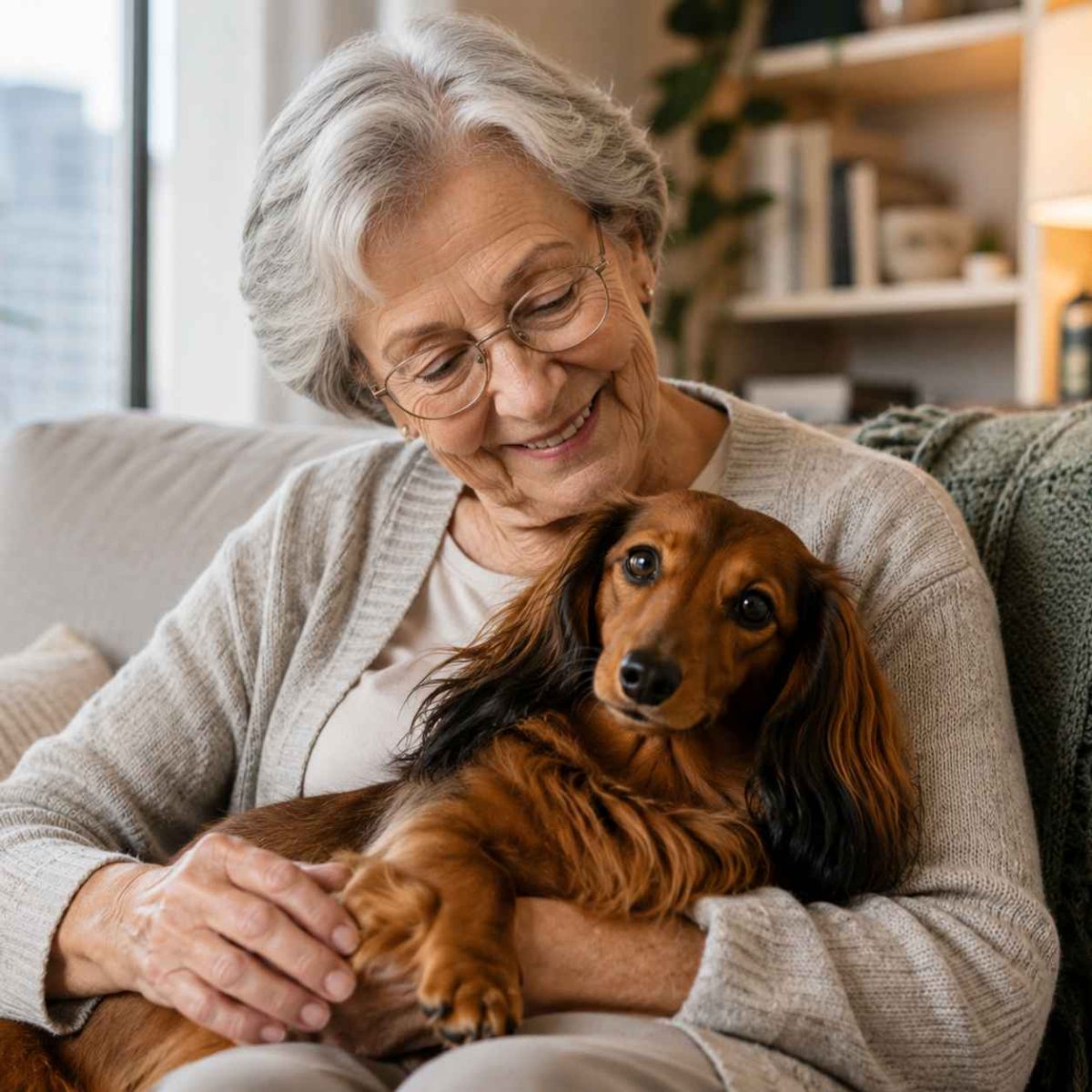
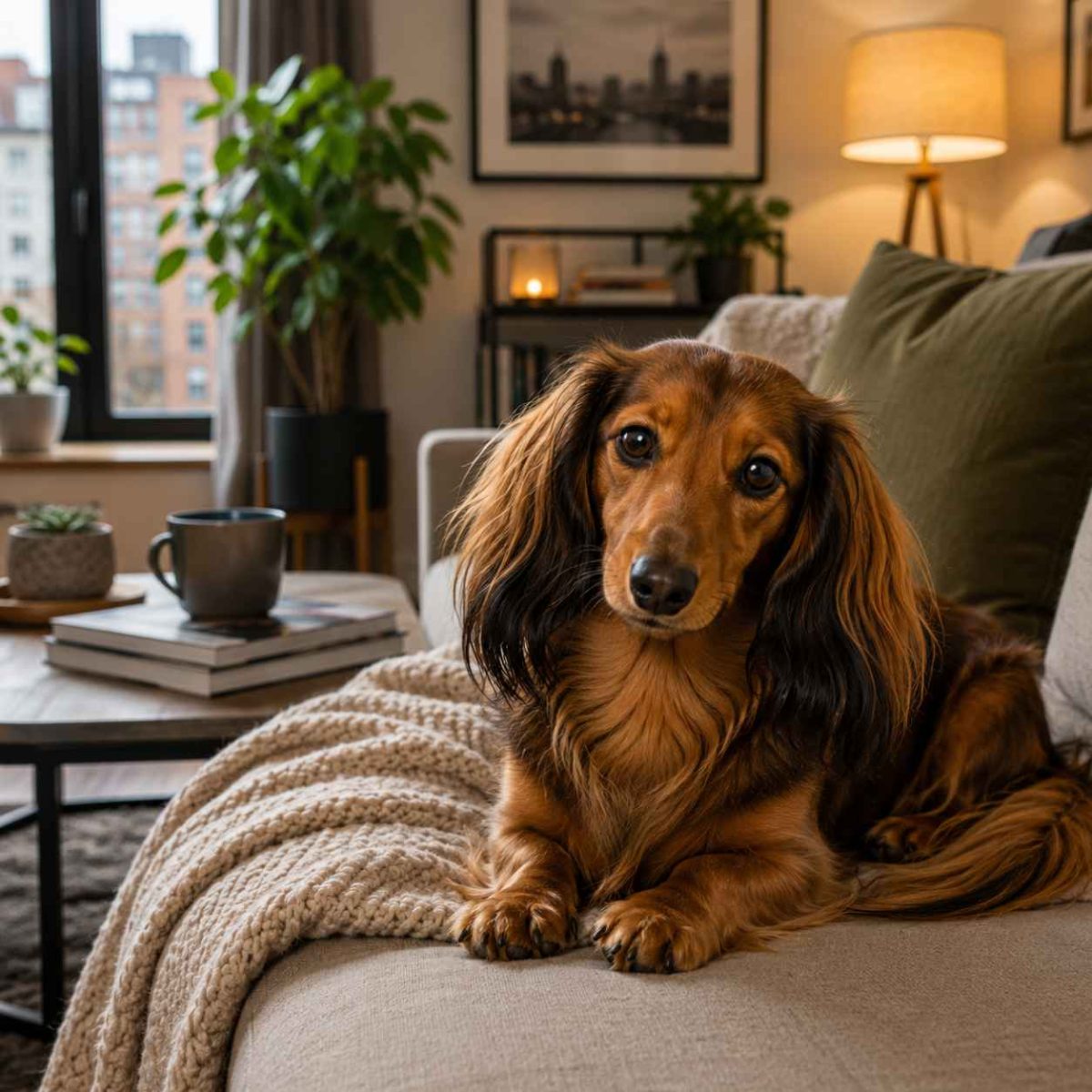
Smooth, Longhaired & Wirehaired Dachshunds
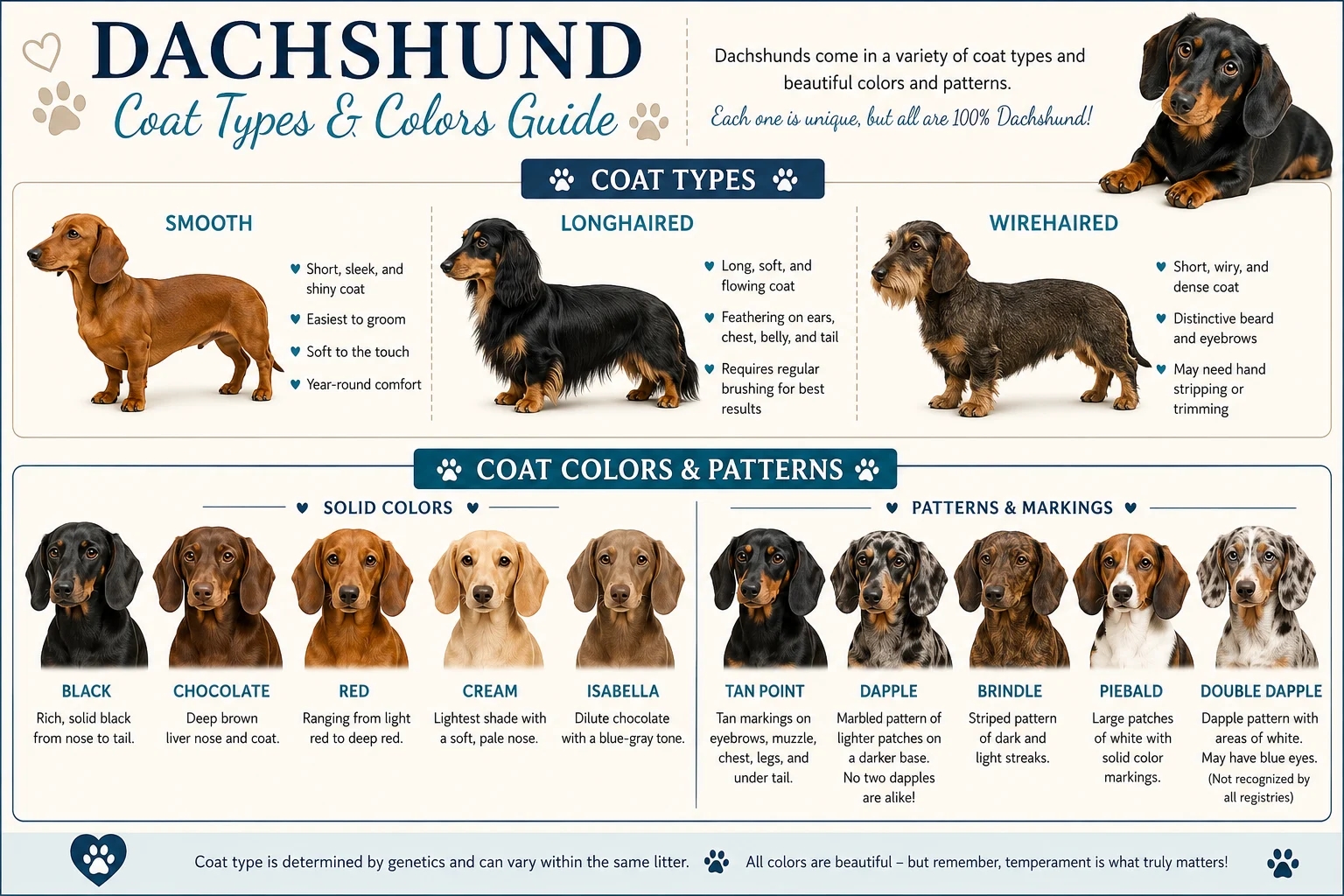
Dachshunds come in three official coat varieties: Smooth, Longhaired and Wirehaired. Coat affects grooming, shedding patterns and appearance, but all three varieties should retain recognizable Dachshund structure and temperament.
Smooth Dachshund
The Smooth Dachshund has short, glossy hair lying close to the body. It is the simplest coat to maintain and needs little more than regular brushing with a grooming mitt or soft brush, occasional bathing, nail care and routine skin checks.
Short hair does not mean no shedding. Smooth Dachshunds can release a steady supply of small hairs, and those short hairs have a remarkable talent for attaching themselves to upholstery.
Longhaired Dachshund
The Longhaired Dachshund has sleek, often slightly wavy hair that is longer under the neck, on the chest, ears, underside, legs and tail. The tail develops the characteristic flowing “flag.”
Longhaired Dachshunds need more regular brushing than Smooths. Pay special attention behind the ears, in the armpits, on the feathering and anywhere a harness rubs. A metal comb after brushing helps find small tangles hiding close to the skin.
Longhaired Miniature Dachshund
The Longhaired Miniature Dachshund is especially popular, and it is easy to see why: it combines the compact size of the Miniature with the elegant, soft outline of the Longhaired coat. It is still a Dachshund first. The longer coat does not guarantee a calmer personality, reduced barking or fewer spinal concerns.
Prospective owners should prioritize the health, structure and temperament of the breeding dogs over a particular shade or extra-fluffy puppy coat.
Wirehaired Dachshund
The Wirehaired Dachshund has a short, harsh outer coat with undercoat, plus the breed variety’s unmistakable beard and eyebrows. Regular brushing removes debris, while some show and pet coats are maintained with hand stripping to preserve texture.
Clipping can change the texture and appearance of a wire coat. Owners who care about traditional coat quality should ask an experienced Dachshund groomer about hand stripping rather than assuming every professional grooming salon uses the same method.
Dachshund Colors & Patterns: Red, Cream, Black & Tan, Dapple, Piebald & More
Dachshunds have one of the most varied wardrobes in the dog world. The U.S. breed standard describes solid colors, two-colored dogs and several distinct patterns. Coat type and color are separate traits: a red Dachshund, for example, can be Smooth, Longhaired or Wirehaired.
Common Dachshund colors
- Red
- Cream
- Black and tan or cream
- Chocolate and tan or cream
- Wild boar
- Gray/blue and tan or cream
- Fawn/Isabella and tan or cream
Dachshund patterns
- Dapple — the Dachshund term for merle patterning
- Brindle — dark striping over the coat
- Piebald — clearly defined white areas with colored patches
- Sable — dark overlay on a red base
What is a dapple Dachshund?
A dapple Dachshund has lighter areas contrasting with a darker base color. Dapple is a pattern, not a size or separate breed. Dapple can appear in Standard or Miniature Dachshunds and in the accepted coat varieties.
Merle genetics deserve special care in breeding. Pairing two merle/dapple dogs can produce double-merle offspring with a substantially increased risk of auditory and eye abnormalities. A responsible breeder should understand the genetics of the dogs being paired and should never use “rare color” marketing as a substitute for health and welfare.
What is an English Cream Dachshund?
“English Cream” is a popular descriptive and breeder-marketing term, particularly for pale Longhaired Dachshunds, but it is not a separate breed or AKC size classification. A beautiful cream coat tells you very little about orthopedic, cardiac, eye or spinal health. Ask the same health-testing and temperament questions you would ask for any other puppy.
Are blue, Isabella or unusual colors “rare”?
Color rarity should never be the main reason to select a breeder. The official standard, pedigree knowledge, health testing, sound structure, good temperament and responsible puppy raising matter far more than whether a puppy is advertised as exclusive, exotic or rare.
Do Dachshunds Shed? Are Wiener Dogs Hypoallergenic?
Yes, Dachshunds shed. No, Dachshunds are not considered hypoallergenic. That answer applies to Standard and Miniature Dachshunds and to Smooth, Longhaired and Wirehaired varieties.
Which Dachshund sheds the least?
Individual dogs vary, and visible hair is only part of the story. Smooths shed short hairs throughout the year. Longhaired dogs may produce more noticeable wisps and need brushing to remove loose coat. Wirehaired Dachshunds have both outer coat and undercoat and require their own maintenance routine.
It is therefore more useful to choose a coat based on the grooming you are willing to do than to search for a supposedly “non-shedding Dachshund.” There is no such official variety.
Are Mini Dachshunds hypoallergenic?
No. Smaller body size does not turn a Miniature Dachshund into a hypoallergenic dog. Allergic reactions are triggered by proteins associated with dander, saliva and other secretions, not simply by how much hair appears on the sofa.
If allergies influence your breed choice, read our guide to hypoallergenic and allergy-friendly small dogs and, when possible, spend meaningful time around adult Dachshunds before making a commitment.
Why is my Dachshund suddenly shedding more?
Seasonal changes can increase normal shedding, but abrupt hair loss, bald patches, persistent itching, skin odor or inflammation can indicate a medical problem. Parasites, allergies, infection, endocrine disease and other conditions require proper veterinary assessment rather than being dismissed as “normal Dachshund shedding.”
Dachshund Temperament & Personality
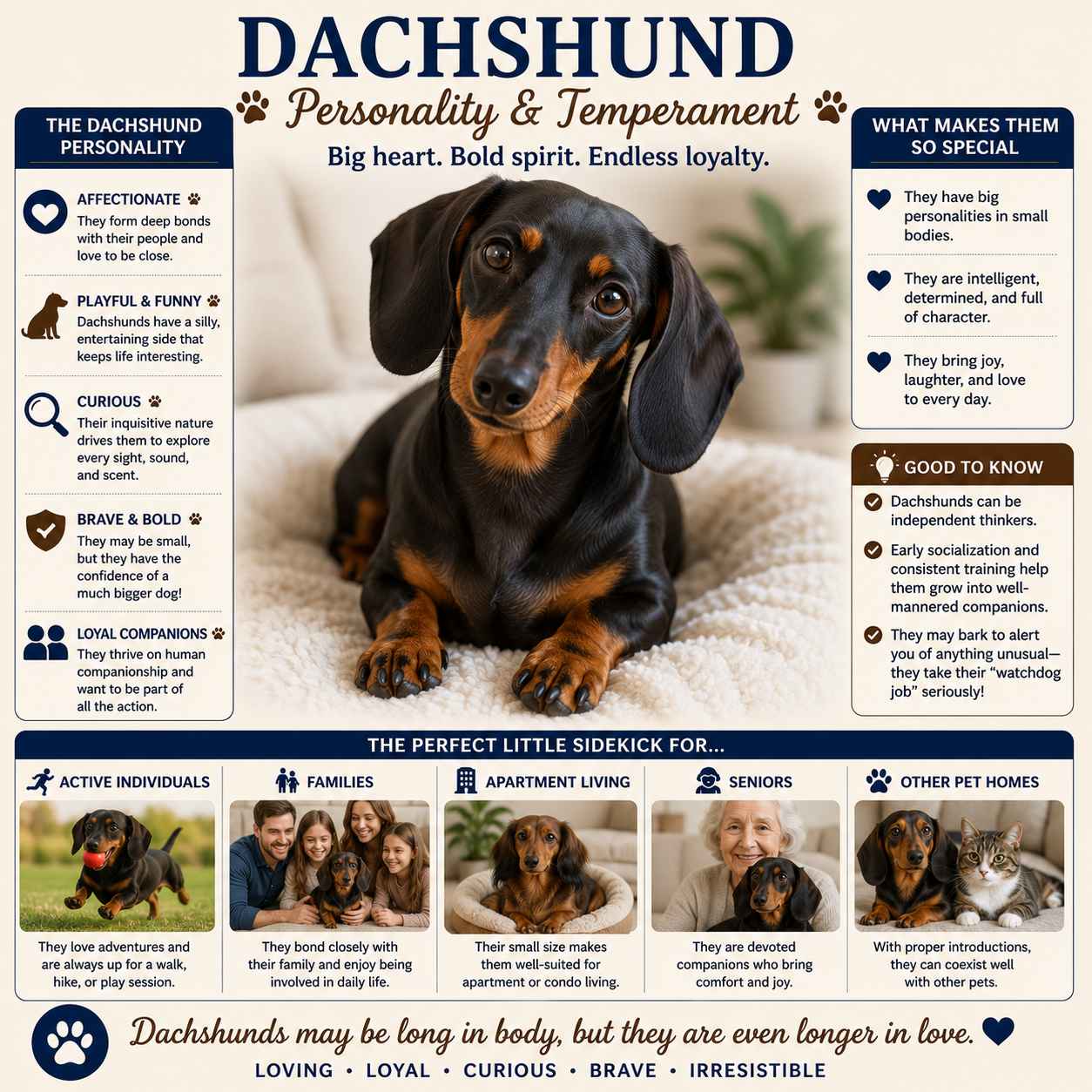
Dachshunds are commonly affectionate, clever, lively, alert, brave and persistent. The official breed standard famously emphasizes courage, and that trait still appears in everyday life when a twelve-pound dog confidently informs a delivery driver, large dog or suspicious garden ornament that it has been noticed.
They often form intense bonds with their people. Many are classic shadow dogs that move from room to room with a favorite person, curl against them on the sofa and burrow under bedding at night. This devotion makes the Dachshund a wonderfully intimate companion, but it also means independence should be taught rather than assumed.
Are Dachshunds friendly?
Many are affectionate with family and can be sociable with visitors, but the breed can also be reserved or alert around unfamiliar people. Early, thoughtful socialization matters. A puppy should learn that unfamiliar humans, dogs, sounds, surfaces and environments are normal without being forced into interaction when frightened.
Are Dachshunds aggressive?
Breed does not make every individual aggressive. Fear, pain, poor socialization, resource guarding, handling conflicts and learned behavior can all contribute to growling or biting. Dachshunds are small enough that warning behavior is sometimes laughed off until it escalates.
Respect growls as communication. Do not punish away the warning while leaving the underlying fear or discomfort unchanged. Sudden irritability in a previously tolerant Dachshund also warrants a veterinary check because back or neck pain can make handling unexpectedly uncomfortable.
Do coat varieties have different personalities?
You will hear plenty of owner folklore: Longhairs are sweeter, Wires are feistier, Smooths are classic Dachshunds. Individual family lines may indeed show patterns, but coat should not be treated as a reliable temperament test. Meet the parents, ask about relatives, and evaluate the individual dog.
Are Dachshunds Smart? Intelligence & Training

Dachshunds are smart dogs. Their challenge is not lack of intelligence; it is independent decision-making. The breed was expected to work underground, separated from direct handler control. A dog confronting quarry in a tunnel could not wait for a committee meeting before deciding what to do next.
That heritage helps explain the modern Dachshund who appears to understand “come” perfectly well but pauses to assess whether your offer is more compelling than the scent beside the fence.
Best training methods for Dachshunds
- Use food, play and access to sniffing as rewards.
- Keep sessions short enough that the dog remains engaged.
- Train in different rooms and environments.
- Reward behavior you like before it becomes necessary to correct behavior you dislike.
- Teach calm handling for feet, ears, teeth and veterinary examinations.
- Build recall gradually using a long line in safe areas.
- Avoid harsh physical correction, intimidation and training methods that make the dog afraid of you.
Recall can be difficult
A Dachshund’s nose is powerful and its prey drive can be substantial. Off-leash reliability should never be assumed simply because the dog is affectionate at home. Secure fencing and a leash are often the safest choices in unfenced areas.
Teach practical life skills
Useful Dachshund training includes much more than sit and stay. Teach waiting at doors, settling on a mat, trading objects, coming away from windows, accepting a harness, walking without pulling, staying calm when visitors arrive and using a ramp when appropriate.
For broader help, visit the Dogs Central Small Dog Training Guide.
Are Dachshunds Hard to Potty Train? House-Training a Wiener Dog
Dachshunds have a reputation for difficult house training. The reputation is not entirely imaginary, but it is also not destiny. A consistent routine, close supervision and immediate reinforcement can produce a reliably house-trained Dachshund.
Several factors make the process easier to derail: small bladder capacity in Miniatures and puppies, sensitivity to cold or rain, strong interest in outdoor smells, and a tendency for humans to relax supervision too quickly after a few successful days.
A practical Dachshund potty-training routine
- Take the puppy outside immediately after waking.
- Go out after meals, drinking, play and naps.
- Use a predictable toilet area at first.
- Reward outdoor toileting immediately—not five minutes later after coming indoors.
- Supervise closely inside or use an appropriately sized puppy-safe confinement area.
- Clean accidents thoroughly with an enzymatic cleaner.
- Increase freedom gradually after a consistent success pattern is established.
Rain, snow and the Dachshund veto
Some Dachshunds react to bad weather as though you personally arranged it. A covered toilet area, a warm coat for cold conditions and a very predictable routine can help. What generally does not help is deciding the dog “won’t go” and bringing it inside unsupervised, where a warm rug is waiting.
A fully house-trained adult who suddenly begins having accidents should receive veterinary evaluation. Urinary disease, gastrointestinal illness, pain, age-related changes and other medical problems can cause house-soiling.
Do Wiener Dogs Bark a Lot? Dachshund Barking & Common Behavior Traits
Yes, many Dachshunds are naturally vocal. Barking was useful in a working hound that needed to communicate when quarry was underground or out of the hunter’s sight. Modern homes have doorbells instead of badger dens, but the instinct to announce important events remains.
Common barking triggers
- People passing windows
- Hallway and elevator sounds
- Visitors and deliveries
- Other dogs
- Wildlife in the yard
- Excitement
- Boredom
- Frustration
- Being left alone
Teaching a “quiet” cue can help, but prevention is just as important. Block intense window-watching when necessary, use white noise in apartments, reward the dog for noticing a trigger and then disengaging, and give the dog enough sniffing, exercise and mental work that barking is not its only hobby.
Digging
Digging is deeply on-brand for a breed developed to pursue animals underground. Give an enthusiastic digger an approved place to use the behavior when practical rather than expecting instinct to disappear through scolding.
Burrowing under blankets
Blanket burrowing is almost a Dachshund lifestyle. Many love warm, enclosed sleeping spots. Make sure a dog under bedding cannot be sat on or trapped and that very warm blankets do not cause overheating.
Why does my Mini Dachshund shake?
Small dogs can shiver when cold, excited, frightened or overstimulated. However, shaking can also accompany pain or illness. In a Dachshund, unexplained trembling combined with reluctance to move, a tense abdomen, hunched posture, weakness or sensitivity to touch deserves prompt veterinary attention because spinal pain is one possible cause.
Dachshund Companionship Needs: Can They Be Left Alone?
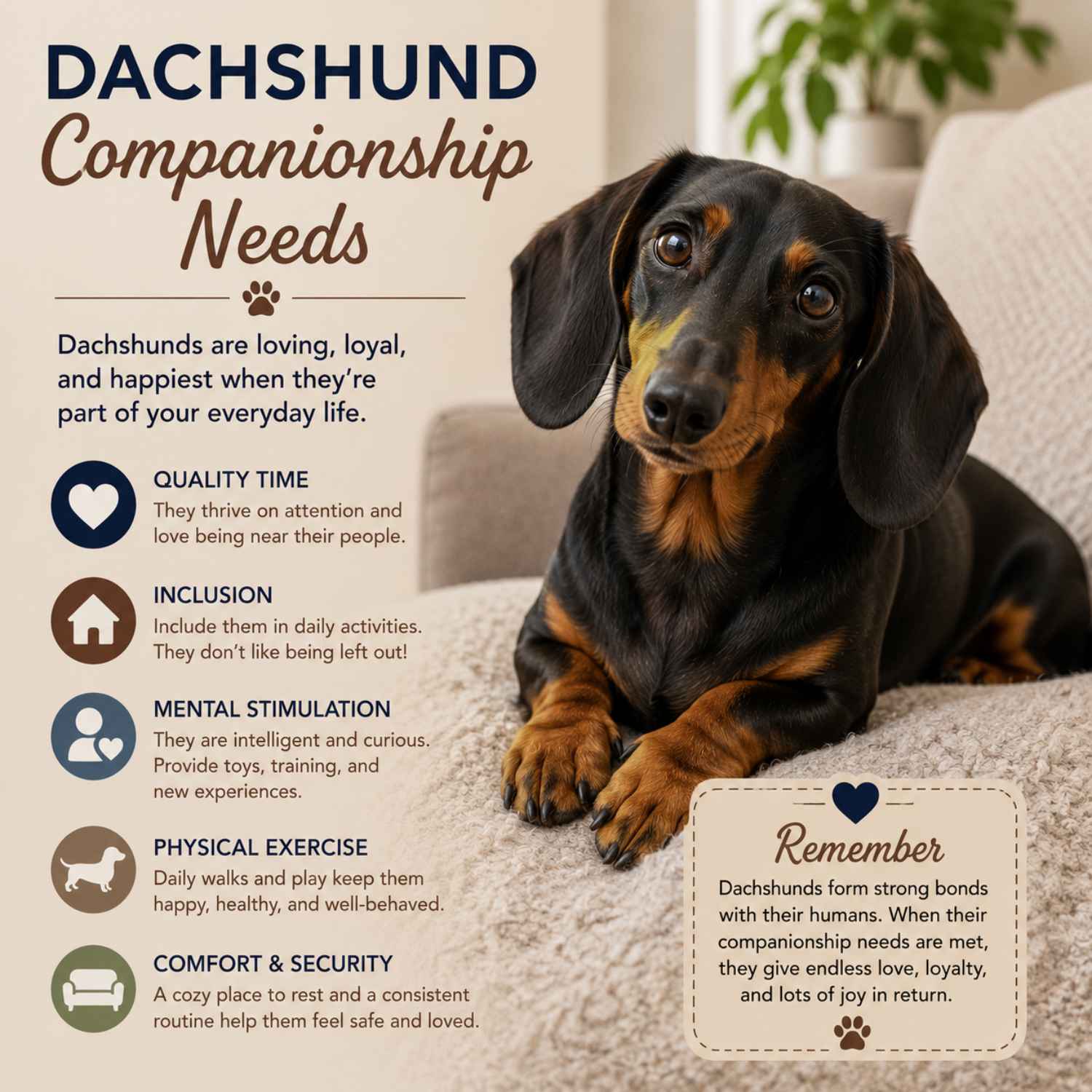
Dachshunds often become deeply attached to their people. Many happily spend the day moving between a sunny patch, a blanket and whichever room currently contains their favorite human.
That does not mean every Dachshund has separation anxiety. A healthy attachment and a clinical separation-related problem are different things. The goal is to raise a dog that enjoys companionship but can also settle safely when family members leave.
Teach independence early
- Let puppies relax in a pen or gated area while you remain nearby.
- Practice very short departures before the dog is distressed.
- Provide safe food enrichment when appropriate.
- Return calmly rather than turning every departure and arrival into an event.
- Increase duration gradually.
A Dachshund is generally a poor fit for a lifestyle in which the dog is expected to spend very long days alone with little exercise or social contact. A dog walker, sitter, family member or other arrangement may be needed for longer absences.
Signs of possible separation distress
Persistent screaming or barking, destructive escape attempts, pacing, drooling, inability to eat when left, panic and frantic attempts to follow one person can indicate more than boredom. Severe cases should be discussed with a veterinarian and a qualified behavior professional.
Dachshund Exercise, Enrichment & Back-Friendly Activity
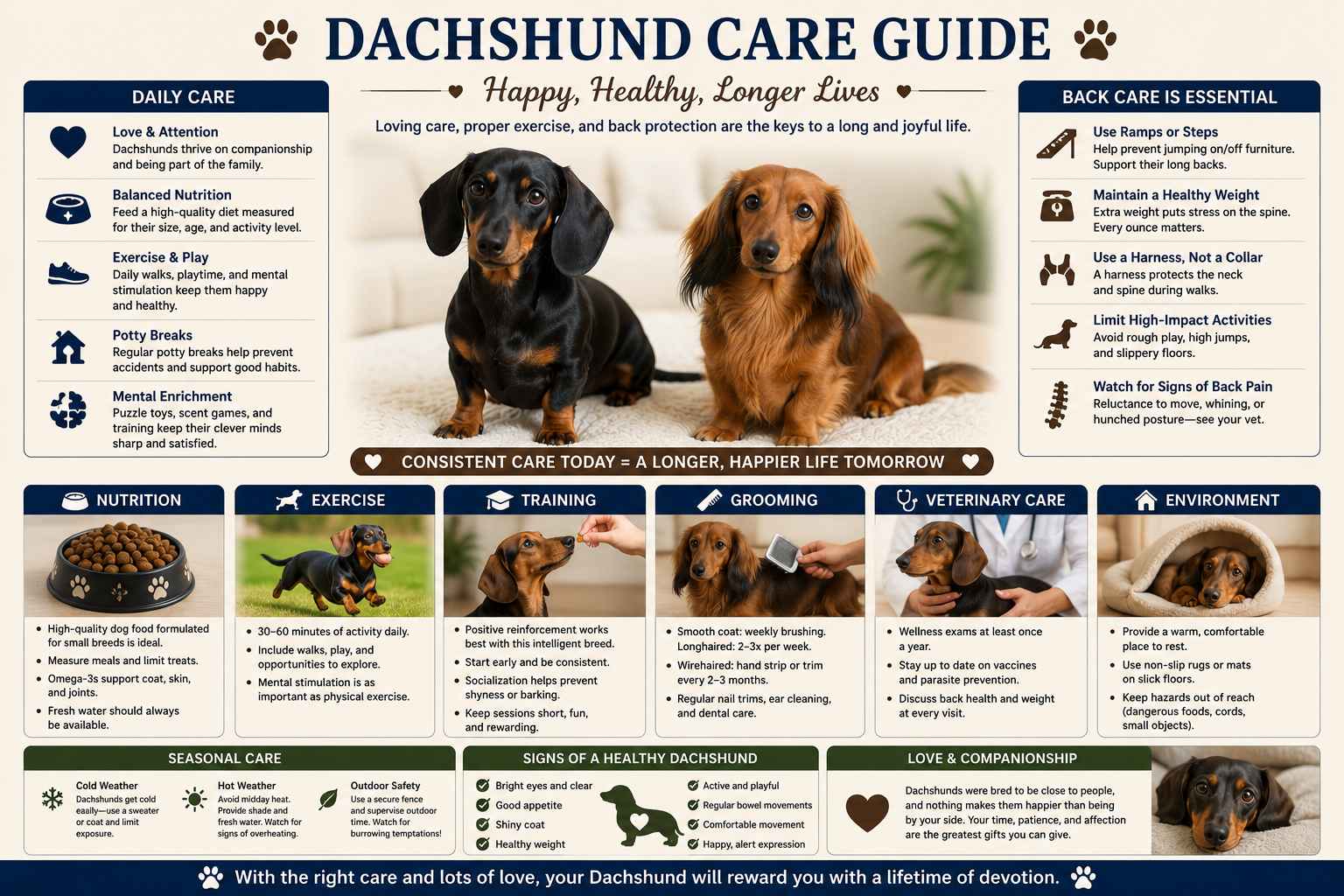
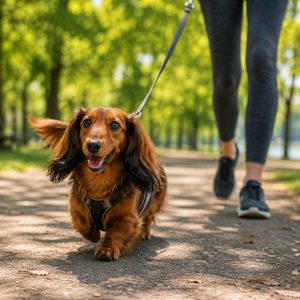
Dachshunds are low to the ground, not low-energy. Healthy adults need regular exercise to support cardiovascular health, muscle strength, healthy weight and emotional well-being.
Many adults do well with roughly 30–60 minutes of activity spread through the day, adjusted to age, health, conditioning and the individual dog. Walks do not need to be speed marches. Sniffing is meaningful mental work for a scent hound.
Good activities for Dachshunds
- Sniff walks
- Food-search games
- Beginner nose work
- Low-impact retrieve games
- Trick training
- Puzzle feeders
- Exploring securely fenced areas
- Earthdog or scent-oriented activities where appropriate
Protecting the back without creating a sedentary dog

Spinal risk does not mean a Dachshund should avoid normal exercise. Strong supporting muscles and healthy body condition are valuable. The aim is sensible activity while reducing unnecessary repeated high-impact habits.
Use ramps where practical for favorite furniture, especially if the alternative is launching repeatedly from a high bed or sofa. Add non-slip rugs on slick floors where the dog tends to scramble. Lift a Dachshund with the chest and rear supported rather than letting the hindquarters dangle.
What is the best harness for a Dachshund?
There is no single best harness for every Dachshund because chests, shoulder width and body lengths vary. Look for a well-fitted harness that:
- does not rub behind the elbows;
- does not restrict shoulder movement;
- cannot easily be backed out of;
- sits securely without pressing awkwardly on the neck;
- is measured to the actual dog rather than chosen by breed name alone.
A harness is useful equipment, but it is not a medical device that can prevent IVDD. Training a dog to walk without constant pulling still matters.
Can Dachshunds swim?
Some Dachshunds can swim, but their short legs and long bodies do not make them effortless water dogs. Supervise closely around pools, docks and open water, provide an easy exit, and consider a properly fitted canine flotation vest for boating or deeper water. Never assume a dog can save itself because it paddled once in shallow water.
Dachshund Grooming & Coat Care
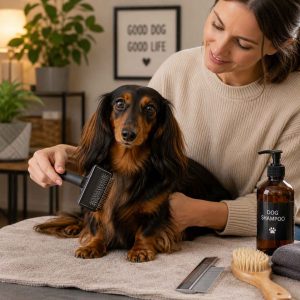
Dachshund grooming ranges from very simple to moderately involved depending on coat. None of the three varieties requires the frequent full-body clipping schedule typical of many Poodle crosses.
Smooth Dachshund grooming
Brush weekly with a soft brush or rubber grooming mitt. Short coats make it easy to inspect skin, lumps, scratches and parasites. Smooth Dachshunds often need extra warmth in cold climates because there is little coat insulation.
Longhaired Dachshund grooming
Brush several times a week and comb through feathering. Check behind the ears, under the front legs, around the tail and under harness straps. Remove small tangles before they become tight mats.
Wirehaired Dachshund grooming
Brush regularly and discuss hand stripping with an experienced groomer if you want to maintain a traditional harsh coat. Keep the beard clean after wet food, drinking and outdoor adventures.
Nails
Trim often enough that the dog can stand and walk comfortably. Long nails can change paw placement and gait. Teach nail handling while the puppy is young and reward calm cooperation.
Ears
Check drop ears for redness, odor, discharge, swelling or discomfort. Routine observation is useful; repeated infections require veterinary diagnosis rather than endless home cleaning.
Bathing
Bathe when dirty or odorous using dog-formulated products. Longhaired dogs should be thoroughly dried and brushed afterward so damp tangles do not tighten.
For general coat and nail-care advice, see Dogs Central’s Small Dog Grooming Guide.
Are Dachshunds Good Family Dogs? Children, Dogs, Cats & Other Pets

Dachshunds can be loving family companions, particularly in households that appreciate their personality and understand how to handle a long-backed small dog safely.
Are Dachshunds good with children?
Many are excellent with respectful children. The concern is less that Dachshunds dislike children and more that rough handling can frighten or physically hurt the dog. Toddlers may accidentally fall on a dog, lift it incorrectly, chase it into hiding or interfere while it eats or sleeps.
Adults should supervise young children and teach them to let the dog walk away, support the dog’s body correctly when lifting is allowed, and never climb on, squeeze or drag a Dachshund.
Are Dachshunds good with other dogs?
Many enjoy canine company and some adore other Dachshunds. Compatibility depends on temperament, size, play style and social experience. A tiny Miniature can be injured by a much larger dog that plays roughly even if neither dog intends harm.
Are Dachshunds good with cats?
They can be, especially when introduced thoughtfully. Individual prey drive varies. A Dachshund that becomes highly aroused by a running cat should be managed carefully rather than allowed to rehearse chasing.
What about rabbits, guinea pigs and other small pets?
Use substantial management. Hunting small quarry is part of Dachshund history. A friendly dog can still have predatory behavior toward small animals. Secure housing and physical separation are safer than relying on good intentions.
Compare other options in the Dogs Central Best Small Dogs for Families guide.
Are Dachshunds Good Apartment Dogs?
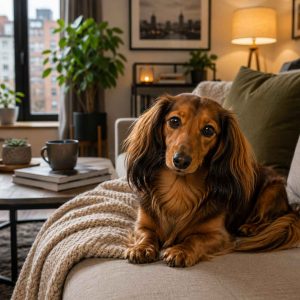
Dachshunds can be very good apartment dogs. Their compact size and moderate exercise needs fit smaller homes well. The challenge is usually not square footage—it is sound.
Dachshunds notice hallway footsteps, elevator doors, neighboring dogs and people arriving at the building. Without training, an excellent little watchdog can become an exhausting little building announcer.
Helping a Dachshund succeed in an apartment
- Provide daily walks with real sniffing time.
- Use rugs or runners on slippery floors.
- Teach quiet settling around hallway sounds.
- Use curtains or window film if visual triggers cause nonstop barking.
- Plan frequent toilet trips for puppies.
- Teach elevator manners if applicable.
- Do not assume a small dog exercises itself indoors.
For more comparisons, see The 10 Best Small Dog Breeds for Apartment Living.
Are Dachshunds Good for Seniors and First-Time Dog Owners?
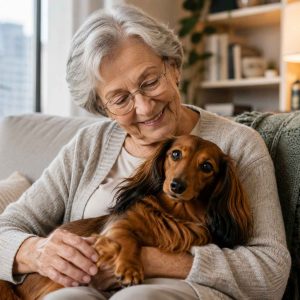
Dachshunds for seniors
Dachshunds can be excellent companions for active seniors. They are small enough to fit easily into apartments and daily routines, generally need moderate rather than extreme exercise, and often love spending long stretches near their favorite person.
The practical caveats matter. A young puppy may be quick underfoot, house training takes consistency, barking can be substantial, and a Dachshund with back trouble may someday need to be lifted or carried. An adult dog with known temperament can be an especially attractive choice for a senior who would rather skip puppy chaos.
See our Best Small Dogs for Seniors guide for additional considerations.
Dachshunds for first-time owners
A Dachshund can be a rewarding first dog for someone who is prepared for an independent hound rather than expecting automatic obedience. First-time owners should be ready to learn about house training, barking, recall, dental care, healthy body condition and IVDD awareness.
If you like a dog with humor, loyalty and a mind of its own, the learning curve can be enjoyable. If you want a dog that finds obedience inherently rewarding, another breed may be easier.
Compare options in Best Small Dogs for First-Time Owners.
Dachshund Health Issues: IVDD, Back Problems & Other Concerns
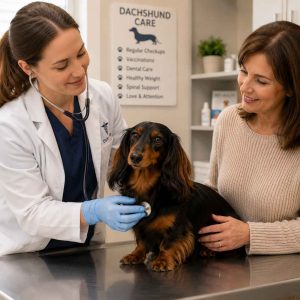
Dachshunds can live long, active lives, but their distinctive body type comes with a health issue every owner should understand: intervertebral disc disease (IVDD).
Intervertebral disc disease (IVDD)
Intervertebral discs sit between the vertebrae and help stabilize and cushion the spine. In IVDD, disc degeneration and herniation can cause pain and, in more severe cases, compression of the spinal cord with weakness or paralysis.
Dachshunds are a chondrodystrophic breed, meaning their characteristic short-legged skeletal development is linked with changes that also make disc degeneration an important breed concern. There is no responsible way to promise that a particular puppy will never develop IVDD.
Possible signs of a spinal emergency
Contact a veterinarian promptly if a Dachshund shows signs such as:
- sudden back or neck pain;
- crying out when moving or being lifted;
- reluctance to walk, jump or use stairs when normally willing;
- a hunched or tense posture;
- wobbling or crossing the rear feet;
- weakness in one or more limbs;
- dragging the hind feet or legs;
- loss of normal bladder or bowel control;
- inability to stand or walk.
Do not wait for paralysis before seeking care. A sudden neurologic change is not something to treat at home with rest, braces or internet remedies before a veterinarian has assessed the dog.
Can you prevent Dachshund back problems?
No strategy can guarantee prevention, but sensible lifelong habits are worthwhile:
- keep the dog lean;
- provide regular age-appropriate exercise;
- reduce repeated high jumps from furniture;
- use ramps where practical;
- provide traction on slippery floors;
- support both chest and hindquarters when lifting;
- seek veterinary care quickly for pain or neurologic signs.
Do not confuse “protect the back” with “never let the dog exercise.” Sedentary obesity is not a spinal-health strategy.
Patellar luxation
Patellar luxation occurs when the kneecap moves out of its normal position. Signs may include intermittent skipping or carrying a hind leg. Severity varies, and some dogs require little management while others need orthopedic treatment.
Cardiac disease
Cardiac evaluation is one of the health tests recommended for Dachshund breeding stock by the national breed club through AKC health-testing guidance. Routine veterinary examinations can also identify murmurs or other changes that deserve further investigation.
Eye disease
Ophthalmologist evaluation is likewise among the recommended breeding-dog screenings. Owners should seek veterinary care for persistent squinting, redness, cloudiness, discharge, eye pain or apparent vision change.
Obesity
Weight management deserves its own health heading in Dachshunds because extra weight adds load to an already vulnerable spinal system. A few pounds can represent a substantial percentage of a Miniature Dachshund’s ideal body weight.
Ear and skin concerns
Drop ears need routine observation, and recurrent ear infections or persistent itching should be investigated properly. Longhaired and Wirehaired coats can hide skin changes more easily than a Smooth coat.
Veterinary information note: This guide provides general educational information and is not a diagnosis or substitute for veterinary care. New pain, weakness, difficulty walking or other neurologic signs in a Dachshund warrant prompt professional assessment.
For more general preventive-care information, visit Dogs Central’s Small Dog Health Guide.
What Health Testing Should a Responsible Dachshund Breeder Do?
Prospective puppy buyers should ask for documented health screening on the parents, not simply a statement that the dogs are “healthy,” “vet checked” or “DNA tested.”
The American Kennel Club’s current Hound Group health-testing page lists the following tests recommended for Dachshunds by the national breed club:
- Patella evaluation
- Cardiac exam
- Ophthalmologist evaluation
Ask the breeder for the registered names of the sire and dam and verify results when possible through the Orthopedic Foundation for Animals database.
What about DNA testing?
DNA panels can be useful for specific inherited variants and parentage information, but a broad DNA panel does not replace physical examinations of eyes, heart and patellas. “DNA clear” is not a synonym for “fully health tested.”
Ask about IVDD and family history
There is no simple puppy-certificate that eliminates IVDD risk. Ask whether parents, grandparents, siblings or previous offspring have experienced significant disc disease or back surgery. A responsible breeder should be willing to discuss the breed’s spinal risk openly rather than pretending it disappears in carefully bred dogs.
Dapple breeding questions
If dapple is present, ask how the breeder determines the merle status of both parents. Because some merle expression can be subtle, knowledgeable breeding decisions matter more than visual guesswork alone.
How Long Do Dachshunds Live? Wiener Dog Lifespan & Aging
Dachshunds typically have a life expectancy of about 12–16 years. Individual dogs can live shorter or longer lives, and no breeder can promise a particular lifespan.
How long do Mini Dachshunds live?
Miniature Dachshunds share the same commonly cited 12–16-year breed life-expectancy range. Size alone does not determine an individual’s lifespan. Genetics, dental health, body condition, preventive care, accidents and treatment of disease all matter.
Helping a Dachshund age well
- Keep weight lean throughout adulthood.
- Maintain dental care.
- Continue comfortable exercise rather than allowing total deconditioning.
- Use non-slip surfaces when mobility becomes less secure.
- Provide easier access to favorite resting places.
- Discuss changes in thirst, appetite, sleep, toileting or behavior with your veterinarian.
- Do not assume slowing down is “just old age” when pain could be treated.
Senior Dachshunds often remain opinionated, playful and socially engaged long after their muzzles begin to gray. Adjust the activity rather than removing the fun.
Dachshund Dental Care
Dachshunds need the same serious dental attention as other small dogs. Periodontal disease can progress while a dog continues eating normally, so waiting until a tooth falls out is not an effective plan.
Introduce tooth brushing during puppyhood with dog-specific toothpaste. Start with brief lip lifting and mouth handling, reward cooperation and gradually build a routine the dog can tolerate.
Ask your veterinarian about professional dental cleaning based on the individual dog’s mouth. Persistent bad breath, red or bleeding gums, heavy tartar, loose teeth, facial swelling, dropping food or reluctance to chew deserve evaluation.
Dental chews may complement brushing, but they are not a complete dental program by themselves.
Dachshund Nutrition, Feeding & Weight Management
Dachshunds are talented at looking underfed five minutes after dinner. Their backs are not impressed by the performance.
Feed a complete and balanced diet appropriate for life stage and health, then adjust the amount to maintain a lean body condition. Package feeding charts are starting points, not instructions that override what the actual dog’s body is telling you.
How much should a Dachshund eat?
There is no reliable one-size serving for a breed that ranges from a six- or seven-pound Miniature to a thirty-pound Standard. Age, neuter status, activity, food calorie density, health and treats all change calorie needs.
Your veterinarian can help set a calorie target when weight loss or gain is needed. Use part of the daily food allowance as training rewards if treats are beginning to add up.
How can you tell if a Dachshund is overweight?
Do not judge by the number on the scale alone. You should be able to feel the ribs without pressing through a thick layer of fat, and the dog should have a visible waist when viewed from above. Ask your veterinarian to show you how to assess body condition.
Dachshund puppies
Puppies need a nutritionally complete growth diet and appropriate meal frequency. Do not manipulate food intake to produce an unnaturally tiny adult. Healthy skeletal and muscular development is more important than meeting a seller’s “micro” prediction.
Senior Dachshunds
Aging dogs may need calorie adjustments as activity changes. Medical conditions can also alter nutritional needs. Choose food based on the dog’s actual health rather than switching automatically because a birthday qualifies the dog as “senior.”
For broader feeding guidance, visit Small Dog Nutrition.
What Is Life With a Dachshund Really Like?
Life with a Dachshund is rarely quiet in the metaphorical sense, and sometimes not in the literal one either. These dogs are observers. They know which cupboard contains treats, which neighbor owns the suspicious recycling bin, what time you normally sit down in the evening and exactly how many blankets are currently available for tunneling.
A realistic day includes several toilet opportunities, a walk with time to sniff, a little training, food enrichment, rest and a substantial amount of togetherness. Many Dachshunds happily adapt to a work-from-home routine as long as “work from home” still includes breaks for canine affairs.
They are portable without being passive. A Dachshund wants to investigate, not simply be carried through the world. Let the dog use its nose, make choices on walks and learn new skills.
The most successful owners usually have a sense of humor. A breed developed for determined independent work may occasionally respond to a perfectly reasonable request with a look suggesting that your proposal has been received and will be reviewed.
Dachshund Puppies: Mini, Standard, Longhaired & More
Dachshund puppies are enormously appealing, which makes it particularly important to slow down before buying. High demand for Miniature Dachshund puppies, Longhaired Mini Dachshunds, dapple puppies and cream puppies creates a market where careful breeders and high-volume sellers can look similar in a search result.
What should a well-raised Dachshund puppy be learning?
- Calm handling of feet, ears and mouth
- Comfort wearing a light harness
- Age-appropriate exposure to household sounds
- Confidence on different safe surfaces
- Positive experiences with suitable people
- Safe interaction with healthy, well-mannered dogs
- Very short periods of independence
- Foundations for house training
- Comfort with a crate or safe confinement area if the household plans to use one
Dachshund puppy socialization
Socialization is not a contest to see how many strangers can touch the puppy. The goal is to build positive associations and recovery skills. Let puppies observe the world at a distance they can handle and reward curiosity and calm behavior.
Puppy back care
Normal puppy play is important. Avoid turning a puppy into a sedentary animal because of fear of IVDD. At the same time, there is no benefit in encouraging repetitive leaps from high furniture or slippery stair races.
Mini Dachshund puppy size predictions
Be cautious with guaranteed adult-weight claims. Parent size and family history help, but puppies are living animals rather than manufactured products. The goal should be a healthy Dachshund of sound structure, not an adult who must remain below a marketing number at all costs.
Before choosing any puppy source, also read Dogs Central’s Responsible Small Dog Breeders & Puppies guide.
Dachshund Names & Wiener Dog Name Ideas
Dachshunds practically invite creative names. Their German heritage, hunting history, long silhouette, coat colors and comic confidence offer much better inspiration than a generic list of the same twenty dog names.
Ideas can come from:
- German heritage: Fritz, Heidi, Otto, Greta, Klaus, Liesel
- Long-and-low humor: Slinky, Stretch, Noodle, Link
- Food-inspired names: Pretzel, Brat, Schnitzel, Pepper
- Hound personality: Scout, Tracker, Dash, Ranger
- Coat colors: Rusty, Cocoa, Ember, Cream, Pepper
If you want a larger general list right now, browse the Dogs Central Small Dog Names Guide.
Dachshund & Wiener Dog Breeders, Price & Puppies for Sale

People searching for Dachshund breeders, Miniature Dachshund breeders, wiener dog breeders, puppies for sale near me or a Dachshund price are often ready to make a major decision. Availability should not be the first criterion.
How much is a Wiener Dog or Dachshund?
There is no single national Dachshund puppy price. Cost varies by breeder, region, veterinary care, health testing, pedigree, puppy-raising practices and demand. A low price can signal skipped care, but a very high price does not prove quality.
Be cautious about paying large premiums for words such as “teacup,” “micro,” “rare,” “exclusive,” “English cream” or unusual color alone. The things worth paying for are responsible breeding practices, documented health screening, excellent puppy raising and a breeder who remains accountable for the dogs produced.
Questions to ask a Dachshund breeder
- Can I meet the mother and see where the puppies are raised?
- What are the parents’ adult weights and temperaments?
- What patella, cardiac and ophthalmic screening has been completed?
- Can I verify the results?
- What spinal problems or IVDD have occurred in close relatives?
- If dapple is involved, how are merle genetics evaluated?
- How are puppies socialized and introduced to handling?
- What veterinary care has each puppy received?
- At what age do puppies leave?
- What does the contract say if I cannot keep the dog later?
Red flags
- Many breeds or mixes always available
- No verifiable health testing
- Guaranteed tiny adult size
- Pressure to send a deposit immediately
- Refusal to show the puppy live or let you verify the seller
- Heavy emphasis on rare color with little discussion of health
- Routine dapple-to-dapple breeding
- No meaningful questions about your home
- No contract or return policy
- Puppies treated as interchangeable inventory
Dogs Central separates education from breeder promotion. Our Responsible Small Dog Breeders & Puppies resource explains what to look for before sending a deposit. Breed-specific puppy and breeder-showcase resources can be added as the Dachshund silo grows.
Dachshund Adoption, Rescue & Rehoming

Adoption can be an excellent way to find a Dachshund, Miniature Dachshund or Dachshund mix. Adult dogs offer one major advantage: their finished size, coat, energy level and much of their established personality are already visible.
Search municipal shelters, Dachshund rescues, small-dog rescues and private owner-assisted rehoming. Search several breed descriptions because a dog may be listed as a Dachshund, Mini Dachshund, Doxie, wiener dog or Dachshund mix.
Considering rehoming a Dachshund?
Sometimes a loving owner faces illness, housing changes, financial hardship, family changes or another situation that makes keeping a dog impossible. Thoughtful rehoming is about finding a carefully screened new home while being completely honest about the dog’s health, temperament, behavior and needs.
Pet Rehoming Network maintains a dedicated Miniature Dachshund adoption and rehoming resource for people looking to adopt and owners who need help finding a new home for a cherished Dachshund.
If your Dachshund came from a responsible breeder, contact that breeder as well. Many responsible breeders require or strongly encourage owners to return the dog or involve them in rehoming rather than placing the dog independently.
Popular Dachshund Mixes
Dachshunds appear in a huge number of mixed-breed searches. A mix can inherit any combination of size, coat, body proportions, prey drive, vocal behavior and health risks from its parents. The cute designer name does not guarantee that the dog will receive only the most convenient traits from each breed.
Chiweenie — Dachshund Chihuahua mix
The Chiweenie combines the Dachshund with the Chihuahua. Many are tiny, affectionate and alert, but adult proportions and coat vary. A Chiweenie that inherits a long, Dachshund-like body may also deserve particular attention to spinal health.
Dorkie — Dachshund Yorkie mix
The Dorkie is a Dachshund–Yorkshire Terrier mix. This small companion can combine terrier persistence with Dachshund scenting and alertness.
Jackshund — Dachshund Jack Russell mix
The Jackshund combines two bold, energetic hunting backgrounds. Prospective owners should be prepared for more drive and activity than the small body may suggest.
Mauxie — Dachshund Maltese mix
The Mauxie combines the Dachshund with the Maltese. Coat, shedding, size and personality can vary depending on which parent traits dominate.
Doxiepoo — Dachshund Poodle mix
Dachshund–Poodle mixes are commonly called Doxiepoos. The cross can vary enormously in coat and build, and a Poodle parent does not guarantee a hypoallergenic or non-shedding puppy.
Explore more crosses in Dogs Central’s Small Designer Dog Breeds Guide.
Male vs. Female Dachshunds
Sex is a poor shortcut for predicting whether a Dachshund will be affectionate, independent, vocal or easy to train. Individual genetics, socialization, family line and learning history matter far more than broad claims that “males are cuddly” or “females are stubborn.”
If choosing a puppy, describe your household to the breeder and ask which individual puppy’s confidence, activity and social style appear to fit best rather than selecting by sex alone.
Spaying and neutering decisions should be discussed with your veterinarian in the context of the individual dog’s health, age and lifestyle. Surgery should not be sold as a guaranteed cure for barking, fear, resource guarding or poor house training.
Dachshund Pros & Cons
Reasons people love Dachshunds
- Deeply affectionate and loyal
- Big personality in a small package
- Long potential lifespan
- Moderate daily exercise needs
- Three very different coat varieties
- Standard and Miniature size options
- Excellent sense of humor and entertaining behavior
- Often adaptable to apartment life
- Enjoy scent games and training when properly motivated
- Can be wonderful companions for adults, families with respectful children and active seniors
Challenges to consider
- Meaningful IVDD and spinal-health concerns
- Often vocal
- Can be independent during training
- House training sometimes takes patience
- May have strong prey drive
- Can become very attached to one or more people
- Small Miniatures can be vulnerable to rough handling
- Not hypoallergenic
- Longhaired and Wirehaired varieties require more coat care
- Weight management matters throughout life
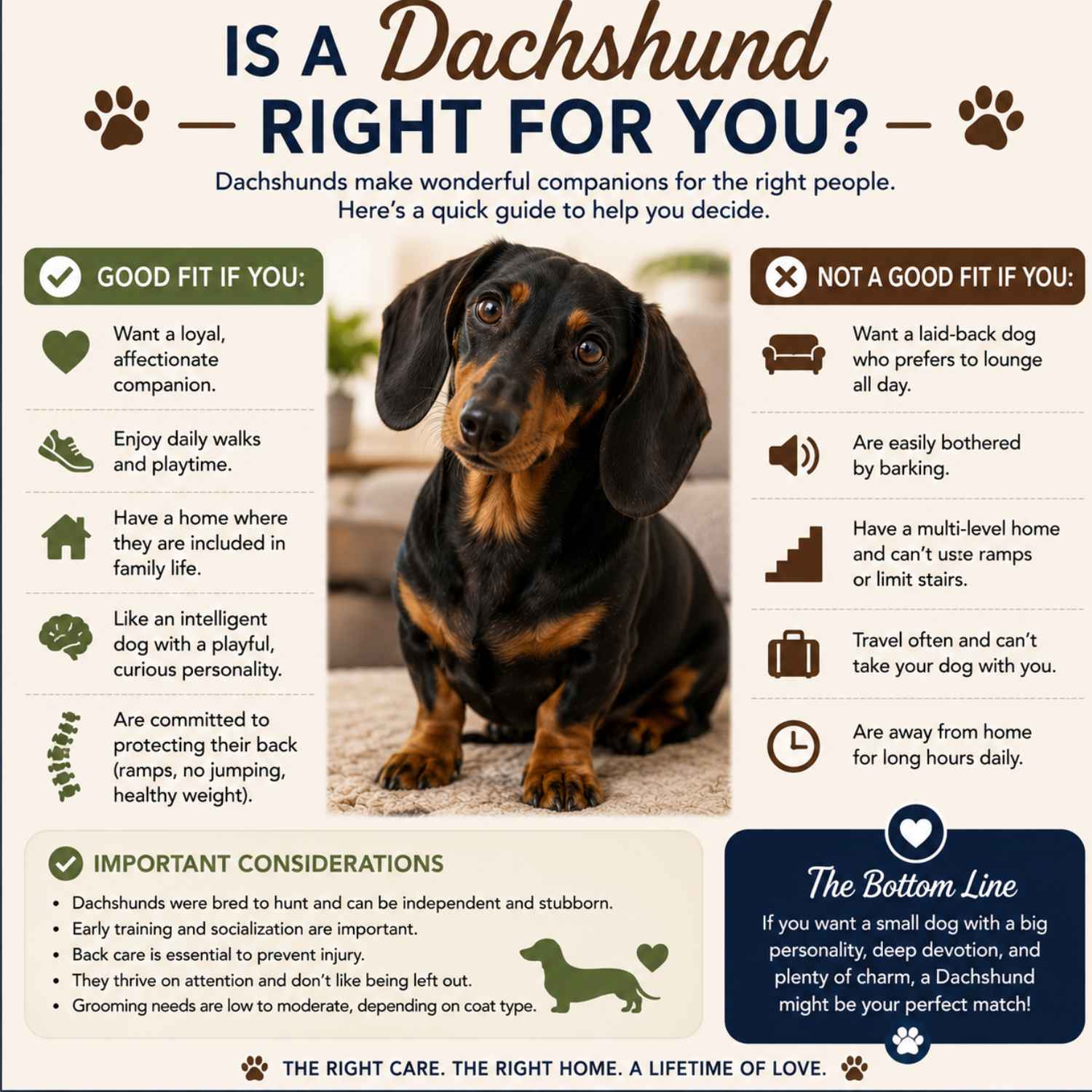
Is a Dachshund Right for You?
A Dachshund can be a wonderful choice if you want a small dog that behaves like a real hound rather than an ornament: curious, affectionate, opinionated, clever and eager to investigate the world nose-first.
A Dachshund may suit you if:
- You want a dog closely involved in family life.
- You enjoy a confident, funny personality.
- You can provide daily walks and sniffing opportunities.
- You are patient with training and house-training routines.
- You can manage barking rather than expecting a naturally silent dog.
- You are willing to maintain a lean body weight and take spinal health seriously.
- You can supervise interactions with very young children.
You may prefer another breed if:
- You want a naturally quiet dog.
- You expect automatic off-leash reliability.
- You need a hypoallergenic or genuinely non-shedding breed.
- The dog will be alone for very long periods every day.
- You do not want to think about ramps, weight management or IVDD risk.
- You prefer a dog that is highly eager to comply with repetitive obedience.
The Dachshund’s shape may be comic, but the dog inside it is serious about being a hound, a watchdog, a digger, a tracker and a best friend. People who appreciate the whole package often become lifelong Dachshund devotees.
Frequently Asked Questions About Dachshunds & Wiener Dogs
Is a wiener dog a Dachshund?
Yes. Wiener dog is a common nickname for the Dachshund. Sausage dog and Doxie are other common names. “Weiner dog” is a frequent misspelling in searches.
What is a Doxie?
Doxie is an affectionate nickname for a Dachshund. It does not describe a separate breed.
How big does a Miniature Dachshund get?
Under the U.S. breed standard, Miniature Dachshunds compete in a class division for dogs weighing 11 pounds and under at 12 months of age and older. Individual build and body length vary.
How big is a Standard Dachshund?
Standard Dachshunds are usually 16–32 pounds. They are much more substantial than Miniatures while retaining the same characteristic long, low outline.
What is a tweenie Dachshund?
“Tweenie” is an informal nickname for a Dachshund that falls between common Miniature and Standard weights. It is not an official AKC size classification.
What is a teacup Dachshund?
There is no official teacup Dachshund variety. “Teacup” is marketing language for an unusually small dog or puppy.
How long do Dachshunds live?
Dachshunds commonly have a life expectancy of about 12–16 years. Genetics, weight, dental health, veterinary care and other factors affect the individual dog.
How long do Mini Dachshunds live?
Miniature Dachshunds share the same commonly cited 12–16-year breed life-expectancy range. Being smaller does not guarantee a specific lifespan.
Are Wiener dogs hypoallergenic?
No. Dachshunds are not considered hypoallergenic, and Smooth, Longhaired and Wirehaired varieties all shed to some degree.
Do Wiener dogs shed a lot?
Shedding is generally manageable but varies by coat and individual dog. Smooths shed short hair, Longhairs need regular brushing, and Wires have a harsh outer coat with undercoat.
Do Dachshunds bark a lot?
Many do. Dachshunds are alert hounds with a history of using their voices while hunting. Training and environmental management can reduce nuisance barking, but people wanting a naturally quiet breed should take the tendency seriously.
Why are Wiener dogs so long?
The Dachshund’s long, low body was developed for underground hunting. Short legs helped the dog enter dens, while a long, developed ribcage and powerful front supported digging, endurance and working ability.
What were Dachshunds bred to hunt?
Dachshunds are best known for badger hunting and were also used for other quarry and tracking work. The breed’s scenting, persistence, digging ability and courage reflect that history.
Are Dachshunds good family dogs?
They can be excellent family companions, especially with respectful children who understand gentle handling. Very young children should be supervised closely around a small, long-backed dog.
Are Dachshunds good apartment dogs?
Often yes. Their size and exercise needs suit apartments well, but their barking can create problems if hallway and neighbor noises are not managed.
Are Dachshunds easy to train?
They are intelligent but independent. Short, reward-based sessions generally work better than harsh correction or repetitive drilling.
Are Dachshunds hard to potty train?
Some are. Frequent outdoor trips, immediate rewards, supervision and consistency are the foundations of successful house training. Bad weather can make some Dachshunds especially reluctant to go outside.
Do Mini Dachshunds have back problems?
Miniature Dachshunds share the breed’s IVDD concern. Small size does not remove the spinal risk associated with Dachshund structure and genetics.
What are warning signs of IVDD in a Dachshund?
Back or neck pain, crying when moved, reluctance to walk, wobbling, weakness, dragging the hind legs or loss of bladder control can be warning signs. Sudden pain or neurologic change needs prompt veterinary assessment.
Can Dachshunds swim?
Some can, but their body shape is not ideal for effortless swimming. Supervise around water, provide easy exits and consider a properly fitted canine life jacket for boating or deeper water.
What is a dapple Dachshund?
Dapple is the Dachshund term for merle patterning. It can occur in Standard or Miniature dogs. Responsible breeding matters because double-merle offspring have increased risks of hearing and eye abnormalities.
What is an English Cream Dachshund?
English Cream is a popular descriptive term for certain pale cream Dachshunds, especially Longhairs. It is not a separate Dachshund breed or AKC size variety.
How much does a Dachshund cost?
Prices vary widely by region and breeder. Cost alone is not a quality test. Give much greater weight to documented health screening, temperament, puppy raising, transparency and the breeder’s lifelong responsibility for the dogs produced.
Where can I adopt a Dachshund?
Check shelters, Dachshund rescues and owner-assisted rehoming. Pet Rehoming Network’s Miniature Dachshund adoption and rehoming resource is another place to look for private-owner adoption opportunities and rehoming information.
Final Thoughts: More Hound Than Hot Dog
The Dachshund’s silhouette makes people smile, but the breed becomes much easier to understand when you look past the hot-dog jokes. This is a hunting hound compressed into a remarkably low package: courageous, alert, scent-driven, affectionate and capable of making independent decisions.
The same qualities that make Dachshunds so beloved can also make them challenging. Barking needs training. House training needs consistency. Prey drive needs management. Spinal health deserves lifelong attention. And a dog bred to think independently may occasionally regard your command as one possible option among several.
For owners who appreciate that personality rather than fighting it, few small dogs are more entertaining or devoted. A well-bred or thoughtfully adopted Dachshund can be a deeply affectionate companion for many years—and quite possibly the reason you eventually decide one Dachshund is not enough.
Trusted Dachshund Resources
For breed standards, health testing, spinal-health education and responsible Dachshund ownership, useful starting points include:
- Dachshund Club of America: national parent club, including the official Dachshund breed standard and IVDD information.
- American Kennel Club: Dachshund breed information and current Hound Group health-testing recommendations.
- Orthopedic Foundation for Animals: health-testing information and public results database.
Online information is useful for preparation, but it cannot examine your dog. Pain, neurologic change, persistent illness or questions about an individual Dachshund’s health should be discussed with a veterinarian.
About This Dachshund Guide
Dogs Central has been helping dog lovers learn about companion dogs since 2002. This Dachshund guide is part of our expanding library of practical small-dog resources for prospective owners, puppy buyers, adopters and people already sharing their lives with small dogs.
As the Dachshund section grows, we may add dedicated Miniature Dachshund resources, puppy-selection guidance, a Dachshund names guide, breeder-showcase profiles, harness and equipment guidance, deeper coat-color information, owner experiences and new original images and infographics. Our goal is to keep improving this page as a genuinely useful Dachshund resource rather than treating a breed guide as permanently finished.