
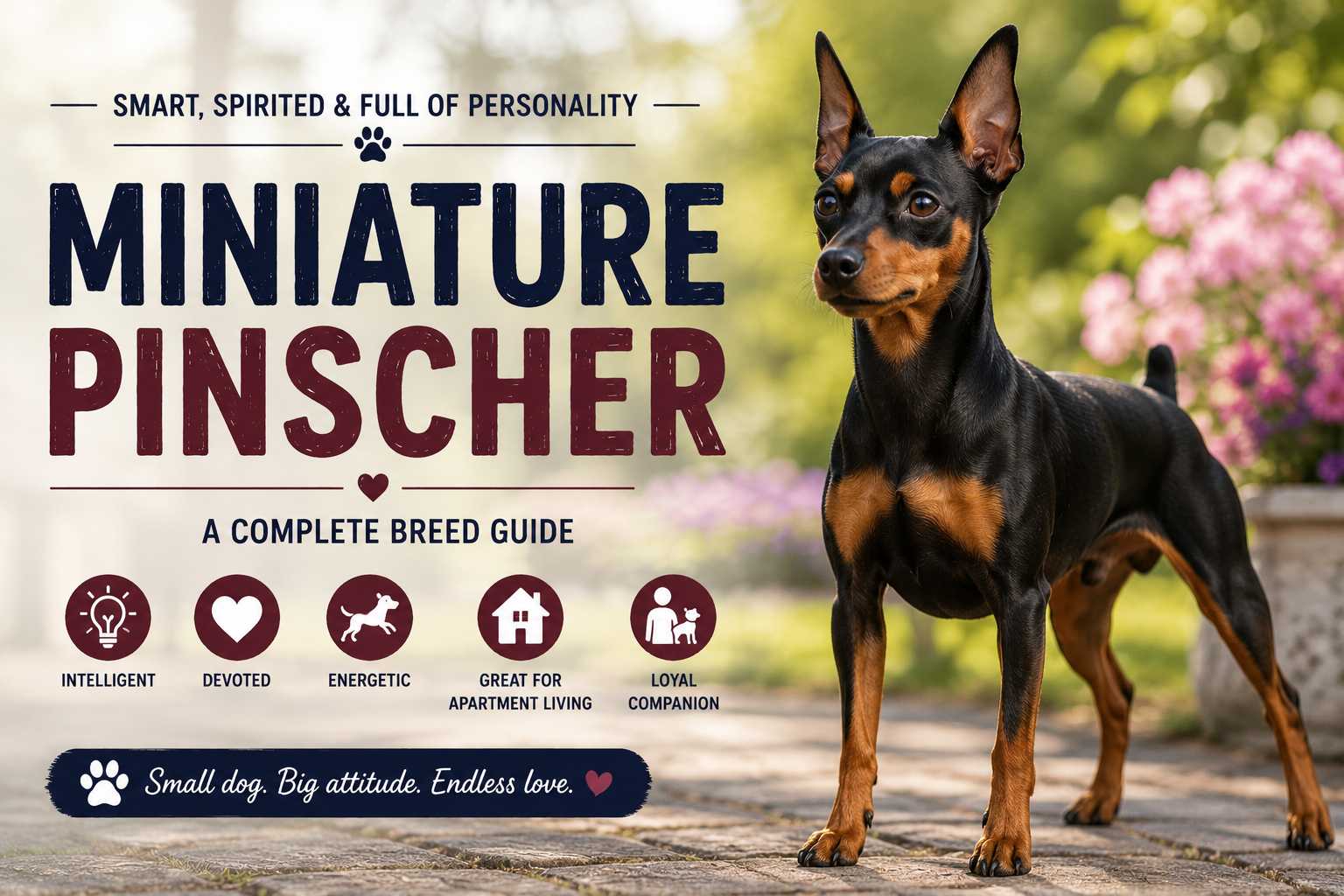
Miniature Pinschers: The Complete Min Pin Dog Breed Guide
Small body. Enormous self-confidence. The Miniature Pinscher—better known to generations of fans as the Min Pin or Minpin—is a sleek, athletic little dog with a bright mind, a busy agenda, and very little interest in behaving like a decorative lapdog. This is a toy breed with working-dog roots: alert, fast, curious, independent, affectionate with its people, and often hilariously convinced that it should be in charge.
And before we go any further, let’s clear up the question that follows this breed everywhere: a Miniature Pinscher is not a miniature Doberman Pinscher. The resemblance is real, especially in black-and-rust dogs, but the Min Pin is a distinct and much older breed. It was developed in Germany as a small vermin-catching dog, while the Doberman was created much later as a large protection and working breed.
For the right owner, a Min Pin can be an extraordinarily entertaining companion. They are compact enough for small homes, easy to groom, long-lived by canine standards, and intensely engaging. For the wrong owner, that same intelligence and confidence can become door-dashing, selective hearing, alarm barking, stolen objects, and a tiny dog running a surprisingly efficient household coup.
This guide goes well beyond height, weight, and coat color. We’ll look at what Miniature Pinschers are really like to live with, how big they get, how long they live, their health and exercise needs, training challenges, colors, children and pets, apartment and senior living, puppies, responsible breeders, adoption, popular Min Pin mixes, and the questions people most often ask before bringing one home.
What Is a Min Pin?
A Min Pin is a Miniature Pinscher, a small German dog breed traditionally used to control rats and other vermin. “Min Pin,” “Minpin,” and occasionally “Min-Pin” are simply informal ways of referring to the Miniature Pinscher; they are not separate breeds.
The American Kennel Club places the Miniature Pinscher in the Toy Group. Adults are genuinely small, but their behavior often surprises people expecting a delicate lapdog. Min Pins tend to be vigorous, alert, inquisitive, and highly aware of what is happening around them. Many enjoy cuddling when the day’s business is finished, but they are usually happiest when they are also allowed to explore, play, learn, patrol the house, and participate in family life.
The breed’s nickname, the “King of Toys,” fits remarkably well. A typical Min Pin carries itself with confidence and animation. The breed standard even emphasizes complete self-possession and a distinctive high-stepping gait. This combination of elegance and comic audacity is a large part of the breed’s appeal.
Miniature Pinscher at a Glance
| Breed name | Miniature Pinscher |
|---|---|
| Common names | Min Pin, Minpin, Mini Pinscher; Zwergpinscher in FCI usage |
| Origin | Germany |
| Traditional purpose | Vermin control / barnyard ratter and companion |
| AKC group | Toy |
| Height | 10–12.5 inches at the shoulder; 11–11.5 inches is preferred in the AKC standard |
| Typical weight | About 8–10 pounds |
| Life expectancy | About 12–16 years |
| Coat | Short, smooth, close-fitting |
| Shedding | Low to moderate; easy coat maintenance |
| Hypoallergenic? | No |
| Energy level | High for a toy breed |
| Trainability | Very intelligent, but independent and opportunistic |
| Watchdog ability | Excellent alert watchdog; not a protection dog |
| Best for | Engaged owners who enjoy a bright, active, confident small dog |
Individual dogs vary. A rescue Min Pin with an unknown background may fall outside typical breed-standard measurements, and dogs advertised as Min Pins may sometimes be mixes. Temperament is also shaped by genetics, socialization, training, health, and life experience.
Is a Miniature Pinscher a Miniature Doberman Pinscher?
No. The Miniature Pinscher is not a miniature Doberman. This is one of the most persistent misconceptions about the breed, and the confusion is understandable: black-and-rust Min Pins can look remarkably like pocket-sized Dobermans. Both breeds also originated in Germany and carry the word “Pinscher” in their North American names.
But appearance is not ancestry. The Miniature Pinscher existed as a small ratting type long before the Doberman Pinscher was developed in the late 1800s. Breed histories commonly associate the Min Pin with older German pinscher-type dogs and probable Dachshund and Italian Greyhound influence. The Doberman, by contrast, was deliberately developed by Louis Dobermann as a substantially larger guardian and working dog.
Miniature Pinscher vs. Doberman: Quick Differences
| Trait | Miniature Pinscher | Doberman Pinscher |
|---|---|---|
| Size | 10–12.5 inches; about 8–10 lb | Large working breed, roughly 24–28 inches tall |
| Historical role | Small vermin catcher and companion | Guardian and working dog |
| Development | Older German breed/type | Developed in the late 19th century |
| Breed relationship | Distinct breed | Distinct breed |
| Why they look alike | Sleek outline, erect-ear appearance in many photos, short coat, and similar black/rust patterning can create a strong visual resemblance. | |
So if someone calls your Min Pin a “mini Doberman,” you can forgive the visual mistake—but you can also confidently explain that the little dog has its own history. We plan to explore this search confusion even more deeply in the Dogs Central breed-comparisons library.
Miniature Pinscher History & Origin
The Miniature Pinscher originated in Germany, where small, quick pinscher-type dogs were useful around farms and stables because they could pursue rats and other vermin. That history helps explain several modern Min Pin traits: speed, curiosity, determination, alertness, and a willingness to investigate small moving things.
The breed’s precise early ancestry cannot be reconstructed with certainty from modern pedigrees, and responsible histories should acknowledge that. Commonly cited influences include the German Pinscher, smooth-coated Dachshund, and Italian Greyhound. What is clear is that the Min Pin developed independently of the Doberman and was established as a recognizable small German breed before the Doberman’s creation.
Miniature Pinschers became increasingly visible in German dog shows around the turn of the 20th century. They reached the United States in the early 1900s, and the American Kennel Club recognized the breed in 1925. The Miniature Pinscher Club of America was formed soon afterward. The breed was initially known under different naming conventions in the United States before “Miniature Pinscher” became the official AKC name in 1972.
In Europe you may encounter the name Zwergpinscher—literally “dwarf pinscher.” Historical references to the Reh Pinscher can also cause confusion; “reh” referred to a small reddish deer and historically related particularly to stag-red coloring rather than identifying a different modern breed.
The useful thing about history is not memorizing dates. It is understanding the dog in front of you. A breed shaped to notice movement, pursue vermin, work independently, and stay alert is unlikely to become a passive ornament simply because it now sleeps under a duvet.
Miniature Pinscher Appearance, Size & Weight
A well-proportioned Miniature Pinscher is compact, balanced, sleek, and surprisingly sturdy for its size. The body is short-coupled rather than fragile-looking, the head tapers cleanly, and the expression is bright and alert. Their short, glossy coat emphasizes the athletic outline instead of hiding it.
How Big Does a Miniature Pinscher Get?
Under the AKC breed standard, adult Miniature Pinschers measure 10 to 12.5 inches at the shoulder, with 11 to 11.5 inches preferred. The AKC’s general breed information lists an average weight of approximately 8 to 10 pounds. A healthy pet may vary somewhat, but dramatically smaller or larger dogs should not automatically be assumed to represent a special variety.
Because they are light and compact, Min Pins are physically convenient for apartment dwellers, travelers, and owners who need a dog they can lift. Their smallness also creates vulnerabilities: a fall from furniture, a careless child, a collision with a much larger dog, or being stepped on can cause real injury.
The Famous Min Pin Gait
One of the breed’s signatures is its high-stepping, hackney-like movement. It gives a Min Pin an unmistakable “look at me” quality when trotting. It should not be confused with pain, although any new or uneven gait, limping, reluctance to bear weight, or sudden change in movement warrants veterinary attention.
Full-Grown Min Pin: Small Dog, Not a Fragile Dog
A mature Min Pin should look athletic rather than spindly or overweight. Because the breed is so small, even a pound or two of excess body weight can represent a significant percentage of total mass. You should be able to discuss an appropriate body-condition target with your veterinarian rather than relying only on the number on the scale.
Miniature Pinscher Colors: Red, Black, Chocolate, Blue & More
Color searches are unusually popular for Miniature Pinschers. People look for red Min Pins, brown or chocolate dogs, black Min Pins, blue Min Pins, fawn dogs, white Miniature Pinschers, merles, harlequins, and more. The important distinction is between colors that occur or can be registered and colors accepted by a particular breed standard for conformation showing.
The classic Miniature Pinscher colors most people recognize are solid red, stag red, black with rust markings, and chocolate with rust markings. AKC registration records contain additional color descriptions, but the official show standard is more restrictive than the full registration color list.
What Is a Red Stag Min Pin?
Stag red is red intermingled with darker hairs rather than a perfectly uniform solid red. It is an old and characteristic look in the breed. “Red,” “brown,” and “tan” are often used casually by pet owners, so photographs and pedigree information are more useful than informal color labels alone.
What About Blue Min Pins?
Blue is a dilute pigmentation that can occur in the breed and appears in AKC registration color terminology. It should not be treated as evidence of a separate “blue Min Pin” variety. Dilute coat colors in dogs can sometimes be associated with coat or skin problems, so anyone considering a puppy advertised primarily for an unusual color should ask health-focused questions rather than allowing rarity marketing to drive the decision.
White, Merle and Harlequin Miniature Pinschers
Be especially cautious when a seller markets a striking nonstandard pattern as a rare, premium form of Miniature Pinscher. Ask how the color arose, request verifiable pedigree information where relevant, and place health, temperament, genetic diversity, and responsible breeding above novelty. A dramatic coat pattern is not a reason to overlook poor puppy-rearing practices.
Color should be one of the least important factors in choosing a companion. The best color is attached to a healthy, behaviorally sound dog whose needs fit your household.
Are There Teacup or Toy Miniature Pinschers?
There is no separate teacup Miniature Pinscher breed. The Miniature Pinscher is already a toy-sized dog. “Teacup Min Pin,” “toy Miniature Pinscher,” “micro Min Pin,” and similar labels are marketing terms rather than recognized size varieties within the breed standard.
That matters because “smaller” is not automatically “better.” Deliberately chasing extreme smallness can make already tiny puppies more vulnerable to injury and may accompany poor breeding decisions. A seller emphasizing that a puppy will remain exceptionally tiny should be able to discuss the parents’ adult sizes, health history, veterinary care, feeding needs, and any special risks without resorting to vague promises.
If your goal is simply a very small companion, a standard-sized Min Pin is already compact. Choose for stable temperament, sound structure, appropriate health screening, good early socialization, and fit with your lifestyle—not for a “teacup” label.
Our Miniature Pinscher puppy guide will go deeper into evaluating puppy advertisements, unusual-size claims, low-price offers, online scams, health testing, and what responsible puppy raising actually looks like.
Miniature Pinscher Temperament & Personality
If you want a small dog with a subdued personality, keep looking. The typical Min Pin is bold, animated, observant, clever, curious, affectionate, and independent. They often form strong attachments to their people while retaining enough self-confidence to make their own decisions about what should happen next.
This is where the phrase “big dog in a small body” actually earns its keep. Many Min Pins will challenge a suspicious noise, investigate a visitor, pursue something moving across the yard, climb onto furniture to improve their surveillance position, and confidently approach dogs many times their size. Their courage is charming, but owners have to supply the judgment the dog occasionally forgets to bring.
Are Min Pins Affectionate?
Many are deeply affectionate with their chosen people. They may follow family members from room to room, burrow under blankets, seek warm laps, and insist on being included. Affection does not necessarily mean universal sociability. Some Min Pins are discerning about strangers and need thoughtful early socialization to become comfortable, neutral adults rather than suspicious or reactive ones.
Are Min Pins Aggressive?
Fearlessness and alertness should not be confused with indiscriminate aggression. However, an under-socialized, frightened, frustrated, or poorly managed small dog can absolutely bark, lunge, snap, or bite. Because a Min Pin is tiny, people sometimes laugh at warning behavior they would take seriously in a 70-pound dog. That is unfair to the dog and can make behavior worse.
Respect growls and avoidance signals. Teach children and adults not to corner, grab, tease, or disturb a resting dog. Use reward-based training and seek qualified professional help early if fear, guarding, reactivity, or biting develops.
“Min Pins Are the Worst”—Why Do Some Owners Feel Overwhelmed?
Internet searches sometimes reveal exasperated owners using dramatic phrases about the breed. Usually the underlying issue is a mismatch between expectations and reality. A Min Pin purchased as an “easy little dog” may turn out to be an energetic escape artist with opinions, prey drive, a loud alarm system, and a talent for learning exactly which household rules are negotiable.
The solution is not harshness. It is management, enrichment, consistency, early training, realistic expectations, and a sense of humor. A well-guided Min Pin can be an absolute delight precisely because there is so much dog packed into such a small frame.
Miniature Pinscher Intelligence & Training
Min Pins are intelligent enough to learn quickly—and independent enough to notice when you are inconsistent. Training works best when it is clear, upbeat, rewarding, and woven into daily life rather than saved for a formal ten-minute session.
Start with the skills that keep a tiny, fast dog safe: name response, recall, wait at doors, leave it, drop it, polite leash walking, handling for veterinary care, settling on a mat, and calm responses to visitors and other dogs. Reward the behavior you want before undesirable habits become rehearsed routines.
House Training a Min Pin
Toy breeds can be challenging to house train because their bladders are small, owners sometimes miss subtle signals, and unpleasant weather can make indoor flooring seem very attractive. Use a predictable schedule, frequent outdoor opportunities, immediate rewards for eliminating in the correct place, close supervision indoors, and sensible confinement when you cannot supervise. Punishing accidents after the fact teaches very little and can make a dog reluctant to eliminate in front of you.
Recall and Door Safety
A Min Pin’s combination of speed, curiosity, and chase instinct makes reliable management essential. Do not assume a dog that recalls beautifully in the kitchen will ignore a squirrel beside an open gate. Practice recall gradually around distractions, use secure fencing, and build a household habit in which exterior doors are never casually left open.
Why Harsh Training Backfires
Physical corrections may suppress behavior temporarily while increasing fear, defensive responses, or avoidance. Min Pins are capable of learning sophisticated skills through reinforcement-based methods. The goal is not to “win” against a stubborn little dog; it is to make cooperation worthwhile and establish predictable boundaries.
For a deeper step-by-step program, see our growing Miniature Pinscher training guide.
Barking, Watchdog Behavior & Common Min Pin Habits
Miniature Pinschers are naturally alert. Many notice footsteps in the hallway, a delivery at the door, a dog outside the window, or a mysterious leaf that clearly requires investigation. That makes them effective alert watchdogs, but it does not make them guard or protection dogs.
Barking becomes a problem when the dog is allowed to practice it endlessly. Reduce visual triggers when necessary, teach a calm station away from the door, reward quiet behavior, and provide enough activity that the dog is not inventing a security job out of boredom.
Escape Artist Tendencies
Min Pins have a reputation for finding weak points in containment. Check fence gaps, balcony openings, loose screens, and gates. A small dog can pass through a space that looks harmless from adult eye level. A secure harness and identification are sensible precautions, especially during travel.
Chasing and Scavenging
Ratting ancestry can surface as enthusiastic pursuit of rodents and other small moving animals. Indoors, curiosity may extend to socks, tissues, dropped food, or tiny objects. Puppy-proofing matters because an object that a Labrador might ignore can be swallowed by an eight-pound dog.
Possessiveness
Some Min Pins become possessive of people, beds, toys, or food. Preventing resource guarding is easier than trying to undo an entrenched pattern. Teach trades, approach the dog with good things rather than routinely taking valued items away, and avoid encouraging “cute” possessiveness toward a favorite person.
Miniature Pinscher Exercise Needs & Enrichment
Min Pins are high-energy by toy-dog standards. Their exercise needs are manageable because their legs are short and their bodies are small, but they still need daily opportunities to move, sniff, explore, play, and think.
For many healthy adults, a combination of brisk walks, sniffing outings, indoor play, short training sessions, and secure off-leash activity in an enclosed area works better than trying to exhaust the dog with one long march. Puppies need age-appropriate activity rather than forced endurance exercise, while seniors may prefer shorter, more frequent outings.
Good Activities for Min Pins
- Food puzzles and scatter feeding
- Short obedience or trick-training sessions
- Sniff walks where the dog gets time to investigate
- Fetch or chase games with appropriately sized toys
- Agility foundations and low-impact obstacle work
- Rally, scent games, and other dog sports
- Hide-and-seek with toys or family members
Mental exercise is especially valuable. Five minutes of learning can take the edge off a busy Min Pin in a way that mindless laps around the block may not.
Cold weather deserves special consideration. The breed’s short coat and small body offer limited insulation, so many Min Pins appreciate a well-fitting coat in cold climates. In hot weather, shift strenuous activity away from the hottest part of the day and provide water and shade.
Are Miniature Pinschers Good Family Dogs?
They can be excellent family companions in homes that understand small-dog safety and appreciate an active, opinionated personality. A Min Pin is usually happiest as a genuine member of the household rather than a dog expected to entertain itself for most of the day.
Are Min Pins Good With Children?
Many live happily with respectful children, especially when raised with positive experiences. The more important question is whether the children are good with a Min Pin. An eight- or nine-pound dog can be injured by being dropped, squeezed, stepped on, chased, or grabbed while sleeping.
Homes with very young children need particularly close supervision. Teach children to sit on the floor for interaction, allow the dog to walk away, avoid hugging or carrying the dog without guidance, and leave food and sleeping areas alone. Never rely on breed reputation as a substitute for supervising children and dogs together.
Other Dogs
Well-socialized Min Pins can live successfully with other dogs, but confidence can exceed common sense. A Min Pin may challenge or pester a much larger dog, creating a dangerous size mismatch even when neither animal is generally aggressive. Choose playmates carefully and intervene before arousal escalates.
Cats and Small Pets
Some Min Pins live peacefully with cats, particularly when introduced carefully, while others are persistent chasers. Individual history matters. Rodents, rabbits, and other small prey-type pets require secure separation; ratting ancestry is relevant here. Do not assume friendship because the Min Pin is itself small.
Can a Miniature Pinscher Live in an Apartment?
Yes—provided exercise, barking, and door safety are managed. Their compact size makes Min Pins physically well suited to apartments and condos. They do not need a huge yard, and a yard would not replace walks or enrichment anyway.
The bigger apartment issue is sound. An alert dog who reacts to every elevator, hallway footstep, or neighboring dog can create friction. Early training, white noise, strategic furniture placement, window management, and rewarding calm behavior can make an enormous difference.
How Long Can a Min Pin Be Left Alone?
Adult dogs vary widely in their comfort with solitude. A well-adjusted adult may handle a normal period alone after gradual training, but a puppy cannot simply be left for a full workday and expected to manage toileting, boredom, and emotional needs. Arrange appropriate breaks and build alone-time skills gradually.
If a Min Pin panics when alone—persistent howling, frantic escape attempts, drooling, destruction around exits, or inability to eat—treat it as a possible separation-related behavior problem rather than “spite.” A veterinarian or qualified behavior professional can help.
Are Miniature Pinschers Good Dogs for Seniors?
A Min Pin can be an excellent companion for an active senior who wants a small, portable, entertaining dog and is comfortable with daily walks and consistent training. The short coat is easy to maintain, the dog is light enough for many adults to lift, and the breed’s long lifespan can be appealing.
There are caveats. A young Min Pin can dart underfoot, pull toward something exciting, bolt through a door, or leap from furniture. For someone with balance or mobility limitations, an exuberant puppy may be a poor match. A calmer adult or senior Min Pin with a known temperament may be a far better choice.
What About First-Time Dog Owners?
First-time owners can succeed with Min Pins, but this is not the most forgiving “starter dog” if the owner expects size to equal simplicity. A novice who enjoys training, sets household routines, puppy-proofs carefully, and seeks help early can do very well. Someone wanting an automatically obedient lapdog may find the breed frustrating.
Miniature Pinscher Grooming, Shedding & Dental Care
One of the Min Pin’s practical advantages is its low-maintenance coat. The short, smooth hair does not need clipping or elaborate styling. A quick weekly brushing with a soft brush or grooming mitt helps remove loose hair and keeps the coat glossy.
Do Miniature Pinschers Shed?
Yes. The coat is short and shedding is usually modest, but “short-haired” does not mean “no shedding.” Individual dogs, season, diet, skin health, and indoor climate can influence how much hair you notice.
Are Min Pins Hypoallergenic?
No dog is guaranteed to be hypoallergenic, and the Miniature Pinscher is not generally considered a low-allergen breed. People can react to proteins in dander, saliva, and urine as well as hair. Anyone with significant dog allergies should spend meaningful time around adult Min Pins before committing.
Bathing, Nails and Ears
Bathe as needed using a dog-appropriate shampoo; frequent bathing is unnecessary for a clean, healthy dog unless your veterinarian recommends it. Keep nails short enough that they do not alter gait or catch on surfaces. Check ears regularly for odor, redness, discharge, or discomfort rather than routinely pouring products into healthy ears without a reason.
Dental Care Is Not Optional
Small dogs can develop significant dental disease, so tooth care deserves the same seriousness as coat care. Ideally, acclimate a puppy to tooth brushing early using canine toothpaste. Your veterinarian can assess the mouth during wellness visits and recommend professional dental treatment when needed. Bad breath, loose teeth, bleeding gums, reluctance to chew, or facial swelling deserve attention.
For a practical routine, visit our growing Miniature Pinscher grooming guide and Miniature Pinscher care guide.
Miniature Pinscher Health Problems
Miniature Pinschers are often long-lived dogs, but no breed is free of inherited or acquired health problems. The Miniature Pinscher Club of America identifies concerns including patellar luxation, Legg-Calvé-Perthes disease, epilepsy, thyroid disease, heart defects, eye problems, and cervical disc disease. That list does not mean an individual Min Pin will develop any of them; it tells owners and breeders what deserves informed attention.
Patellar Luxation
A luxating patella is a kneecap that slips out of its normal groove. Signs can range from an occasional skipping step to persistent lameness. Severity varies, and treatment ranges from monitoring and weight management to surgery in significant cases. A puppy buyer should ask what orthopedic evaluations have been performed on breeding dogs rather than accepting “the parents look healthy” as a substitute for screening.
Legg-Calvé-Perthes Disease
This orthopedic disorder involves deterioration of the femoral head and can cause pain and lameness in young small-breed dogs. Veterinary examination and imaging are needed for diagnosis. The parent club has supported research into hereditary factors in Miniature Pinschers.
Eye, Thyroid, Cardiac and Neurologic Concerns
Eye disease, thyroid disorders, congenital or acquired heart problems, and seizure disorders can occur. Symptoms such as fainting, exercise intolerance, unexplained weight or coat changes, seizures, persistent neck pain, weakness, or vision changes should be evaluated by a veterinarian rather than attributed to age or temperament.
Weight and Injury Prevention
Keeping a Min Pin lean reduces unnecessary stress on small joints. Just as important is preventing avoidable trauma: discourage dangerous leaps from high furniture, supervise interactions with larger dogs, secure balconies and stairs where appropriate, and teach children safe handling.
What Health Testing Should a Breeder Do?
Health screening should be specific to the breed and verifiable. Ask a breeder which tests are recommended by the Miniature Pinscher parent club and whether results can be independently confirmed through recognized health databases. “Vet checked,” “DNA tested,” or “healthy lines” are too vague on their own. Good breeders should be comfortable discussing both strengths and problems in their lines.
Our Miniature Pinscher health guide is the place for deeper explanations of breed-related conditions, screening, preventive care, and questions to take to your veterinarian.
Medical disclaimer: This guide is educational and is not a substitute for veterinary diagnosis or treatment. Contact your veterinarian if your dog is ill, injured, in pain, or showing new or concerning symptoms.
Miniature Pinscher Lifespan: How Long Do Min Pins Live?
The commonly cited Miniature Pinscher life expectancy is approximately 12 to 16 years. That makes the breed relatively long-lived, although no individual dog’s lifespan can be predicted from breed averages.
Longevity is influenced by genetics, preventive veterinary care, body condition, dental health, nutrition, exercise, accident prevention, and plain luck. A 14-year-old Min Pin may still be spirited and playful, but senior dogs benefit from more frequent health monitoring because changes in kidneys, heart, vision, hearing, mobility, cognition, and dental health can develop gradually.
Male vs. Female Min Pin Lifespan
There is no useful rule that lets an owner predict lifespan simply from sex. Individual health and care matter far more. Spay/neuter decisions should be discussed with your veterinarian in the context of the individual dog’s age, health, lifestyle, and reproductive status rather than based on a simplistic longevity promise.
Helping a Min Pin Age Well
Keep the dog lean, maintain muscle with appropriate activity, address dental disease, schedule veterinary checks, and do not dismiss behavior changes as “just getting old.” Increased thirst, house-soiling, nighttime restlessness, reluctance to jump, coughing, weight change, or altered appetite can be medically significant.
Best Food for a Miniature Pinscher: Feeding & Nutrition
The best food for a Miniature Pinscher is a nutritionally complete diet appropriate for the dog’s life stage, health status, body condition, and individual needs. There is no single brand or ingredient list that is automatically best for every Min Pin.
Because the breed is tiny, portion errors add up quickly. Measure meals rather than repeatedly topping up a bowl, count training treats as part of daily calories, and monitor body condition. A small handful of human food can represent a surprisingly large caloric bonus for an eight-pound dog.
Puppies
Growing puppies need food formulated for growth and meals frequent enough for their age and size. Very young toy-breed puppies deserve particular attention to regular eating and signs of weakness or illness. Your breeder and veterinarian should give you a clear feeding schedule when the puppy comes home.
Adults and Seniors
Healthy adults generally do well on a complete adult diet with portions adjusted to maintain a lean body condition. Seniors do not all need the same “senior” formula; dental health, kidney function, activity level, muscle mass, and other medical factors should guide changes.
When to Ask Your Veterinarian
Seek veterinary guidance for persistent vomiting or diarrhea, unexplained weight loss or gain, chronic itching, recurrent ear or skin problems, difficulty chewing, excessive thirst, or a major change in appetite. Avoid using internet food advice to self-treat a medical condition.
See our Miniature Pinscher feeding and nutrition guide for a deeper look at portions, treats, puppy feeding, weight management, and food questions.
What Is It Really Like to Live With a Miniature Pinscher?
Imagine a dog small enough to tuck under one arm but convinced that it has been appointed building manager. That captures a surprising amount of Min Pin life.
A typical day may involve a brisk morning inspection of the neighborhood, breakfast earned partly through a puzzle toy, a nap in the warmest available blanket, an immediate announcement that a parcel has arrived three houses away, a spirited training game, and a late-afternoon burst of activity that makes you question whether eight pounds should legally be allowed that much acceleration.
The breed’s practical advantages are real: minimal coat care, small food portions, easy portability, and a body that fits comfortably into smaller homes. But convenience is not the same as low involvement. Min Pins want interaction. Bored ones are remarkably creative.
Home Safety
Think at Min Pin level. Secure medications, chocolate, xylitol-containing products, tiny children’s toys, batteries, cords, and anything swallowable. Check screens and railings. Be cautious with recliners and sofa beds where a small dog can disappear into mechanisms or blankets.
Warmth
Many Min Pins are enthusiastic heat-seekers. Blankets, sunny windows, and warm laps are prized resources. Their short coat means cold-weather protection may be useful, but clothing should fit safely and never replace supervision.
Travel
The breed’s size makes travel easier, but use a secure carrier or crash-tested restraint rather than allowing a dog to roam in a moving vehicle. Update identification and microchip information before trips. A door-dashing Min Pin in an unfamiliar place can be extremely difficult to catch.
Miniature Pinscher Puppies: What Prospective Owners Should Know
A Min Pin puppy is adorable, fast, curious, and capable of finding hazards you did not know your home contained. Early weeks should focus on safe socialization, toileting routines, handling, bite inhibition, recall foundations, calm alone-time practice, and learning that cooperation with humans pays well.
Do not postpone training because the puppy is tiny. Behaviors such as guarding, frantic barking, biting hands, door rushing, and chasing can become much harder to change after months of rehearsal. At the same time, avoid overwhelming a young puppy. Socialization means creating positive, controlled experiences—not forcing the puppy to endure frightening interactions.
Finding a Healthy, Well-Socialized Min Pin Puppy
Search data shows enormous interest in phrases such as “Min Pin puppies for sale,” “Miniature Pinscher puppies near me,” low-price puppies, and teacup Min Pins. Dogs Central takes a different approach: start by learning how to evaluate the puppy and the person who bred it.
A responsible source should be willing to discuss breed-specific health testing, temperament, the puppy’s parents, early socialization, veterinary care, contracts, and what happens if you can no longer keep the dog. Be wary of sellers who always have many breeds available, refuse meaningful questions, will not show where puppies are raised, pressure you to pay immediately, advertise primarily by “rare” color or tiny size, or offer implausibly cheap puppies with shipping as the main transaction.
Our dedicated Miniature Pinscher Puppies Guide will walk you through finding a healthy, well-socialized puppy, breeder red flags, health screening, scams, teacup claims, price questions, contracts, and what to ask before you put down a deposit.
Miniature Pinscher Puppy Names
A dog with this much personality deserves something better than a list copied from every other breed. Min Pin names can draw inspiration from Germany, the breed’s “King of Toys” nickname, its red and black coat colors, speed, tiny stature, fearless temperament, or comically regal attitude.
Think Kaiser, Otto, Fritz, Heidi, Ember, Rusty, Ruby, Pepper, Jet, Dash, Rocket, Pixie, Rex, Queenie, Baron, Cricket or something wonderfully ironic like Moose.
For many more ideas, including male and female names, German-inspired names, red and black dog names, tiny-dog names, regal names, and funny choices, visit our Miniature Pinscher names guide and the Dogs Central Small Dog Names Guide.
Miniature Pinscher Breeders: How to Begin Your Search
Finding a responsible breeder should involve more than typing “Min Pin breeder near me” and choosing the closest result. Geography matters, but health, temperament, puppy raising, transparency, and lifetime responsibility matter more.
Dogs Central separates breeder discovery from puppy education. Our Miniature Pinscher Breeder Showcase is designed to introduce breeders accepted for inclusion in our Small Dog Breeder Showcase. It can be a useful place to begin, while our puppy guide teaches you how to independently evaluate any breeder you consider.
Questions Worth Asking
- What breed-specific health testing was completed on both parents, and where can results be verified?
- What temperaments do the parents have in ordinary home life?
- How are puppies raised and socialized before going home?
- At what age do puppies leave?
- What veterinary care and documentation are provided?
- What does the contract require if the buyer can no longer keep the dog?
- Why was this particular pairing chosen?
A responsible breeder should also ask you questions. Someone willing to sell an energetic toy-breed puppy to absolutely anyone with a credit card is telling you something important.
Miniature Pinscher Adoption, Rescue & Rehoming
Adoption is another excellent way to welcome a Min Pin into your life. Adults can be particularly appealing because size, energy level, and much of the dog’s personality are already visible. Breed rescue groups, shelters, and carefully managed private rehoming can all be worth exploring.
Pet Rehoming Network currently has an established Miniature Pinscher adoption and rehoming resource for people looking for Min Pins and for owners who need help finding a new home for a dog they love.
If You Need to Rehome a Miniature Pinscher
Life circumstances can change because of housing, finances, family needs, illness, caregiving, relocation, or other situations. Thoughtful rehoming is not the same as casually abandoning a pet. Give yourself time where possible, be completely honest about health and behavior, screen potential adopters carefully, transfer veterinary records, and prioritize a home suited to the individual dog.
A confident Min Pin may still find a household transition stressful. Keeping routines familiar, sending the dog’s bed and favorite belongings, and giving the new family accurate information about feeding, toileting, fears, triggers, medication, and training can improve the transition.
Note for our editorial team: the existing Pet Rehoming Network Miniature Pinscher page uses a legacy URL rather than the newer standard `/miniature-pinscher-rehoming-adoption/` structure. Preserve the established live URL unless a deliberate redirect/update is implemented.
Popular Miniature Pinscher Mixes
Search interest in Min Pin mixes is substantial, especially crosses involving Chihuahuas and Dachshunds. Mixed-breed dogs can inherit any combination of traits from their parents; a cross does not reliably land halfway between two breeds in size, temperament, coat, or health.
Chipin: Chihuahua Miniature Pinscher Mix
The Chihuahua × Miniature Pinscher cross is commonly called a Chipin. Searches for “Min Pin Chihuahua mix,” “Min Pin and Chihuahua mix,” and “Min Pin Chihuahua mix puppy” are especially common. These little dogs may combine the alertness, confidence, attachment, and compact size of both parents, but individual variation is considerable.
Dogs Central has a complete Chipin dog breed guide. You can also explore our Chihuahua guide to understand the other parent breed.
Dachshund Min Pin Mix
Dachshund × Min Pin mixes are another frequently searched combination. They may inherit a longer body, short coat, hunting instincts, boldness, and strong opinions from either side. Because body shape can vary, avoid making assumptions about orthopedic or back-health risk based only on a mixed-breed label. Learn more about the Dachshund parent breed.
Other Min Pin Mixes
People also search for Min Pin crosses with Rat Terriers, Jack Russell Terriers, Yorkshire Terriers, Poodles, Pomeranians, Pugs, Corgis, Italian Greyhounds, Boston Terriers, Maltese, Papillons, Shih Tzus, Schnauzers, Beagles, and larger breeds. When considering any mix, research both parent breeds and evaluate the actual dog rather than relying on a catchy hybrid name.
Browse our designer dog breed guides for more small mixed-breed profiles.
Miniature Pinscher Breed Comparisons
The Min Pin is frequently compared with other sleek, confident small breeds. Comparisons are most useful when they help you choose a dog whose daily needs fit your life—not when they try to declare one breed universally “better.”
Miniature Pinscher vs. Chihuahua
Both are tiny, alert companion dogs with big personalities. Chihuahuas have greater coat and head-type variety, while the Min Pin has a distinctive athletic pinscher outline and ratting heritage. Either can be vocal, devoted, and surprisingly bold. Individual temperament and responsible socialization matter enormously.
Miniature Pinscher vs. Manchester Terrier
Black-and-tan examples can look superficially similar, but they are distinct breeds with different standards and histories. Anyone choosing between them should compare adult size, temperament, exercise needs, and breeder availability rather than selecting from photographs alone.
German Pinscher vs. Miniature Pinscher
The German Pinscher is substantially larger—AKC information places it around 17–20 inches and 25–45 pounds—while the Min Pin is a true toy-sized dog. Both have German pinscher heritage and alert, athletic personalities, but they occupy very different size categories.
Miniature Pinscher vs. Doberman
This is the comparison people ask most often, but the answer bears repeating: the Min Pin is not a scaled-down Doberman. If you love the visual resemblance but need a small companion, evaluate the Min Pin on its own temperament and needs rather than expecting Doberman behavior in miniature.
These pairings are natural candidates for our Dogs Central breed comparisons library.
Miniature Pinscher Pros & Cons
Reasons People Love Min Pins
- Huge personality in a genuinely small package
- Bright, entertaining, and highly interactive
- Short, easy-care coat
- Portable and adaptable to smaller homes
- Usually energetic enough for active owners without needing large-dog mileage
- Alert watchdog
- Often long-lived
- Can excel at training games and dog sports
Challenges to Consider
- Independent streak can challenge inconsistent owners
- Alert barking can become excessive
- Fast and opportunistic around open doors
- May chase small animals
- Confidence around larger dogs can put them at risk
- Needs more exercise and mental engagement than some people expect from a toy breed
- Tiny body requires careful handling around young children and rough play
- Not hypoallergenic
The same trait can appear on both sides of the ledger. Alertness is wonderful if you like a watchdog and irritating if you need absolute quiet. Independence is charming to one owner and maddening to another. Fit matters more than a generic breed score.
Is a Miniature Pinscher the Right Dog for You?
A Min Pin may be an excellent match if you want a small dog that is active, clever, funny, portable, and deeply involved in family life. You should enjoy training rather than seeing it as a chore, be willing to secure doors and fencing, and appreciate a dog with opinions.
A Min Pin May Suit You If…
- You want a small dog without a low-energy personality.
- You enjoy walks, games, tricks, and mental enrichment.
- You can be consistent without being harsh.
- You appreciate an alert watchdog.
- You are willing to supervise interactions with children and larger animals.
- You prefer a short, simple coat.
You May Prefer Another Breed If…
- You want a very quiet dog.
- You expect reliable off-leash behavior without extensive training and management.
- You dislike independent or mischievous personalities.
- You want a dog that needs very little daily engagement.
- Your household cannot safely manage a tiny, fast dog around rough young children or large boisterous pets.
If you are still comparing possibilities, explore the Dogs Central Small Dog Breed Hubs and our Small Dog Breeds A–Z.
Miniature Pinscher Frequently Asked Questions
What is a Min Pin?
A Min Pin is a Miniature Pinscher, a small German dog breed with ratting ancestry. “Min Pin” and “Minpin” are informal names for the same breed.
Is a Miniature Pinscher a miniature Doberman?
No. The Miniature Pinscher is a separate, older breed. The two can look similar because of their sleek outlines and black-and-rust coloring, but the Min Pin was not created by breeding Dobermans down in size.
How big does a Miniature Pinscher get?
The AKC standard allows 10 to 12.5 inches at the shoulder, and general AKC breed information lists approximately 8 to 10 pounds.
How long do Min Pins live?
Typical life expectancy is about 12 to 16 years, although individual lifespan depends on genetics, health, care, and other factors.
What is a Min Pin’s temperament like?
Typical Min Pins are alert, confident, energetic, curious, intelligent, affectionate with their people, and somewhat independent. Early socialization and consistent training are important.
Do Miniature Pinschers bark a lot?
They can. Their alert nature makes them quick to announce visitors and unusual sounds. Training, enrichment, and managing visual or hallway triggers can keep watchdog barking from becoming constant barking.
Do Miniature Pinschers shed?
Yes, but their short coat is generally easy to maintain and shedding is often modest.
Are Min Pins hypoallergenic?
No. People with dog allergies can react to dander and saliva as well as hair.
Are there teacup Miniature Pinschers?
There is no recognized teacup variety. The Miniature Pinscher is already a toy breed. Treat “teacup,” “micro,” and similar size labels as marketing terms and prioritize health and responsible breeding.
Are Miniature Pinschers good with children?
They can be good companions for respectful children, but their tiny size makes rough handling dangerous. Adults should supervise interactions and teach children to respect the dog’s space.
Can Min Pins live with cats?
Some do very well with cats, particularly with careful introductions. Others have a stronger chase response. Individual temperament and history matter.
Are Miniature Pinschers good apartment dogs?
Yes, if their exercise and mental needs are met and alert barking is managed. Secure door routines are especially important in shared buildings.
What health problems do Min Pins have?
Breed-club health information identifies concerns including patellar luxation, Legg-Calvé-Perthes disease, epilepsy, thyroid disease, heart defects, eye problems, and cervical disc disease. A veterinarian and responsible breeder can provide more individualized guidance.
What is a blue Min Pin?
Blue refers to dilute pigmentation, not a separate breed or size variety. Do not choose a puppy primarily because a seller markets its color as rare.
What is a Chihuahua Min Pin mix called?
A Chihuahua × Miniature Pinscher mix is commonly called a Chipin. Mixed-breed puppies can inherit different combinations of traits from either parent.
Trusted Miniature Pinscher Resources
- Miniature Pinscher Club of America – parent-club breed education, health information, breeder referral, and rescue resources.
- American Kennel Club – Miniature Pinscher – breed standard information, size, colors, history, and general care.
- MPCA Health & Research Information – breed health concerns and research information.
- Orthopedic Foundation for Animals – searchable health-testing records and canine health resources.
- World Small Animal Veterinary Association – evidence-based nutrition guidance for pet owners and veterinary teams.
Breed clubs and registries are useful starting points, but they do not replace individualized veterinary advice or your own careful evaluation of a breeder, rescue, trainer, or other service provider.
About This Miniature Pinscher Guide
Dogs Central is building an expanding library devoted to small dogs and the people who love them. This Miniature Pinscher guide is designed to serve as the main hub for a growing breed silo that will include deeper resources on puppies, health, training, grooming, care, nutrition, names, mixes, comparisons, and more.
As the library grows, we may add new photographs, infographics, owner experiences, expert resources, and supporting articles. Our goal is simple: when someone is trying to decide whether a Min Pin belongs in their life—or trying to give the Min Pin already sleeping under their blanket a better life—we want them to find practical, thoughtful help here.