
The Miniature Dachshund may be tiny enough to tuck under one arm, but nobody remembered to shrink the hound personality. Also affectionately called a Mini Dachshund, Mini Doxie, mini wiener dog, or mini sausage dog, this little version of the Dachshund combines an unmistakably long, low silhouette with courage, curiosity, loyalty, a powerful nose, and a surprisingly authoritative bark.
Miniature Dachshunds are enormously popular companion dogs, and the appeal is easy to understand. They fit comfortably into small homes, come in three dramatically different coat varieties, can live well into their teens, and often form exceptionally close bonds with their people. A Mini can be equally enthusiastic about investigating a scent trail outdoors and tunneling beneath a blanket five minutes later.
But “miniature” should never be mistaken for “maintenance-free.” These dogs are true Dachshunds. House training can require patience. Barking is part of the breed’s heritage. Prey drive can be strong. Their long-backed structure makes intervertebral disc disease (IVDD) an important lifelong health consideration. And because they are so popular, puppy buyers must also navigate a marketplace full of “teacup,” “micro,” “rare color,” dapple, cream, and guaranteed-size claims.
This complete Dogs Central guide takes an especially deep look at the subjects Miniature Dachshund owners and prospective owners ask about most: full-grown size and weight, Mini vs. Standard Dachshunds, long-haired Mini Dachshunds, dapple and English cream coats, colors, lifespan, temperament, training, potty training, shedding, hypoallergenic claims, food, back problems, harnesses, stairs, puppies, breeders, price, adoption, and everyday life with a Mini Doxie.
Written by: Deborah G. Moore
Last updated: August 15, 2026
Miniature Dachshund at a Glance
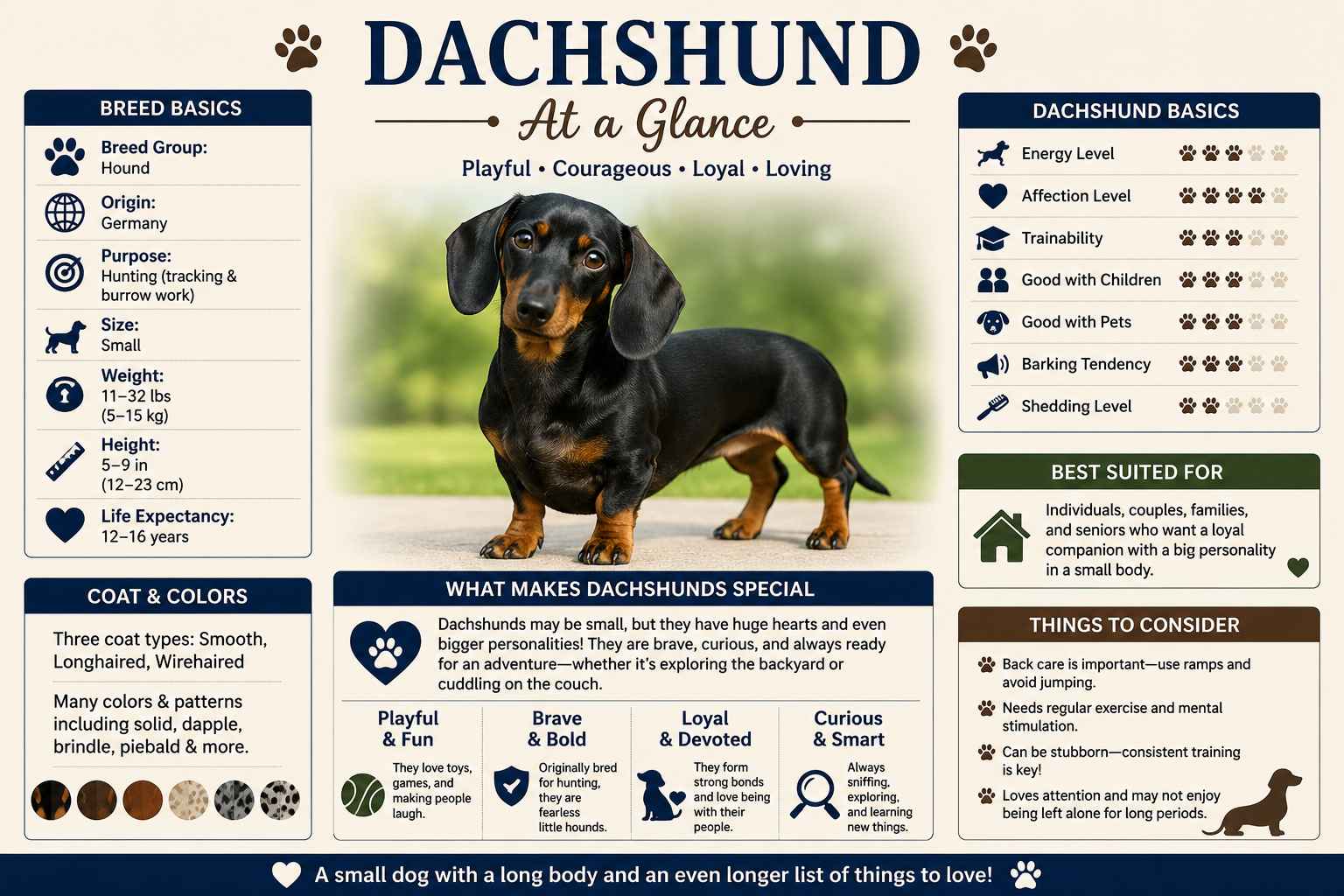
| Breed | Dachshund — Miniature size variety |
|---|---|
| Other Names | Mini Dachshund, Mini Doxie, Mini Wiener Dog, Mini Sausage Dog |
| Breed Group | Hound |
| Origin | Germany |
| U.S. Miniature Size | 11 pounds and under at 12 months of age and older for the AKC Miniature class division |
| Typical Height | Often about 5–6 inches at the shoulder |
| Coat Varieties | Smooth, Longhaired, Wirehaired |
| Common Colors | Red, cream, black and tan, chocolate and tan, plus other accepted colors and patterns |
| Patterns | Dapple, brindle, piebald and sable, depending on coat genetics |
| Temperament | Affectionate, lively, courageous, clever, alert, curious and often independent |
| Energy Level | Moderate |
| Exercise Needs | Regular daily walks, sniffing, play and mental enrichment |
| Trainability | Intelligent but independent; best with patient reward-based training |
| Shedding | Yes; amount and grooming needs vary by coat |
| Hypoallergenic? | No |
| Barking | Often moderate to high |
| Apartment Friendly | Often excellent if barking, toileting and exercise are managed |
| Life Expectancy | About 12–16 years |
| Major Health Consideration | IVDD and lifelong spinal health |
| Best For | People who want a devoted, compact companion and appreciate a true hound personality |
Important: Miniature Dachshunds are defined somewhat differently by kennel clubs around the world. In the United States, the Dachshund Club of America/AKC standard uses weight for the Miniature class division. The Royal Kennel Club in the UK also describes an ideal Miniature weight around 10 pounds with a desired maximum around 11 pounds. Always use the standard relevant to your country if showing or breeding dogs.
What Is a Miniature Dachshund?
A Miniature Dachshund is the smaller size variety of the Dachshund. It is not a designer dog, a Dachshund mix, or a separate newly created breed. In the United States, the Dachshund Club of America breed standard states that Dachshunds are bred and shown in Standard and Miniature sizes, with Miniatures competing in a class division for dogs weighing 11 pounds and under at 12 months of age and older.
Miniatures share the same characteristic Dachshund outline and basic breed qualities as Standards: a long ribcage, short legs, powerful front, drop ears, good scenting ability, courage, persistence and a tendency to make their opinions known.
What is a Mini Doxie?
Mini Doxie is simply a nickname for a Miniature Dachshund. “Doxie” is a familiar shorthand for Dachshund. You may also hear mini wiener dog, mini sausage dog, miniature weenie dog, or simply “mini.” None of those names describes a different breed.
Is every small Dachshund automatically a Miniature?
Not in a formal show sense. A young puppy cannot be classified by adult weight with certainty, and a mature dog falling between commonly recognized Miniature and Standard weights is sometimes informally called a “tweenie” Dachshund. Tweenie is not an official AKC size classification.
Are Miniature Dachshunds ethical?
The Miniature is a long-established recognized size variety of the Dachshund, not a recent attempt to miniaturize an unrelated breed. Ethical concerns arise when breeders prioritize extreme tininess, unhealthy structure, fashionable colors or rapid sales over sound health, temperament and responsible breeding practices.
That distinction becomes especially important when advertisements use terms such as teacup, micro, toy, pocket or “super mini.” Those are marketing terms rather than additional official U.S. Dachshund sizes.
For the breed as a whole, see our complete Dachshund Dog Breed Guide.
Miniature Dachshund History: What Were Mini Dachshunds Bred For?
Miniature Dachshunds belong to a breed developed in Germany for hunting. The name Dachshund is commonly translated as “badger dog,” and the larger Standard Dachshund is closely associated with going to ground after badger and other quarry.
Smaller Dachshunds were developed for work involving smaller animals. Historical AKC material notes that Miniatures were used for rabbit hunting. Their compact size allowed them to pursue smaller quarry while retaining the scenting ability, persistence, courage and vocal communication of the larger Dachshund.
Why does this history matter to a pet owner?
Because the Miniature Dachshund’s behavior makes much more sense when you remember that this tiny dog has hound software installed.
A Mini may:
- spend half a walk investigating one fascinating smell;
- dig enthusiastically in soil, blankets or bedding;
- chase squirrels or rabbits;
- bark when something unusual happens;
- continue working on a puzzle long after another dog has lost interest;
- make independent decisions instead of constantly checking with its person.
None of these traits means a Miniature Dachshund is untrainable. They simply mean training works best when it respects the dog’s motivation and history rather than expecting the unquestioning response of a breed developed for close handler direction.
Where does the Mini Doxie come from?
The Dachshund originated in Germany, where the breed is also known as the Teckel. Different kennel-club systems classify Dachshund sizes somewhat differently. The United States recognizes Standard and Miniature size divisions, while Germany traditionally recognizes a third rabbit-sized category called Kaninchen. Buyers in North America should not assume a seller’s use of “Kaninchen,” “rabbit,” or “teacup” automatically creates a special AKC variety.
Miniature Dachshund vs. Standard Dachshund: What’s the Difference?
The primary formal difference is size. Miniature and Standard Dachshunds belong to the same breed and share the same fundamental long-bodied, short-legged hound type. Both occur in Smooth, Longhaired and Wirehaired coats.
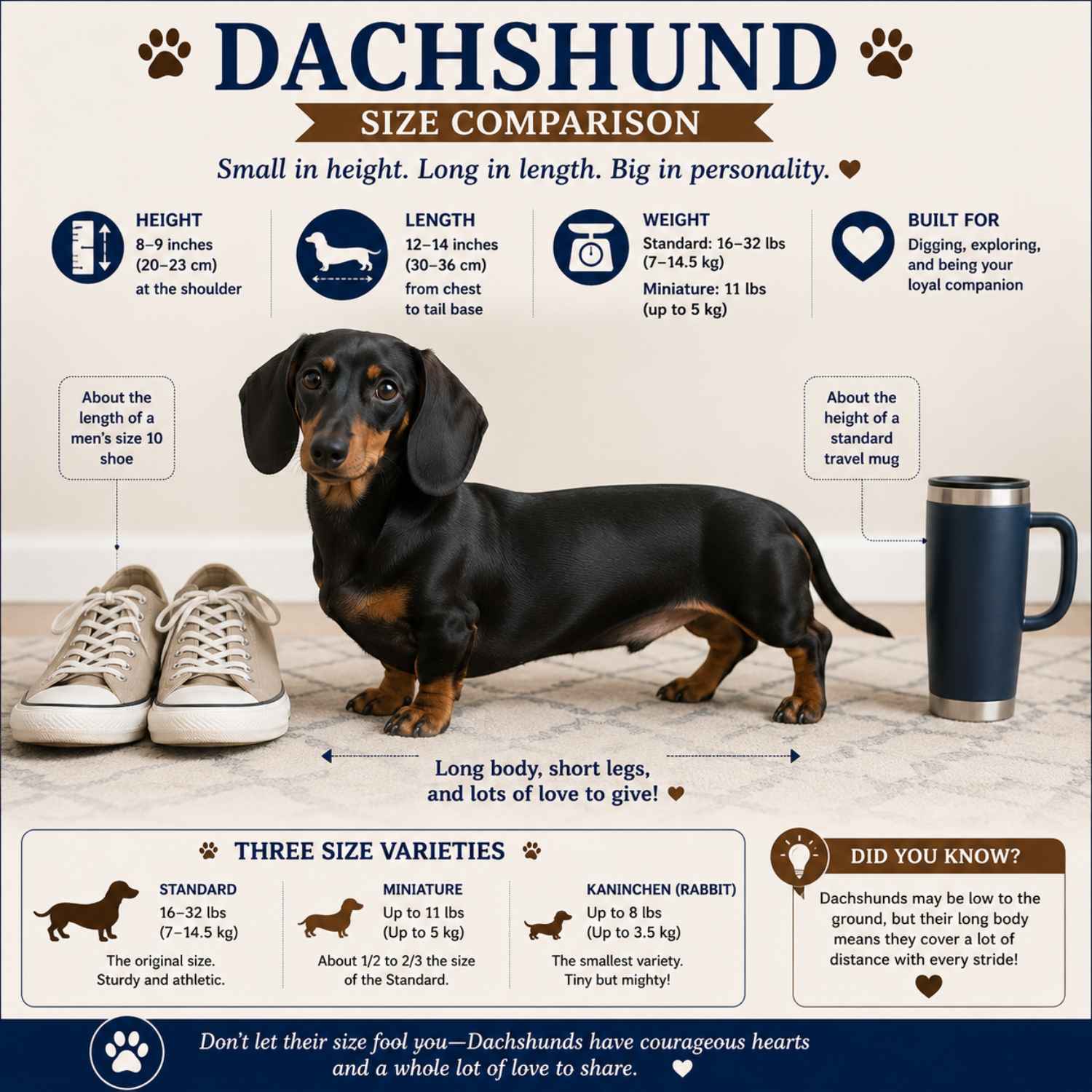
| Trait | Miniature Dachshund | Standard Dachshund |
|---|---|---|
| U.S. Weight | 11 lb and under at 12 months and older for Miniature class division | Usually 16–32 lb |
| Typical Height | About 5–6 inches | About 8–9 inches |
| Coats | Smooth, Longhaired, Wirehaired | Smooth, Longhaired, Wirehaired |
| Temperament | True Dachshund temperament; individual variation | True Dachshund temperament; individual variation |
| Exercise | Moderate daily activity adjusted for size | Moderate daily activity; often somewhat more physical capacity |
| IVDD Concern | Yes | Yes |
| Best Home | Especially convenient for small homes and owners wanting a very compact dog | Good for owners who prefer a sturdier, more substantial Dachshund |
Is a Miniature Dachshund calmer than a Standard?
Not necessarily. Size is not a temperament switch. Family line, socialization, age, exercise, individual personality and coat line can all influence behavior. A ten-pound Miniature can be every bit as bold, vocal or scent-driven as a twenty-five-pound Standard.
Does a Miniature Dachshund have fewer back problems?
Do not assume smaller means protected from IVDD. Miniature Dachshunds share the same chondrodystrophic breed background that makes disc disease a major Dachshund health concern. Sound breeding, lean body condition, appropriate exercise and prompt veterinary care matter at both sizes.
Which is better for an apartment?
Both sizes can live successfully in apartments. The Miniature is physically easier to accommodate, but barking is often more important than body size when living beside close neighbors. A well-trained Standard may be a quieter apartment companion than a Mini who considers every hallway noise a breaking-news event.
How Big Does a Miniature Dachshund Get? Full-Grown Size, Weight & Growth
A full-grown Miniature Dachshund is a very small hound. In the United States, the formal Miniature class division is based on adult weight: 11 pounds and under at 12 months of age and older. Height is commonly listed around 5–6 inches at the shoulder.
That does not mean every healthy pet Miniature must weigh exactly the same. Bone, body condition, sex and individual family lines vary. The goal is a healthy adult with appropriate body condition—not forcing a dog under an arbitrary number through underfeeding.
Miniature Dachshund weight chart: useful or misleading?
Generic puppy weight charts can give a rough idea of growth, but they cannot guarantee adult size. Two puppies of the same age can mature differently, and growth does not occur in a perfectly straight line.
Better predictors include:
- the adult weight and build of both parents;
- the sizes of grandparents and other close relatives;
- mature dogs from earlier litters involving the same lines;
- the puppy’s actual growth pattern over several months;
- your veterinarian’s assessment of body condition.
When does a Mini Dachshund stop growing?
Most Miniature Dachshunds achieve much of their height during the first year, but the body can continue filling out as the chest deepens and the dog develops adult muscle. A dog that looks lanky at eight months may look more substantial at eighteen months without having become “too big.”
How long is a Miniature Dachshund?
There is no official U.S. nose-to-tail length requirement. Dachshund standards describe proportion and type rather than giving pet owners a universal body-length number. If you are buying a harness, coat, carrier, ramp or bed, measure your actual dog.
How do I know if my Dachshund is really a Mini?
For AKC class-division purposes, the answer is determined by adult weight at 12 months or older. A breeder can describe a puppy as expected to mature as a Miniature based on its line, but puppy size is still a prediction until the dog grows.
What is a “teacup Mini Dachshund”?
There is no official teacup Dachshund classification. A seller may use the term for an especially tiny puppy or adult. That does not create a new breed variety, and extreme smallness is not automatically a virtue. Tiny puppies can be more physically vulnerable and may have crowded teeth or other management concerns.
Choose health and structure before size bragging rights. The best Miniature Dachshund is not necessarily the smallest dog a breeder can produce.
What Does a Miniature Dachshund Look Like?
A Miniature Dachshund should look unmistakably like a Dachshund in a smaller package: low to the ground, long in body, muscular rather than frail, with a deep ribcage, strong front, drop ears, tapered muzzle and alert hound expression.
Short legs are part of the breed’s chondrodystrophic structure. The dog should still be capable of active, balanced movement. “Miniature” should not mean spindly, weak, overly fine-boned or so exaggerated that normal movement becomes difficult.
Why is the Mini Dachshund so long?
The long, low shape comes from the breed’s original work. Short legs allowed Dachshunds to enter underground passages, while a long ribcage and strong body supported endurance and digging. The silhouette may look whimsical today, but it originated as functional hunting anatomy.
What should a healthy body condition look like?
You should be able to feel the ribs without pressing through a heavy fat layer, and there should be a discernible waist when viewed from above. Because Miniature Dachshunds are so small, even a seemingly modest amount of extra weight can represent a meaningful percentage of ideal body weight.
Do not use the phrase “sausage dog” as a body-condition goal. The breed should be long—not round.
Miniature Dachshund Coat Types: Smooth, Longhaired & Wirehaired
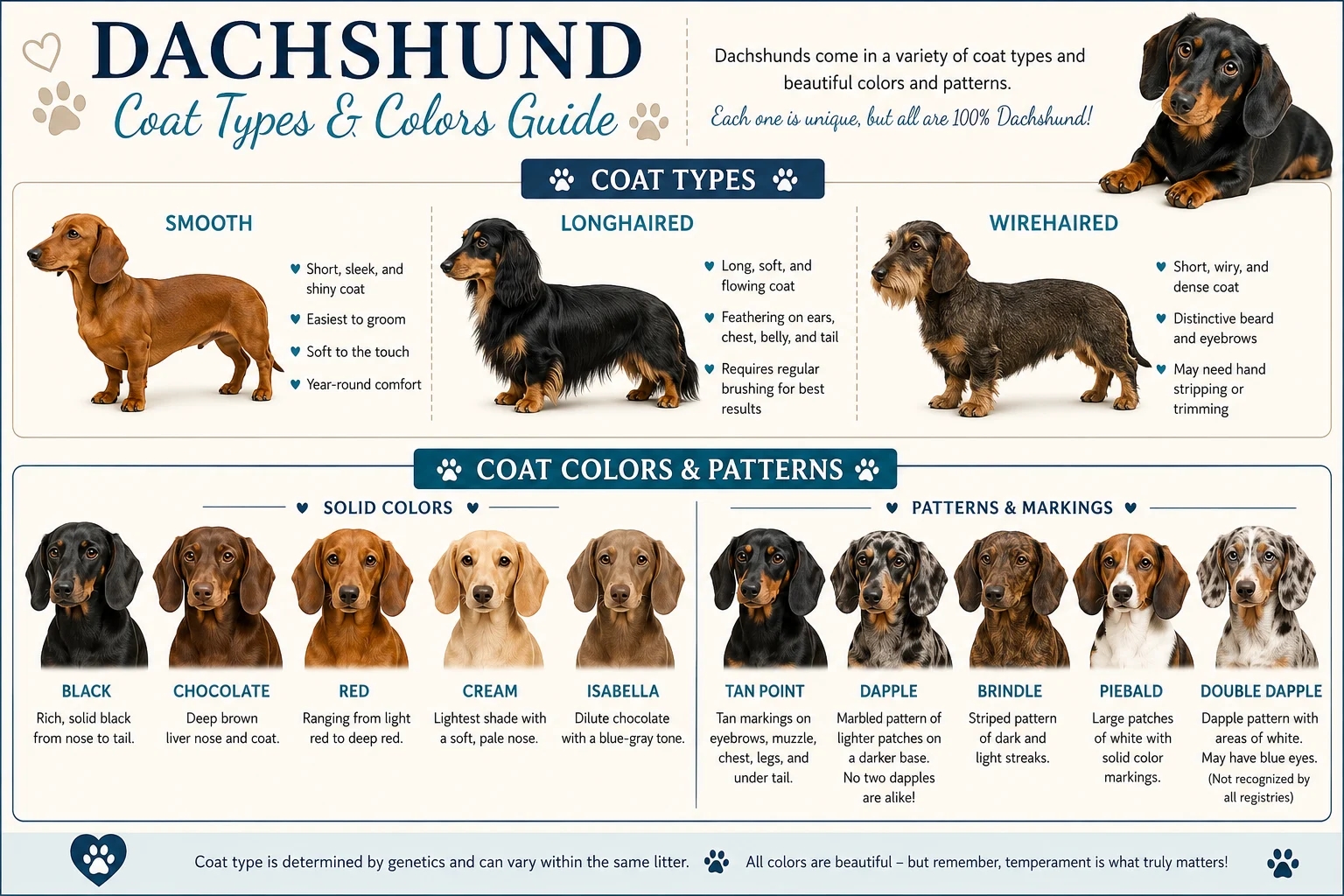
Miniature Dachshunds come in three coat varieties. The coat can make the dogs look surprisingly different, but Smooth, Longhaired and Wirehaired Minis are all Dachshunds.
Smooth Miniature Dachshund
The Smooth has short, close, glossy hair and is the easiest coat to maintain. Weekly brushing with a grooming mitt or soft brush removes loose hair and makes skin checks easy.
Smooth Minis can feel cold quickly in winter, particularly when they are lean and close to the ground. A practical coat or sweater can be useful in harsh weather, but clothing should fit without restricting the shoulders or rubbing behind the front legs.
Longhaired Miniature Dachshund
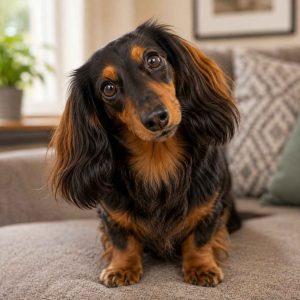
The Longhaired variety develops soft, sleek hair with feathering on the ears, chest, underside, legs and tail. The appearance ranges from modest feathering to a very glamorous “fluffy Mini Dachshund” look.
Longhairs need brushing and combing several times a week, especially behind the ears, under the front legs, around the tail and wherever a harness creates friction.
Wirehaired Miniature Dachshund
The Wirehaired Miniature has a harsh outer coat with undercoat plus the variety’s distinctive beard and eyebrows. Weekly brushing and occasional professional grooming keep the coat tidy. Traditional wire-coat maintenance may include hand stripping rather than routine clipping.
What is a silky wirehaired Mini Dachshund?
“Silky wire” or “silky wirehaired” is an informal descriptive term sometimes used for dogs whose wire coat has softer or longer furnishings than the classic harsh show coat. It is not a fourth official Dachshund coat variety.
Long-Haired Miniature Dachshunds: Why Are They So Popular?
The Long-Haired Miniature Dachshund is one of the most sought-after versions of the breed. Its combination of tiny size, long body, silky ears and flowing tail produces a particularly elegant little dog—and the coat comes in an impressive range of colors and patterns.
But buyers should resist the idea that “long-haired Mini Doxie” automatically describes a particular temperament. The dog remains a Dachshund, and individual behavior depends on genetics, family line, socialization and learning history.
Do Long-Haired Mini Dachshunds shed?
Yes. The longer hair makes loose coat more visible and requires more regular grooming than a Smooth. Brushing several times per week helps remove dead hair before it accumulates around the home and prevents tangles from becoming mats.
Are Long-Haired Mini Dachshunds hypoallergenic?
No. Long hair does not make the breed hypoallergenic, and neither does Miniature size.
Long-Haired Mini Dachshund grooming
Use a soft pin or slicker brush appropriate to the coat, followed by a comb to find tangles close to the skin. Concentrate on:
- behind and beneath the ears;
- the chest feathering;
- the armpits;
- the underside of the body;
- the back of the legs;
- the tail furnishings;
- areas underneath harness straps.
Long-Haired Mini Dachshund colors
Longhairs can be found in red, black and tan, cream, chocolate combinations, dapple and other accepted colors and patterns. Some of the most heavily marketed combinations—such as English cream or long-haired dapple—command enormous attention online, which makes responsible breeder evaluation especially important.
A beautiful coat is lovely. It is not a health test.
Miniature Dachshund Colors: Dapple, English Cream, Red, Black & Tan, Chocolate & More
Miniature Dachshunds can display the same broad coat-color and pattern possibilities seen across the Dachshund breed. The official standard distinguishes between base colors and patterns rather than treating every attractive combination as a separate type of Mini Doxie.
Common Miniature Dachshund colors
- Red
- Cream
- Black and tan
- Black and cream
- Chocolate and tan
- Chocolate and cream
- Wild boar, especially associated with wire coats
- Gray/blue and tan or cream
- Fawn/Isabella and tan or cream
Common patterns
- Dapple — the Dachshund term for merle
- Brindle
- Piebald
- Sable
What is a dapple Mini Dachshund?
A dapple Miniature Dachshund has lighter areas contrasting with a darker base coat. Dapple is a pattern, not a separate breed and not evidence of higher quality.
The important welfare issue is double merle/double dapple breeding. Breeding two merle/dapple dogs can produce puppies with two copies of the merle variant and a significantly greater risk of serious hearing and eye abnormalities. Responsible breeders understand the genetics of the dogs they pair and do not treat dapple as a harmless fashion upgrade.
What is a long-haired dapple Mini Dachshund?
It is simply a Miniature Dachshund combining the Longhaired coat with dapple patterning. The two traits describe coat texture and pattern; they do not change the dog’s fundamental breed needs or eliminate IVDD risk.
What is an English Cream Mini Dachshund?
“English Cream” is a popular term used especially for pale cream Longhaired Dachshunds with particular ancestry and appearance. It is not a separate Dachshund breed or official U.S. size. Buyers should be wary of advertisements that use the label as proof of rarity, health or superior temperament.
What is a golden or blonde Mini Dachshund?
“Golden” and “blonde” are informal descriptions people may use for lighter red or cream-colored dogs. Those words do not create additional recognized Dachshund colors by themselves. If registration color matters to you, ask what color and pattern the breeder records under the applicable kennel-club standard rather than relying on marketing vocabulary.
What is a split-face Mini Dachshund?
“Split face” is an informal appearance description, not an official Dachshund color or pattern in the U.S. breed standard. People generally use it when contrasting markings appear to divide the face dramatically. The visual effect can occur with patterning such as dapple or piebald, depending on the individual dog.
Because “split face” can be used as a social-media or sales description rather than a genetic term, ask the breeder what the dog’s actual registered color and pattern are and whether merle/dapple genetics are present.
What about blue eyes?
Blue or partially blue eyes can occur in connection with dapple/merle patterning. Eye color is not a quality rating. Especially where merle is involved, responsible breeding decisions matter much more than producing an eye color that photographs well.
Do Mini Dachshunds Shed? Are Miniature Dachshunds Hypoallergenic?
Miniature Dachshunds do shed, and they are not considered hypoallergenic. Miniature size does not change the allergy biology of the breed.
How much do Mini Dachshunds shed?
Many owners find the shedding manageable, but the experience varies by coat:
- Smooth Minis shed short hairs that can stick surprisingly well to upholstery and clothing.
- Longhaired Minis release longer visible hairs and require brushing to manage loose coat and prevent tangles.
- Wirehaired Minis have a harsh outer coat and undercoat and need regular coat maintenance.
Do Long-Haired Mini Dachshunds shed a lot?
They can shed noticeably, but grooming changes what you see around the home. Regular brushing collects loose hair in the brush rather than allowing all of it to migrate to furniture and clothing.
Why is my Mini Dachshund shedding more than usual?
Seasonal coat change can increase shedding. Sudden patchy hair loss, intense itching, skin odor, redness, sores or a major change in coat quality can reflect allergies, parasites, infection, hormonal disease or another medical problem and deserves veterinary attention.
Can a Miniature Dachshund be hypoallergenic?
No individual dog can be guaranteed not to trigger allergies. Dog allergens are associated with proteins in dander, saliva and other secretions as well as material carried on hair.
If allergies are a major factor in choosing a dog, see Dogs Central’s Hypoallergenic Small Dogs Guide before assuming a short-haired small breed will be allergy friendly.
Miniature Dachshund Temperament & Personality
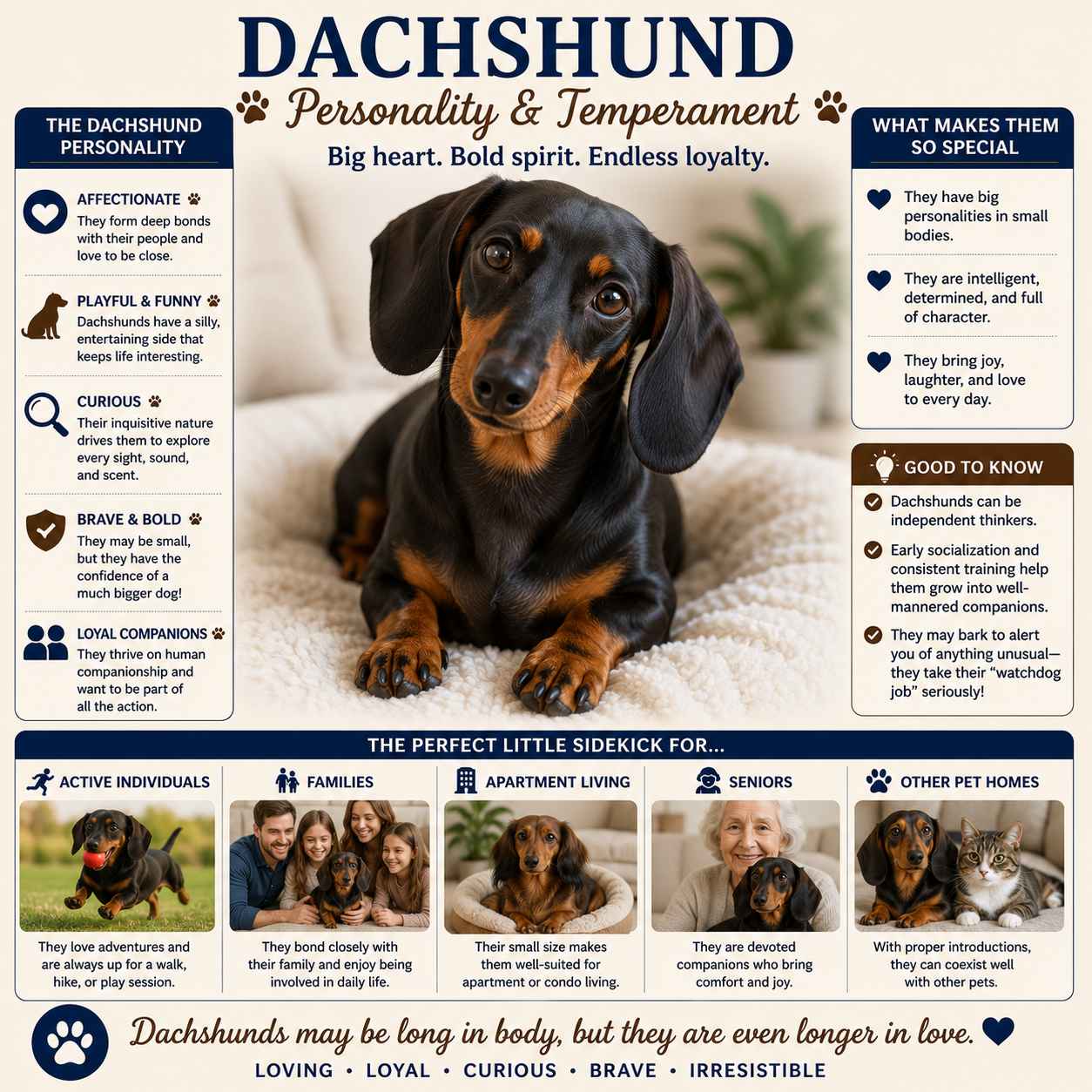
Miniature Dachshunds are typically affectionate, lively, clever, curious, courageous and alert. Many have an especially intense attachment to their families and a thoroughly Dachshund conviction that their small stature should not limit their authority.
Are Mini Dachshunds good dogs?
They can be outstanding companion dogs for the right person. They are portable, funny, devoted and usually enthusiastic about being involved in daily life. The right person also appreciates that a hound bred to work independently may bark, dig, chase, investigate smells and occasionally make its own executive decisions.
Are Mini Dachshunds aggressive?
No breed label guarantees aggression or friendliness. Genetics, pain, socialization, fear, resource guarding, learning history and handling all influence behavior.
Small-dog warning signals are sometimes ignored because a growl from a nine-pound dog seems less threatening than one from a ninety-pound dog. That can allow problems to escalate. Respect warning behavior, identify the cause and use qualified help when needed.
In Dachshunds, a sudden increase in irritability can also signal pain. A dog with neck or back discomfort may object strongly to being picked up or touched.
Are Long-Haired Mini Dachshunds calmer?
You may hear owners say Longhairs are gentler or softer than Smooths and Wires. Coat-line tendencies may exist within particular families, but coat is not a temperament guarantee. Meet the parents and ask about adult relatives rather than choosing temperament by hair length.
Do Mini Dachshunds cuddle?
Many do—enthusiastically. Burrowing under blankets and pressing against a favorite person are common owner experiences. But affection should still be consensual. A small dog does not automatically enjoy being picked up, hugged or carried whenever a human feels like it.
Are Mini Dachshunds Smart? Intelligence & Training
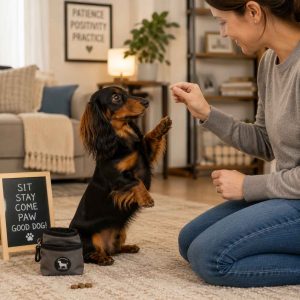
Miniature Dachshunds are intelligent dogs with an independent working style. They often learn quickly; whether they consider your request worth repeating is a separate question.
Training works best when it is rewarding, clear and practical. Food rewards are particularly useful, but sniffing, toys and access to something the dog wants can also reinforce good behavior.
Best Mini Dachshund training priorities
- Name response and attention
- Reliable recall foundations
- Loose-leash walking
- Wait at doors and curbs
- Settle on a mat
- Leave it and drop it
- Quiet behavior around common barking triggers
- Comfort with handling, nails, ears and teeth
- Using a ramp where appropriate
- Comfort being briefly separated from family members
Recall deserves special work
A Miniature Dachshund can love you enormously and still follow an exciting scent in the opposite direction. Use a long line in safe areas while building recall, and do not assume a reliable response in the living room automatically transfers to a park full of rabbits.
Avoid harsh training
Force and intimidation are unnecessary and can create fear, avoidance or defensive behavior. Short sessions, clear criteria and rewards tend to work far better with a clever dog that was historically expected to think for itself.
For more help, visit Dogs Central’s Small Dog Training Guide.
Are Mini Dachshunds Hard to Potty Train?
Some Miniature Dachshunds can be challenging to house train, but they are absolutely capable of becoming reliable. The combination of a small bladder, low body close to cold wet ground, an independent streak and human inconsistency can make the process slower than some owners expect.
How to potty train a Mini Dachshund
- Take the puppy out immediately after waking.
- Go out after meals, drinking, play and naps.
- Use frequent scheduled trips between those predictable moments.
- Go to the same general toilet area initially.
- Reward immediately after the puppy toilets outside.
- Supervise closely indoors.
- Use a puppy-safe pen or appropriately sized crate when you cannot supervise.
- Clean accidents thoroughly with an enzymatic product.
- Expand indoor freedom only after a reliable success pattern develops.
Why does rain make everything harder?
A Mini Dachshund’s chest and belly are only inches from wet grass, snow or slush. Some dogs take one look at bad weather and conclude that the indoor rug presents a more civilized solution.
A covered toilet area can help. So can a warm coat and a predictable routine. The most important step is supervision after an unsuccessful outdoor trip. Bringing the puppy inside and immediately turning it loose often produces exactly the accident you were trying to prevent.
Should I punish accidents?
No. Punishment after an accident does not teach the location you prefer and can make a puppy reluctant to toilet in front of you at all. Prevent, supervise, reward the correct location and improve your schedule.
Why is my trained adult suddenly having accidents?
House-soiling in a previously reliable adult can be medical. Urinary disease, gastrointestinal illness, pain, age-related cognitive change and other conditions should be considered rather than assuming the dog has suddenly become stubborn.
Do Mini Dachshunds Bark a Lot?
Many Miniature Dachshunds are naturally vocal. Barking is not a bizarre defect that somehow appeared in modern pets. Dachshunds are hounds whose working history included communicating with hunters around quarry and underground work.
A Mini’s bark can also sound impressively large for the body producing it.
Common Mini Dachshund barking triggers
- doorbells and deliveries;
- people in hallways;
- neighbors passing windows;
- other dogs;
- wildlife;
- excitement;
- attention-seeking;
- boredom;
- fear;
- being left alone.
How to reduce excessive barking
Start by identifying why the dog is barking. An alert bark at the window is handled differently from panic when left alone.
Helpful strategies can include visual barriers, white noise, adequate daily exercise, scent games, rewarding quiet disengagement from triggers and teaching the dog to settle away from the front door. Repeatedly yelling “quiet” can accidentally turn barking into a duet.
What about bark collars?
Because barking can reflect fear, anxiety, arousal or a legitimate need, suppressing the sound without identifying its cause is not a thoughtful first approach. Work on the trigger and teach an alternative behavior. Seek qualified behavior help for persistent barking associated with distress or aggression.
Can Mini Dachshunds Be Left Alone?
Mini Dachshunds can learn to stay alone for reasonable periods, but many are strongly companion-oriented and do not thrive when routinely isolated for very long days.
A dog that follows you from room to room is not automatically suffering from separation anxiety. The concern is inability to cope when you leave.
Teach independence before it becomes an emergency
- Let the puppy relax behind a gate or in a pen while you remain nearby.
- Move briefly out of sight and return while the puppy is still calm.
- Provide safe food enrichment where appropriate.
- Practice departures of seconds and minutes before expecting hours.
- Keep departures and arrivals calm and predictable.
Possible separation-related distress
Persistent barking or screaming, frantic scratching at exits, destructive escape attempts, drooling, pacing, house-soiling only when alone or refusing high-value food after departure can be warning signs. Severe cases deserve veterinary and qualified behavior support.
A second dog is not a guaranteed treatment. Some Minis enjoy canine companionship tremendously, but a dog distressed specifically by separation from a person may remain distressed even with another dog in the room.
How Much Exercise Does a Miniature Dachshund Need?
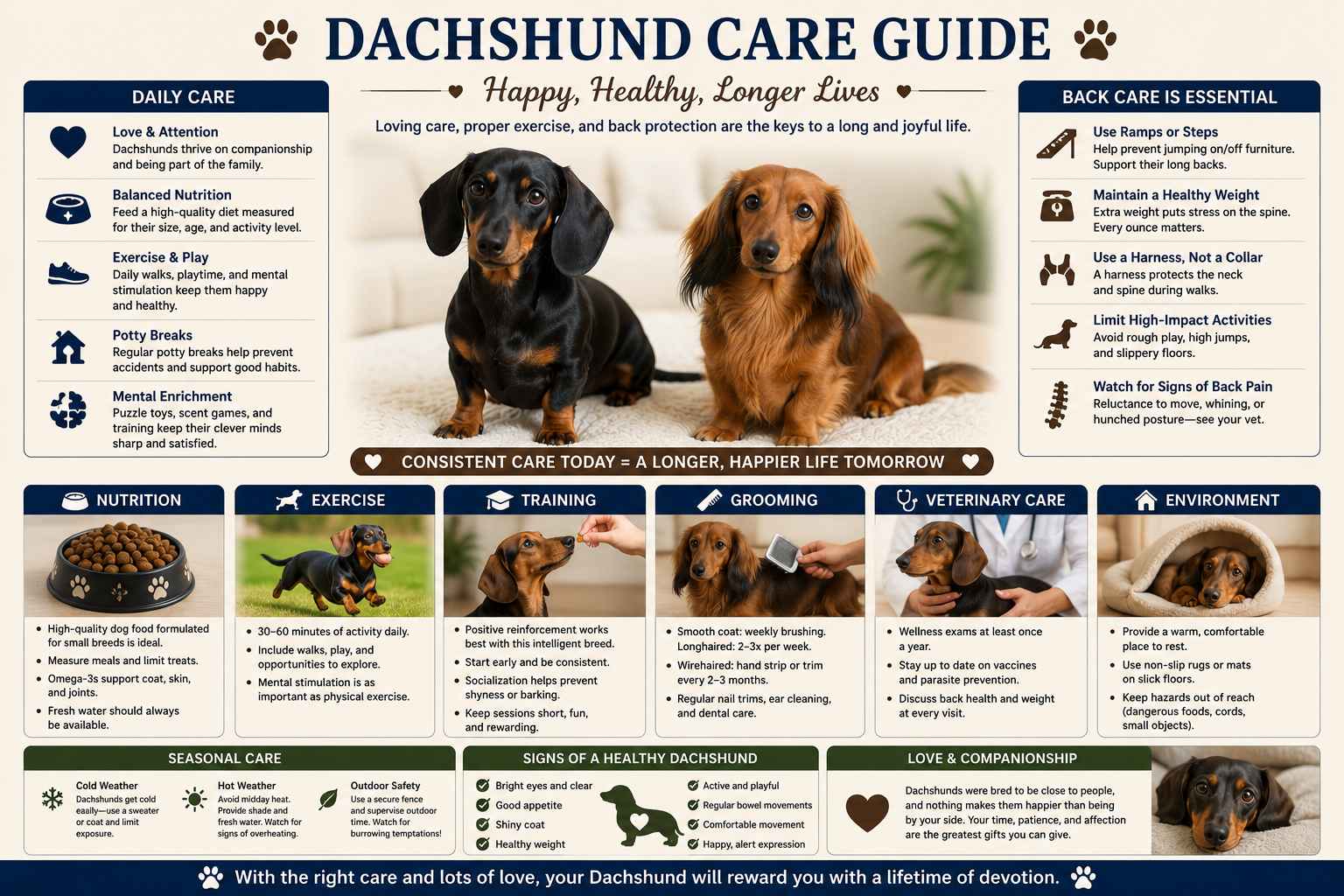
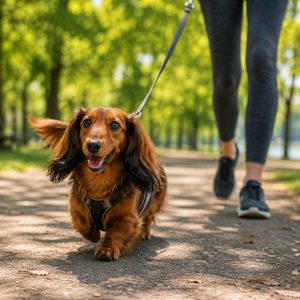
Miniature Dachshunds need regular daily exercise, even though their legs are short and their bodies are small. Appropriate activity supports healthy weight, cardiovascular health, muscle tone, confidence and mental well-being.
Many healthy adults enjoy around 30–60 minutes of activity across the day, but age, conditioning, weather, health and individual preference matter more than a rigid stopwatch target.
Sniffing counts
A ten-minute scent investigation can be more meaningful to a Dachshund than marching briskly past every interesting smell. Build walks that include both movement and time to use the nose.
Excellent Mini Doxie enrichment
- snuffle mats;
- scatter feeding in safe grass;
- hide-and-seek with treats;
- beginner scent work;
- food puzzles;
- short trick-training sessions;
- safe digging opportunities;
- toy searches;
- low-impact retrieve games;
- supervised exploration in securely fenced areas.
Can Mini Dachshunds swim?
Some can swim, but the long body and short legs do not make swimming effortless. Supervise closely, provide an easy exit and consider a properly fitted canine flotation vest around deeper water, boats or docks.
Exercise for puppies
Puppies need frequent opportunities for normal self-paced movement, exploration and play rather than forced long-distance exercise. Avoid turning spinal-health awareness into inactivity. Developing bodies still need movement and muscle.
Can Mini Dachshunds Climb Stairs? Jumping, Ramps & Back-Friendly Living
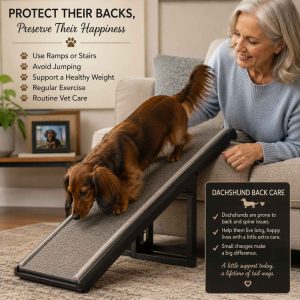
One of the most common Mini Dachshund questions is whether they should ever use stairs or jump. The useful answer is more nuanced than “never move vertically again.”
Dachshunds need normal, appropriate exercise and good muscle condition. At the same time, repeated high-impact leaps from beds, sofas or other elevated surfaces are easy to reduce and offer no special health benefit.
Practical back-friendly habits
- Use a stable ramp for frequently accessed high furniture when practical.
- Add traction to slippery floors and ramp surfaces.
- Prevent repeated launching from very high beds.
- Support both chest and hindquarters when lifting.
- Keep the dog lean.
- Provide regular exercise so supporting muscles stay conditioned.
- Ask your veterinarian about activity restrictions if your dog has known spinal disease.
Are stairs forbidden?
There is no sensible reason to panic if a healthy Dachshund encounters a step. The larger goal is managing repetitive strain, falls, slipping, excessive jumping and individual medical risk. A Mini with previous IVDD, weakness or pain may need much stricter environmental management than a healthy young adult.
How should you pick up a Mini Dachshund?
Support the front of the body and the rear so the spine remains reasonably level. Do not scoop the dog by the front legs or allow the hindquarters to hang unsupported.
Best Harness for a Mini Dachshund: Fit Matters More Than the Label
Mini Dachshunds have an unusual combination of deep chest, short legs and long torso, so generic small-dog sizing can fit poorly. A harness advertised “for Dachshunds” can still be wrong for your particular dog.
Look for a harness that:
- allows free shoulder movement;
- does not cut into the armpits;
- does not press tightly across the throat;
- is difficult for the dog to back out of;
- lies securely against the body without twisting;
- can be adjusted around the Mini’s actual chest measurements.
Measure chest girth and follow the manufacturer’s instructions rather than buying by age or breed label alone.
Harness or collar?
A properly fitted collar remains useful for identification tags. Many owners prefer a harness for leash walking because it spreads leash pressure across the body rather than concentrating it at the neck. A harness does not cure pulling, however. Loose-leash training is still important.
Mini Dachshund sweaters and clothes
Clothing is particularly useful for Smooth Minis in cold weather, but the same fitting problem applies. The garment must be long enough for the torso without hanging over the rear or restricting the front legs. Measure before buying.
Miniature Dachshund Grooming & Coat Care
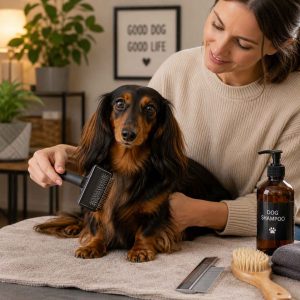
Grooming requirements depend strongly on coat type, but Miniature Dachshunds are generally less clipping-intensive than many small designer breeds.
Smooth coat
Brush about weekly, wipe dirt from the coat as needed and bathe when genuinely dirty. Smooth coats make skin monitoring simple but offer less insulation in winter.
Longhaired coat
Brush several times per week and follow with a comb to catch small tangles. Increase grooming during periods of heavier shedding or after hiking through brush and burrs.
Wirehaired coat
Brush weekly and keep the beard clean. Owners wanting traditional wire texture should ask a knowledgeable groomer about hand stripping rather than assuming clipping is the only option.
Nails
Keep nails short enough that they do not alter the dog’s stance or gait. Tiny dogs can be surprisingly opposed to nail trims, so start cooperative handling when they are young.
Ears
Check the drop ears for redness, odor, discharge, swelling or discomfort. Repeated infections need veterinary investigation rather than repeated home treatment without diagnosis.
Teeth
Tooth brushing deserves to be part of grooming from puppyhood. Miniature Dachshunds have small mouths in which dental disease can become a substantial quality-of-life problem.
See Dogs Central’s Small Dog Grooming Guide for general grooming and handling help.
Are Miniature Dachshunds Good Family Dogs? Children, Dogs & Cats

Miniature Dachshunds can be excellent family dogs when the household understands small-dog handling and the breed’s needs. They are often affectionate, playful and deeply involved in family routines.
Are Mini Dachshunds good with kids?
Many live happily with children, especially older children who can follow rules. The concern with toddlers is physical as much as behavioral. A very small long-backed dog can be injured by falling, being dropped, being squeezed or being lifted incorrectly.
Teach children to:
- let the dog move away when it wants space;
- leave sleeping and eating dogs alone;
- avoid sitting on, hugging tightly or chasing the dog;
- never pick up the dog without adult guidance;
- use calm play rather than wrestling.
Are Mini Dachshunds good with other dogs?
Often yes. Some love living with another Dachshund. Consider size and play style, because a seven-pound Mini can be accidentally injured by a much larger rambunctious dog.
Are Mini Dachshunds good with cats?
They can be, particularly when raised together and introduced thoughtfully. Individual prey drive varies. A cat that runs can activate chase behavior in a dog whose ancestors were selected to pursue quarry.
What about rabbits and rodents?
Use secure separation. A Miniature Dachshund’s small size does not erase its hunting ancestry. Friendship should never be assumed between a scent hound and a prey-sized pet.
Compare more breeds in our Best Small Dogs for Families guide.
Are Mini Dachshunds Good Apartment Dogs?

Miniature Dachshunds are physically very well suited to apartment living. They take up little space, do not need a large yard and can get adequate exercise through walks, play and enrichment.
The challenge is frequently barking rather than size.
Apartment success tips
- Teach the puppy that hallway sounds are normal.
- Reward quiet behavior after noises.
- Use window coverings if street activity triggers constant barking.
- Provide real daily walks instead of relying on indoor play alone.
- Plan frequent toilet trips during house training.
- Add non-slip runners on slick flooring.
- Use ramps for frequently accessed furniture where appropriate.
A high-rise owner should remember that getting from the apartment to the outdoor toilet area can take several minutes. Young puppies often need to be carried during urgent elevator trips until bladder control improves.
See The 10 Best Small Dog Breeds for Apartment Living for more comparisons.
Are Mini Dachshunds Good for Seniors and First-Time Dog Owners?

Mini Dachshunds for seniors
A Miniature Dachshund can be a wonderful senior companion. The dog is highly portable, generally has moderate exercise needs, fits small homes and often enjoys substantial cuddle time after a walk.
There are practical considerations. Puppies can be quick underfoot, and a Dachshund with future back trouble may need lifting or extra veterinary care. For some older adults, adopting a house-trained adult Mini with known temperament may be an especially good fit.
Read Best Small Dogs for Seniors for broader comparisons.
Mini Dachshunds for first-time owners
First-time owners can do very well with the breed if they are prepared for the hound personality. The learning curve centers on house training, barking, recall, independent behavior and spinal-health awareness.
A Mini is often easier physically to manage than a large dog, but not necessarily easier to train simply because it weighs under eleven pounds.
Miniature Dachshund Health Problems: IVDD, Back Issues & More
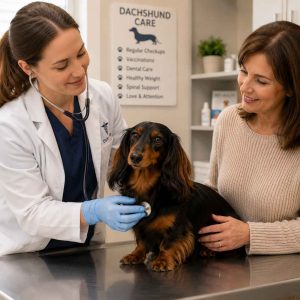
Miniature Dachshunds can enjoy long, active lives, but prospective owners should understand the breed’s health profile before bringing one home. The biggest breed-specific concern is intervertebral disc disease (IVDD).
Do Mini Dachshunds have back problems?
They are at meaningful risk. Dachshunds are a chondrodystrophic breed, and degeneration of the intervertebral discs is a major clinical problem recognized by the Dachshund Club of America.
A Mini’s smaller body does not remove the underlying breed risk.
What is IVDD?
Intervertebral discs sit between vertebrae and help stabilize and cushion the spine. When a disc degenerates and herniates, it can cause pain and potentially compress the spinal cord. Clinical severity ranges from pain without obvious weakness to major neurologic impairment and paralysis.
Warning signs that need veterinary attention
- crying out or sudden pain;
- reluctance to move;
- refusal to jump or use stairs when normally willing;
- hunched or tense posture;
- neck stiffness;
- wobbling;
- weak rear legs;
- knuckling or dragging feet;
- inability to stand;
- loss of normal bladder or bowel control.
Sudden pain, weakness or neurologic change in a Dachshund deserves prompt veterinary assessment. Do not wait for paralysis before seeking help.
Can IVDD be prevented?
No home routine can guarantee that a genetically predisposed Dachshund will never develop disc disease. Sensible habits include maintaining a lean body condition, providing regular exercise and muscle conditioning, reducing needless repetitive high-impact jumping, providing traction on slippery surfaces and seeking veterinary attention promptly when symptoms appear.
Patellar luxation
Patellar luxation occurs when the kneecap moves out of its normal groove. Signs can include intermittent skipping or briefly carrying a hind leg. Severity varies widely.
Heart disease
Cardiac examination is among the health tests recommended for Dachshund breeding stock by the national breed club through current AKC health-testing guidance. Routine veterinary examinations also help identify murmurs or changes that deserve investigation.
Eye conditions
Ophthalmologist evaluation is another recommended breeding-stock screen. Squinting, cloudiness, eye pain, persistent redness, discharge or changes in vision should be evaluated promptly.
Dental disease
The Mini’s tiny mouth can develop significant plaque and periodontal disease. Tooth brushing and veterinary dental assessment should be normal parts of care rather than afterthoughts.
Obesity
Excess body fat is especially undesirable in a long-backed breed. Weight control supports overall health and avoids adding unnecessary load to the spine and joints.
Veterinary information note: This guide provides general educational information and is not a diagnosis or substitute for veterinary care. Pain, weakness, dragging limbs, inability to walk or other sudden neurologic signs require prompt professional attention.
For general preventive-care information, visit Dogs Central’s Small Dog Health Guide.
What Health Testing Should a Miniature Dachshund Breeder Do?
Miniature Dachshunds are the same breed as Standard Dachshunds, so the national breed club’s Dachshund health-screening recommendations apply.
The current American Kennel Club Hound Group health-testing page lists the following tests recommended by the national breed club for Dachshunds:
- Patella evaluation
- Cardiac exam
- Ophthalmologist evaluation
Ask to see the actual results for the sire and dam. When testing is registered with the Orthopedic Foundation for Animals, buyers can often verify records rather than relying entirely on a breeder’s statement.
“DNA tested” is not enough by itself
DNA panels can be useful for particular variants, but they do not replace physical examinations of heart, eyes and patellas. A breeder saying “all our dogs are DNA clear” has not necessarily completed every meaningful health screen.
Ask about family history of IVDD
No breeder can guarantee an IVDD-free puppy. Nevertheless, a breeder should be comfortable discussing back problems in parents, siblings, grandparents and previous offspring rather than avoiding the subject.
Ask about dapple genetics
If a puppy is dapple—or dapple is present in the family—ask how the breeder determines the merle status of both parents and avoids double-merle pairings.
How Long Do Mini Dachshunds Live? Miniature Dachshund Lifespan
The commonly cited Miniature Dachshund life expectancy is about 12–16 years. Some dogs live beyond that range and others do not reach it. Genetics, accidents, dental health, body condition, veterinary care and disease all influence individual longevity.
Do Mini Dachshunds live longer than Standards?
It is tempting to assume that the smaller size automatically means a longer life, but the sensible expectation is the same broad Dachshund range rather than a promised lifespan based on size alone.
Helping a Mini Dachshund age well
- Keep body condition lean.
- Maintain regular dental care.
- Continue comfortable daily movement.
- Use rugs or runners when hard floors become difficult.
- Make favorite sleeping areas easier to reach.
- Pay attention to changes in thirst, appetite, sleep, mobility and house training.
- Do not dismiss new pain as simply getting old.
Do Mini Dachshunds sleep a lot?
Like most dogs, Miniature Dachshunds spend a substantial part of the day sleeping and resting, particularly after exercise or as they age. A sudden major increase in sleeping, lethargy, reluctance to move or loss of interest in normal activities can signal pain or illness and deserves attention.
Miniature Dachshund Dental Care
Dental care is particularly important in a tiny companion dog. Crowded teeth and small mouths can allow plaque and periodontal disease to become serious before owners notice obvious difficulty eating.
Begin cooperative mouth handling in puppyhood and work toward frequent brushing with dog-specific toothpaste.
Dental warning signs
- persistent bad breath;
- red or bleeding gums;
- heavy tartar;
- loose teeth;
- dropping food;
- chewing only on one side;
- facial swelling;
- reluctance to have the muzzle touched.
Dental chews may complement a care plan but do not replace brushing and veterinary assessment when disease is present.
Best Food for a Mini Dachshund: Nutrition, Feeding & Healthy Weight
The “best” food for a Miniature Dachshund is a complete and balanced diet appropriate to the dog’s life stage, health and individual needs. There is no single brand or ingredient list that is automatically best for every Mini Doxie.
What matters especially for Dachshunds is avoiding excess weight.
How much should a Mini Dachshund eat?
Portions depend on the dog’s actual weight, age, activity, reproductive status, health and the calorie density of the food. A measuring cup of one food can contain very different calories from a cup of another.
Use package guidance as a starting point, then monitor body condition. Your veterinarian can help calculate a calorie target when weight loss, weight gain or a medical diet is needed.
Mini Dachshund feeding chart
A generic feeding chart cannot account for every dog. The most useful “chart” is the nutritional information on the specific food plus ongoing assessment of the individual dog’s body condition.
Feeding Mini Dachshund puppies
Puppies should receive a nutritionally complete growth diet and meals scheduled appropriately for age. Very tiny puppies should not go excessively long without food. Follow your veterinarian’s advice if a puppy is unusually small, weak, reluctant to eat or not growing normally.
Treats count
Mini Dachshunds can be extremely persuasive about snacks. On a dog weighing only several pounds, cheese cubes, dental chews and table scraps can become a large percentage of daily calories very quickly.
Using part of the normal food allowance for training is an easy way to reward generously without accidentally feeding two dinners.
Healthy weight matters to the back
You should be able to feel the ribs without pushing through a thick fat layer, and a waist should be visible from above. A long body is breed type. A cylindrical body is excess weight.
Read our Small Dog Nutrition Guide for broader feeding information.
What Is Life With a Mini Dachshund Really Like?
A Mini Dachshund is small enough to occupy very little physical space and talented enough to occupy a surprising amount of emotional and conversational space.
Many owners wake up with a dog under the blankets, negotiate the morning bathroom trip in bad weather, take a walk that involves extensive scent research, work under close Dachshund supervision, and discover that the sofa technically has room for several people but only one preferred Mini sleeping position.
A realistic day might include:
- several toilet trips;
- one or more walks with sniffing time;
- a puzzle feeder or food-search game;
- short training sessions;
- quiet time near family members;
- tooth or grooming care;
- some alert barking that still needs management;
- burrowing into something soft whenever available.
What surprises first-time owners?
The sheer amount of dog inside such a small body. Minis can be bold, athletic, opinionated and persistent. They are not simply scaled-down lap ornaments.
Why do Mini Dachshunds shake?
Small dogs may shiver when cold, excited, worried or overstimulated. But unexplained shaking can also accompany pain or illness. In a Dachshund, trembling combined with a hunched posture, reluctance to move or discomfort when handled should be taken seriously because spinal pain is one possible cause.
Miniature Dachshund Puppies: What Prospective Owners Should Know
Miniature Dachshund puppies are in enormous demand, particularly Longhaired Minis, dapples, creams and tiny puppies advertised as expected to stay exceptionally small. High demand makes responsible buyer education essential.
What should a well-raised Mini Dachshund puppy experience?
- gentle handling of paws, ears and mouth;
- positive exposure to ordinary household sounds;
- different safe surfaces;
- age-appropriate interaction with people;
- appropriate experiences with healthy, well-behaved dogs;
- short periods away from constant human contact;
- early grooming exposure;
- foundations for toilet training;
- safe exploration and play.
Do not choose by color first
The prettiest dapple or palest cream puppy is not automatically the best match. Ask first about parent temperament, health testing, IVDD family history, puppy-rearing environment and breeder support.
Can a breeder guarantee the adult weight?
A knowledgeable breeder can make an educated prediction from family lines, but growth is biological rather than manufactured. Be skeptical of contractual-sounding promises that a puppy will finish at exactly six, seven or eight pounds.
How many puppies do Mini Dachshunds have?
Litter size varies and should not be used as a measure of breeder quality. The important questions are whether the dam and puppies receive appropriate veterinary care and whether the breeder is producing litters responsibly rather than maximizing volume.
Preparing for your puppy
Have a secure harness, appropriately sized crate or pen, non-slip surfaces, safe chew items, a veterinary appointment plan and a toilet-training schedule ready before arrival. If high furniture will be accessible, install a secure ramp before the puppy learns that launching from the sofa is a daily sport.
Our planned dedicated puppy resource is Miniature Dachshund Puppies: Finding and Choosing a Healthy Mini Doxie Puppy.
Also see the New Puppy Checklist and Preparing for a Small Dog Breed Puppy.
Mini Dachshund Names & Mini Doxie Name Ideas
The Miniature Dachshund offers almost unfair amounts of naming inspiration. You can borrow from German heritage, hunting history, the long silhouette, coat color or the dog’s comic self-confidence.
German-inspired Mini Doxie names
Otto, Fritz, Heidi, Greta, Liesel, Klaus, Hans, Frieda and Wolfgang.
Long-and-low names
Slinky, Stretch, Noodle, Link, Twiggy and Dash.
Food-inspired sausage-dog names
Pretzel, Pickle, Pepper, Brat, Schnitzel, Bean and Cocoa.
Names for cream, red and chocolate Minis
Honey, Maple, Biscuit, Ember, Rusty, Toffee, Truffle and Mocha.
For hundreds more ideas, see the Dogs Central Small Dog Names Guide. We can also build the planned dedicated Miniature Dachshund Names Guide around German, hound, sausage-dog, coat-color and personality themes.
Miniature Dachshund Breeders, Price & Puppies for Sale Near You

Searches for Mini Dachshund puppies for sale, Miniature Dachshund breeders, reputable Mini Dachshund breeders, puppies near me and particular colors are among the most common ways prospective owners find this breed. They are also the searches where buyers are most vulnerable to scams and high-volume sellers.
How much does a Mini Dachshund cost?
There is no single nationwide Miniature Dachshund price. Cost varies by region, breeder, pedigree, health testing, veterinary care, puppy-raising practices, coat and demand.
A suspiciously low price can indicate skipped care. A very high price does not prove quality. The question is not “Is this puppy expensive?” but “What responsible practices am I actually paying for?”
Why are Mini Dachshunds so expensive?
Responsible breeding has real costs: appropriate health evaluation of breeding dogs, reproductive care, veterinary treatment, quality nutrition, registration, equipment, socialization, puppy veterinary care, time and lifelong support. Fashionable color premiums, however, are not themselves evidence of responsible breeding.
Questions to ask a Miniature Dachshund breeder
- What are the parents’ mature weights?
- Can I meet the mother and see where the puppies are raised?
- What are the parents like in everyday life?
- What patella, cardiac and ophthalmic testing has been completed?
- Can the results be independently verified?
- What IVDD or significant back problems have occurred in close relatives?
- If dapple is involved, how is merle status of both parents established?
- How are the puppies socialized?
- What veterinary care will the puppy receive before leaving?
- What happens if I cannot keep the dog later in life?
Red flags
- “Teacup” or “micro” is the main sales pitch.
- Guaranteed exact adult weight.
- Many breeds and mixes always available.
- No verifiable health testing.
- Dapple-to-dapple breeding.
- Heavy “rare color” marketing with little health discussion.
- Pressure to send money immediately.
- Seller refuses reasonable live verification.
- No questions about your home or lifestyle.
- No return-to-breeder policy or long-term responsibility.
Online puppy scams
High-demand small breeds are frequent scam bait. Reverse-search photos where possible, verify the seller’s identity, insist on live interaction with the actual puppy and mother where practical, and be suspicious of sellers who can produce any color, sex and age on demand.
Dogs Central’s Responsible Small Dog Breeders & Puppies guide explains the process in more depth.
The planned Miniature Dachshund breeder showcase will live at Miniature Dachshund Breeders, separate from the educational puppy guide.
Miniature Dachshund Adoption, Rescue & Rehoming

Adoption is an excellent route to Miniature Dachshund ownership, particularly for someone who would prefer an adult with a known size, coat, temperament and activity level.
Mini Dachshunds may become available through Dachshund rescues, municipal shelters, all-breed rescues and private owner-assisted rehoming. Search several terms—Miniature Dachshund, Mini Dachshund, Doxie and Dachshund—because listings are not always labeled consistently.
Pet Rehoming Network maintains a dedicated Miniature Dachshund Adoption & Rehoming page with private-owner adoption listings when available, adoption information and help for owners who need to find a carefully matched new home for a cherished Mini Doxie.
Need to rehome a Miniature Dachshund?
Illness, housing changes, family circumstances, financial hardship and other life events can make keeping a beloved dog impossible. Thoughtful rehoming focuses on honesty about the dog’s needs, careful adopter screening and a safe transition rather than simply finding the first person willing to take the dog.
If the dog came from a breeder, contact that breeder too. Responsible breeders often require or encourage owners to involve them if a dog needs another home.
Popular Mini Dachshund Mixes
Because Miniature Dachshunds are so popular, they appear in many mixed-breed combinations. Mixed dogs can inherit any combination of body length, leg length, coat, prey drive, barking, personality and health risks from their parents.
Chiweenie — Mini Dachshund Chihuahua mix
The Chiweenie is one of the best-known Dachshund mixes. Many are tiny, affectionate and alert. Size, ear carriage, body proportions and coat vary considerably.
Doxiepoo — Dachshund Poodle mix
A Doxiepoo can inherit a curlier Poodle-influenced coat or a more Dachshund-like coat. Poodle ancestry does not guarantee a non-shedding or hypoallergenic dog.
Dorkie — Dachshund Yorkie mix
The Dorkie blends Dachshund and Yorkshire Terrier ancestry in a small companion package.
Jackshund — Dachshund Jack Russell mix
The Jackshund combines two confident hunting backgrounds and can be a busy, clever little dog.
Mauxie — Dachshund Maltese mix
The Mauxie can vary widely in coat and appearance depending on which parent’s traits are inherited.
Browse more crosses in the Small Designer Dog Breeds Guide.
Male vs. Female Miniature Dachshunds
Sex is not a reliable shortcut to temperament. Male Mini Dachshunds are not automatically cuddlier, and females are not automatically more independent. Family line, individual genetics, socialization and learning history are much more informative.
If you are choosing among puppies, describe your household and priorities to a breeder who knows the litter well. The puppy whose confidence, activity level and social style fit your home may be a better choice than choosing solely by sex or coat color.
Questions about spaying, neutering and timing should be discussed with your veterinarian in the context of the individual dog’s health and lifestyle.
Miniature Dachshund Pros & Cons
Reasons people love Mini Dachshunds
- Exceptionally compact size
- Affectionate and devoted to family
- Long potential lifespan
- Moderate exercise needs
- Three distinctive coat varieties
- Huge range of attractive colors and patterns
- Funny, expressive personality
- Good physical fit for apartments
- Bright and enjoyable to train when motivated
- Easy to travel with compared with larger dogs
Challenges to consider
- Significant IVDD and spinal-health concern
- Can bark frequently
- House training may require extra patience
- Independent hound personality
- Strong prey drive in some individuals
- Can become extremely attached to family
- Tiny size makes rough handling dangerous
- Not hypoallergenic
- Dental care is important
- Popular colors and tiny sizes attract irresponsible sellers
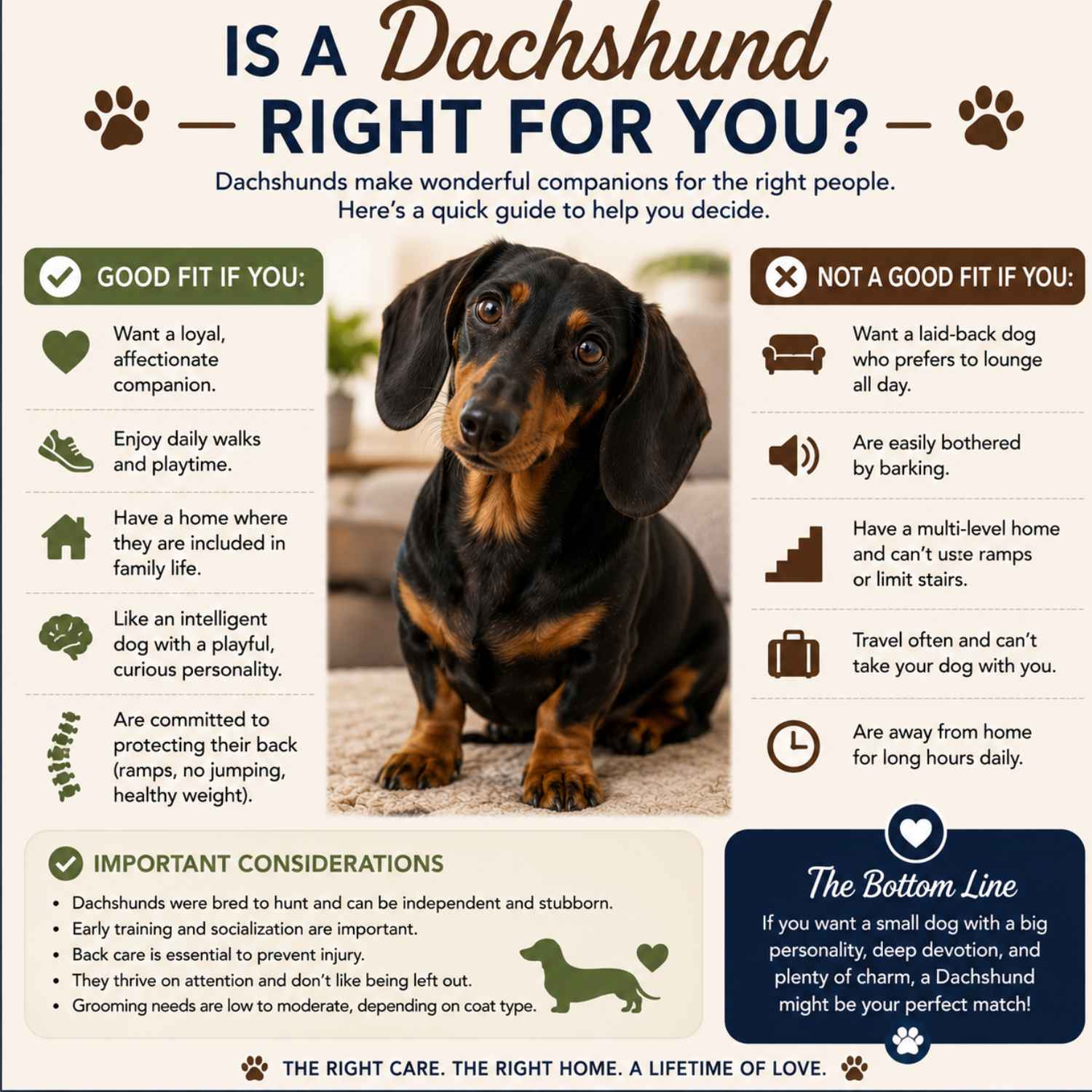
Is a Miniature Dachshund Right for You?
A Miniature Dachshund may be a wonderful fit if you want a genuinely small dog with the personality and instincts of a real working hound. This is a companion for someone who enjoys closeness but also appreciates independence, humor and a little determination.
A Mini Dachshund may suit you if:
- You want a highly portable small companion.
- You enjoy a dog with strong personality.
- You can provide daily walks, sniffing and enrichment.
- You have patience for house training.
- You are prepared to manage barking.
- You will keep the dog lean and take spinal health seriously.
- You want a dog closely involved in everyday life.
You may prefer another breed if:
- You need a naturally quiet dog.
- You need a non-shedding or hypoallergenic dog.
- The dog will spend very long days alone.
- You want effortless off-leash reliability.
- You dislike independent behavior.
- You have very rough young children and cannot supervise closely.
- You are not comfortable with the breed’s IVDD risk.
The Miniature Dachshund’s body is tiny. The commitment is not. For the right household, that compact hound can become an extraordinarily devoted member of the family for many years.
Frequently Asked Questions About Miniature Dachshunds
What is a Mini Dachshund?
A Mini Dachshund is a Miniature Dachshund, the smaller size variety of the Dachshund. In the United States, Miniatures compete in a class division for dogs weighing 11 pounds and under at 12 months of age and older.
What is a Mini Doxie?
Mini Doxie is simply a nickname for a Miniature Dachshund.
Is a Miniature Dachshund a separate breed?
No. In the United States, the Dachshund is bred and shown in Standard and Miniature sizes. Miniatures are not a separate breed from Standards.
How big does a Mini Dachshund get?
A U.S. show Miniature is 11 pounds and under at 12 months or older. Height is commonly around 5–6 inches at the shoulder, although individual pet dogs vary.
When is a Mini Dachshund full grown?
Most achieve much of their height during the first year and then continue filling out as the chest and musculature mature.
How much should a Mini Dachshund weigh?
The U.S. Miniature class division is 11 pounds and under at 12 months and older, but healthy body condition matters more than forcing every pet dog to one number.
How long is a Miniature Dachshund?
There is no official universal nose-to-tail length. Measure the individual dog when selecting clothing, harnesses, carriers or ramps.
What is a teacup Mini Dachshund?
Teacup is an unofficial marketing term, not a recognized Dachshund size variety.
What is the difference between a Mini Dachshund and a regular Dachshund?
The main formal difference is size. Miniature and Standard Dachshunds are the same breed and come in the same three coat varieties.
How long do Mini Dachshunds live?
Miniature Dachshunds commonly have a life expectancy of about 12–16 years, although individual longevity varies.
Are Mini Dachshunds hypoallergenic?
No. Mini Dachshunds shed and cannot be guaranteed allergy friendly.
Do Mini Dachshunds shed a lot?
Shedding is often manageable, but all three coat varieties shed to some degree. Longhaired dogs need more brushing, and Wirehaired coats have undercoat as well as harsh outer hair.
Do Mini Dachshunds bark a lot?
Many are naturally vocal. Dachshunds are alert hounds with a working history in which using their voice was useful.
Are Mini Dachshunds easy to train?
They are intelligent but independent. Reward-based training, consistency and good motivation work better than harsh correction.
Are Mini Dachshunds hard to potty train?
Some can be challenging. Frequent trips, supervision, immediate outdoor rewards and consistency are particularly important.
Are Mini Dachshunds good family dogs?
They can be excellent family companions, especially with respectful children who understand gentle handling of a small long-backed dog.
Can Mini Dachshunds climb stairs?
Healthy dogs can encounter stairs, but owners should reduce slipping, falls and unnecessary repetitive high-impact activity. Dogs with IVDD or other mobility problems need individualized veterinary guidance.
Do Mini Dachshunds have back problems?
They share the Dachshund breed’s important IVDD risk. Miniature size does not eliminate the concern.
Do Mini Dachshunds have fewer back problems than Standards?
Do not assume that. Both sizes belong to the same chondrodystrophic breed and require spinal-health awareness.
Can Mini Dachshunds swim?
Some can swim, but their long body and short legs do not make them natural endurance swimmers. Supervise closely around water.
Why does my Mini Dachshund shake?
Small dogs may shiver from cold, excitement or stress, but shaking can also indicate pain or illness. Trembling with reluctance to move or signs of discomfort deserves veterinary attention.
What is a dapple Mini Dachshund?
Dapple is the Dachshund term for merle patterning. It can occur in Miniature and Standard Dachshunds and is not a separate breed.
What is an English Cream Mini Dachshund?
English Cream is a descriptive term used especially for pale Longhaired Dachshunds. It is not a separate breed or size classification.
What is a split-face Mini Dachshund?
Split face is an informal appearance description for dramatic contrasting facial markings, not an official U.S. Dachshund color or pattern term.
How much does a Mini Dachshund cost?
Prices vary by location, breeder, health testing, pedigree, puppy raising and demand. A high price does not prove quality, and an unusually low price can signal skipped care or a scam.
Where can I adopt a Miniature Dachshund?
Check Dachshund rescues and local shelters and visit Pet Rehoming Network’s Miniature Dachshund Adoption & Rehoming page for owner-assisted adoption listings and rehoming information.
Final Thoughts: A True Dachshund in Miniature
The most useful thing to understand about the Miniature Dachshund is that the word Miniature changes the size, not the identity of the dog.
This is still a Dachshund: a courageous little scent hound with a history of independent work, a talent for digging, a useful voice, a tremendous nose and a deep capacity for attachment. The smaller package makes the breed exceptionally convenient for apartments, travel and close companionship, but it does not erase the need for training, exercise, dental care, careful weight management or lifelong awareness of spinal health.
If you choose a puppy, put health, structure and temperament ahead of color and extreme tiny size. If you adopt an adult, appreciate the advantage of knowing exactly what size, coat and personality you are bringing home.
For owners who genuinely enjoy the Dachshund personality, a Mini Doxie can be one of the funniest, most affectionate and most memorable little companions imaginable.
Trusted Miniature Dachshund Resources
- Dachshund Club of America: National breed club, Dachshund breed standard, and IVDD information.
- American Kennel Club: Dachshund breed information and current Hound Group health-testing recommendations.
- Orthopedic Foundation for Animals: Health-testing information and searchable records.
- The Royal Kennel Club: Miniature Dachshund information and UK breed-standard guidance.
- Dogs Australia: Dachshund breed-standard information for Australia.
Breed information can help you prepare, but online content cannot examine an individual dog. Discuss health, diet, pain, mobility, growth and reproductive questions with your veterinarian.
About This Miniature Dachshund Guide
Dogs Central has been helping dog lovers learn about companion dogs since 2002. This Miniature Dachshund guide is part of our growing library of detailed small-dog resources designed for prospective owners, puppy buyers, adopters and people already sharing their lives with little dogs.
This page is intended to grow. Future Mini Dachshund resources can include a dedicated puppy guide, breed-specific names, a breeder showcase, harness recommendations, feeding and nutrition, Longhaired Miniature Dachshunds, coat colors and patterns, owner experiences and new original images and infographics.