
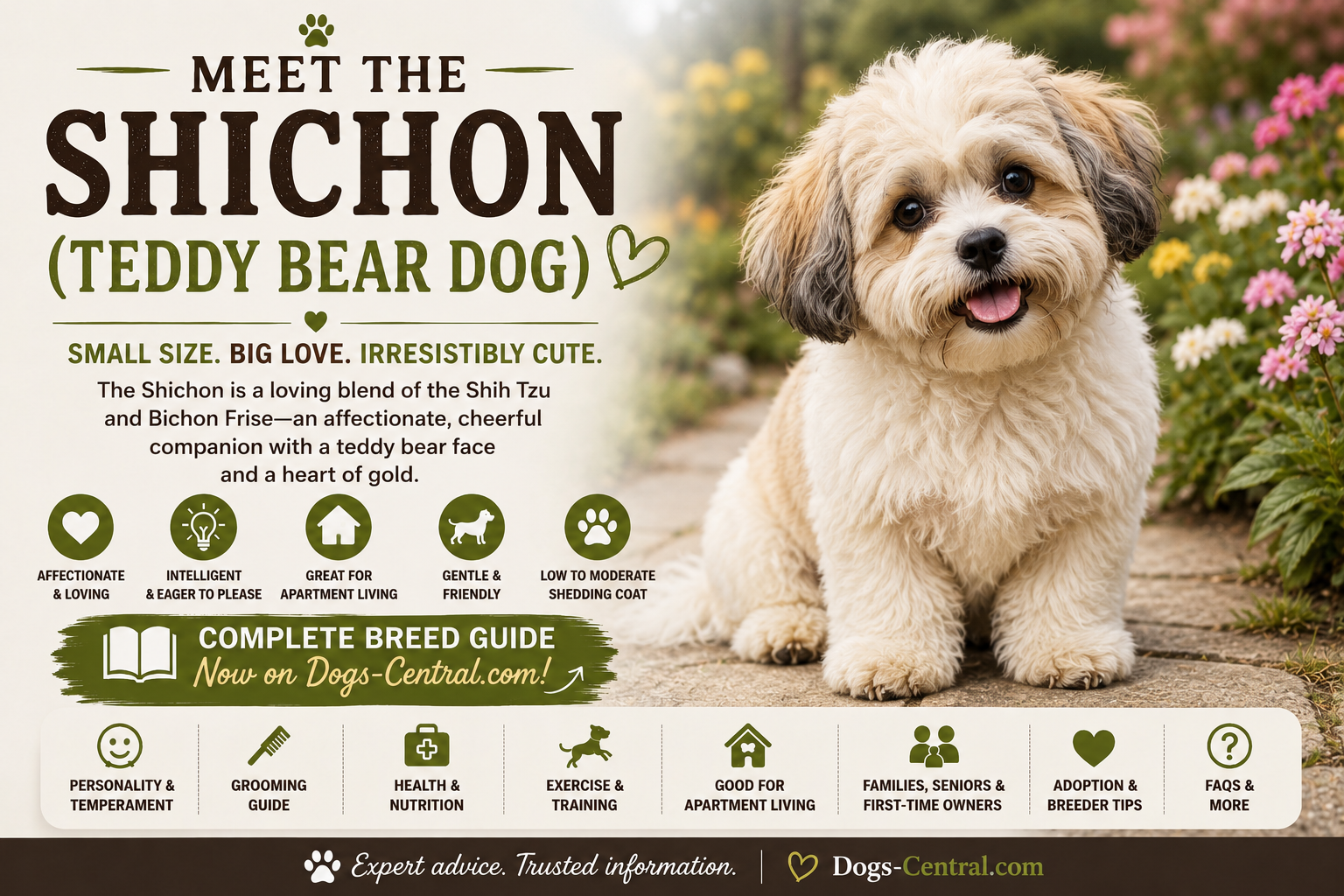
Fluffy, affectionate and famously teddy-bear-like, the Shichon is a small companion dog created by crossing a Shih Tzu with a Bichon Frise. Also called a Zuchon, Shih Tzu Bichon mix, Bichon Shih Tzu mix and—very commonly—a Teddy Bear Dog, this cheerful little cross has become popular with people looking for a sociable small dog with a soft coat and a strong desire to be part of family life.
The nickname deserves one immediate clarification: “Teddy Bear Dog” is not one standardized breed. It is an informal term used for several small, fluffy purebreds and mixes. The Shichon is one of the dogs most strongly associated with the name, thanks to its round-eyed expression, soft coat and characteristic rounded grooming styles.
Shichons are often loving, playful, people-oriented and adaptable, but they are designer crossbreeds rather than standardized purebred dogs. Adult size, coat texture, shedding, appearance and temperament can vary—even among puppies from the same litter. Anyone considering a Shichon should understand both the Shih Tzu and the Bichon Frise, because a puppy can inherit traits from either side of the family.
This complete Dogs Central guide covers the questions people most often ask about Shichon dogs and Teddy Bear Dogs: full-grown size, temperament, coat colors, shedding, allergy considerations, grooming and haircuts, training, exercise, health, lifespan, feeding, puppies, breeders, price, adoption and what it is really like to live with one.
Shichon at a Glance
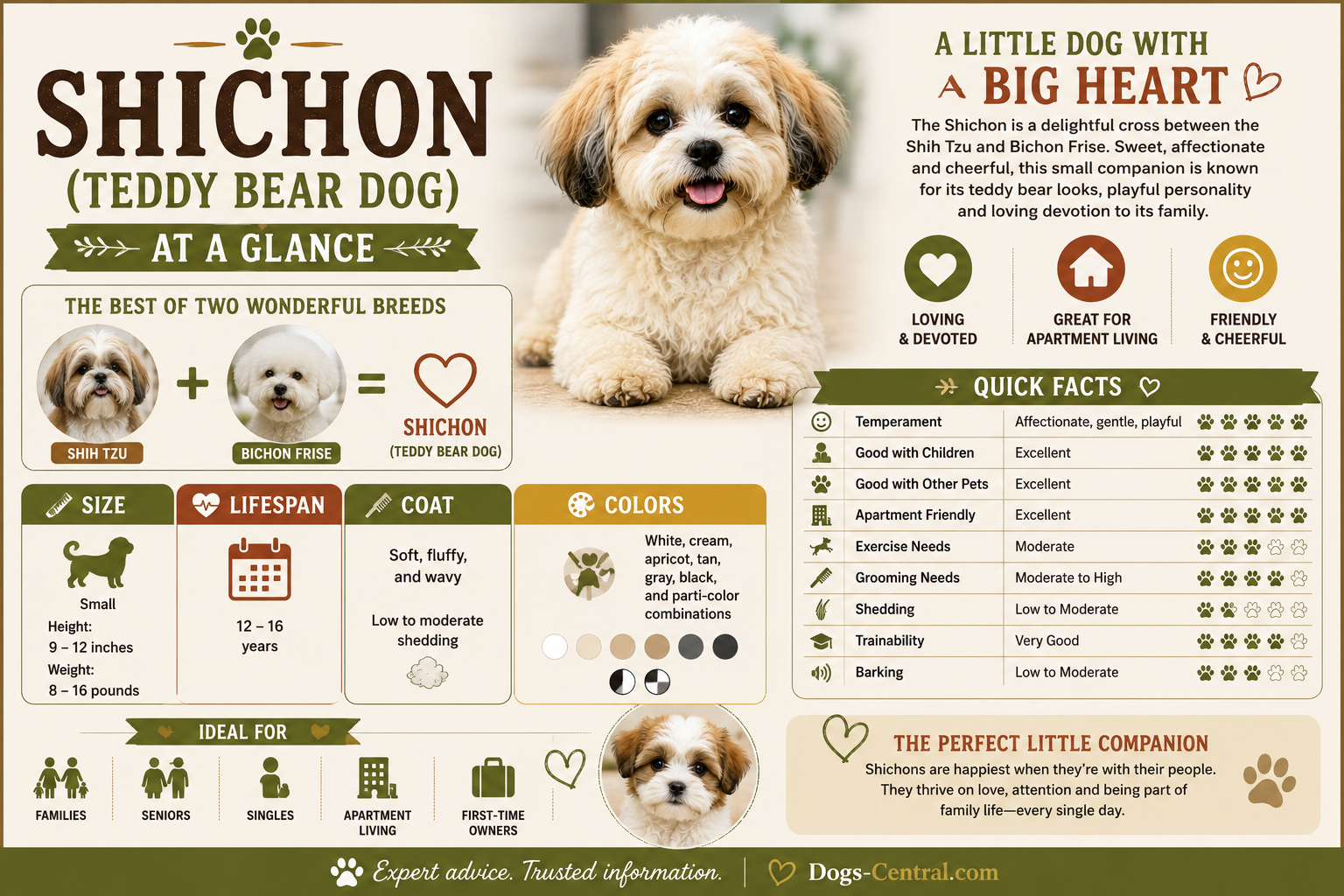
| Other names | Zuchon, Shih Tzu Bichon mix, Bichon Shih Tzu mix, Teddy Bear Dog |
|---|---|
| Parent breeds | Shih Tzu × Bichon Frise |
| Breed type | Designer crossbreed / small companion dog |
| Typical adult height | Often about 9–12 inches, with individual variation |
| Typical adult weight | Often about 8–16 pounds, with individual variation |
| Coat | Soft; may be wavy, curly, straighter or a blend |
| Common colors | White, cream, apricot, tan, brown/chocolate, black, gray, sable and multicolor combinations |
| Shedding | Usually low, but not zero and not perfectly predictable |
| Hypoallergenic? | No dog is completely hypoallergenic; some Shichons may be easier for some allergy sufferers than heavier-shedding breeds |
| Grooming | High: frequent brushing plus regular trimming/professional grooming |
| Exercise | Moderate; walks, play and mental enrichment |
| Trainability | Generally good with positive, consistent training |
| Apartment friendly | Often very good, provided exercise and barking are managed |
| Typical lifespan | Often approximately 12–16 years; individual longevity varies |
| Best suited to | People seeking an affectionate, interactive small companion and willing to keep up with grooming |
A Shichon is a crossbreed, so these figures describe common tendencies rather than a breed standard. A responsible breeder should never guarantee an exact adult weight, perfectly non-shedding coat or particular temperament.
What Is a Shichon Dog?
A Shichon is a Shih Tzu Bichon Frise mix. The name is usually pronounced “shee-shon,” although owners use several variations. You may also encounter Zuchon, Bichon Shih Tzu, Shih Tzu Bichon mix and Teddy Bear Dog.
The Shichon is not an AKC-recognized purebred breed and does not have one official standard controlling size, coat or appearance. That is not a criticism; it simply means prospective owners should expect more variation than they would within a carefully bred established breed.
An individual Shichon may inherit the Bichon’s buoyant, curly coat and outgoing manner, the Shih Tzu’s longer flowing coat and companion-focused personality, or a mixture of both. Genetics do not split themselves neatly down the middle.
F1, F1b and Multigenerational Shichons
An F1 Shichon generally has one purebred Shih Tzu parent and one purebred Bichon Frise parent. “F1b” usually means a first-generation Shichon has been bred back to one of the parent breeds. F2 and multigenerational labels describe other ancestry combinations.
Those labels can help describe pedigree, but they do not guarantee a particular coat, allergy response, adult size, health outcome or personality. Ask about the actual dogs behind the pedigree and the health testing performed on them.
Explore the Small Designer Dog Breeds Guide
Is a Shichon the Same as a Teddy Bear Dog?
A Shichon is commonly called a Teddy Bear Dog, but “Teddy Bear Dog” does not refer to one single breed. This is important because searches for teddy bear dogs often lead to photographs of several different dogs that share a fluffy, round-faced appearance.
The term can be applied to Shichons and other small companion dogs or mixes, especially when groomed with a rounded face, soft ears and plush body coat. A puppy advertised simply as a “teddy bear puppy” should therefore come with a clear explanation of its actual parentage.
For Shichons, the teddy-bear look usually comes from the combination of expressive dark eyes, facial hair, a soft coat and grooming that rounds the muzzle and head. Coat texture can still vary considerably.
Why the Distinction Matters
If you are buying a puppy, “Teddy Bear Dog” tells you very little about ancestry or health. Ask whether the puppy is actually a Shih Tzu × Bichon Frise cross, request information about both parents and evaluate the breeder’s health-testing and puppy-raising practices. A cute marketing name should never replace a pedigree and responsible breeding information.
Shichon Origin & Parent Breeds
There is no well-documented single founder or universally accepted date for the Shichon. Shih Tzus and Bichon Frises may have been crossed informally long before the designer-dog era, while deliberate breeding and the names Shichon and Zuchon became increasingly visible as small companion crosses grew in popularity.
Rather than repeating an unsupported creation story, the most useful way to understand the Shichon is to know the two established breeds behind it.
The Shih Tzu Parent
The Shih Tzu is an ancient companion breed developed to live closely with people. Shih Tzus are generally affectionate, outgoing and comfortable with a relatively modest exercise routine. Their long, dense coat requires substantial maintenance, and their short-faced anatomy can influence heat tolerance, eyes, teeth and breathing.
The Bichon Frise Parent
The Bichon Frise is a cheerful small companion famous for its white, soft, curly coat and sociable nature. Bichons are typically lively without being extreme athletes and often enjoy training, play and close involvement with their families.
What Can a Shichon Inherit?
A Shichon can inherit the people-oriented nature common to both parents, which helps explain the cross’s popularity as a companion. But prospective owners should also be prepared for grooming, dental care, possible separation-related behavior and health vulnerabilities from either family line.
What Does a Shichon Look Like?
Most Shichons are compact, sturdy little dogs with dark expressive eyes, drop ears and a soft coat that gives them their famous stuffed-animal appearance. Beyond that broad description, there can be considerable variation.
Some have a curlier, more Bichon-like coat and slightly leggier outline. Others have straighter or gently wavy hair, a more distinctly Shih Tzu-like face and heavier furnishings around the ears and muzzle. Many fall somewhere between the two.
The muzzle may be longer than that of a typical Shih Tzu, but this is not guaranteed. A less extremely shortened muzzle can be desirable from a functional standpoint, yet no breeder should claim that crossing automatically eliminates every breathing concern associated with short-faced ancestry.
Do Shichons Change Color?
They can. Puppy coats may lighten, deepen or change pattern as adult hair develops. A puppy with darker ears or markings may become much lighter with maturity, particularly where fading genes are present in the family. Choose a puppy for health and temperament rather than expecting its eight-week color to remain identical for life.
Full-Grown Shichon Size & Weight
Most full-grown Shichons are small dogs, commonly around 8–16 pounds and roughly 9–12 inches tall. Some adults fall outside those ranges because the Shichon is not standardized and the size of the actual parents matters.
If adult size is important to you, ask for the mature weights and heights of both parents and, ideally, close relatives from previous litters. Those figures are more useful than a seller’s promise that a puppy will be exactly ten pounds.
When Is a Shichon Full Grown?
Most small dogs complete the majority of skeletal growth during their first year, although coat, muscle and overall maturity continue developing afterward. A veterinarian can tell you whether an individual puppy is growing appropriately.
Mini, Toy and Teacup Shichons
“Teacup Shichon,” “mini Shichon” and similar terms are marketing language, not officially recognized Shichon sizes. Deliberately pursuing extreme tininess can increase fragility and make issues such as dental crowding and low blood sugar in very small puppies more concerning.
Healthy structure and temperament should matter more than producing the smallest possible dog.
Shichon Temperament & Personality
Shichons are commonly affectionate, cheerful, playful and highly people-oriented. Many seem happiest when they are included in whatever the family is doing, whether that means a neighborhood walk, a game on the living-room floor or supervising someone working at a desk.
Both parent breeds were developed primarily for companionship, so a strong interest in humans is unsurprising. A well-socialized Shichon often greets familiar people enthusiastically and can be friendly with visitors. Individual dogs vary, however, and genetics plus early experiences influence confidence.
Are Shichons Cuddly?
Many are. The Shichon’s popularity as a lap dog is not based only on appearance. These dogs often seek physical closeness and enjoy settling beside or on their people. Still, every dog should be allowed to choose when it wants contact rather than being treated like a stuffed toy.
Are Shichons Calm?
Adults often have a pleasant balance between playfulness and relaxation, but puppies can be busy, silly and energetic. “Calm” should not be confused with inactive. Daily walks, play, training and enrichment help a Shichon settle appropriately indoors.
Are Shichons Smart?
Usually. Both parent breeds can learn quickly, especially when training is rewarding. Shichons are often excellent candidates for tricks, manners and interactive games. They can also learn accidental lessons with impressive speed—such as barking to make a person pick them up.
Male vs. Female Shichon Temperament
There is no reliable rule that every male will be more affectionate or every female more independent. Individual genetics, early socialization, training and life experience matter far more. Choose the puppy or adult whose temperament best suits your household rather than selecting by sex alone.
Are Shichons Good Family Dogs?
Shichons can be excellent family companions when their need for companionship, grooming and respectful handling fits the household. Their moderate size makes them easier to manage than many larger breeds while still giving them a little more physical substance than the tiniest toy dogs.
Are Shichons Good With Children?
Many are affectionate with children, particularly when raised around kind, dog-savvy youngsters. “Good with children,” however, should never mean a dog is expected to tolerate pulling, squeezing, chasing or being disturbed while sleeping or eating.
Adults should supervise young children and teach them to interact on the floor rather than carry the dog. Give the Shichon a quiet retreat where children do not follow.
Are Shichons Good With Other Dogs?
Often, yes. Early positive socialization helps. Match playmates by play style and supervise large size differences; even a friendly large dog can accidentally injure a small companion during rough play.
Can Shichons Live With Cats?
Many can coexist very successfully with cats. Introduce slowly, prevent chasing and provide elevated escape routes and dog-free spaces for the cat.
Other Small Pets
Individual prey interest varies. Birds, rabbits, rodents and other small animals should be protected through thoughtful management rather than assuming the Shichon’s friendly reputation guarantees safety.
Compare the Best Small Dogs for Families
Shichon Training & Housebreaking
Shichons usually respond very well to positive, reward-based training. They tend to enjoy interaction and can be motivated by tiny food rewards, toys, praise and access to things they like.
Begin with practical life skills: name response, recall, leash walking, settling on a mat, polite greetings, leaving objects, comfortable grooming and being relaxed for brief periods away from you.
Are Shichons Easy to Potty Train?
Some are straightforward; others require patience. Small dogs have small bladders, and owners sometimes miss subtle signs that a puppy needs to go outside.
Take a puppy to the toilet area after waking, eating, drinking and active play, plus frequent trips in between. Reward successful toileting immediately. Closely supervise indoors and use an enzymatic cleaner on accidents. Punishment after an accident can create anxiety without teaching the correct location.
Crate Training
A crate can be useful for safe transport, sleep and short-term management when introduced positively. It should not become the dog’s primary living environment. Shichons are social companion dogs that need movement, play, learning and meaningful interaction.
Socialization
Good socialization means positive, age-appropriate exposure to normal life: visitors, household sounds, vacuum cleaners, grooming tools, children at a safe distance, traffic, different surfaces, friendly dogs, car travel and veterinary handling. The goal is confidence, not overwhelming the puppy with as many experiences as possible.
Explore Small Dog Training Resources
Barking, Attachment & Separation Anxiety
Shichons are not generally known as relentless barkers, but individuals can become vocal when excited, bored, worried or alerting to noises. Apartment hallways, windows and doorbells are common triggers.
Reward calm behavior before barking escalates, reduce unnecessary visual triggers and teach a positive routine for visitors. Yelling “quiet” repeatedly often adds excitement rather than teaching calmness.
Can Shichons Be Clingy?
Yes. A strong desire for human companionship is one of the cross’s attractions, but it can become excessive if the puppy never learns to relax independently. Encourage naps away from your lap, food toys enjoyed alone and very brief comfortable separations from puppyhood.
Can a Shichon Be Left Alone?
Adults vary, but Shichons generally are not ideal for households where the dog will routinely be alone for very long days. Puppies need frequent toilet breaks and social contact. Build alone-time gradually rather than abruptly expecting a newly arrived puppy to cope with hours of isolation.
Persistent howling, frantic escape attempts, destruction around exits, drooling or inability to settle when alone can indicate a genuine separation-related problem. Severe cases deserve help from a veterinarian and qualified behavior professional.
Explore Small Dog Behavior Resources
Shichon Coat Types & Colors
One reason Shichon photographs look so varied is that the parent coats are different. The Bichon has a curly double coat, while the Shih Tzu carries a long, dense coat with a different texture and fall. A Shichon can inherit a coat anywhere along that spectrum.
Common Shichon Coat Types
- Curly: more strongly reminiscent of the Bichon and often very plush when clipped.
- Wavy: a common-looking middle ground that creates the classic soft teddy-bear appearance.
- Straighter: may show more obvious Shih Tzu influence and can grow long if not clipped.
Coat texture can change between puppyhood and adulthood, so the coat you see at eight weeks is not a guaranteed preview of the mature dog.
Shichon Colors
Shichons may be white, cream, apricot, gold/tan, brown or chocolate, black, gray, sable or combinations of these colors. White dogs with colored ears or facial markings are especially common in photographs, but there is no “best” Shichon color.
Some markings fade considerably with age. Color should be treated as an enjoyable cosmetic trait—not a reason to overlook health, temperament or breeder quality.
Do Shichons Shed? Are Shichons Hypoallergenic?
Shichons are usually low-shedding dogs, but they are not guaranteed to be hypoallergenic. This is one of the most important distinctions for prospective owners.
Both parent breeds are often chosen by people who dislike loose hair, so many Shichons release relatively little visible coat into the home. Loose hair can remain trapped within the coat, however, which contributes to matting and increases the need for brushing.
Can You Still Be Allergic to a Shichon?
Yes. Dog allergies can involve proteins associated with dander, saliva and urine, not simply loose hair. An individual person’s reaction can differ from dog to dog.
If allergies are central to your decision, spend meaningful time with the actual adult dogs or puppy before committing when possible. Do not rely on a breeder’s guarantee that an F1b, curly coat or “hypoallergenic line” cannot trigger allergies.
Read the Dogs Central Guide to Hypoallergenic Small Dogs
Shichon Grooming & Haircut Styles
Low shedding does not mean low maintenance. Shichons commonly need substantial coat care because soft hair tangles and mats easily, especially behind the ears, under the legs, around the collar or harness and anywhere moisture or friction occurs.
How Often Should You Brush a Shichon?
For a longer coat, daily or near-daily combing is often the easiest way to prevent mats. A short clipped coat may be manageable with brushing several times weekly. Brush all the way to the skin in small sections rather than skimming over the top layer while tangles tighten underneath.
How Often Does a Shichon Need Professional Grooming?
Many owners schedule grooming approximately every six to eight weeks, although coat length, texture and the chosen haircut change the interval. Dogs kept in a short practical trim may be easier for busy families to maintain.
Popular Shichon Haircuts
- Teddy bear cut: rounded face with a soft, even body length—the style most associated with the “Teddy Bear Dog” nickname.
- Puppy cut: a practical shorter trim kept fairly even over the body.
- Longer natural style: preserves more flowing coat but requires much more frequent brushing and combing.
- Short summer/practical trim: reduces daily coat work, although skin still needs sun and heat protection.
- Rounded face with shorter body: keeps the signature Shichon expression while making the body easier to maintain.
Bring photographs to the groomer because names such as “puppy cut” and “teddy bear cut” can mean different lengths to different people.
Face, Eyes and Ears
Keep facial hair clean and comfortably trimmed around the eyes. Persistent tearing, redness, squinting, odor or discharge deserves veterinary attention rather than being treated as merely cosmetic.
Nails and Handling
Trim nails regularly and begin cooperative grooming exercises early. Touch paws, lift ears, look at teeth and introduce brushes and dryers gradually with rewards. A lifetime of grooming is much easier when the dog views handling as predictable and safe.
Explore Small Dog Grooming Resources
Shichon Exercise & Enrichment
Shichons usually have moderate exercise needs. Many adults thrive with daily walks plus indoor play and mental activity rather than hours of strenuous exercise.
Think in terms of a balanced day rather than a stopwatch. A healthy adult may enjoy several outings totaling roughly 30–45 minutes, but age, weather, health and individual energy level matter more than a rigid number.
Good Activities for a Shichon
- Sniffing walks
- Gentle fetch
- Hide-and-seek
- Food puzzles and snuffle mats
- Short trick-training sessions
- Searching for hidden treats
- Visits to safe dog-friendly places
- Calm play with compatible dogs
Mental enrichment is especially useful for a companion dog that spends much of the day indoors. Five or ten minutes of scent work or training can be more satisfying than simply circling the same block again.
Heat and Exercise
Some Shichons inherit a relatively shortened muzzle from the Shih Tzu side. Be conservative with strenuous activity in hot, humid weather and watch the individual dog’s breathing and recovery. Walk during cooler parts of the day and provide water and shade.
Are Shichons Good Apartment Dogs?
Shichons are often excellent apartment dogs. Their small size and moderate exercise requirements mean they do not need a large yard, provided their physical and mental needs are met in other ways.
The bigger considerations are barking, house-training and companionship. Hallway footsteps and neighboring doors can trigger alert barking, while a young puppy may need toilet trips more frequently than is convenient in a high-rise.
Teach calm responses to building noises early and have a realistic toileting plan. An apartment is not too small for a Shichon; a lifestyle with too little interaction or enrichment can be.
Compare the Best Small Dogs for Apartments
Are Shichons Good Dogs for Seniors?
Shichons can be outstanding companions for seniors who want an affectionate small dog and are comfortable with the grooming commitment. Their manageable exercise needs, portable size and enjoyment of close companionship are significant advantages.
There are practical considerations. Grooming appointments and dental care add ongoing expense. Puppies can be underfoot and require frequent trips outside. For someone with mobility or balance limitations, a calm adult Shichon with established house manners may be a better fit than an energetic puppy.
When choosing a dog for an older adult, temperament and lifestyle match matter more than simply choosing the smallest puppy available.
Explore the Best Small Dogs for Seniors
Are Shichons Good for First-Time Owners?
Often, yes. Their companion-focused nature, moderate exercise requirements and willingness to engage with people can make Shichons approachable for new dog owners.
The catch is grooming. First-time owners sometimes underestimate how quickly a soft low-shedding coat can mat. House-training and alone-time training also need consistency from the beginning.
A new owner willing to learn positive training, maintain the coat, provide dental care and socialize the puppy thoughtfully can find the Shichon a very rewarding first dog.
Compare Small Dogs for First-Time Owners
Shichon Health Issues & Responsible Health Testing
Shichons can be healthy, long-lived dogs, but crossing two breeds does not automatically erase inherited disease. A puppy can inherit vulnerabilities present in either the Shih Tzu or Bichon Frise family.
Potential issues worth discussing with a veterinarian include dental disease, luxating patellas, eye disorders, allergies or skin problems, orthopedic disease and urinary problems. A Shichon that inherits a particularly shortened muzzle may also have more difficulty with heat or breathing than a dog with a more moderate face.
Patellar Luxation
Small dogs can develop kneecaps that slip out of their normal groove. Signs may include skipping, briefly carrying a hind leg or intermittent lameness. Severity varies, and persistent symptoms deserve veterinary assessment.
Eye Problems
Both parent breeds have eye-health considerations. Watch for squinting, redness, cloudiness, excessive discharge, rubbing or sudden vision changes. Hair should be kept from constantly irritating the eye surface.
Allergies and Skin Disease
Bichons can be affected by skin problems and allergies, and Shichons may also experience itching, recurrent ear problems or skin inflammation. Chronic scratching should be investigated rather than repeatedly covered up with shampoos or diet changes without a diagnosis.
Urinary Problems
Bichon health literature identifies bladder stones among important breed concerns. Straining to urinate, frequent attempts, blood in urine or inability to pass urine requires prompt veterinary attention; inability to urinate can be an emergency.
Hip and Orthopedic Concerns
Although Shichons are small, orthopedic health still matters. Bichon breeding recommendations have historically included hip evaluation along with patella and eye screening. Ask what testing was performed on the actual parents rather than assuming small dogs cannot have hip problems.
Breathing and Heat Tolerance
Shih Tzus are brachycephalic, or short-faced. A Shichon’s muzzle length varies, but dogs with shorter faces deserve particular care in hot weather and should not be selected for increasingly extreme facial shortening.
What Health Tests Should Shichon Breeders Do?
There is no single universally mandated Shichon testing program, so responsible breeders should use the health recommendations for both parent breeds as their starting point. Meaningful testing may include orthopedic, patella and eye evaluations and other tests relevant to the family lines.
Ask for the registered names of the parents and independently verify available results through the Orthopedic Foundation for Animals (OFA). “Vet checked,” “health guaranteed” and “DNA tested” are not equivalent to a thoughtful program of breed-appropriate health screening.
This guide provides general educational information and cannot diagnose an individual dog. New or concerning symptoms should be discussed with your veterinarian.
Explore Small Dog Health Resources
How Long Do Shichons Live?
Many Shichons live approximately 12–16 years, although no lifespan range can predict an individual dog’s longevity.
Both parent breeds are small companion dogs with the potential for long lives. Genetics matter, but so do maintaining a healthy weight, regular veterinary care, dental care, exercise, good nutrition and prompt attention to new symptoms.
Helping a Shichon Stay Healthy Into the Senior Years
- Keep the dog lean and active.
- Brush teeth consistently and obtain veterinary dental care when needed.
- Maintain regular wellness examinations.
- Keep coat, skin, eyes and ears comfortable and monitored.
- Adjust exercise as mobility and stamina change.
- Investigate new thirst, urinary changes, limping, coughing, weight loss or behavior changes rather than assuming they are “just old age.”
Shichon Dental Care
Dental care is one of the least glamorous but most important parts of owning a Shichon. Small jaws can crowd teeth, and periodontal disease can become painful and advanced long before an owner notices an obvious problem.
Daily tooth brushing with dog toothpaste is ideal. Start gradually, reward cooperation and ask your veterinarian to examine the mouth during routine visits. Human toothpaste should not be used.
Bad breath, red or bleeding gums, loose teeth, reluctance to chew, dropping food or facial swelling deserve veterinary attention. Puppies should also be checked for retained baby teeth as the adult teeth erupt.
Shichon Nutrition & Feeding
Shichons need a complete and balanced diet appropriate for their life stage, body condition and health. Because they are small, even modest amounts of extra food and treats can add up quickly.
How Often Should a Shichon Eat?
Many healthy adults do well with two measured meals per day. Puppies generally need more frequent meals while growing. Very young or unusually tiny puppies may need individualized feeding advice from the breeder and veterinarian.
How Much Should a Shichon Eat?
There is no responsible universal cup measurement because foods differ dramatically in calorie density. Start with the feeding guidance for the chosen food, assess body condition and adjust with veterinary guidance.
Preventing Weight Gain
You should generally be able to feel the ribs beneath a light covering and see a waist from above. A fluffy coat can disguise weight gain, so use your hands rather than judging by silhouette alone.
Keep training treats tiny. A Shichon does not need a biscuit the size intended for a retriever to understand that it did something brilliant.
Explore Small Dog Nutrition & Feeding
What Is It Really Like Living With a Shichon?
Life with a well-adjusted Shichon tends to be highly interactive. These dogs often want to know where their people are, what they are doing and whether there might be room for one small fluffy supervisor.
A typical adult may enjoy a morning walk and breakfast, snooze while the household works, wake for play or a training game, patrol the window for neighborhood developments and settle happily beside the family in the evening.
The coat is the recurring practical job. Brushing cannot be postponed indefinitely without consequences. The other major responsibility is making sure affection does not become dependence: a Shichon should be loved generously while still learning that it is safe to rest alone.
Everyday Safety
- Use a well-fitted harness for walks.
- Supervise interactions with larger dogs.
- Protect puppies from falls from high furniture.
- Check mats before they tighten against the skin.
- Use caution with heat, particularly in shorter-faced individuals.
- Keep identification and microchip information current.
Explore the Small Dog Care Guide
Shichon Puppies: What Prospective Owners Should Know
Shichon puppies are appealing precisely because they look so much like plush toys—but they need to be raised as confident dogs. The first months should include household life, gentle handling, play, learning, safe exploration and plenty of sleep.
What a Well-Raised Shichon Puppy Should Experience
Age-appropriate exposure to vacuum cleaners, doorbells, visitors, grooming tools, car rides, different surfaces, friendly animals and ordinary indoor and outdoor sounds helps prepare a puppy for family life. Socialization should be positive and controlled rather than overwhelming.
Grooming Starts in Puppyhood
Because grooming will be lifelong, introduce brushing, combing, face handling, paw handling and the sounds of clippers or dryers gradually. Waiting until the puppy is badly matted before its first serious grooming session makes the experience harder for everyone.
Puppy Coat vs. Adult Coat
A Shichon’s adult texture and color may not be obvious in a young puppy. Soft puppy hair can mature into a curlier, wavier or straighter coat, and markings can fade. Be skeptical of guarantees about a puppy’s final coat or exact degree of shedding.
Shichon Puppy Names
The teddy-bear appearance invites playful names such as Teddy, Paddington, Mochi, Biscuit, Winnie, Coco, Pippin, Honey, Bear, Buttons, Maple, Maisie, Archie and Benny. A dedicated Shichon names guide can go much deeper into color, personality and teddy-bear-inspired ideas.
Planned supporting guide: Shichon Puppy Guide: Choosing & Raising a Healthy Shih Tzu Bichon Mix Puppy
Planned names guide: Shichon Dog Names
Shichon Breeders, Puppies for Sale & Price
Search demand for Shichon puppies for sale, Shichon breeders and Teddy Bear puppies is substantial. The safest way to approach those searches is to focus first on the quality of the breeding program—not how quickly a puppy can be purchased.
What to Look for in a Responsible Shichon Breeder
- Adult breeding dogs live as valued family companions.
- Puppies are born and raised in a clean home environment and experience normal household life.
- The breeder can identify both parents and explain their temperaments, ages and adult sizes.
- Breed-appropriate health screening is performed for both the Shih Tzu and Bichon Frise sides.
- Health results can be independently verified where registries such as OFA apply.
- Puppies receive thoughtful early socialization and grooming preparation.
- The breeder asks prospective owners questions rather than selling to anyone with payment.
- A written contract explains responsibilities and includes a return-to-breeder provision if the owner cannot keep the dog.
- The breeder remains available for support after the puppy goes home.
Breeder Red Flags
- Many unrelated breeds or designer crosses always available
- Adult breeding dogs housed primarily in separate commercial kennel facilities rather than living as family dogs
- Puppies or adults routinely kept in crates as their main living environment
- No opportunity to see how the dogs are actually raised
- Claims that mixed breeding eliminates genetic disease
- “100% hypoallergenic” guarantees
- Heavy emphasis on teacup size, rare colors or other sales labels
- “Vet checked” offered as a substitute for parent health screening
- Immediate shipping with little or no screening of the buyer
- Pressure to pay quickly
How Much Does a Shichon Cost?
Shichon puppy prices vary by location, breeder, demand and what is included. A very low price can warrant extra scrutiny, but an expensive puppy is not automatically responsibly bred. Health testing, excellent adult-dog care, veterinary care, quality puppy raising and breeder support cost money; a luxury price tag by itself proves none of those things.
Searching for “Shichon Puppies for Sale Near Me”
Geographic convenience should come after breeder quality. A responsibly raised puppy from a breeder a few hours away is a better choice than a poorly bred puppy available around the corner. Learn how to evaluate the breeder before deciding where to buy.
Visit the Responsible Small Dog Breeders Showcase
Planned breeder directory: Responsible Shichon Breeders & Shichon Puppies
Shichon Adoption, Rescue & Rehoming
Shichons and similar Shih Tzu/Bichon mixes do enter rescue and private rehoming situations. Search using several terms—Shichon, Zuchon, Teddy Bear Dog, Shih Tzu mix and Bichon mix—because mixed-breed dogs are not always labeled consistently.
When considering an adult, ask about house-training, grooming tolerance, time alone, barking, children, other pets, health and dental history. One advantage of an adult dog is that mature size, coat and much of the personality are already apparent.
Need to Rehome a Shichon?
Life circumstances sometimes make keeping a beloved dog impossible. Thoughtful rehoming is not abandonment. A carefully managed home-to-home process can help match the dog with an adopter who understands its temperament, grooming, health and companionship needs.
Dogs Central focuses on comprehensive breed education. Our sister service, Pet Rehoming Network, specializes in compassionate private pet rehoming and adoption support.
Planned PRN resource: Shichon Adoption & Rehoming – Pet Rehoming Network
Shichon Compared With Similar Teddy Bear Dogs
The phrase “Teddy Bear Dog” creates understandable confusion because several small dogs can have the same rounded, fluffy appearance. Parentage and adult temperament matter more than the haircut.
| Dog | Parents / Breed | What Often Distinguishes It |
|---|---|---|
| Shichon | Shih Tzu × Bichon Frise | Companion-focused, soft-coated, often wavy/curly; no Poodle parent |
| Shih Tzu | Purebred | More predictable established breed type and long coat |
| Bichon Frise | Purebred | Established white curly-coated breed with more standardized appearance |
| Malshi | Maltese × Shih Tzu | Another Shih Tzu companion cross, often lighter and silkier coated |
| Cavachon | Cavalier King Charles Spaniel × Bichon Frise | Bichon cross with spaniel ancestry and different health/temperament considerations |
| Havachon | Havanese × Bichon Frise | Bichon cross with Havanese ancestry |
Shichon vs. Shih Tzu
A purebred Shih Tzu offers greater predictability of breed type. A Shichon may have a curlier coat, somewhat different muzzle and more variation in appearance because of the Bichon parent.
Shichon vs. Bichon Frise
The Bichon is an established purebred with a standardized white coat and recognizable outline. Shichons occur in many more colors and can inherit a straighter coat and more Shih Tzu-like features.
Shichon vs. Maltipoo
Both can be small, fluffy companion dogs, but the Maltipoo has Poodle ancestry while the Shichon does not. That difference affects the range of coat, structure, temperament and inherited health concerns. Do not choose between them solely on claims about shedding.
Compare More Small Designer Dog Breeds
Shichon Pros & Cons
| Potential Advantages | Potential Challenges |
|---|---|
| Affectionate, people-oriented companion | May struggle with long periods alone |
| Small and easy to accommodate | Coat needs substantial maintenance |
| Usually moderate exercise needs | Professional grooming adds ongoing cost |
| Often friendly and adaptable | House-training can require patience |
| Usually low shedding | Low shedding does not mean allergy-free |
| Can suit apartments and seniors | Barking can become a problem without training |
| Often trainable and playful | Crossbreed traits are less predictable than a standardized purebred |
| Potential for a long lifespan | Health concerns from both parent breeds remain relevant |
Is a Shichon Right for You?
A Shichon May Be a Great Match If You…
- Want an affectionate small dog closely involved in family life.
- Enjoy a playful companion with manageable exercise needs.
- Can brush the coat frequently and budget for regular grooming.
- Will teach independence as well as providing plenty of companionship.
- Want a dog that can fit comfortably into an apartment or smaller home.
- Are willing to train, socialize and provide preventive dental care.
- Accept that a designer cross can vary in coat, size and personality.
You May Prefer Another Dog If You…
- Want a wash-and-wear coat requiring little grooming.
- Need a dog to remain alone for very long workdays.
- Require a guaranteed hypoallergenic dog.
- Want highly predictable adult appearance and coat type.
- Do not want the expense of professional grooming.
- Are attracted mainly by the phrase “teddy bear puppy” rather than the needs of the actual dog.
The Shichon’s charm is genuine, but the right reason to choose one is that its likely needs and personality fit your life—not simply because it looks like something from the toy aisle.
Read Choosing the Right Small Dog
Frequently Asked Questions About Shichons & Teddy Bear Dogs
What is a Shichon?
A Shichon is a cross between a Shih Tzu and a Bichon Frise. It is also called a Zuchon, Shih Tzu Bichon mix, Bichon Shih Tzu mix and, commonly, a Teddy Bear Dog.
Is a Shichon a Teddy Bear Dog?
Yes, Shichons are commonly marketed and described as Teddy Bear Dogs. However, “Teddy Bear Dog” is an informal appearance-based nickname used for several small breeds and mixes, not one standardized breed.
How big does a full-grown Shichon get?
Many adult Shichons are roughly 8–16 pounds and about 9–12 inches tall. Individual size varies, so the mature sizes of both parents provide the best practical clues.
How long do Shichons live?
Many Shichons live approximately 12–16 years, although genetics, health, weight, dental care, veterinary care and lifestyle affect individual longevity.
Do Shichons shed?
Most Shichons shed relatively little compared with heavy-shedding breeds, but shedding is not zero and varies with the inherited coat.
Are Shichons hypoallergenic?
No dog is completely hypoallergenic. Some people with allergies may tolerate an individual low-shedding Shichon better than some other dogs, while others can still react to it.
What does a Shichon look like?
Shichons are small, soft-coated dogs with drop ears and expressive eyes. Their coat may be curly, wavy or relatively straight, and grooming often creates the rounded “teddy bear” appearance.
What colors do Shichons come in?
Shichons may be white, cream, apricot, tan, brown/chocolate, black, gray, sable or multicolored. Puppy colors and markings can change as the adult coat develops.
What is the best haircut for a Shichon?
The teddy bear cut and puppy cut are popular because they preserve a cute rounded expression while keeping the coat manageable. The best length depends on coat texture and how much brushing the owner can realistically maintain.
How often should a Shichon be groomed?
Longer coats may need daily or near-daily brushing, while shorter clips often need brushing several times weekly. Many owners schedule professional grooming about every six to eight weeks.
Are Shichons good family dogs?
They often are. Shichons tend to be affectionate and sociable and can live happily with respectful children and other pets when properly socialized and supervised.
Are Shichons good with children?
Many are, particularly with children taught to handle dogs gently. Adults should supervise young children and make sure the dog has a quiet retreat.
Are Shichons good apartment dogs?
Yes, their compact size and moderate exercise needs often suit apartment life. Owners should still address barking, house-training and daily enrichment.
Are Shichons easy to train?
Shichons are often bright and responsive to reward-based training. Consistency matters, and house-training may require patience.
Can Shichons be left alone?
They can learn to tolerate reasonable periods alone, but they are companion-oriented dogs and may not suit a lifestyle involving very long daily absences. Independence should be taught gradually.
How much exercise does a Shichon need?
Most need moderate daily activity such as walks, play and mental enrichment. Many healthy adults are comfortable with roughly 30–45 minutes of physical activity spread through the day, adjusted for the individual.
What health problems can Shichons have?
Potential concerns from the parent breeds include patellar, eye, dental, skin/allergy, urinary and orthopedic problems. Shorter-faced individuals may also need extra care with heat and breathing. Responsible breeders should screen the parent dogs appropriately.
What is an F1 Shichon?
An F1 Shichon generally has one purebred Shih Tzu parent and one purebred Bichon Frise parent. Generation labels describe ancestry but do not guarantee coat, health, size, temperament or allergy friendliness.
How much does a Shichon puppy cost?
Prices vary widely by region and breeder. Evaluate health testing, parent temperament, puppy raising, veterinary care and breeder support rather than assuming the cheapest or most expensive puppy is automatically the best choice.
Where can I find Shichon puppies for sale?
Look for a responsible home-based breeder who can document both parents, perform appropriate health screening and show how the puppies and adult dogs live. Avoid sellers whose main pitch is immediate availability, teacup size or guaranteed hypoallergenic coats.
Can I adopt a Shichon?
Yes. Shichons and similar mixes can appear through rescue and private rehoming. Search under Shichon, Zuchon, Teddy Bear Dog, Shih Tzu mix and Bichon mix because labeling varies.
Final Thoughts: More Than a Teddy Bear Face
The Shichon’s appeal is easy to understand. This is a small dog with a soft coat, expressive face and a strong tendency to become deeply woven into family life.
But the best Shichon homes see beyond the teddy-bear appearance. They provide training instead of carrying the dog through every challenge, teach comfortable independence as well as offering affection, maintain the coat before mats develop, take dental care seriously and choose breeders based on health and welfare rather than clever marketing.
For the right household, the result can be a delightful companion: playful enough to make daily life entertaining, small enough to fit almost anywhere and affectionate enough to make that small physical footprint feel considerably larger.
Related Dogs Central Guides
- Shih Tzu Breed Guide
- Bichon Frise Breed Guide
- Small Designer Dog Breeds Guide
- Types of Small Dogs
- Hypoallergenic Small Dogs
- Best Small Dogs for Families
- Best Small Dogs for First-Time Owners
- Best Small Dogs for Apartments
- Best Small Dogs for Seniors
- Responsible Small Dog Breeders Showcase
Trusted Resources
- American Shih Tzu Club – Parent-breed education and health information.
- Bichon Frise Club of America – Parent-breed health, breeder and educational resources.
- Orthopedic Foundation for Animals – Public health-testing database and CHIC information.
- American Kennel Club – Information about the Shih Tzu and Bichon Frise parent breeds.
- World Small Animal Veterinary Association – Veterinary and nutrition resources.
Online breed information is useful for planning and learning, but it cannot replace veterinary advice for an individual dog. Seek veterinary care for new, persistent or concerning symptoms.
About This Guide: Our Shichon Resource Is Growing
Dogs Central is building an expanding library devoted to small dogs and the people who love them. This Shichon guide will continue to grow with original photographs, coat and grooming infographics, owner experiences, puppy resources, comparisons and responsible breeder showcases.
As those supporting resources are published, this main guide will serve as the hub—answering the essential questions here and helping readers reach deeper information without turning one page into an endless keyword list.
Shichon Dog Breed Guide: Shih Tzu Bichon Mix & Teddy Bear Dog
Fluffy, affectionate and famously teddy-bear-like, the Shichon is a small companion dog created by crossing a Shih Tzu with a Bichon Frise. Also called a Zuchon, Shih Tzu Bichon mix, Bichon Shih Tzu mix and—very commonly—a Teddy Bear Dog, this cheerful little cross has become popular with people looking for a sociable small dog with a soft coat and a strong desire to be part of family life.
The nickname deserves one immediate clarification: “Teddy Bear Dog” is not one standardized breed. It is an informal term used for several small, fluffy purebreds and mixes. The Shichon is one of the dogs most strongly associated with the name, thanks to its round-eyed expression, soft coat and characteristic rounded grooming styles.
Shichons are often loving, playful, people-oriented and adaptable, but they are designer crossbreeds rather than standardized purebred dogs. Adult size, coat texture, shedding, appearance and temperament can vary—even among puppies from the same litter. Anyone considering a Shichon should understand both the Shih Tzu and the Bichon Frise, because a puppy can inherit traits from either side of the family.
This complete Dogs Central guide covers the questions people most often ask about Shichon dogs and Teddy Bear Dogs: full-grown size, temperament, coat colors, shedding, allergy considerations, grooming and haircuts, training, exercise, health, lifespan, feeding, puppies, breeders, price, adoption and what it is really like to live with one.
Shichon at a Glance
| Other names | Zuchon, Shih Tzu Bichon mix, Bichon Shih Tzu mix, Teddy Bear Dog |
|---|---|
| Parent breeds | Shih Tzu × Bichon Frise |
| Breed type | Designer crossbreed / small companion dog |
| Typical adult height | Often about 9–12 inches, with individual variation |
| Typical adult weight | Often about 8–16 pounds, with individual variation |
| Coat | Soft; may be wavy, curly, straighter or a blend |
| Common colors | White, cream, apricot, tan, brown/chocolate, black, gray, sable and multicolor combinations |
| Shedding | Usually low, but not zero and not perfectly predictable |
| Hypoallergenic? | No dog is completely hypoallergenic; some Shichons may be easier for some allergy sufferers than heavier-shedding breeds |
| Grooming | High: frequent brushing plus regular trimming/professional grooming |
| Exercise | Moderate; walks, play and mental enrichment |
| Trainability | Generally good with positive, consistent training |
| Apartment friendly | Often very good, provided exercise and barking are managed |
| Typical lifespan | Often approximately 12–16 years; individual longevity varies |
| Best suited to | People seeking an affectionate, interactive small companion and willing to keep up with grooming |
A Shichon is a crossbreed, so these figures describe common tendencies rather than a breed standard. A responsible breeder should never guarantee an exact adult weight, perfectly non-shedding coat or particular temperament.
What Is a Shichon Dog?
A Shichon is a Shih Tzu Bichon Frise mix. The name is usually pronounced “shee-shon,” although owners use several variations. You may also encounter Zuchon, Bichon Shih Tzu, Shih Tzu Bichon mix and Teddy Bear Dog.
The Shichon is not an AKC-recognized purebred breed and does not have one official standard controlling size, coat or appearance. That is not a criticism; it simply means prospective owners should expect more variation than they would within a carefully bred established breed.
An individual Shichon may inherit the Bichon’s buoyant, curly coat and outgoing manner, the Shih Tzu’s longer flowing coat and companion-focused personality, or a mixture of both. Genetics do not split themselves neatly down the middle.
F1, F1b and Multigenerational Shichons
An F1 Shichon generally has one purebred Shih Tzu parent and one purebred Bichon Frise parent. “F1b” usually means a first-generation Shichon has been bred back to one of the parent breeds. F2 and multigenerational labels describe other ancestry combinations.
Those labels can help describe pedigree, but they do not guarantee a particular coat, allergy response, adult size, health outcome or personality. Ask about the actual dogs behind the pedigree and the health testing performed on them.
Explore the Small Designer Dog Breeds Guide
Is a Shichon the Same as a Teddy Bear Dog?
A Shichon is commonly called a Teddy Bear Dog, but “Teddy Bear Dog” does not refer to one single breed. This is important because searches for teddy bear dogs often lead to photographs of several different dogs that share a fluffy, round-faced appearance.
The term can be applied to Shichons and other small companion dogs or mixes, especially when groomed with a rounded face, soft ears and plush body coat. A puppy advertised simply as a “teddy bear puppy” should therefore come with a clear explanation of its actual parentage.
For Shichons, the teddy-bear look usually comes from the combination of expressive dark eyes, facial hair, a soft coat and grooming that rounds the muzzle and head. Coat texture can still vary considerably.
Why the Distinction Matters
If you are buying a puppy, “Teddy Bear Dog” tells you very little about ancestry or health. Ask whether the puppy is actually a Shih Tzu × Bichon Frise cross, request information about both parents and evaluate the breeder’s health-testing and puppy-raising practices. A cute marketing name should never replace a pedigree and responsible breeding information.
Shichon Origin & Parent Breeds
There is no well-documented single founder or universally accepted date for the Shichon. Shih Tzus and Bichon Frises may have been crossed informally long before the designer-dog era, while deliberate breeding and the names Shichon and Zuchon became increasingly visible as small companion crosses grew in popularity.
Rather than repeating an unsupported creation story, the most useful way to understand the Shichon is to know the two established breeds behind it.
The Shih Tzu Parent
The Shih Tzu is an ancient companion breed developed to live closely with people. Shih Tzus are generally affectionate, outgoing and comfortable with a relatively modest exercise routine. Their long, dense coat requires substantial maintenance, and their short-faced anatomy can influence heat tolerance, eyes, teeth and breathing.
The Bichon Frise Parent
The Bichon Frise is a cheerful small companion famous for its white, soft, curly coat and sociable nature. Bichons are typically lively without being extreme athletes and often enjoy training, play and close involvement with their families.
What Can a Shichon Inherit?
A Shichon can inherit the people-oriented nature common to both parents, which helps explain the cross’s popularity as a companion. But prospective owners should also be prepared for grooming, dental care, possible separation-related behavior and health vulnerabilities from either family line.
What Does a Shichon Look Like?
Most Shichons are compact, sturdy little dogs with dark expressive eyes, drop ears and a soft coat that gives them their famous stuffed-animal appearance. Beyond that broad description, there can be considerable variation.
Some have a curlier, more Bichon-like coat and slightly leggier outline. Others have straighter or gently wavy hair, a more distinctly Shih Tzu-like face and heavier furnishings around the ears and muzzle. Many fall somewhere between the two.
The muzzle may be longer than that of a typical Shih Tzu, but this is not guaranteed. A less extremely shortened muzzle can be desirable from a functional standpoint, yet no breeder should claim that crossing automatically eliminates every breathing concern associated with short-faced ancestry.
Do Shichons Change Color?
They can. Puppy coats may lighten, deepen or change pattern as adult hair develops. A puppy with darker ears or markings may become much lighter with maturity, particularly where fading genes are present in the family. Choose a puppy for health and temperament rather than expecting its eight-week color to remain identical for life.
Full-Grown Shichon Size & Weight
Most full-grown Shichons are small dogs, commonly around 8–16 pounds and roughly 9–12 inches tall. Some adults fall outside those ranges because the Shichon is not standardized and the size of the actual parents matters.
If adult size is important to you, ask for the mature weights and heights of both parents and, ideally, close relatives from previous litters. Those figures are more useful than a seller’s promise that a puppy will be exactly ten pounds.
When Is a Shichon Full Grown?
Most small dogs complete the majority of skeletal growth during their first year, although coat, muscle and overall maturity continue developing afterward. A veterinarian can tell you whether an individual puppy is growing appropriately.
Mini, Toy and Teacup Shichons
“Teacup Shichon,” “mini Shichon” and similar terms are marketing language, not officially recognized Shichon sizes. Deliberately pursuing extreme tininess can increase fragility and make issues such as dental crowding and low blood sugar in very small puppies more concerning.
Healthy structure and temperament should matter more than producing the smallest possible dog.
Shichon Temperament & Personality
Shichons are commonly affectionate, cheerful, playful and highly people-oriented. Many seem happiest when they are included in whatever the family is doing, whether that means a neighborhood walk, a game on the living-room floor or supervising someone working at a desk.
Both parent breeds were developed primarily for companionship, so a strong interest in humans is unsurprising. A well-socialized Shichon often greets familiar people enthusiastically and can be friendly with visitors. Individual dogs vary, however, and genetics plus early experiences influence confidence.
Are Shichons Cuddly?
Many are. The Shichon’s popularity as a lap dog is not based only on appearance. These dogs often seek physical closeness and enjoy settling beside or on their people. Still, every dog should be allowed to choose when it wants contact rather than being treated like a stuffed toy.
Are Shichons Calm?
Adults often have a pleasant balance between playfulness and relaxation, but puppies can be busy, silly and energetic. “Calm” should not be confused with inactive. Daily walks, play, training and enrichment help a Shichon settle appropriately indoors.
Are Shichons Smart?
Usually. Both parent breeds can learn quickly, especially when training is rewarding. Shichons are often excellent candidates for tricks, manners and interactive games. They can also learn accidental lessons with impressive speed—such as barking to make a person pick them up.
Male vs. Female Shichon Temperament
There is no reliable rule that every male will be more affectionate or every female more independent. Individual genetics, early socialization, training and life experience matter far more. Choose the puppy or adult whose temperament best suits your household rather than selecting by sex alone.
Are Shichons Good Family Dogs?
Shichons can be excellent family companions when their need for companionship, grooming and respectful handling fits the household. Their moderate size makes them easier to manage than many larger breeds while still giving them a little more physical substance than the tiniest toy dogs.
Are Shichons Good With Children?
Many are affectionate with children, particularly when raised around kind, dog-savvy youngsters. “Good with children,” however, should never mean a dog is expected to tolerate pulling, squeezing, chasing or being disturbed while sleeping or eating.
Adults should supervise young children and teach them to interact on the floor rather than carry the dog. Give the Shichon a quiet retreat where children do not follow.
Are Shichons Good With Other Dogs?
Often, yes. Early positive socialization helps. Match playmates by play style and supervise large size differences; even a friendly large dog can accidentally injure a small companion during rough play.
Can Shichons Live With Cats?
Many can coexist very successfully with cats. Introduce slowly, prevent chasing and provide elevated escape routes and dog-free spaces for the cat.
Other Small Pets
Individual prey interest varies. Birds, rabbits, rodents and other small animals should be protected through thoughtful management rather than assuming the Shichon’s friendly reputation guarantees safety.
Compare the Best Small Dogs for Families
Shichon Training & Housebreaking
Shichons usually respond very well to positive, reward-based training. They tend to enjoy interaction and can be motivated by tiny food rewards, toys, praise and access to things they like.
Begin with practical life skills: name response, recall, leash walking, settling on a mat, polite greetings, leaving objects, comfortable grooming and being relaxed for brief periods away from you.
Are Shichons Easy to Potty Train?
Some are straightforward; others require patience. Small dogs have small bladders, and owners sometimes miss subtle signs that a puppy needs to go outside.
Take a puppy to the toilet area after waking, eating, drinking and active play, plus frequent trips in between. Reward successful toileting immediately. Closely supervise indoors and use an enzymatic cleaner on accidents. Punishment after an accident can create anxiety without teaching the correct location.
Crate Training
A crate can be useful for safe transport, sleep and short-term management when introduced positively. It should not become the dog’s primary living environment. Shichons are social companion dogs that need movement, play, learning and meaningful interaction.
Socialization
Good socialization means positive, age-appropriate exposure to normal life: visitors, household sounds, vacuum cleaners, grooming tools, children at a safe distance, traffic, different surfaces, friendly dogs, car travel and veterinary handling. The goal is confidence, not overwhelming the puppy with as many experiences as possible.
Explore Small Dog Training Resources
Barking, Attachment & Separation Anxiety
Shichons are not generally known as relentless barkers, but individuals can become vocal when excited, bored, worried or alerting to noises. Apartment hallways, windows and doorbells are common triggers.
Reward calm behavior before barking escalates, reduce unnecessary visual triggers and teach a positive routine for visitors. Yelling “quiet” repeatedly often adds excitement rather than teaching calmness.
Can Shichons Be Clingy?
Yes. A strong desire for human companionship is one of the cross’s attractions, but it can become excessive if the puppy never learns to relax independently. Encourage naps away from your lap, food toys enjoyed alone and very brief comfortable separations from puppyhood.
Can a Shichon Be Left Alone?
Adults vary, but Shichons generally are not ideal for households where the dog will routinely be alone for very long days. Puppies need frequent toilet breaks and social contact. Build alone-time gradually rather than abruptly expecting a newly arrived puppy to cope with hours of isolation.
Persistent howling, frantic escape attempts, destruction around exits, drooling or inability to settle when alone can indicate a genuine separation-related problem. Severe cases deserve help from a veterinarian and qualified behavior professional.
Explore Small Dog Behavior Resources
Shichon Coat Types & Colors
One reason Shichon photographs look so varied is that the parent coats are different. The Bichon has a curly double coat, while the Shih Tzu carries a long, dense coat with a different texture and fall. A Shichon can inherit a coat anywhere along that spectrum.
Common Shichon Coat Types
- Curly: more strongly reminiscent of the Bichon and often very plush when clipped.
- Wavy: a common-looking middle ground that creates the classic soft teddy-bear appearance.
- Straighter: may show more obvious Shih Tzu influence and can grow long if not clipped.
Coat texture can change between puppyhood and adulthood, so the coat you see at eight weeks is not a guaranteed preview of the mature dog.
Shichon Colors
Shichons may be white, cream, apricot, gold/tan, brown or chocolate, black, gray, sable or combinations of these colors. White dogs with colored ears or facial markings are especially common in photographs, but there is no “best” Shichon color.
Some markings fade considerably with age. Color should be treated as an enjoyable cosmetic trait—not a reason to overlook health, temperament or breeder quality.
Do Shichons Shed? Are Shichons Hypoallergenic?
Shichons are usually low-shedding dogs, but they are not guaranteed to be hypoallergenic. This is one of the most important distinctions for prospective owners.
Both parent breeds are often chosen by people who dislike loose hair, so many Shichons release relatively little visible coat into the home. Loose hair can remain trapped within the coat, however, which contributes to matting and increases the need for brushing.
Can You Still Be Allergic to a Shichon?
Yes. Dog allergies can involve proteins associated with dander, saliva and urine, not simply loose hair. An individual person’s reaction can differ from dog to dog.
If allergies are central to your decision, spend meaningful time with the actual adult dogs or puppy before committing when possible. Do not rely on a breeder’s guarantee that an F1b, curly coat or “hypoallergenic line” cannot trigger allergies.
Read the Dogs Central Guide to Hypoallergenic Small Dogs
Shichon Grooming & Haircut Styles
Low shedding does not mean low maintenance. Shichons commonly need substantial coat care because soft hair tangles and mats easily, especially behind the ears, under the legs, around the collar or harness and anywhere moisture or friction occurs.
How Often Should You Brush a Shichon?
For a longer coat, daily or near-daily combing is often the easiest way to prevent mats. A short clipped coat may be manageable with brushing several times weekly. Brush all the way to the skin in small sections rather than skimming over the top layer while tangles tighten underneath.
How Often Does a Shichon Need Professional Grooming?
Many owners schedule grooming approximately every six to eight weeks, although coat length, texture and the chosen haircut change the interval. Dogs kept in a short practical trim may be easier for busy families to maintain.
Popular Shichon Haircuts
- Teddy bear cut: rounded face with a soft, even body length—the style most associated with the “Teddy Bear Dog” nickname.
- Puppy cut: a practical shorter trim kept fairly even over the body.
- Longer natural style: preserves more flowing coat but requires much more frequent brushing and combing.
- Short summer/practical trim: reduces daily coat work, although skin still needs sun and heat protection.
- Rounded face with shorter body: keeps the signature Shichon expression while making the body easier to maintain.
Bring photographs to the groomer because names such as “puppy cut” and “teddy bear cut” can mean different lengths to different people.
Face, Eyes and Ears
Keep facial hair clean and comfortably trimmed around the eyes. Persistent tearing, redness, squinting, odor or discharge deserves veterinary attention rather than being treated as merely cosmetic.
Nails and Handling
Trim nails regularly and begin cooperative grooming exercises early. Touch paws, lift ears, look at teeth and introduce brushes and dryers gradually with rewards. A lifetime of grooming is much easier when the dog views handling as predictable and safe.
Explore Small Dog Grooming Resources
Shichon Exercise & Enrichment
Shichons usually have moderate exercise needs. Many adults thrive with daily walks plus indoor play and mental activity rather than hours of strenuous exercise.
Think in terms of a balanced day rather than a stopwatch. A healthy adult may enjoy several outings totaling roughly 30–45 minutes, but age, weather, health and individual energy level matter more than a rigid number.
Good Activities for a Shichon
- Sniffing walks
- Gentle fetch
- Hide-and-seek
- Food puzzles and snuffle mats
- Short trick-training sessions
- Searching for hidden treats
- Visits to safe dog-friendly places
- Calm play with compatible dogs
Mental enrichment is especially useful for a companion dog that spends much of the day indoors. Five or ten minutes of scent work or training can be more satisfying than simply circling the same block again.
Heat and Exercise
Some Shichons inherit a relatively shortened muzzle from the Shih Tzu side. Be conservative with strenuous activity in hot, humid weather and watch the individual dog’s breathing and recovery. Walk during cooler parts of the day and provide water and shade.
Are Shichons Good Apartment Dogs?
Shichons are often excellent apartment dogs. Their small size and moderate exercise requirements mean they do not need a large yard, provided their physical and mental needs are met in other ways.
The bigger considerations are barking, house-training and companionship. Hallway footsteps and neighboring doors can trigger alert barking, while a young puppy may need toilet trips more frequently than is convenient in a high-rise.
Teach calm responses to building noises early and have a realistic toileting plan. An apartment is not too small for a Shichon; a lifestyle with too little interaction or enrichment can be.
Compare the Best Small Dogs for Apartments
Are Shichons Good Dogs for Seniors?
Shichons can be outstanding companions for seniors who want an affectionate small dog and are comfortable with the grooming commitment. Their manageable exercise needs, portable size and enjoyment of close companionship are significant advantages.
There are practical considerations. Grooming appointments and dental care add ongoing expense. Puppies can be underfoot and require frequent trips outside. For someone with mobility or balance limitations, a calm adult Shichon with established house manners may be a better fit than an energetic puppy.
When choosing a dog for an older adult, temperament and lifestyle match matter more than simply choosing the smallest puppy available.
Explore the Best Small Dogs for Seniors
Are Shichons Good for First-Time Owners?
Often, yes. Their companion-focused nature, moderate exercise requirements and willingness to engage with people can make Shichons approachable for new dog owners.
The catch is grooming. First-time owners sometimes underestimate how quickly a soft low-shedding coat can mat. House-training and alone-time training also need consistency from the beginning.
A new owner willing to learn positive training, maintain the coat, provide dental care and socialize the puppy thoughtfully can find the Shichon a very rewarding first dog.
Compare Small Dogs for First-Time Owners
Shichon Health Issues & Responsible Health Testing
Shichons can be healthy, long-lived dogs, but crossing two breeds does not automatically erase inherited disease. A puppy can inherit vulnerabilities present in either the Shih Tzu or Bichon Frise family.
Potential issues worth discussing with a veterinarian include dental disease, luxating patellas, eye disorders, allergies or skin problems, orthopedic disease and urinary problems. A Shichon that inherits a particularly shortened muzzle may also have more difficulty with heat or breathing than a dog with a more moderate face.
Patellar Luxation
Small dogs can develop kneecaps that slip out of their normal groove. Signs may include skipping, briefly carrying a hind leg or intermittent lameness. Severity varies, and persistent symptoms deserve veterinary assessment.
Eye Problems
Both parent breeds have eye-health considerations. Watch for squinting, redness, cloudiness, excessive discharge, rubbing or sudden vision changes. Hair should be kept from constantly irritating the eye surface.
Allergies and Skin Disease
Bichons can be affected by skin problems and allergies, and Shichons may also experience itching, recurrent ear problems or skin inflammation. Chronic scratching should be investigated rather than repeatedly covered up with shampoos or diet changes without a diagnosis.
Urinary Problems
Bichon health literature identifies bladder stones among important breed concerns. Straining to urinate, frequent attempts, blood in urine or inability to pass urine requires prompt veterinary attention; inability to urinate can be an emergency.
Hip and Orthopedic Concerns
Although Shichons are small, orthopedic health still matters. Bichon breeding recommendations have historically included hip evaluation along with patella and eye screening. Ask what testing was performed on the actual parents rather than assuming small dogs cannot have hip problems.
Breathing and Heat Tolerance
Shih Tzus are brachycephalic, or short-faced. A Shichon’s muzzle length varies, but dogs with shorter faces deserve particular care in hot weather and should not be selected for increasingly extreme facial shortening.
What Health Tests Should Shichon Breeders Do?
There is no single universally mandated Shichon testing program, so responsible breeders should use the health recommendations for both parent breeds as their starting point. Meaningful testing may include orthopedic, patella and eye evaluations and other tests relevant to the family lines.
Ask for the registered names of the parents and independently verify available results through the Orthopedic Foundation for Animals (OFA). “Vet checked,” “health guaranteed” and “DNA tested” are not equivalent to a thoughtful program of breed-appropriate health screening.
This guide provides general educational information and cannot diagnose an individual dog. New or concerning symptoms should be discussed with your veterinarian.
Explore Small Dog Health Resources
How Long Do Shichons Live?
Many Shichons live approximately 12–16 years, although no lifespan range can predict an individual dog’s longevity.
Both parent breeds are small companion dogs with the potential for long lives. Genetics matter, but so do maintaining a healthy weight, regular veterinary care, dental care, exercise, good nutrition and prompt attention to new symptoms.
Helping a Shichon Stay Healthy Into the Senior Years
- Keep the dog lean and active.
- Brush teeth consistently and obtain veterinary dental care when needed.
- Maintain regular wellness examinations.
- Keep coat, skin, eyes and ears comfortable and monitored.
- Adjust exercise as mobility and stamina change.
- Investigate new thirst, urinary changes, limping, coughing, weight loss or behavior changes rather than assuming they are “just old age.”
Shichon Dental Care
Dental care is one of the least glamorous but most important parts of owning a Shichon. Small jaws can crowd teeth, and periodontal disease can become painful and advanced long before an owner notices an obvious problem.
Daily tooth brushing with dog toothpaste is ideal. Start gradually, reward cooperation and ask your veterinarian to examine the mouth during routine visits. Human toothpaste should not be used.
Bad breath, red or bleeding gums, loose teeth, reluctance to chew, dropping food or facial swelling deserve veterinary attention. Puppies should also be checked for retained baby teeth as the adult teeth erupt.
Shichon Nutrition & Feeding
Shichons need a complete and balanced diet appropriate for their life stage, body condition and health. Because they are small, even modest amounts of extra food and treats can add up quickly.
How Often Should a Shichon Eat?
Many healthy adults do well with two measured meals per day. Puppies generally need more frequent meals while growing. Very young or unusually tiny puppies may need individualized feeding advice from the breeder and veterinarian.
How Much Should a Shichon Eat?
There is no responsible universal cup measurement because foods differ dramatically in calorie density. Start with the feeding guidance for the chosen food, assess body condition and adjust with veterinary guidance.
Preventing Weight Gain
You should generally be able to feel the ribs beneath a light covering and see a waist from above. A fluffy coat can disguise weight gain, so use your hands rather than judging by silhouette alone.
Keep training treats tiny. A Shichon does not need a biscuit the size intended for a retriever to understand that it did something brilliant.
Explore Small Dog Nutrition & Feeding
What Is It Really Like Living With a Shichon?
Life with a well-adjusted Shichon tends to be highly interactive. These dogs often want to know where their people are, what they are doing and whether there might be room for one small fluffy supervisor.
A typical adult may enjoy a morning walk and breakfast, snooze while the household works, wake for play or a training game, patrol the window for neighborhood developments and settle happily beside the family in the evening.
The coat is the recurring practical job. Brushing cannot be postponed indefinitely without consequences. The other major responsibility is making sure affection does not become dependence: a Shichon should be loved generously while still learning that it is safe to rest alone.
Everyday Safety
- Use a well-fitted harness for walks.
- Supervise interactions with larger dogs.
- Protect puppies from falls from high furniture.
- Check mats before they tighten against the skin.
- Use caution with heat, particularly in shorter-faced individuals.
- Keep identification and microchip information current.
Explore the Small Dog Care Guide
Shichon Puppies: What Prospective Owners Should Know
Shichon puppies are appealing precisely because they look so much like plush toys—but they need to be raised as confident dogs. The first months should include household life, gentle handling, play, learning, safe exploration and plenty of sleep.
What a Well-Raised Shichon Puppy Should Experience
Age-appropriate exposure to vacuum cleaners, doorbells, visitors, grooming tools, car rides, different surfaces, friendly animals and ordinary indoor and outdoor sounds helps prepare a puppy for family life. Socialization should be positive and controlled rather than overwhelming.
Grooming Starts in Puppyhood
Because grooming will be lifelong, introduce brushing, combing, face handling, paw handling and the sounds of clippers or dryers gradually. Waiting until the puppy is badly matted before its first serious grooming session makes the experience harder for everyone.
Puppy Coat vs. Adult Coat
A Shichon’s adult texture and color may not be obvious in a young puppy. Soft puppy hair can mature into a curlier, wavier or straighter coat, and markings can fade. Be skeptical of guarantees about a puppy’s final coat or exact degree of shedding.
Shichon Puppy Names
The teddy-bear appearance invites playful names such as Teddy, Paddington, Mochi, Biscuit, Winnie, Coco, Pippin, Honey, Bear, Buttons, Maple, Maisie, Archie and Benny. A dedicated Shichon names guide can go much deeper into color, personality and teddy-bear-inspired ideas.
Planned supporting guide: Shichon Puppy Guide: Choosing & Raising a Healthy Shih Tzu Bichon Mix Puppy
Planned names guide: Shichon Dog Names
Shichon Breeders, Puppies for Sale & Price
Search demand for Shichon puppies for sale, Shichon breeders and Teddy Bear puppies is substantial. The safest way to approach those searches is to focus first on the quality of the breeding program—not how quickly a puppy can be purchased.
What to Look for in a Responsible Shichon Breeder
- Adult breeding dogs live as valued family companions.
- Puppies are born and raised in a clean home environment and experience normal household life.
- The breeder can identify both parents and explain their temperaments, ages and adult sizes.
- Breed-appropriate health screening is performed for both the Shih Tzu and Bichon Frise sides.
- Health results can be independently verified where registries such as OFA apply.
- Puppies receive thoughtful early socialization and grooming preparation.
- The breeder asks prospective owners questions rather than selling to anyone with payment.
- A written contract explains responsibilities and includes a return-to-breeder provision if the owner cannot keep the dog.
- The breeder remains available for support after the puppy goes home.
Breeder Red Flags
- Many unrelated breeds or designer crosses always available
- Adult breeding dogs housed primarily in separate commercial kennel facilities rather than living as family dogs
- Puppies or adults routinely kept in crates as their main living environment
- No opportunity to see how the dogs are actually raised
- Claims that mixed breeding eliminates genetic disease
- “100% hypoallergenic” guarantees
- Heavy emphasis on teacup size, rare colors or other sales labels
- “Vet checked” offered as a substitute for parent health screening
- Immediate shipping with little or no screening of the buyer
- Pressure to pay quickly
How Much Does a Shichon Cost?
Shichon puppy prices vary by location, breeder, demand and what is included. A very low price can warrant extra scrutiny, but an expensive puppy is not automatically responsibly bred. Health testing, excellent adult-dog care, veterinary care, quality puppy raising and breeder support cost money; a luxury price tag by itself proves none of those things.
Searching for “Shichon Puppies for Sale Near Me”
Geographic convenience should come after breeder quality. A responsibly raised puppy from a breeder a few hours away is a better choice than a poorly bred puppy available around the corner. Learn how to evaluate the breeder before deciding where to buy.
Visit the Responsible Small Dog Breeders Showcase
Planned breeder directory: Responsible Shichon Breeders & Shichon Puppies
Shichon Adoption, Rescue & Rehoming
Shichons and similar Shih Tzu/Bichon mixes do enter rescue and private rehoming situations. Search using several terms—Shichon, Zuchon, Teddy Bear Dog, Shih Tzu mix and Bichon mix—because mixed-breed dogs are not always labeled consistently.
When considering an adult, ask about house-training, grooming tolerance, time alone, barking, children, other pets, health and dental history. One advantage of an adult dog is that mature size, coat and much of the personality are already apparent.
Need to Rehome a Shichon?
Life circumstances sometimes make keeping a beloved dog impossible. Thoughtful rehoming is not abandonment. A carefully managed home-to-home process can help match the dog with an adopter who understands its temperament, grooming, health and companionship needs.
Dogs Central focuses on comprehensive breed education. Our sister service, Pet Rehoming Network, specializes in compassionate private pet rehoming and adoption support.
Planned PRN resource: Shichon Adoption & Rehoming – Pet Rehoming Network
Shichon Compared With Similar Teddy Bear Dogs
The phrase “Teddy Bear Dog” creates understandable confusion because several small dogs can have the same rounded, fluffy appearance. Parentage and adult temperament matter more than the haircut.
| Dog | Parents / Breed | What Often Distinguishes It |
|---|---|---|
| Shichon | Shih Tzu × Bichon Frise | Companion-focused, soft-coated, often wavy/curly; no Poodle parent |
| Shih Tzu | Purebred | More predictable established breed type and long coat |
| Bichon Frise | Purebred | Established white curly-coated breed with more standardized appearance |
| Malshi | Maltese × Shih Tzu | Another Shih Tzu companion cross, often lighter and silkier coated |
| Cavachon | Cavalier King Charles Spaniel × Bichon Frise | Bichon cross with spaniel ancestry and different health/temperament considerations |
| Havachon | Havanese × Bichon Frise | Bichon cross with Havanese ancestry |
Shichon vs. Shih Tzu
A purebred Shih Tzu offers greater predictability of breed type. A Shichon may have a curlier coat, somewhat different muzzle and more variation in appearance because of the Bichon parent.
Shichon vs. Bichon Frise
The Bichon is an established purebred with a standardized white coat and recognizable outline. Shichons occur in many more colors and can inherit a straighter coat and more Shih Tzu-like features.
Shichon vs. Maltipoo
Both can be small, fluffy companion dogs, but the Maltipoo has Poodle ancestry while the Shichon does not. That difference affects the range of coat, structure, temperament and inherited health concerns. Do not choose between them solely on claims about shedding.
Compare More Small Designer Dog Breeds
Shichon Pros & Cons
| Potential Advantages | Potential Challenges |
|---|---|
| Affectionate, people-oriented companion | May struggle with long periods alone |
| Small and easy to accommodate | Coat needs substantial maintenance |
| Usually moderate exercise needs | Professional grooming adds ongoing cost |
| Often friendly and adaptable | House-training can require patience |
| Usually low shedding | Low shedding does not mean allergy-free |
| Can suit apartments and seniors | Barking can become a problem without training |
| Often trainable and playful | Crossbreed traits are less predictable than a standardized purebred |
| Potential for a long lifespan | Health concerns from both parent breeds remain relevant |
Is a Shichon Right for You?
A Shichon May Be a Great Match If You…
- Want an affectionate small dog closely involved in family life.
- Enjoy a playful companion with manageable exercise needs.
- Can brush the coat frequently and budget for regular grooming.
- Will teach independence as well as providing plenty of companionship.
- Want a dog that can fit comfortably into an apartment or smaller home.
- Are willing to train, socialize and provide preventive dental care.
- Accept that a designer cross can vary in coat, size and personality.
You May Prefer Another Dog If You…
- Want a wash-and-wear coat requiring little grooming.
- Need a dog to remain alone for very long workdays.
- Require a guaranteed hypoallergenic dog.
- Want highly predictable adult appearance and coat type.
- Do not want the expense of professional grooming.
- Are attracted mainly by the phrase “teddy bear puppy” rather than the needs of the actual dog.
The Shichon’s charm is genuine, but the right reason to choose one is that its likely needs and personality fit your life—not simply because it looks like something from the toy aisle.
Read Choosing the Right Small Dog
Frequently Asked Questions About Shichons & Teddy Bear Dogs
What is a Shichon?
A Shichon is a cross between a Shih Tzu and a Bichon Frise. It is also called a Zuchon, Shih Tzu Bichon mix, Bichon Shih Tzu mix and, commonly, a Teddy Bear Dog.
Is a Shichon a Teddy Bear Dog?
Yes, Shichons are commonly marketed and described as Teddy Bear Dogs. However, “Teddy Bear Dog” is an informal appearance-based nickname used for several small breeds and mixes, not one standardized breed.
How big does a full-grown Shichon get?
Many adult Shichons are roughly 8–16 pounds and about 9–12 inches tall. Individual size varies, so the mature sizes of both parents provide the best practical clues.
How long do Shichons live?
Many Shichons live approximately 12–16 years, although genetics, health, weight, dental care, veterinary care and lifestyle affect individual longevity.
Do Shichons shed?
Most Shichons shed relatively little compared with heavy-shedding breeds, but shedding is not zero and varies with the inherited coat.
Are Shichons hypoallergenic?
No dog is completely hypoallergenic. Some people with allergies may tolerate an individual low-shedding Shichon better than some other dogs, while others can still react to it.
What does a Shichon look like?
Shichons are small, soft-coated dogs with drop ears and expressive eyes. Their coat may be curly, wavy or relatively straight, and grooming often creates the rounded “teddy bear” appearance.
What colors do Shichons come in?
Shichons may be white, cream, apricot, tan, brown/chocolate, black, gray, sable or multicolored. Puppy colors and markings can change as the adult coat develops.
What is the best haircut for a Shichon?
The teddy bear cut and puppy cut are popular because they preserve a cute rounded expression while keeping the coat manageable. The best length depends on coat texture and how much brushing the owner can realistically maintain.
How often should a Shichon be groomed?
Longer coats may need daily or near-daily brushing, while shorter clips often need brushing several times weekly. Many owners schedule professional grooming about every six to eight weeks.
Are Shichons good family dogs?
They often are. Shichons tend to be affectionate and sociable and can live happily with respectful children and other pets when properly socialized and supervised.
Are Shichons good with children?
Many are, particularly with children taught to handle dogs gently. Adults should supervise young children and make sure the dog has a quiet retreat.
Are Shichons good apartment dogs?
Yes, their compact size and moderate exercise needs often suit apartment life. Owners should still address barking, house-training and daily enrichment.
Are Shichons easy to train?
Shichons are often bright and responsive to reward-based training. Consistency matters, and house-training may require patience.
Can Shichons be left alone?
They can learn to tolerate reasonable periods alone, but they are companion-oriented dogs and may not suit a lifestyle involving very long daily absences. Independence should be taught gradually.
How much exercise does a Shichon need?
Most need moderate daily activity such as walks, play and mental enrichment. Many healthy adults are comfortable with roughly 30–45 minutes of physical activity spread through the day, adjusted for the individual.
What health problems can Shichons have?
Potential concerns from the parent breeds include patellar, eye, dental, skin/allergy, urinary and orthopedic problems. Shorter-faced individuals may also need extra care with heat and breathing. Responsible breeders should screen the parent dogs appropriately.
What is an F1 Shichon?
An F1 Shichon generally has one purebred Shih Tzu parent and one purebred Bichon Frise parent. Generation labels describe ancestry but do not guarantee coat, health, size, temperament or allergy friendliness.
How much does a Shichon puppy cost?
Prices vary widely by region and breeder. Evaluate health testing, parent temperament, puppy raising, veterinary care and breeder support rather than assuming the cheapest or most expensive puppy is automatically the best choice.
Where can I find Shichon puppies for sale?
Look for a responsible home-based breeder who can document both parents, perform appropriate health screening and show how the puppies and adult dogs live. Avoid sellers whose main pitch is immediate availability, teacup size or guaranteed hypoallergenic coats.
Can I adopt a Shichon?
Yes. Shichons and similar mixes can appear through rescue and private rehoming. Search under Shichon, Zuchon, Teddy Bear Dog, Shih Tzu mix and Bichon mix because labeling varies.
Final Thoughts: More Than a Teddy Bear Face
The Shichon’s appeal is easy to understand. This is a small dog with a soft coat, expressive face and a strong tendency to become deeply woven into family life.
But the best Shichon homes see beyond the teddy-bear appearance. They provide training instead of carrying the dog through every challenge, teach comfortable independence as well as offering affection, maintain the coat before mats develop, take dental care seriously and choose breeders based on health and welfare rather than clever marketing.
For the right household, the result can be a delightful companion: playful enough to make daily life entertaining, small enough to fit almost anywhere and affectionate enough to make that small physical footprint feel considerably larger.
Related Dogs Central Guides
- Shih Tzu Breed Guide
- Bichon Frise Breed Guide
- Small Designer Dog Breeds Guide
- Types of Small Dogs
- Hypoallergenic Small Dogs
- Best Small Dogs for Families
- Best Small Dogs for First-Time Owners
- Best Small Dogs for Apartments
- Best Small Dogs for Seniors
- Responsible Small Dog Breeders Showcase
Trusted Resources
- American Shih Tzu Club – Parent-breed education and health information.
- Bichon Frise Club of America – Parent-breed health, breeder and educational resources.
- Orthopedic Foundation for Animals – Public health-testing database and CHIC information.
- American Kennel Club – Information about the Shih Tzu and Bichon Frise parent breeds.
- World Small Animal Veterinary Association – Veterinary and nutrition resources.
Online breed information is useful for planning and learning, but it cannot replace veterinary advice for an individual dog. Seek veterinary care for new, persistent or concerning symptoms.
About This Guide: Our Shichon Resource Is Growing
Dogs Central is building an expanding library devoted to small dogs and the people who love them. This Shichon guide will continue to grow with original photographs, coat and grooming infographics, owner experiences, puppy resources, comparisons and responsible breeder showcases.
As those supporting resources are published, this main guide will serve as the hub—answering the essential questions here and helping readers reach deeper information without turning one page into an endless keyword list.
SEO META DESCRIPTION:
Meet the Shichon, a Shih Tzu Bichon mix known as a Teddy Bear Dog. Learn about full-grown size, temperament, grooming, haircuts, shedding, health and puppies.
–>