The Akita is a dog of striking contrasts: imposing yet often quiet, independent yet intensely loyal, dignified in public yet capable of remarkable silliness with trusted family. Originating in Japan and developed as a powerful hunting and guardian dog, the modern American Akita is not a breed to choose casually. Its beauty comes packaged with strength, self-confidence, prey drive, natural protectiveness and a well-documented tendency toward intolerance of other dogs—particularly dogs of the same sex. For the right owner, those qualities create an extraordinary companion. Akitas can be clean, calm in the home, deeply affectionate with their people and wonderfully observant. For the wrong owner, the same traits can become difficult or dangerous when combined with weak fencing, casual dog-park socializing, poor breeding, inadequate socialization or confrontational training. This guide goes well beyond the familiar “loyal and courageous” summary. It explains American Akita vs Japanese Akitainu differences, Akita vs Shiba Inu, adult size and weight, black, white, brindle and pinto colors, long-haired Akitas, shedding, temperament, dog aggression, prey drive, children and cats, training, exercise, health testing, hypothyroidism, bloat/GDV, autoimmune disease, lifespan, feeding, puppies, breeders, price, near-me searches, adoption and popular Akita mixes. The Akita is a large, powerful Japanese working breed known for dignity, courage, intense loyalty and a naturally protective nature. This is not an oversized, fluffy retriever. A well-bred Akita is typically quiet and composed, deeply attached to family, reserved with strangers and capable of making independent decisions. Many are intolerant of unfamiliar dogs, particularly dogs of the same sex, and prey drive can be substantial. The word Akita can create confusion because people use it for related but increasingly distinct dogs. In the United States, the AKC breed called simply the Akita is the larger, heavier type commonly called the American Akita elsewhere. The AKC now separately recognizes the Japanese Akitainu, a more refined Japanese breed with a narrower accepted color range and a different standard. This guide focuses on the AKC Akita, often called the American Akita. That distinction matters when you are comparing appearance, colors, breeders, pedigrees, health information or puppy advertisements. Search results frequently mix the two types together. The Akita is a primitive spitz-type working dog with erect ears, a broad head, dense double coat and a large tail curled over the back. The impressive outline is only part of the breed. Akitas were shaped by hunting, guarding and harsh northern conditions. Modern dogs retain independence, territorial awareness, prey drive and a strong tendency to form close bonds with their own people. Those traits can make an Akita extraordinarily rewarding in the right home and unusually difficult in the wrong one. Prospective owners should choose the breed for its temperament and management needs—not because the puppy looks like a plush bear. The Akita’s roots lie in northern Japan. Regional hunting dogs in the snowy mountain country around Odate and what is now Akita Prefecture contributed to the breed that developed over centuries. These dogs were valued for courage, stamina and versatility, including hunting large game and guarding. Japan’s native dogs became the focus of preservation efforts during the twentieth century. The Akita achieved extraordinary cultural importance and was designated among Japan’s natural monuments. Akita imagery became associated with health, happiness, protection and long life; small Akita statues have traditionally been given to mark births or wish an ill person recovery. World War II was devastating for Japanese dogs. Food shortages, wartime use of dog fur and disruption of breeding programs reduced populations dramatically. After the war, Japanese preservationists worked to restore what they considered the native Akita type. At the same time, American servicemen brought Akitas home, where breeders developed dogs from bloodlines that included heavier, more substantial postwar stock. Over time, the American and Japanese populations diverged in appearance and breeding priorities. This history explains why today’s American Akita and Japanese Akitainu are related yet visually and institutionally distinct. Helen Keller is credited with bringing the first Akita to the United States in 1937 after visiting Japan. American interest grew substantially after World War II when returning servicemen brought dogs home. The Akita Club of America was established as the breed developed in the United States, and the AKC admitted the Akita to regular Working Group competition in 1973. No discussion of Akita history is complete without Hachikō, the Japanese dog remembered for continuing to return to Shibuya Station after his owner’s death. His story became an enduring symbol of fidelity. It is moving, but prospective owners should not reduce Akita temperament to “loyal.” The same deep attachment can coexist with independence, territorial behavior and reserve toward outsiders. One of the most important Akita questions is also one of the most commonly misunderstood: What is the difference between an American Akita and a Japanese Akita? They share ancestry, but modern standards emphasize different appearance and color. Neither is a “better” Akita. They are different expressions of related heritage. Buyers should decide which breed they actually want and seek breeders working deliberately within that breed’s standard and health program. Akitas and Shiba Inus share Japanese spitz characteristics—upright ears, curled tails, dense coats and an alert expression—but they are dramatically different in size and management. Someone attracted to the Japanese look should not choose an Akita simply as a “bigger Shiba.” The size, strength, territoriality and management responsibilities are fundamentally different. The American Akita should immediately convey power, balance and substance. The official standard describes a large, alert dog with heavy bone, a broad head forming a blunt triangle, small dark eyes, erect ears and a large curled tail that visually balances the head. The head is massive without being wrinkled at rest. The muzzle is broad and full rather than narrow. Eyes are small, dark brown, deep-set and triangular. Ears are relatively small compared with the head, strongly erect and carried slightly forward. The Akita is only slightly longer than tall. The chest is broad and deep, the back firm and level, and the legs heavily boned. A correct Akita should look powerful without appearing clumsy or excessively exaggerated. The large, full tail is a breed hallmark. It is set high and carried over the back or against the flank in a substantial curl. An uncurled or sickle tail is a disqualification under the AKC standard. Despite the breed’s mass, movement should be brisk and powerful, with a strong level back. An Akita is not meant to lumber. Functional structure matters because this is a large dog expected to remain mobile and athletic. Akitas are genuinely large dogs. Adult males should stand 26–28 inches at the withers and females 24–26 inches. The Akita Club of America notes that males commonly weigh around 100–115 pounds and females around 75–90 pounds, although healthy individuals vary. Photographs often fail to communicate the breed’s physical presence. A mature male can weigh as much as a human adult while carrying that weight in a compact, heavy-boned frame. This affects everything from vehicle choice and veterinary handling to leash skills and emergency planning. Akitas gain height relatively early, but large breeds continue to mature physically after they look “big.” Bone, chest, head and musculature may continue developing into the second or even third year. Behavioral maturity also matters: dog intolerance or territorial behavior may become more apparent as an adolescent reaches social maturity. Do not try to make a puppy grow as fast or as large as possible. Rapid weight gain is not a badge of quality. Feed a complete diet appropriate for growth, monitor body condition and discuss growth with your veterinarian. A lean, steadily developing puppy is preferable to an overfed puppy carrying unnecessary load on developing joints. Be cautious when sellers advertise “giant,” “king,” “massive,” or deliberately oversized Akitas as though bigger automatically means better. Breed type includes balance, soundness and correct proportion. Extreme size can create additional orthopedic and handling burdens. American Akitas occur in a striking range of colors. Under the current AKC standard, any color including white, brindle or pinto is permitted, with two explicit exceptions: merle and liver are disqualifications. Markings may include a mask or blaze; white Akitas have no mask. All-white Akitas are recognized. Their dense white coat can make the broad head and dark eyes especially dramatic. The standard prefers a black nose on white dogs but allows a lighter nose on whites. Black can appear extensively in American Akitas, including dogs that look nearly solid black as well as black-and-white combinations. Color distribution varies widely. Brindle creates dark striping over a lighter base and can range from obvious tiger striping to very dark coats where the pattern is subtler. Brindle is fully acceptable in the American Akita. Under the standard, pinto has a white background with large, evenly placed patches covering the head and more than one-third of the body. This bold pattern is strongly associated with American Akita appearance. American Akitas can display rich reds, fawns, silvers and combinations with black overlay or masks. The undercoat may differ in color from the outer coat, adding visual depth. Merle is not an accepted Akita marking pattern and is a disqualification under the AKC standard. “Rare merle Akita” advertising should therefore prompt questions about ancestry and breeding priorities, not a premium purchase price. Because the American Akita already has a broad legitimate color palette, color should never outrank temperament, health, structure or breeder ethics. A responsible breeder should be able to talk at length about the parents and health program—not merely the puppy’s unusual shade. Long-haired Akitas—sometimes called woolly Akitas or long-coat Akitas—occur when a puppy inherits the relevant recessive coat genetics from both parents. The result can be dramatic: longer, softer-looking hair with feathering around the ears, body, legs and tail. Long coats are not a separate Akita breed. Under the American standard, indications of ruff or feathering are faults because the desired working coat is short to moderate, harsh, dense and weather-resistant. Coat length does not create a different temperament. A woolly Akita is still an Akita and should be evaluated for the same powerful, independent breed characteristics. Long coats require more frequent brushing to prevent tangles and matting, especially behind ears, around the tail and in friction areas. Snow and ice can also cling more readily to excessive coat. Owners should not assume the glamorous appearance is lower maintenance. Novelty does not make a puppy better bred. Some families specifically adore long coats, but a premium price should never distract from health clearances, temperament, pedigree knowledge and responsible placement. Akitas have a dense double coat built for cold northern weather. The soft undercoat insulates the body while the straighter, harsher outer coat helps protect against moisture and snow. The coat is beautiful, relatively clean in texture—and capable of producing astonishing quantities of loose hair. They shed year-round and typically undergo major seasonal coat blows, often about twice a year. During a coat blow, undercoat can come out in handfuls and tufts. If dog hair on clothing, furniture and floors causes distress, an Akita is a difficult choice. Brush thoroughly at least weekly during ordinary periods and much more often during coat changes. A slicker, pin brush, comb and appropriate undercoat tools can help. A high-velocity dryer used safely can remove enormous amounts of loose coat after bathing. Akitas are often notably clean dogs and do not require constant bathing. Bathe when dirty or when coat maintenance calls for it. The dense undercoat must be rinsed and dried thoroughly. Routine shaving is generally inappropriate for a healthy double coat. Removing the protective outer coat does not turn a northern breed into a heat-adapted short-haired dog. Instead, manage heat with timing, shade, water, air conditioning and sensible exercise. Large dogs need cooperative grooming skills. Teach nail handling while the puppy is small; wrestling a 100-pound adult over nail trims is a poor long-term plan. Check ears, brush teeth with dog-safe toothpaste and practice calm body handling throughout life. No. Akitas shed heavily and produce allergen-carrying dander. Anyone with significant dog allergies should spend time around adult Akitas before committing. Akita temperament is the heart of this breed guide. The official standard describes the Akita as alert, responsive, dignified and courageous and specifically notes that Akitas may be intolerant of other dogs, particularly those of the same sex. A well-bred, well-socialized Akita should not be a frantic or indiscriminately aggressive dog. Many are calm, quiet and deeply affectionate with family. But calmness should never be mistaken for softness. Akitas are serious dogs with substantial physical power, natural guarding instincts and an independent mind. Akitas often form profound bonds with their household. Many want to be near their people without constantly demanding attention. Their devotion can feel almost solemn compared with the indiscriminate friendliness of more socially exuberant breeds. Reserve is normal. The goal of socialization is not to make an Akita love every stranger; it is to produce a stable dog that can encounter unfamiliar people without fear, panic or inappropriate aggression. Akitas tend to notice what belongs and what does not. They do not need special protection or attack training. In fact, deliberately intensifying guarding behavior in an already powerful, independent guardian can create unnecessary risk. Many Akitas are not nuisance barkers. A dog may watch silently and vocalize when something seems significant. This can make the breed appealing to people who dislike constant barking, but a quiet guardian is not the same thing as an easy dog. An Akita may understand exactly what you asked and still evaluate whether cooperation seems worthwhile. Good training builds reinforcement history, clarity and trust rather than trying to overpower the dog. This deserves unusually direct treatment. Same-sex intolerance is a recognized breed tendency and may emerge as a dog matures even if the adolescent once played happily with many dogs. Owners should not assume early sociability guarantees adult dog-park compatibility. Calling an entire breed “aggressive” is too crude to be useful, but pretending Akita-related aggression risks do not exist is equally irresponsible. The breed standard itself acknowledges intolerance of other dogs, especially same-sex dogs. The Akita Club of America also emphasizes high prey drive and the need for careful management around other animals. An Akita may be neutral around some dogs yet intolerant of others. Same-sex conflict is particularly important. This tendency can appear or intensify with social maturity, which means a puppy’s behavior at six months does not reliably predict behavior at three years. Akitas descend from hunting dogs. Cats, rabbits, poultry, wildlife and small dogs can trigger predatory interest in some individuals. Early familiarity may improve household compatibility but cannot erase genetics. Visitors entering the home, contractors, delivery workers and children’s friends can create situations requiring management. Teach a reliable stationing routine and use gates, crates or separate rooms when appropriate rather than expecting the dog to make perfect social decisions independently. Food and high-value resources should be managed thoughtfully, especially in multi-pet homes. Feed separately. Teach trades and cooperative handling using reward-based methods rather than repeatedly taking items away to “prove” authority. Responsible Akita ownership is proactive. It means secure fencing, strong leash skills, controlled introductions, honest assessment of the individual dog and avoiding environments such as chaotic dog parks where the dog is set up to fail. Akitas are intelligent, but intelligence and biddability are different traits. A Golden Retriever may repeat an exercise because working with the handler is intrinsically rewarding. An Akita may learn the exercise rapidly and then wonder why a fourth repetition is necessary. Train with food, play, access to valued activities and clear consequences such as loss of opportunity. Harsh physical confrontations can damage trust and escalate conflict with a large, self-possessed dog. For an Akita, good socialization means learning to remain composed around people, dogs, traffic, veterinary handling, noises and new environments. Do not force greetings. Neutrality is an excellent goal. Prey drive, dog intolerance and independence make casual off-leash freedom a poor gamble in unsecured areas. Even a well-trained Akita can make a fast decision when wildlife appears. Use secure fencing and long lines where appropriate. Do not seek attack or protection training for a family Akita. The breed already has natural guardian instincts. The safer training priority is control, neutrality, disengagement and reliable cooperation. Choose trainers experienced with large guardian and primitive breeds who use humane, evidence-informed methods. “Dominance” theatrics are not expertise. Akitas are powerful working dogs, but most are not frantic endurance machines. The Akita Club of America characterizes their exercise level as moderate. A good daily walk, purposeful play and mental activity can suit many healthy adults. Many adults do well with one or two substantial walks plus shorter outings and enrichment. Individual needs vary. Young adults may be much more energetic than seniors, and cold weather can bring out an impressive burst of enthusiasm. The dense double coat is superbly adapted to cold. Many Akitas come alive in snow. Secure containment still matters: enjoying winter does not make roaming safe. Heat deserves respect. Exercise during cooler hours, provide shade and water, use air conditioning when necessary and watch for heat stress. Never rely on shaving as a heat-management strategy. Akitas can participate in obedience, rally, scent work, tracking, barn hunt, weight pull and other activities when the individual dog enjoys them. Mental work is especially useful because repetitive drilling can bore an independent dog. A growing Akita does not need forced roadwork, repeated high jumping or strenuous distance running. Build fitness gradually while bones and joints mature. In the right household, Akitas can be deeply devoted family companions. They are often clean, relatively quiet indoors and affectionate with their own people. But “good family dog” should not be interpreted as universally tolerant, socially easy or suitable for every busy household. Akitas do best with families who respect boundaries, supervise interactions, train consistently and understand that guests and neighborhood animals are not automatically members of the dog’s trusted inner circle. Akitas raised with respectful children can form strong bonds, but this is not a breed for casual, unsupervised child-dog interaction. The Akita Club of America cautions that an Akita may accept its own children yet be less tolerant of visiting children. Running, squealing, wrestling and rough play between children can be difficult for a protective dog to interpret. A dog may perceive ordinary play as conflict involving “its” child. During energetic gatherings, management behind a gate or in another room may be the safest choice. No climbing, hugging, teasing, food stealing, riding, cornering or disturbing a sleeping dog. Children should understand that a dog choosing to leave is ending the interaction. An adult scrolling a phone in another room is not supervising. Because of the Akita’s size and power, prevention matters enormously. Akitas can live successfully with another dog, particularly a compatible dog of the opposite sex, but there are no guarantees. Same-sex pairings carry greater risk. Some Akitas are happiest as the only dog. Dog parks are generally a poor match for the breed. Uncontrolled greetings, rude play, crowded gates and unfamiliar dogs create exactly the kind of social pressure that a dog-selective Akita may not tolerate. Some Akitas live peacefully with cats they know, especially when raised with them. Others have too much prey drive for safe coexistence. Introductions should be gradual, controlled and supported by escape routes and vertical space for the cat. Rabbits, poultry, rodents and other small animals may be perceived as prey. Physical separation is often the safest management plan. An Akita does not require an estate, but housing suitability is about more than floor area. A calm adult can settle well indoors if exercised, yet the breed’s size, guarding behavior and dog selectivity make management more demanding than with many apartment breeds. A sturdy, secure enclosure is extremely valuable. Akitas should not roam. Check gates, fence height, digging opportunities and the possibility of neighborhood dogs approaching the boundary. Before acquiring an Akita, verify landlord, condominium, municipal and homeowner-insurance rules. Breed restrictions exist in some jurisdictions and policies. Discovering a prohibition after bringing home a puppy can become a rehoming crisis. Create a routine before you need it. A gate, crate, separate room or trained place behavior can prevent chaotic door interactions. Management is not failure; it is responsible ownership. The Akita is often described as unsuitable for beginners. A highly committed first-time owner with excellent professional support may succeed, but someone who wants an easy, forgiving first dog has many better options. Akitas can be robust dogs, but the breed has important orthopedic, endocrine, eye, autoimmune and emergency health concerns. Responsible breeders should screen breeding stock according to current Akita Club of America recommendations and discuss family health history openly. The Akita Club of America currently lists three minimum screenings: The club also lists optional/additional testing including elbows, patellas and amelogenesis imperfecta. Results should be independently verifiable rather than represented by vague claims such as “vet checked” or “DNA clear.” Hip dysplasia can contribute to pain and arthritis. Ask for the actual sire and dam results. A normal gait in a young adult is not a substitute for screening. Hypothyroidism is an important Akita concern. The breed club recommends thyroid screening of breeding stock and notes that testing for OFA certification should include free T4, TSH and thyroglobulin autoantibodies. Symptoms in affected dogs can include lethargy, weight changes, skin or coat problems and other nonspecific signs; diagnosis belongs with a veterinarian. Breeding animals should receive specialist eye examinations. Akitas can be affected by several ocular problems, and some immune-mediated disease can involve the eyes. Autoimmune conditions are a significant breed-health topic, and not all can be screened out with a DNA panel. This makes honest pedigree knowledge and long-term breeder follow-up particularly valuable. Amelogenesis imperfecta/enamel hypoplasia affects tooth enamel and has a genetic test available for Akitas. It is among the additional tests identified by the breed club. This guide is educational and does not replace individualized veterinary diagnosis or treatment. Gastric dilatation-volvulus (GDV), often called bloat or gastric torsion, is a life-threatening emergency. The Akita Club of America specifically warns owners about this condition. In GDV, the stomach distends and may twist, compromising blood flow and rapidly causing shock. A dog can deteriorate in a short time. If GDV is suspected, go to an emergency veterinarian immediately. Do not wait to see whether the dog improves and do not attempt home treatment. Akita owners should know the location and phone number of the nearest 24-hour emergency hospital. Discuss individual risk and preventive gastropexy with your veterinarian, particularly if the dog is undergoing another planned abdominal procedure. Sebaceous adenitis (SA) is an inflammatory disease targeting sebaceous glands in the skin and is recognized in Akitas. Owners may notice hair loss, altered or brittle coat texture, scaling, thickened skin or a distinctive musty odor. Diagnosis commonly involves veterinary dermatologic evaluation and skin biopsy. There is currently no simple DNA test that allows breeders to eliminate all SA risk. This is one reason family history and breeder transparency matter. Akitas can also be affected by an immune-mediated syndrome resembling Vogt-Koyanagi-Harada disease in humans. The immune system attacks pigment-producing cells, particularly in the eyes and skin. Eye inflammation can be painful and may threaten vision. Squinting, eye pain, excessive tearing, reduced vision or pigment loss around the nose and skin deserve prompt veterinary attention. Eye pain is never a “wait until next week” problem. The Akita Club of America gives a typical lifespan of approximately 11–13 years. Some dogs live longer and others shorter lives. Genetics, body condition, cancer, orthopedic health, autoimmune disease, emergency conditions and ordinary preventive care all influence longevity. Extra weight increases stress on hips, knees and other joints. A dense coat can conceal gradual weight gain, so use hands as well as eyes to assess body condition. Older Akitas may benefit from rugs on slippery floors, ramps for vehicles, supportive bedding and shorter, more frequent walks. Difficulty rising or reluctance to exercise should be investigated rather than dismissed as inevitable aging. Pain, sensory loss and cognitive changes can alter tolerance. A previously patient dog may become less comfortable with handling or other pets. Veterinary assessment should come before assuming a senior has simply become “grumpy.” Akitas need a complete, balanced diet appropriate to life stage, body condition and health. There is no single “best Akita food” that suits every dog. Because Akitas are large dogs, puppy nutrition should support steady rather than maximal growth. Choose a complete food appropriate for large-breed growth and avoid unnecessary calcium supplementation unless a veterinarian specifically recommends it. Measure meals and monitor body condition. Calorie needs vary enormously with sex, age, activity, neuter status and the energy density of the food. Feeding by the scoop without periodically assessing the dog is how gradual obesity sneaks under a thick coat. Akitas can be food-motivated, making treats useful for training. Keep rewards small and count substantial training calories as part of the daily intake. Feed dogs separately when there is any tension around food. Do not create unnecessary competition over bowls, chews or high-value treats. Because GDV is a breed concern, discuss meal size, exercise around feeding and preventive gastropexy with your veterinarian. Evidence around individual feeding practices evolves, so avoid relying on internet folklore as a guarantee against bloat. An Akita puppy can look impossibly soft and teddy-bear-like. The adult dog may weigh 100 pounds or more and possess strong guarding, hunting and dog-selective tendencies. Every puppy decision should therefore be made with the adult in mind. Expose puppies positively to people of different appearances, surfaces, sounds, vehicles, veterinary handling and calm environments. Socialization should create confidence and neutrality, not turn every encounter into an uncontrolled greeting. Carefully chosen puppy play can teach useful skills, but dog-park chaos is not socialization. As the Akita matures, inherited dog intolerance may appear despite excellent puppy experiences. Practice paws, ears, mouth, collar, brushing, restraint and muzzle conditioning with rewards. Cooperative handling is one of the best investments you can make before the dog becomes enormous. Do not automatically select the boldest puppy because it seems impressive. A knowledgeable breeder can help match confidence, sociability and activity level to the household. If you are actively shopping for a puppy, use the dedicated Akita Puppies Guide for breeder evaluation, scams, deposits, contracts, health records and responsible acquisition. Akita breeder quality matters enormously because temperament and health problems in a large guardian breed can have serious consequences. A responsible breeder should be able to explain not only what the parents look like, but why the mating was chosen. At minimum, ask for verifiable hip, eye and thyroid clearances consistent with Akita Club of America recommendations. Ask about elbows, patellas, amelogenesis imperfecta and the health and longevity of close relatives. Whenever practical, meet the mother and other adult relatives. The sire may live elsewhere. Observe stability: an Akita may be reserved, but uncontrolled fear or indiscriminate aggression should not be romanticized as “protective.” Ask where puppies are raised, what they have experienced, how the breeder assesses temperament and how puppies are matched to homes. Early life should include appropriate handling and environmental exposure. The Akita Club of America Code of Ethics emphasizes health screening, avoiding wholesale or pet-store sales and taking responsibility when a placement does not work out. A breeder willing to help or take a dog back is demonstrating that the puppy remains a lifetime responsibility. A third-party seller separates you from the person who selected the parents and raised the litter. That makes meaningful evaluation of temperament, pedigree, living conditions and health testing far harder. Akita puppies are visually striking and easy bait for photo-based scams. Verify the breeder’s identity, speak directly, confirm health results independently and be suspicious of pressure to send a deposit immediately through irreversible payment methods. Akita puppy prices vary substantially by region, breeder, pedigree, health program and availability. Price alone cannot tell you whether a puppy is responsibly bred. Health screening, quality veterinary care, breeding expenses, emergency reproductive care, puppy raising, socialization, registration, equipment and years of breeder experience all cost money. A low purchase price may be tempting, but poor breeding can carry enormous downstream costs in orthopedic disease, unstable temperament, emergency veterinary care and professional behavior support. “Cheap” is not a useful goal when choosing a powerful dog expected to share your home for a decade or more. Beautiful marketing, rare-color claims and a premium price can coexist with inadequate health testing. Verify substance rather than assuming expensive means ethical. Large dogs consume more food, require larger crates and equipment, often incur higher medication and boarding costs, and can generate substantial emergency-veterinary bills. Budget for training, secure fencing, grooming equipment, insurance or emergency savings and senior mobility needs. “Akita puppies for sale near me” is a natural search, but the nearest litter should not automatically win. Responsible breeding is specialized enough that waiting or traveling can be wiser than buying the first locally available puppy. Confirm health clearances, breeder identity, puppy-raising practices and contract terms. Ask for live conversation or video when distance prevents an immediate visit. Reverse-image searching puppy photos can sometimes expose stolen images. “Someone else is sending money in an hour” is not a reason to abandon due diligence. Ethical breeders generally care more about the right placement than the fastest payment. Distance does not automatically make a breeder suspicious, but shipping arrangements should be transparent and realistic. Scammers often invent escalating transport, crate or insurance fees after receiving an initial payment. An adult Akita may be an excellent option for an experienced home because mature temperament and dog compatibility can sometimes be assessed more clearly than in a young puppy. Akitas enter rescue and private rehoming for many reasons: housing restrictions, dog-to-dog conflict, owner illness, divorce, financial hardship or simply a mismatch between the breed and the original household. Adopting an adult can be deeply rewarding, but accurate behavioral information matters. Ask about dog tolerance, prey drive, children, visitors, food guarding, veterinary handling, escape behavior, bite history and how the dog behaves when left alone. Contact the breeder first if possible. Responsible breeders often want to help and may require return under the contract. Do not conceal aggression or health problems in an attempt to place the dog faster; the next home needs complete information to succeed. Thoughtful home-to-home rehoming can sometimes reduce disruption, but screening matters greatly with a powerful breed. The goal is not simply to find someone willing to take the dog—it is to find a home equipped for that particular Akita. Akita mixes attract substantial interest, especially crosses with German Shepherds, Siberian Huskies, Pit Bull-type dogs, Labrador Retrievers and Chow Chows. Mixed ancestry can produce enormous variation in size, coat, guarding behavior, prey drive and dog sociability. This combination can produce a large, intelligent, protective dog with substantial training and management needs. Both ancestry lines can contribute guarding tendencies, so early socialization and stable parental temperament matter greatly. An Akita-Husky mix may combine Akita independence and guarding with Husky endurance, escape talent and prey drive. The result is not automatically an easier version of either breed. Appearance and temperament vary widely because “pit bull” itself may refer to several breeds or mixed ancestry. Evaluate the individual dog rather than relying on a designer label. Retriever ancestry may contribute sociability and retrieving behavior, but it does not guarantee a dog will inherit Labrador-like friendliness. Akita traits can remain prominent. Crossbreeding does not erase inherited risk. Responsible breeders should consider relevant health concerns from both sides rather than claiming “hybrid vigor” as a substitute for screening. The right Akita owner does not need to be harsh, dominant or physically stronger than the dog. The right owner needs judgment, consistency, patience, management skills and respect for what genetics can—and cannot—be trained away. An Akita can be one of the most memorable dogs a person ever lives with. That is precisely why the decision deserves more thought—not less. In the United States, the AKC breed called Akita is the dog often called the American Akita internationally. The Japanese Akitainu is now separately recognized and has a different standard and appearance. Males should stand 26–28 inches and females 24–26 inches. Adult males commonly weigh around 100–115 pounds and females around 75–90 pounds, although individuals vary. The Akita Club of America gives a typical lifespan of about 11–13 years. Akitas should be stable and controlled, but dog intolerance—especially toward dogs of the same sex—is a recognized breed tendency. Many also have strong prey drive and natural guarding instincts. They can be deeply devoted family dogs in experienced, well-managed homes. They are not universally tolerant dogs and require thoughtful supervision around children, visitors and other animals. Some are excellent with children they know, particularly when raised with them, but interactions require supervision. Visiting children and rough play can be more complicated for a protective dog. Some live successfully with cats, especially when raised together, while others have prey drive that makes the pairing unsafe. Individual assessment and careful management are essential. Yes, some can, but same-sex pairings are higher risk. Many Akitas do best with a compatible opposite-sex dog or as the only dog. Generally no. The breed’s dog-selective tendencies and physical power make uncontrolled dog-park interactions a poor risk. Many Akitas are relatively quiet and not prone to nuisance barking. They are nevertheless highly watchful natural guardians. Yes. They have dense double coats and can shed spectacular amounts during seasonal coat blows. No. Akitas shed heavily and produce dander. Routine shaving of a healthy double coat is generally not recommended. Use brushing, coat blow-outs and sensible heat management instead. The American Akita standard permits any color including white, brindle and pinto. Merle and liver are disqualifications. Merle is not an accepted Akita pattern under the AKC standard and is a disqualification. Merle marketing should prompt careful investigation of ancestry. A long-haired or woolly Akita inherits a recessive long-coat trait. It is still an Akita, but the long coat is a fault under the American breed standard. They are very intelligent but independent. They learn quickly, yet may not repeat exercises simply to please a handler. Short, clear, reward-based sessions work well. Usually they are better suited to experienced owners. A very prepared first-time owner with skilled support can succeed, but the breed is powerful and relatively unforgiving of management mistakes. Many healthy adults have moderate exercise needs and enjoy daily walks plus mental enrichment. Needs vary with age and individual temperament. The Akita Club of America currently lists hip evaluation, ophthalmologist eye evaluation and a thyroid panel with TgAA as minimum recommended testing. Bloat/GDV is a life-threatening emergency in which the stomach distends and may twist. Unproductive retching, abdominal distension, restlessness or collapse require immediate emergency veterinary care. Prices vary by breeder, region, pedigree and health program. Health testing, stable temperament and responsible placement matter more than finding the cheapest or most expensive puppy. Prioritize a responsible breeder over proximity. Verify health clearances, temperament, contracts and puppy-raising practices before paying a deposit. Both are Japanese spitz-type breeds, but the Akita is dramatically larger and more powerful. A Shiba is not simply a miniature Akita, and their management needs differ. Because of prey drive, independence and possible dog intolerance, unsecured off-leash freedom can be risky. Secure fenced areas and long lines are safer choices for many Akitas.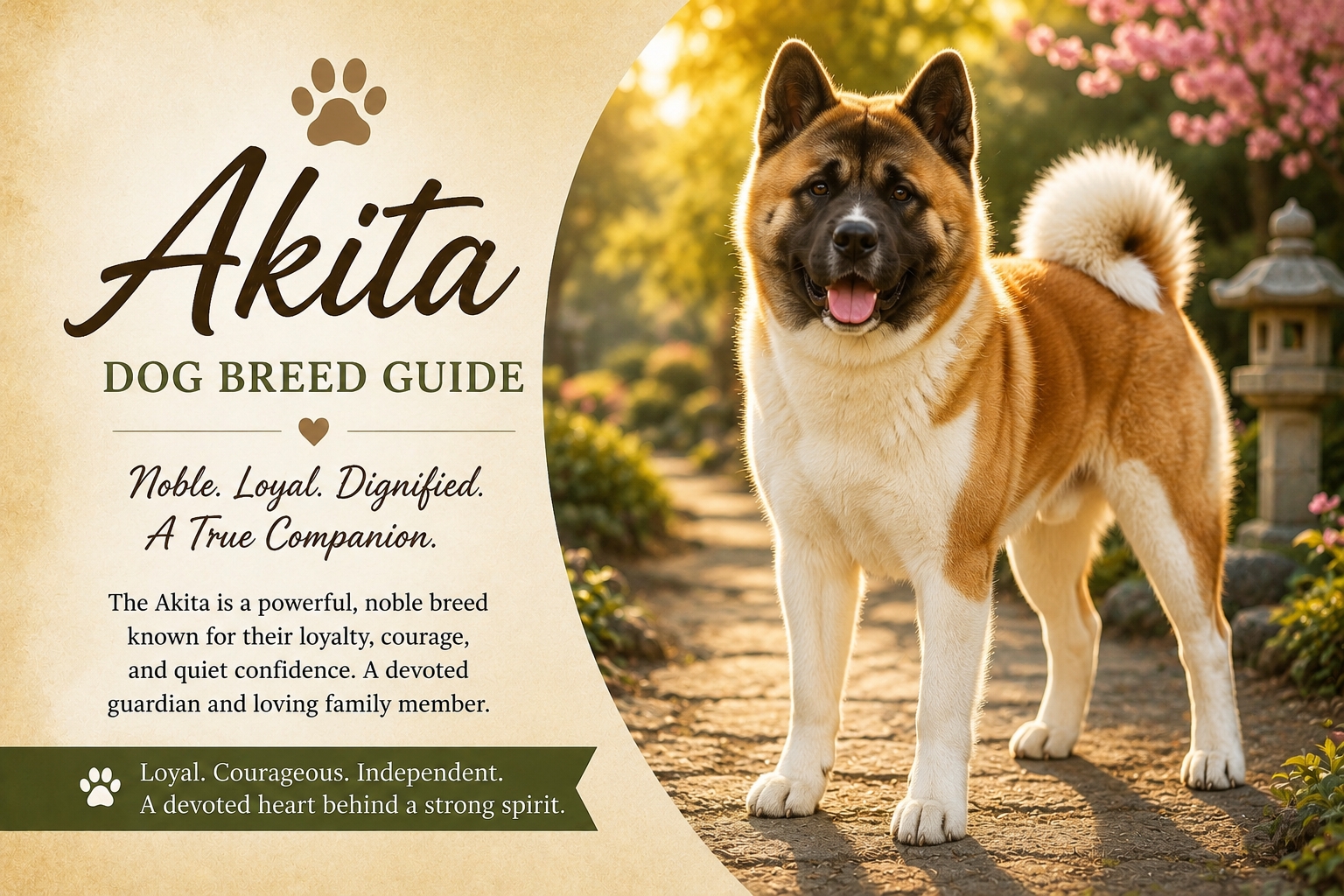
All About Akitas – Your Complete Akita Dog Breed Guide
Akita at a Glance
Origin Japan, particularly the mountainous northern region associated with Akita Prefecture and Odate AKC Group Working Group Height Males 26–28 inches; females 24–26 inches at the withers Typical weight Often about 100–115 lb for males and 75–90 lb for females, with individual variation Build Large, powerful, heavy-boned and only slightly longer than tall Coat Dense, weather-resistant double coat Colors Under the American Akita standard, any color including white, brindle and pinto; merle and liver are disqualifications Temperament Alert, responsive, dignified, courageous, loyal, independent and often reserved Trainability Highly intelligent but independent; best with skilled, consistent, reward-based handling Exercise Moderate; regular walks, purposeful activity and mental enrichment Shedding Heavy, especially during seasonal coat blows Lifespan Often about 11–13 years Best suited to Experienced or exceptionally well-prepared owners who value a loyal, quiet, serious companion and can manage a powerful dog responsibly What Is an Akita?
Akita History & Japanese Origins
War, Preservation and Diverging Types
Helen Keller and the Akita in America
Hachikō and the Akita’s Reputation for Loyalty
American Akita vs Japanese Akitainu
Feature Akita / American Akita Japanese Akitainu Overall impression Large, massive, powerful and heavy-boned More refined, agile and distinctly Japanese in type Head Broad, blunt-triangular, substantial More wedge-shaped and foxlike Colors Very broad range, including white, brindle and pinto Much narrower traditional range, including red, white and brindle under the AKC Japanese Akitainu listing Black mask Permitted and common Not characteristic of the Japanese standard Pinto Permitted Not part of traditional Japanese breed type AKC status Established Working Group breed Separately recognized by AKC Akita vs Shiba Inu: Similar Look, Very Different Scale
Trait Akita Shiba Inu Size Large, powerful working dog Small-to-medium companion/hunting breed Typical adult weight Often roughly 75–115+ lb depending on sex and individual Usually around 17–23 lb Physical power Very high Much easier for most adults to physically manage Dog tolerance Same-sex intolerance is an important breed concern Can also be selective, but consequences are on a different physical scale Guarding presence Strong natural guardian tendencies Alert but not comparable in guardian power Akita Appearance & Breed Type
Head and Expression
Body and Bone
The Curled Tail
Movement
Akita Size, Weight & Full-Grown Development
How Big Is a Full-Grown Akita?
When Is an Akita Full Grown?
Akita Puppy Growth
Giant Akitas and Oversize Marketing
Akita Colors & Markings
White Akitas
Black Akitas
Brindle Akitas
Pinto Akitas
Red, Fawn and Other Shades
Merle Akitas
Rare-Color Marketing
Long-Haired Akitas: The Woolly or Long-Coat Akita
Does a Long Coat Affect Personality?
Grooming a Long-Coat Akita
Should Long-Coat Puppies Cost More?
Akita Coat, Shedding & Grooming
How Much Do Akitas Shed?
Brushing
Bathing
Should You Shave an Akita?
Nails, Ears and Teeth
Are Akitas Hypoallergenic?
Akita Temperament & Personality
Deep Loyalty
Reserved With Strangers
Natural Guardian Instinct
Quiet but Watchful
Independent Thinking
Same-Sex Dog Intolerance
Are Akitas Aggressive? Understanding Dog Intolerance, Guarding & Prey Drive
Dog-Directed Aggression
Prey Drive
Territorial Behavior
Resource Guarding
What Responsible Ownership Looks Like
Training an Akita: Intelligence Without Automatic Obedience
Use Modern Reward-Based Methods
Start Early
Socialization Is Not Forced Friendliness
Recall and Off-Leash Risk
Protection Training
Professional Help
Akita Exercise Needs & Enrichment
Daily Exercise
Cold Weather
Hot Weather
Activities
Puppy Exercise
Are Akitas Good Family Dogs?
Strengths in Family Life
Challenges
Akitas and Children
Why Visiting Children Matter
Teach Children Respect
Supervision Means Active Supervision
Akitas With Other Dogs, Cats & Small Pets
Other Dogs
Dog Parks
Cats
Small Pets
Apartment Living, Fencing & Everyday Management
Secure Fencing
Rental and Insurance Restrictions
Visitors and Service People
First-Time Owners
Akita Health Issues & Recommended Health Testing
Minimum Breeding-Dog Health Clearances
Hip Dysplasia
Hypothyroidism
Eye Disease
Autoimmune Disease
Amelogenesis Imperfecta
Bloat / GDV: An Akita Emergency Every Owner Should Know
Possible Warning Signs
Planning Ahead
Sebaceous Adenitis & Uveodermatologic Syndrome (VKH-Like Disease)
Sebaceous Adenitis
Uveodermatologic Syndrome / VKH-Like Disease
Akita Lifespan & Senior Care
Keeping an Akita Lean
Senior Mobility
Senior Behavior Changes
Akita Nutrition & Feeding
Akita Puppy Food
Adult Feeding
Training Treats
Food Guarding and Multi-Pet Homes
Feeding and Bloat
Akita Puppies: Adorable, Powerful Dogs in Training
Early Socialization
Dog Socialization
Handling
Choose Temperament Over Drama
Finding a Responsible Akita Breeder
Verify Health Clearances
Meet Adult Akitas
Puppy Raising
Contracts and Lifetime Responsibility
Pet Stores, Brokers and High-Volume Sellers
Online Scams
Akita Price & the Real Cost of Ownership
What Responsible Breeding Costs
Why Cheap Akita Puppies Can Be Expensive
A High Price Is Not Proof Either
Lifetime Costs
Akita Puppies for Sale Near Me: Search for Quality Before Distance
Slow Down Before Paying a Deposit
Beware of Urgency
Shipping
Consider Adults and Rescue
Akita Adoption & Rehoming
If You Need to Rehome an Akita
Popular Akita Mixes
Akita German Shepherd Mix
Akita Husky Mix
Akita Pit Bull Mix
Akita Lab Mix
Health in Akita Mixes
Akita Pros & Cons
Why People Love Akitas
Potential Challenges
Is an Akita Right for You?
An Akita May Be Right for You If You:
You May Prefer Another Breed If You:
Akita Frequently Asked Questions
What is the difference between an Akita and an American Akita?
How big do Akitas get?
How long do Akitas live?
Are Akitas aggressive?
Are Akitas good family dogs?
Are Akitas good with children?
Are Akitas good with cats?
Can Akitas live with other dogs?
Are Akitas good at dog parks?
Do Akitas bark a lot?
Do Akitas shed a lot?
Are Akitas hypoallergenic?
Can you shave an Akita?
What colors do Akitas come in?
Are merle Akitas purebred?
What is a long-haired Akita?
Are Akitas easy to train?
Are Akitas good for first-time owners?
How much exercise does an Akita need?
What health tests should Akita breeders perform?
What is bloat in Akitas?
How much does an Akita puppy cost?
Where should I look for Akita puppies near me?
What is the difference between an Akita and a Shiba Inu?
Can Akitas be off leash?
Trusted Akita Resources