

Searching for Miniature Dachshund puppies for sale can become emotional very quickly. One photograph of a tiny long-haired Mini Doxie with floppy ears and enormous eyes can make an otherwise sensible person start calculating driving time, checking airline routes, and wondering how fast a deposit can be sent.
That is exactly when it pays to slow down.
A Miniature Dachshund puppy should come from healthy, temperamentally sound parents, be raised in a clean and stimulating environment, receive thoughtful early socialization and veterinary care, and be placed by someone who cares what happens to that dog long after the payment clears. Coat color, proximity to your home, a tiny predicted adult weight, and immediate availability are secondary.
Dogs Central does not sell Miniature Dachshund puppies on this page. This is a puppy-buyer education guide. Our goal is to help you recognize responsible breeding, understand what health evidence to request, spot puppy mills and brokers, avoid online scams, evaluate dapple and “teacup” marketing, understand contracts and deposits, and know when the right decision is to walk away—even from a puppy you have already fallen in love with.
The U.S. keyword data for Miniature Dachshunds makes buyer education particularly important. People search heavily for Mini Dachshund puppies for sale, Miniature Dachshund puppies, long-haired Mini Dachshund puppies, Mini Dachshund breeders, puppies near me, dapple puppies, English cream puppies, cheap Mini Dachshund puppies, and puppies under $300 or $500. Those searches can lead to conscientious breeders, but they also create exactly the market scammers, brokers, commercial puppy sellers, and irresponsible breeders try to reach.
Before looking for a puppy, read our complete Miniature Dachshund breed guide and the broader Dachshund breed guide. A Mini Dachshund remains a puppy for only a short time. The adult dog may be part of your life for well over a decade.
Written by: Deborah G. Moore
Last updated: August 15, 2026

Mini Dachshund Puppy Buyer Quick Checklist
Before you send a deposit for a Miniature Dachshund puppy, you should be able to answer yes to most or all of these questions:
- Do I know who actually bred this puppy and where the litter was born?
- Can I identify the mother and learn about the father?
- Have I seen meaningful health-testing documentation for both parents?
- Can I verify public health results where available?
- Have I asked about IVDD and significant back problems in close relatives?
- If dapple is involved, do I understand the merle/dapple status of both parents?
- Can I see the mother with the puppies, preferably where the litter is raised?
- Do the puppies appear clean, bright, curious, comfortable, and able to move normally?
- Does the breeder know the puppies as individuals rather than inventory numbers?
- Can the breeder explain what the puppies have experienced during early socialization?
- Has the breeder asked whether my home is suitable for a Miniature Dachshund?
- Will I receive written veterinary, vaccination, parasite-control, and microchip information as applicable?
- Will I receive a written purchase contract before pickup?
- Does the contract address what happens if I cannot keep the dog later in life?
- Do I understand the deposit and refund terms?
- Am I choosing for health, temperament, and structure before coat color or extreme smallness?
- Have I resisted pressure to pay immediately because “someone else is interested”?
If several answers are no, stop and ask more questions. There will be other puppies.
What Should a Healthy Miniature Dachshund Puppy Look & Act Like?
A healthy-looking Mini Dachshund puppy should generally be bright, responsive, appropriately active, and comfortable in its body when awake. Puppies naturally cycle between wild bursts of play and profound sleep, so one quiet moment does not tell you much. What matters is the overall pattern.
Eyes should look comfortable rather than persistently red, cloudy, crusted, or tightly squinted. Breathing should be easy at rest. The coat and skin should be reasonably clean. The puppy should be able to walk, play, and explore without obvious lameness, dragging, or unusual weakness. Body condition should look appropriate—not painfully thin and not dramatically pot-bellied.
Behavior is part of puppy health
A puppy does not have to be the boldest member of the litter to be healthy. Some are naturally more thoughtful or reserved. But extreme shutdown, frantic fear, inability to recover from mild novelty, chronic avoidance of people, or unusual lethargy deserves attention.
A well-raised puppy should have some experience with gentle handling, household sounds, ordinary surfaces, age-appropriate novelty, brief separation from littermates, and calm human interaction.
Pay particular attention to movement
Miniature Dachshunds have an unusual long-backed, short-legged structure. Puppies can look somewhat awkward while growing, but they should move comfortably without obvious persistent pain, weakness, dragging, or inability to coordinate their rear legs. Do not accept “all Dachshunds walk funny” as an explanation for an obvious movement problem.
A healthy-looking puppy can still inherit disease risk
A puppy can look beautiful during a 30-minute visit and still be at elevated risk for inherited orthopedic, cardiac, eye, or spinal problems. That is why parent health screening and family history matter even when the puppy appears perfect.
What to Know Before You Start Looking for a Miniature Dachshund Puppy
Decide whether you actually want the adult Miniature Dachshund before you start browsing puppy photographs.
Mini Dachshunds are small, affectionate, clever, and frequently hilarious. They can also be vocal, determined, scent-driven, challenging to house train, sensitive to being left alone, and vulnerable to back problems. Their compact size makes them convenient. It does not make them effortless.
Ask yourself whether you are ready for:
- a dog that may bark at doors, neighbors, wildlife, and unfamiliar sounds;
- patient toilet training through rain, cold, or snow;
- daily walks and scent-oriented enrichment;
- lifelong dental care and careful weight management;
- ramps or other practical back-friendly changes around the home;
- possible future IVDD-related veterinary expenses;
- a strong prey drive around small animals;
- a dog that may become deeply attached to one or more family members;
- 12–16 years of responsibility in many cases.
Choose the size variety intentionally
In the United States, Miniature Dachshunds compete in a class division for dogs weighing 11 pounds and under at 12 months of age and older. A puppy’s exact final weight cannot be guaranteed. If mature size is important, ask about the adult weight and build of both parents and mature offspring from related litters.
Choose the coat you can maintain
Smooth Minis have the simplest coat care. Longhaired Miniature Dachshunds require more brushing and combing. Wirehaired Minis need regular coat maintenance and may benefit from experienced hand stripping if traditional coat texture is desired.
Read the Miniature Dachshund Breed Guide before puppy shopping. If the adult breed still sounds right for you, then begin looking for the breeder—not merely the puppy.
How to Find a Responsible Miniature Dachshund Breeder
A responsible Miniature Dachshund breeder is not simply someone who owns two registered Dachshunds and has puppies available. Good breeding requires planning around health, temperament, sound structure, pedigree, family history, and the long-term welfare of the dogs produced.
A good breeder should be able to explain why a particular sire and dam were paired. The answer should go beyond “they are both beautiful” or “people wanted cream dapples.” Useful answers discuss temperament, health screening, conformation, strengths and weaknesses of the family lines, previous offspring, and what the breeder hoped to achieve with the litter.
Responsible Mini Dachshund breeding usually includes:
- breed-appropriate parent health screening before breeding;
- knowledge of IVDD and other health problems in the pedigree;
- selection for stable temperament as well as appearance;
- thoughtful dapple/merle breeding decisions;
- adult breeding dogs receiving excellent daily care and living as valued dogs;
- puppies raised in a clean, enriched environment;
- planned early socialization and handling;
- careful matching of puppies with homes;
- a written contract and return-to-breeder commitment;
- support after the puppy goes home.
Registration is not proof of responsible breeding
Registration can document pedigree and eligibility within a registry. It does not prove that parents were properly health tested, that the litter was thoughtfully planned, that puppies were well socialized, or that the breeder will take responsibility if something goes wrong. An expensive website, professional photography, a large social-media following, or a long waiting list does not independently establish quality either.
Dogs Central’s Small Dog Breeders Directory can be one starting point as that resource grows, but inclusion in any directory should never replace your own investigation.
What Health Testing Should Miniature Dachshund Puppy Parents Have?
The best time to reduce avoidable inherited risk is before the puppies exist.
The American Kennel Club’s current Hound Group health-testing guidance lists the following screening recommended for Dachshunds by the national breed club:
- Patella evaluation
- Cardiac exam
- Ophthalmologist evaluation
Miniature and Standard Dachshunds are the same breed, so Dachshund recommendations apply to Miniatures as well.
Ask for the parents’ registered names
Do not settle for a photograph of certificates that might or might not belong to the dogs in front of you. Ask for the registered names of the sire and dam and look for public health-test records through the Orthopedic Foundation for Animals database where applicable. A breeder should be able to explain what each test evaluated and when it was performed.
Ask specifically about IVDD and family history
Intervertebral disc disease is the health problem most strongly associated with the Dachshund. There is no ordinary “IVDD-clear puppy certificate” that eliminates the breed’s spinal risk.
- Have either parent ever had significant back or neck pain?
- Have either parent required treatment or surgery for IVDD?
- What about full siblings of the parents?
- What about grandparents and previous offspring?
- At what ages did any disc problems appear?
A breeder cannot promise that a puppy will never develop IVDD. What you want is someone who understands the problem, keeps meaningful family records, avoids pretending the risk does not exist, and makes breeding decisions with long-term health in mind.
Dapple breeding needs additional genetic care
If either parent is dapple—or might genetically be merle despite subtle markings—ask exactly how the breeder determined the merle status of both dogs. Breeding two merle/dapple dogs can produce double-merle puppies with substantially greater risk of hearing and eye abnormalities.
What about additional DNA tests?
A breeder may perform additional DNA testing based on pedigree, coat line, family history, or veterinary/genetic guidance. That can be useful. A commercial DNA panel should be viewed as one tool, not a substitute for recommended physical screening of eyes, heart, and patellas or for honest family-health knowledge.
For current breed-health information, consult the Dachshund Club of America health resources and DCA IVDD information.
Why “Vet Checked” or “DNA Tested” Is Not Enough
“Vet checked” is useful information. It is simply not the same thing as breeding-stock health screening.
A veterinarian may examine a puppy and find clear lungs, normal hydration, no obvious infection, and no immediate clinical concern. That tells you about the puppy’s health at that time. It does not tell you whether the parents received specialist eye examinations, patella evaluations, or cardiac screening before breeding.
Likewise, a DNA panel can detect selected genetic variants. It cannot replace an ophthalmic examination or the physical evaluation required for patella and cardiac screening.
Ask the follow-up question
When a breeder says, “Our dogs are fully health tested,” respond with: “Great. Which tests were performed on the sire and dam, at what ages, and where can I verify the results?”
A knowledgeable breeder should not be offended by that question.
A health guarantee is not the same as health testing
A guarantee may define what happens if a puppy develops a covered condition. It is a contract remedy after something has gone wrong. Preventive screening before breeding is a different—and more important—part of responsible breeding. A promise to replace a puppy does not undo the emotional or veterinary impact of inherited disease in the dog already living in your home.
Questions to Ask a Miniature Dachshund Breeder
You do not need to sound suspicious or hostile. Good puppy buying is simply informed puppy buying.
- Why did you choose these two Dachshunds for this litter?
- How old are the sire and dam, and what are their mature weights?
- Are they Smooth, Longhaired, or Wirehaired?
- What health screening has each parent completed?
- May I have their registered names and copies or links to the results?
- Have either parent or close relatives had IVDD, back surgery, or repeated back pain?
- Have close relatives had patellar, heart, or eye problems?
- If dapple is involved, what is the merle/dapple status of both parents?
- How do the parents behave with strangers, children, and other dogs?
- Does either parent show severe fear, problematic aggression, or separation distress?
- Where are the puppies born and where do they spend their days?
- What socialization experiences have they had this week?
- How are they introduced to nail care, ear handling, tooth handling, collars, and harnesses?
- For Longhaired puppies, how are they introduced to brushing and combing?
- How do you begin house-training foundations?
- How do you decide which puppy is best suited to each family?
- At what age do puppies leave?
- What food are they eating?
- What veterinary care will each puppy receive before going home?
- Will the puppy be microchipped?
- What is included in the contract and what is the deposit policy?
- What happens if I cannot keep the dog years from now?
- May I speak with owners of previous puppies?
The breeder does not have to give you the answer you hoped to hear every time. What matters is knowledgeable, transparent communication rather than evasion or sales pressure.
Questions a Good Mini Dachshund Breeder Should Ask You
A seller who wants to know nothing about you is giving you useful information about their priorities. A responsible breeder has invested substantial time, money, effort, and emotion in a litter and should care where those puppies live.
Expect questions about:
- who lives in your household and the ages of any children;
- other pets;
- your experience with dogs or Dachshunds;
- work schedule and normal time away from home;
- housing and landlord restrictions where relevant;
- fencing and outdoor safety;
- exercise expectations;
- your plan for house training;
- your understanding of IVDD and back care;
- whether you are prepared for barking;
- the grooming needs of the coat variety you want;
- your plans for routine and emergency veterinary care;
- what you would do if your circumstances changed.
A breeder may tell you a particular puppy is not a good match, or that the breed itself does not sound right for your situation. That can be disappointing. It can also be evidence that the breeder is thinking about the dog’s future instead of merely completing a sale.
“Which color do you want, and where should I send the payment request?” is not meaningful placement screening.
Meet the Mother & See Where Mini Dachshund Puppies Are Raised
Whenever reasonably possible, meet the puppy’s mother where the litter is being raised. The sire may belong to another breeder or live elsewhere, so his absence is not automatically suspicious. The mother is usually much more accessible.
Look at the mother as carefully as the puppy
Does she appear healthy and appropriately conditioned? Does she move comfortably? Is she reasonably relaxed around the breeder? Is she clean? Does she look like a cherished dog or simply breeding stock?
Her temperament matters too. A mother protecting very young puppies may understandably be more watchful than usual, but chronic extreme fear, inability to recover around normal household activity, or serious unstable behavior should not simply be dismissed.
Look beyond the staged visit area
Ask where the puppies spend an ordinary Tuesday morning—not just where visitors are invited to sit. You want evidence that puppies have opportunities to move and play, sleep undisturbed, interact with people, experience normal household activity, explore age-appropriate surfaces and toys, and live with clean water and bedding.
If you cannot visit in person
Long distance can make an in-person visit impossible. Interactive live videoùú
- known health information;
- spay/neuter or breeding-rights terms;
- health-guarantee coverage and exclusions;
- requirements for your first veterinary examination;
- refund or replacement provisions if applicable;
- what happens if you cannot keep the dog;
- any restrictions or obligations agreed to by both parties.
The lifetime return clause matters
A responsible breeder generally wants to know if a dog they produced loses its home. Many require the dog to be returned to them or require the breeder to participate in finding a safe alternative. That clause is evidence of long-term accountability.
Understand the health guarantee
Read what conditions are covered, for how long, what documentation is required, and what remedy the breeder offers. Some guarantees require a veterinary examination within a defined period after purchase.
A contract alone does not prove a breeder is responsible. A breeder who refuses to put important promises in writing, however, deserves additional scrutiny.
Mini Dachshund Puppy Deposits & Payment Safety
A deposit can be a normal way to reserve a puppy or a place on a litter list. It is also the moment a fake puppy advertisement can turn into a financial loss.
Before paying a deposit:
- verify the breeder’s real identity and physical location;
- know which litter or puppy the deposit concerns;
- understand whether the deposit is refundable;
- read written deposit terms;
- confirm how the remaining balance is paid;
- keep copies of messages, invoices, contracts, and receipts;
- verify that the puppy actually exists.
Do not let urgency replace verification
“Three other people are asking about her right now” may be true. It may also be a pressure tactic. A responsible breeder generally wants the right home more than the fastest electronic transfer.
Be cautious with difficult-to-recover payment methods
The U.S. Federal Trade Commission warns that pet scammers may use urgent payment demands and difficult-to-recover payment methods. A seller asking for gift cards, cryptocurrency, unusual wire arrangements, or a succession of unexpected payment requests should trigger extra caution.
Never keep paying surprise “shipping insurance,” “special crate,” “customs,” “airport release,” or “refundable delivery” charges merely because someone claims the puppy is already in transit.
Online Mini Dachshund Puppy Scams: How to Protect Yourself
Miniature Dachshunds are attractive scam bait: adorable, expensive enough to make a fake sale lucrative, and heavily searched online. Long-haired cream and dapple puppies are especially easy for scammers to market with stolen photographs.
Common puppy-scam warning signs
- The price is dramatically lower than comparable responsibly bred puppies.
- You are told to pay immediately before another buyer gets the puppy.
- The seller refuses live video or meaningful real-time communication.
- Every puppy color and sex seems magically available.
- The same puppy photographs appear on unrelated sites.
- The seller’s location changes during the conversation.
- Messages are generic and do not answer questions about the actual puppy.
- There is no verifiable information about the mother or father.
- The puppy can supposedly be shipped anywhere immediately.
- Unexpected transport, insurance, crate, or veterinary fees appear after payment.
- The seller asks for payment methods that are difficult to reverse.
- The breeder never asks whether you are a suitable owner.
Ask for real-time proof
Request a live video call. During the call, ask the breeder to show the puppy interacting with littermates and the mother. Ask an unscripted question such as, “Could you show me the white marking on her chest?” or “Can you show me where they sleep?” A scammer using stolen photos may be able to send dozens of images. They cannot easily produce the puppy live.
Reverse-search photographs
If the same puppy photo appears under different breeder names, states, or prices, walk away.
Cheap-puppy searches deserve extra caution
Search demand exists for Mini Dachshund puppies under $500, under $300, cheap Mini Dachshund puppies, and free puppies near me. Those are exactly the queries where a fabricated “bargain” can feel irresistible.
A low price is not proof of a scam, and a high price is not proof of honesty. But when the puppy is priced far below what responsible breeding normally costs in your region, investigate rather than celebrate.
For current scam advice, see the Federal Trade Commission’s pet-scam guidance.
Mini Dachshund Puppy Mills: Why Animal Welfare Matters
A puppy mill is not simply “a breeder whose website I dislike.” The concern is high-volume commercial breeding in which profit and production can take priority over the physical and emotional welfare of breeding dogs and puppies.
The puppy you see for sale may look clean and adorable while the mother remains hundreds of miles away in a commercial facility the buyer never sees.
Problems associated with irresponsible high-volume breeding can include:
- adult dogs bred repeatedly for profit;
- insufficient veterinary care;
- overcrowded or unsanitary housing;
- inadequate exercise and little meaningful human companionship;
- poor early socialization;
- breeding dogs spending much of their lives confined;
- little individualized knowledge of puppy temperament;
- commercial transport and resale through brokers or retailers.
The polished website problem
Commercial sellers understand what puppy buyers want to hear. Phrases such as “family raised,” “loved from birth,” and “our babies” may be completely true—or may be marketing wrapped around a supply chain the buyer never sees.
Ask concrete questions: Who owns the mother? Where does she sleep? Where was the litter born? Who has raised the puppies every day? Can you show me that environment?
The ASPCA Puppy Mills 101 resource explains how commercial puppy production can affect breeding dogs as well as puppies.
Why Dogs Central Does Not Recommend Buying Mini Dachshund Puppies From Pet Stores
Dogs Central does not recommend purchasing puppies from retail pet stores.
The central issue is transparency. When a puppy is sold through a retail storefront, the buyer may have no meaningful access to the mother, father, breeding environment, breeder’s decision-making, or conditions in which adult breeding dogs live.
A retail store can separate the puppy from its source
The staff member helping you may genuinely care about the puppy in front of them. They may still have little direct knowledge of the breeder, the mother’s living conditions, parent temperament, or how the litter was raised.
Registration papers do not solve the problem
A registered puppy can still come from a poor breeding environment. Registration describes pedigree or registry status; it does not certify humane daily care or comprehensive health testing.
If you previously bought a pet-store puppy
This section is not intended to shame you. Many buyers were told the puppies came from excellent breeders and had no reason to know how commercial distribution systems work.
The useful question is what to do differently next time: trace the puppy to the person who bred it, learn how the parents live, verify health testing, and insist on transparency.
The ASPCA’s Puppy Pipeline explains the role of brokers and commercial distribution between breeding facilities and retail outlets.
Mini Dachshund Puppy Brokers & High-Volume Sellers
The person advertising the puppy may not be the person who bred or raised it.
A puppy broker acts as a middleman—obtaining puppies from breeders and reselling them. A polished seller can therefore appear to be a small breeder even when the actual puppy source is somewhere else entirely.
Ask five direct questions:
- Who owns the mother?
- Where was this puppy born?
- Who raised the litter?
- Can I speak directly with that person?
- Can I verify the parents’ health testing?
Watch for inventory behavior
A seller who always has Mini Dachshunds in multiple coat types, colors, ages, and sexes available may be producing at very high volume or sourcing puppies from elsewhere. Likewise, a website selling Mini Dachshunds alongside many unrelated breeds and designer mixes deserves careful investigation.
“We work with partner breeders”
That phrase can describe a legitimate referral network—or a commercial brokerage operation. Ask exactly what “partner” means. Who receives your money? Who owns the mother? Who made the breeding decision? Who raised the puppy?
The more people standing between you and the breeding dog, the harder it becomes to evaluate welfare and health practices.
Irresponsible Backyard Breeding: What the Term Should Mean
Not every small hobby breeder is irresponsible, and not every larger breeder is automatically a puppy mill. Dogs Central uses the term backyard breeder for someone breeding without adequate knowledge, health screening, planning, socialization, buyer screening, contracts, or lifetime responsibility.
Common warning signs include:
- breeding a pet because “she should have one litter”;
- breeding because two dogs are available and cute;
- no breed-specific parent health testing;
- little knowledge of IVDD or pedigree health;
- no thoughtful temperament selection;
- no knowledge of merle/dapple genetics;
- puppies raised with minimal socialization;
- no screening of buyers;
- no written contract or take-back commitment;
- no support after sale.
A breeder does not need a giant kennel, expensive advertising, or professional show career to be responsible. They do need knowledge, preparation, transparency, and accountability.
Mini Dachshund Puppy Red Flags: When You Should Walk Away
Walking away can be extraordinarily difficult once you have seen the puppy. That is why it helps to decide your red lines before visiting.
Stop or investigate further if:
- you cannot identify the puppy’s actual breeder or where the litter was raised;
- the seller refuses to show the mother without a credible explanation;
- parent health testing cannot be documented;
- “vet checked” is used as the only breeding-health evidence;
- IVDD questions are dismissed because “our line never gets it”;
- the breeder intentionally pairs two dapples;
- extreme tininess is promoted as the primary breeding goal;
- the seller guarantees an exact tiny adult weight;
- many breeds or litters are always available;
- puppies seem chronically fearful, ill, filthy, or shut down;
- the environment appears overcrowded or poorly maintained;
- the breeder knows little about individual puppy temperament;
- the seller wants money before answering basic questions;
- there is no written contract;
- the seller has no interest in where the puppy will live;
- the puppy is being sent home unusually young;
- the seller refuses real-time verification during an online purchase;
- the story changes when you ask detailed questions.
Do not “rescue” a puppy by purchasing from a bad source
It is emotionally difficult to leave a puppy in circumstances you dislike. But paying the seller completes the transaction and creates demand for another litter.
If you believe animals are being neglected or treated unlawfully, document what you can safely and contact the appropriate local animal-welfare or enforcement authority rather than funding the seller.
Teacup, Micro, Ultra Mini & Tiny Mini Dachshund Puppies
Teacup, micro, ultra mini, pocket, and similar labels are not additional official U.S. Dachshund size varieties. The recognized U.S. Dachshund sizes are Standard and Miniature.
The Miniature class division is already small: 11 pounds and under at 12 months and older. A seller advertising a “teacup Mini Dachshund” is therefore using marketing language, not an AKC size classification.
Why buyers are attracted to ultra-tiny puppies
Tiny puppies are visually irresistible and convenient to imagine carrying everywhere. But extreme smallness should never outrank sound structure and healthy development.
Exact adult weight cannot be guaranteed
Parent size, pedigree, growth rate, and previous litters can help a breeder estimate mature size. They cannot manufacture a precise adult number from an eight-week-old puppy.
Be skeptical of statements such as “guaranteed four pounds full grown,” “will never exceed six pounds,” “true teacup line,” or “micro Dachshund breed.”
Very tiny puppies can be more physically vulnerable
Extremely small puppies may be easier to injure through falls, rough handling, or play with much larger dogs. Tiny mouths can also make dental crowding a practical concern.
The goal should be a healthy Miniature Dachshund—not winning a contest for smallest adult dog.
Dapple, English Cream, Long-Haired & Rare-Color Mini Dachshund Puppies
Coat color is one of the strongest purchase drivers in Miniature Dachshunds. Long-haired dapples, English creams, reds, chocolates, piebalds, and unusual-looking puppies attract enormous online interest.
Enjoy color. Just do not let it make the breeding decision for you.
Dapple Mini Dachshund puppies
Dapple is the Dachshund term for merle patterning. A responsible breeder should understand the genetics behind the dogs being bred and avoid double-merle/double-dapple pairings because of the increased risk of serious hearing and eye abnormalities.
If buying a dapple puppy, ask whether either parent is dapple, what the registered colors and patterns of both parents are, whether genetic testing was used when merle status was unclear, and whether the pairing was dapple-to-dapple.
English Cream Mini Dachshund puppies
“English Cream” is a popular descriptive term, especially in Longhaired Miniature Dachshunds. It is not a separate breed and should not exempt the breeder from the same health and temperament standards expected of every Dachshund. A pale coat does not prove excellent breeding.
Long-haired Mini Dachshund puppies
Longhaired puppies need early introduction to brushing, combing, ear handling, and coat care. Ask what grooming the litter has already experienced. A breeder specializing in Longhairs should be able to discuss adult coat maintenance, mat-prone areas, shedding, and how puppy coat develops.
Blue, Isabella, “golden,” split-face, and unusual markings
Marketing vocabulary can outrun official breed terminology. Ask the breeder to distinguish between the dog’s actual registered color or pattern and informal descriptions used for advertising.
Color premiums do not prove quality. A puppy advertised as “rare” deserves more scrutiny around health and genetics, not less.
How Much Is a Mini Dachshund Puppy? What Price Actually Tells You
There is no responsible universal Miniature Dachshund puppy price that applies across the United States. Cost varies with region, breeder practices, health testing, pedigree, veterinary care, litter expenses, coat, demand, and marketing.
Price is not a quality certificate.
Responsible breeding costs money
Meaningful expenses can include pre-breeding health screening, veterinary reproductive care, quality nutrition, emergency veterinary care, whelping supplies, puppy veterinary examinations, vaccination and parasite control, microchipping where used, registration expenses, socialization equipment, enrichment, and considerable breeder time.
An expensive puppy can still be poorly bred
Some sellers charge large premiums for cream, dapple, blue eyes, unusual markings, or extreme tininess without investing comparably in health screening or puppy raising.
A low price can mean many different things
It can represent a legitimate private situation, a seller cutting corners, a commercial source, an accidental litter, or a completely fictitious puppy scam. Evaluate the breeding program first and the number on the invoice second.
Why Cheap Mini Dachshund Puppies Can Become Very Expensive
Searches for Mini Dachshund puppies under $500, under $300, cheap puppies, and free Mini Dachshund puppies are understandable. Families have budgets. The danger comes when purchase price becomes the only filter.
A bargain puppy may carry hidden costs
Poor breeding and inadequate early care can contribute to expenses involving parasites or infectious disease, poor nutrition, untreated congenital problems, behavioral fear from poor socialization, separation problems, house-training difficulties, dental issues, orthopedic problems, and unexpected emergency care.
Responsible breeding does not guarantee a disease-free dog. Irresponsible breeding simply removes many of the safeguards designed to reduce avoidable risk.
The purchase price is only the beginning
Budget for veterinary care, food, dental care, training, insurance or emergency savings, pet sitting, equipment, grooming where relevant, parasite prevention, and replacement of items your puppy decides are technically chew toys.
If the only Mini Dachshund you can afford is one from a source that cannot provide basic health or welfare evidence, waiting may be far less expensive than rushing.
How to Find Mini Dachshund Puppies Near You Without Choosing by Distance Alone
“Mini Dachshund puppies near me” is a perfectly reasonable search. Meeting the breeder and avoiding difficult transport are real advantages. But proximity should be a convenience—not your main breeder qualification.
A responsible breeder three hours away can be a far better choice than an irresponsible seller ten minutes away.
Ways to expand your search responsibly
- Use the Dachshund Club of America member breeder directory as one research source.
- Check Dogs Central’s Small Dog Breeders Directory as it grows.
- Ask Dachshund owners you trust how they researched breeders.
- Ask your veterinarian for local breed-club or breeder-referral ideas while still doing your own due diligence.
- Attend dog shows or Dachshund events where you can meet adult dogs and knowledgeable breed enthusiasts.
- Expand your driving radius before lowering your health or welfare standards.
State-specific searches do not require state-specific standards
People search for Mini Dachshund puppies in Texas, Florida, Ohio, Georgia, California, Michigan, North Carolina, and many other states. The buyer-safety questions stay the same everywhere:
Who bred the puppy? How do the parent dogs live? What health testing was completed? How was the puppy raised? Can the evidence be verified?
Travel, Shipping & Long-Distance Mini Dachshund Puppy Purchases
Buying from a responsible breeder at a distance is not automatically unsafe. It simply requires more verification.
Before committing long-distance:
- verify the breeder’s identity;
- have interactive live video conversations;
- see the mother and puppy environment;
- verify parent health testing;
- review the contract before paying;
- understand exactly how transport will occur;
- know who is responsible at every point in the trip;
- understand what happens if weather, flight, or health concerns delay transport.
Picking up the puppy yourself can add transparency
If feasible, traveling to the breeder can let you see more than commercial delivery does. You can meet the breeder, see the mother, observe the environment, and travel home with the puppy yourself.
Shipping claims are a favorite scam tool
Be particularly suspicious when a seller says a puppy has already been handed to a delivery company and then demands additional money for a climate-controlled crate, refundable insurance, airport fees, or emergency paperwork. Do not let the claim that the puppy is “stuck in transit” bypass your normal fraud instincts.
Choosing Between Mini Dachshund Puppies in a Litter
Once you trust the breeder and the breeding itself, then you can choose—or be matched with—the puppy.
Do not assume “pick of the litter” means “best puppy”
Best for what? A show prospect, performance dog, active family, retired couple, first-time dog owner, and quiet single-person household may each need different traits.
Ask the breeder to describe each puppy
A breeder who knows the litter well should be able to talk about confidence, activity level, people orientation, persistence, vocal tendencies, response to novelty, ability to settle, independence, food motivation, and interaction with littermates.
Do not choose extreme fear because the puppy “needs you”
A very frightened puppy can absolutely become a wonderful dog, but a chronically fearful temperament may require more experienced support than a first-time buyer realizes.
Do not choose the wildest puppy just because it is entertaining
The puppy that turns your shoelaces into a full-contact sport may be fantastic in an active home and exhausting in a quiet one. Choose for the life you actually live.
Male vs. Female Mini Dachshund Puppies
Sex is usually a poor shortcut for temperament. Male Mini Dachshunds are not automatically cuddlier, and females are not automatically more independent. Individual personality, family line, socialization, and training matter much more.
If you already have another dog, sex may become one factor in household compatibility, but even then the individual dogs matter. Ask the breeder which puppy’s temperament best matches your home before insisting on a particular sex.
Questions about spaying, neutering, and timing should be discussed with your veterinarian based on the individual dog’s health and circumstances.
Preparing Your Home for a Miniature Dachshund Puppy
Mini Dachshunds are small enough to fit through gaps you did not know existed and long enough to reach surprisingly far when investigating something forbidden.
Before the puppy arrives:
- choose a secure sleeping area;
- set up an appropriately sized crate or puppy pen if you plan to use one;
- install baby gates where needed;
- block dangerous stair access while the puppy is unsupervised;
- provide non-slip rugs on slick floors;
- install a stable ramp for frequently used high furniture if appropriate;
- remove electrical cords and toxic plants;
- store medications and human food securely;
- remove small swallowable objects;
- buy appropriately sized chew toys;
- choose food bowls that are stable and easy to clean;
- buy a properly fitted harness rather than guessing by breed name;
- arrange identification;
- choose a toilet area and household schedule.
Do not give a new puppy the whole house
Too much freedom makes house training, chewing, and safety much harder. Start with a manageable puppy-safe area and expand access gradually as the puppy succeeds.
Prepare for the back from day one
You do not need to wrap the puppy in bubble wrap. Normal self-directed play and movement are important. But there is no reason to teach a tiny puppy that repeated launches from a tall sofa are part of daily life.
Dogs Central’s New Puppy Checklist can help with the practical shopping and setup side of bringing a puppy home.
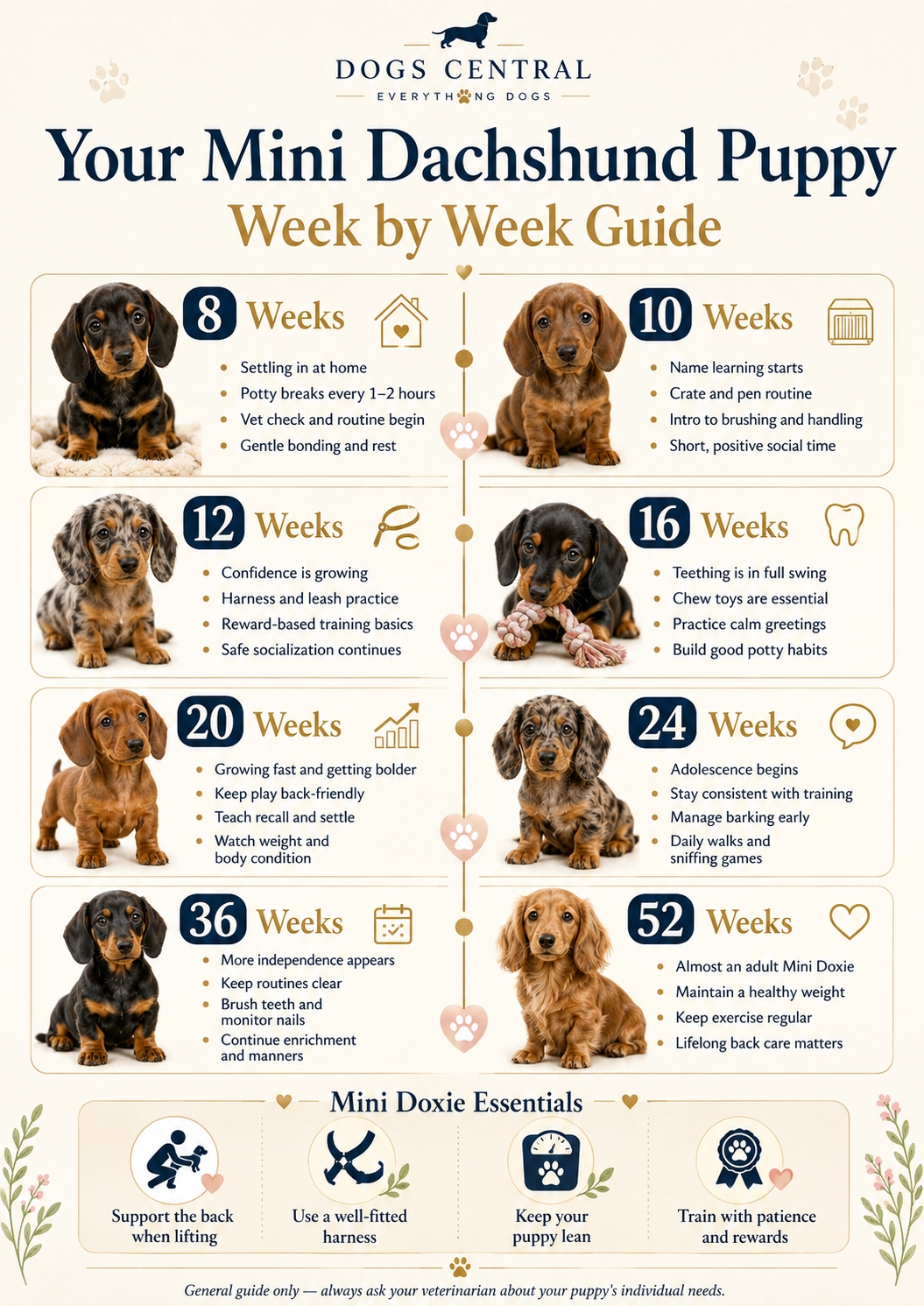
Your First Week With a Mini Dachshund Puppy
The first week is about safety, predictable routine, attachment, and preventing problems—not showing the puppy every exciting thing in its new city.
Day one
- Take the puppy to the chosen toilet area immediately.
- Introduce one safe area of the home first.
- Keep greetings calm.
- Offer the same food the breeder was feeding initially unless your veterinarian advises otherwise.
- Provide water, rest, and quiet.
- Do not invite a crowd over.
House training starts immediately
Take the puppy out after waking, eating, drinking, active play, and naps, as well as frequently between those events. Reward outdoor success immediately. Mini Dachshunds can be particularly reluctant to toilet in bad weather, so establish the routine before the puppy discovers that the rug is warm and rain-free.

Protect sleep
Puppies need a tremendous amount of sleep. An overtired puppy may become bitey, frantic, and unable to settle. Children should understand that sleeping puppies are not available for entertainment.
Begin gentle independence
A Mini Dachshund often becomes deeply attached to people. Practice very short periods of calm separation from the first days rather than having the puppy physically attached to someone every waking minute.
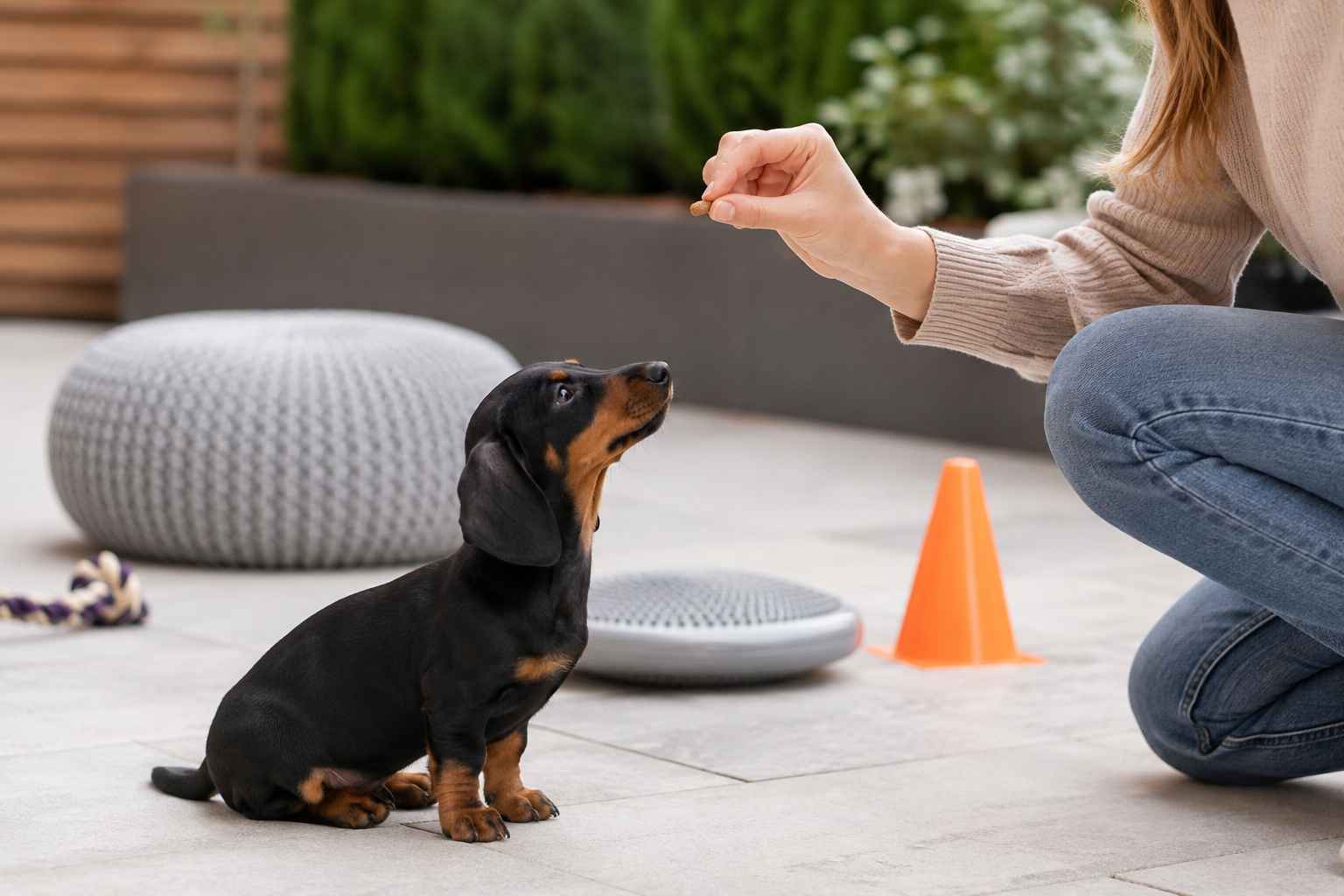
Begin training immediately—but keep it tiny
Name response, following you, coming for food, gentle handling, settling, and simple toilet routines are training. Formal obedience drills can wait.
Continue safe socialization
Socialization does not stop when the puppy leaves the breeder. Work with your veterinarian on a plan that balances disease risk with the importance of positive exposure during the early developmental period.
Book your veterinary examination
Bring breeder records and your contract. Ask questions about vaccination timing, parasite prevention, nutrition, safe exercise, body condition, dental care, and anything you noticed after arrival.
Dogs Central’s Small Dog Training, Small Dog Health, Small Dog Nutrition, and Small Dog Grooming resources can help as your puppy grows.
Miniature Dachshund Adoption or Rehoming as an Alternative to Buying a Puppy
A breeder puppy is not the only way to bring a Miniature Dachshund into your life.
An adult or privately rehomed Mini Dachshund may be an especially good choice if you want more certainty about mature size, coat, energy level, house-training status, and established temperament.
Pet Rehoming Network maintains a dedicated Miniature Dachshund Adoption & Rehoming page with private-owner adoption listings when available and information for people who need to find a carefully matched new home for their dog.
Could an adult be easier than a puppy?
Often, yes. An adult may already sleep through the night, have a known personality, tolerate reasonable time alone, walk on leash, and be past the constant chewing and toilet schedule of puppyhood. That does not make every adult effortless, but it does make the dog more predictable.
Beware of “adoption” used as a sales disguise
A commercial seller can call a transaction an “adoption.” The label does not matter as much as the source. Ask who owns the dog, why it is available, what medical and behavioral history is known, and whether the arrangement is truly rescue/rehoming or simply retail puppy sales with softer language.
Frequently Asked Questions About Miniature Dachshund Puppies
How much are Mini Dachshund puppies?
There is no single nationwide price. Cost varies by region, breeder practices, pedigree, health testing, veterinary care, coat, and demand. Price alone does not prove whether a puppy was responsibly bred.
Where can I find Mini Dachshund puppies for sale near me?
Start with breed-club breeder referrals and carefully researched breeders rather than choosing the closest advertisement. Dogs Central’s Small Dog Breeders Directory can also be one research starting point as it grows.
How do I find a reputable Miniature Dachshund breeder?
Look for documented parent health testing, transparent discussion of IVDD and family health, clean and enriched puppy raising, thoughtful socialization, buyer screening, a written contract, and lifetime responsibility for the dogs produced.
What health testing should Mini Dachshund parents have?
Current AKC guidance based on the national breed club lists patella evaluation, cardiac exam, and ophthalmologist evaluation for Dachshunds. Ask for verifiable results and also discuss IVDD and significant back problems in the family.
Is “vet checked” enough?
No. A routine veterinary examination is valuable but does not replace breeding-stock screening for inherited orthopedic, cardiac, and eye concerns.
Is DNA testing enough?
No. DNA panels can identify selected genetic variants but cannot replace physical screening such as eye, heart, and patella evaluations.
Can a breeder guarantee my Mini Dachshund will stay under a certain weight?
A breeder can estimate adult size based on parents and pedigree, but an exact mature weight cannot be guaranteed from a young puppy.
What is a teacup Mini Dachshund?
Teacup is an unofficial marketing term. The U.S. Dachshund size divisions are Standard and Miniature.
Are “micro” or “ultra Mini” Dachshunds a separate breed?
No. Those are marketing labels rather than additional recognized U.S. Dachshund sizes.
What should I ask about a dapple Mini Dachshund puppy?
Ask about the merle/dapple status of both parents and make sure the litter was not produced from two merle/dapple parents. Responsible color breeding should never come before health.
Are English Cream Mini Dachshund puppies healthier?
No coat label automatically makes a puppy healthier. English Cream is a descriptive term, not a health certification. Evaluate the breeder using the same health, temperament, and welfare standards you would use for any Dachshund.
Are long-haired Mini Dachshund puppies harder to care for?
They require more brushing and combing than Smooths. A good breeder should begin introducing Longhaired puppies to gentle coat and body handling before they go home.
When can a Mini Dachshund puppy leave its mother?
Most puppies are ready to transition around 8–10 weeks, although individual readiness, local law, and very small body size may justify staying with the breeder longer.
What records should come with my puppy?
Expect written veterinary and vaccination information, parasite-control records, microchip information if applicable, parent-health documentation, registration information where relevant, and a written contract.
Are Mini Dachshund puppies hard to potty train?
Some require substantial patience. Frequent scheduled trips, supervision, immediate rewards, and careful management during bad weather are especially important.
Should I buy the calmest puppy in the litter?
Not automatically. A very quiet puppy could be relaxed, sleepy, frightened, or unwell. Ask the breeder about behavior observed over many days rather than choosing from one brief visit.
Should I choose a male or female Mini Dachshund?
Choose for individual temperament and household fit before sex. Broad male-versus-female personality stereotypes are unreliable.
Is it safe to buy a Mini Dachshund puppy online?
It can be possible to arrange a responsible long-distance purchase online, but verify the breeder, puppy, mother, environment, health testing, contract, and transport arrangements before paying. Never rely only on photographs and text messages.
Are puppies advertised for under $300 or $500 scams?
Not automatically, but an unusually low price is a reason to investigate carefully. Cheap-puppy searches are attractive to scammers because buyers may act quickly when they think they have found a bargain.
Why shouldn’t I buy a puppy from a pet store?
Retail sales can separate the buyer from the breeding environment and parent dogs. Dogs Central recommends obtaining a puppy directly from a responsible breeder you can evaluate or choosing a reputable adoption/rehoming source.
Where can I adopt a Miniature Dachshund?
Check local Dachshund rescues and shelters and visit Pet Rehoming Network’s Miniature Dachshund adoption and rehoming page for private-owner listings when available.
Trusted Miniature Dachshund Puppy-Buyer & Animal-Welfare Resources
- Dachshund Club of America: breed education and buyer resources, including the DCA member breeder directory.
- Dachshund Club of America Health: breed-health information and IVDD resources.
- American Kennel Club: current Hound Group health-testing recommendations.
- Orthopedic Foundation for Animals: search public health-testing records and learn about the CHIC program.
- ASPCA: Puppy Mills 101 and the Puppy Pipeline.
- Federal Trade Commission: pet-scam prevention guidance.
No website, registry, directory, breeder list, or health certificate can guarantee a perfect puppy. The purpose of due diligence is to reduce avoidable risk and support people who breed and raise dogs responsibly.
About This Miniature Dachshund Puppy Guide
Dogs Central has been helping dog lovers learn about companion dogs since 2002. This Miniature Dachshund puppy guide is part of our growing buyer-education library designed to help families find healthy, well-socialized puppies without rewarding puppy mills, scams, brokers, pet-store sourcing, or careless breeding.
This guide can grow as the Miniature Dachshund section expands. Future additions may include original puppy-buyer infographics, a Miniature Dachshund names guide, breeder showcase profiles, long-haired Mini Dachshund resources, feeding guidance, harness recommendations, and additional owner experiences.
The standard we want every buyer to remember is simple: do not ask only whether a puppy is available. Ask why this puppy was bred, how the parents were selected, how the litter was raised, and what evidence supports the seller’s claims.