
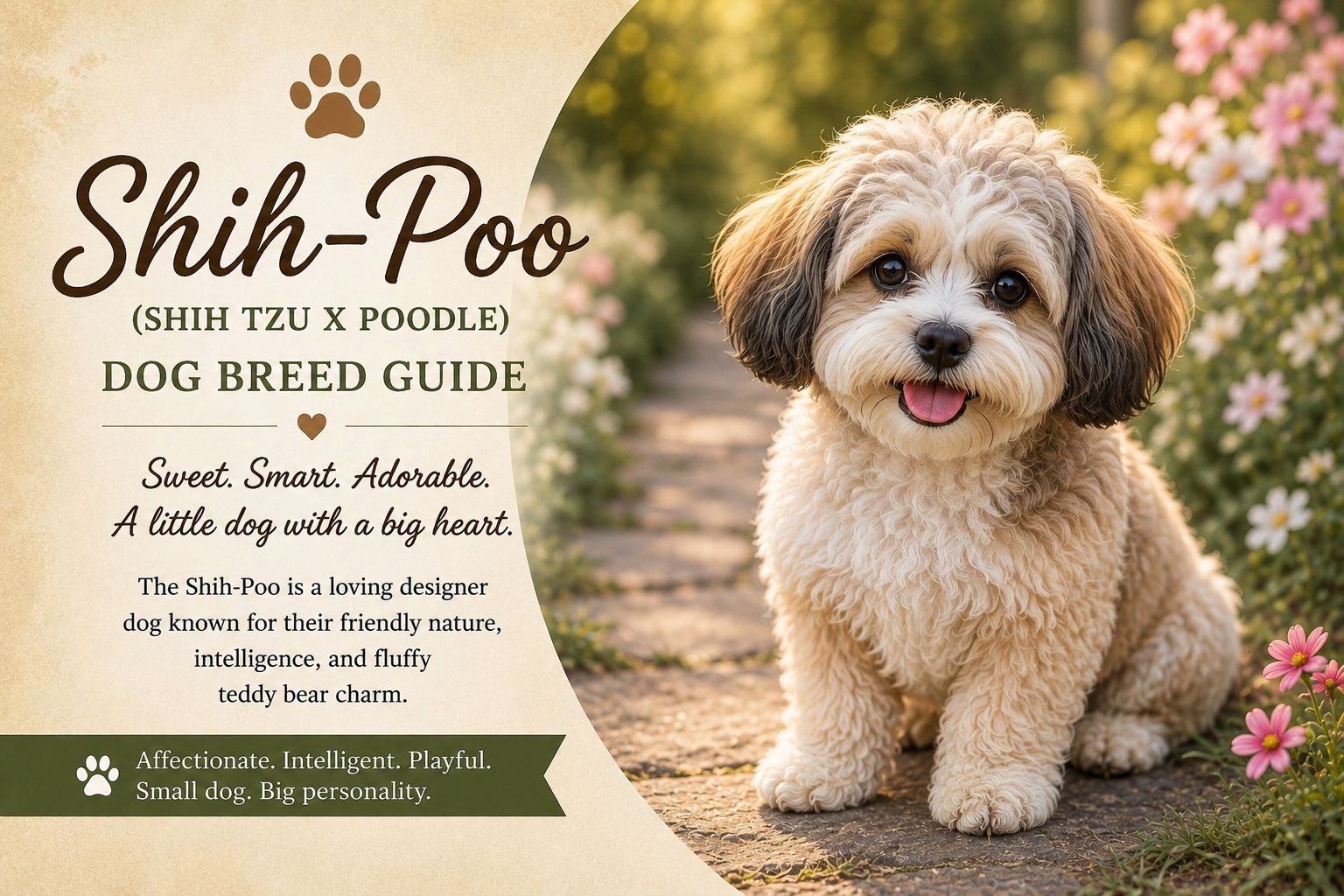
Shih-Poo Dog Breed Guide: Shih Tzu Poodle Mix Size, Temperament, Haircuts, Health & More
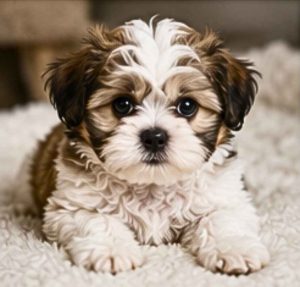 The Shih-Poo—also written Shih Poo, Shihpoo, Shipoo, or simply described as a Shih Tzu Poodle mix or Shih Tzu and Poodle cross—is a small companion dog produced by crossing a Shih Tzu with a Toy or Miniature Poodle. The name sounds tidy. The genetics are considerably less tidy, which is one of the most important things to understand before deciding this is the dog for you.
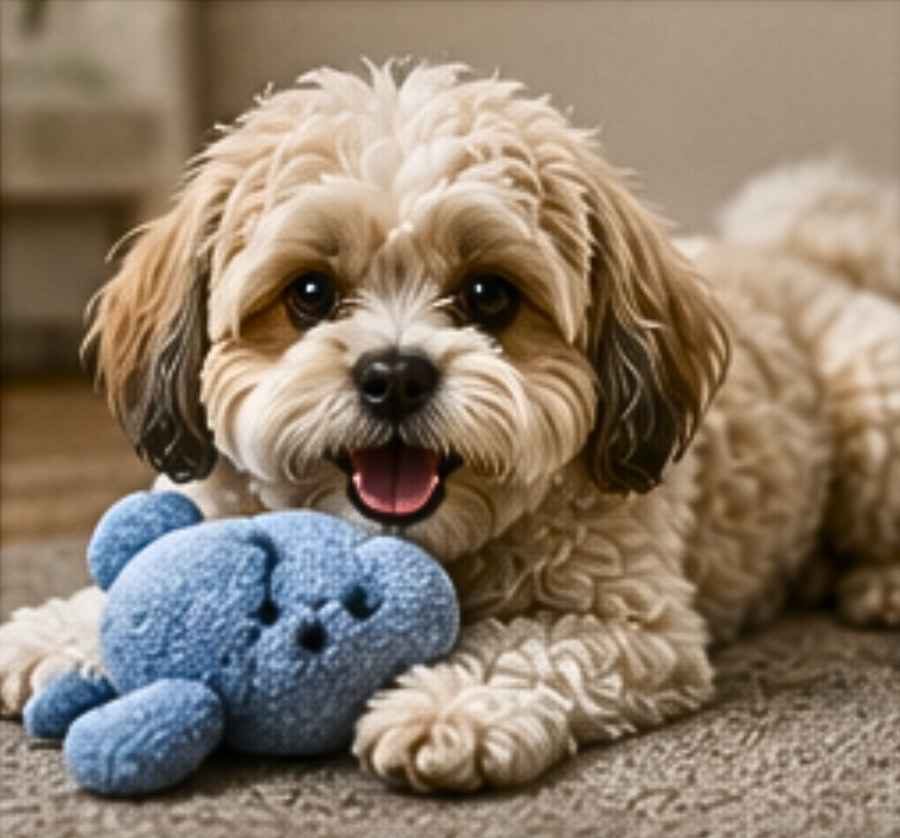
A Shih-Poo may inherit the Poodle’s quick learning, athletic little body and curly low-shedding coat; the Shih Tzu’s sturdier companion-dog build, charming independence and shorter muzzle; or a very individual mixture of the two. Some adults look almost like miniature curly teddy bears. Others retain more of the Shih Tzu’s long, softer coat and rounder head. Size, coat, color, shedding, temperament and even facial structure can vary substantially.
That variability does not make the Shih-Poo a poor choice. It simply means prospective owners should choose the individual dog and the quality of its breeding, not an imaginary guaranteed package attached to a designer name. In return, many Shih-Poos are affectionate, funny, bright little companions who adapt beautifully to apartments and enjoy being involved in family life.
This complete guide covers the subjects Shih-Poo owners and prospective owners search for most: full-grown Shih-Poo size, temperament, grooming and haircuts, coat colors, shedding and hypoallergenic claims, lifespan, health issues, exercise, training, puppies, price, adoption, teacup terminology and comparisons with similar small companion dogs.
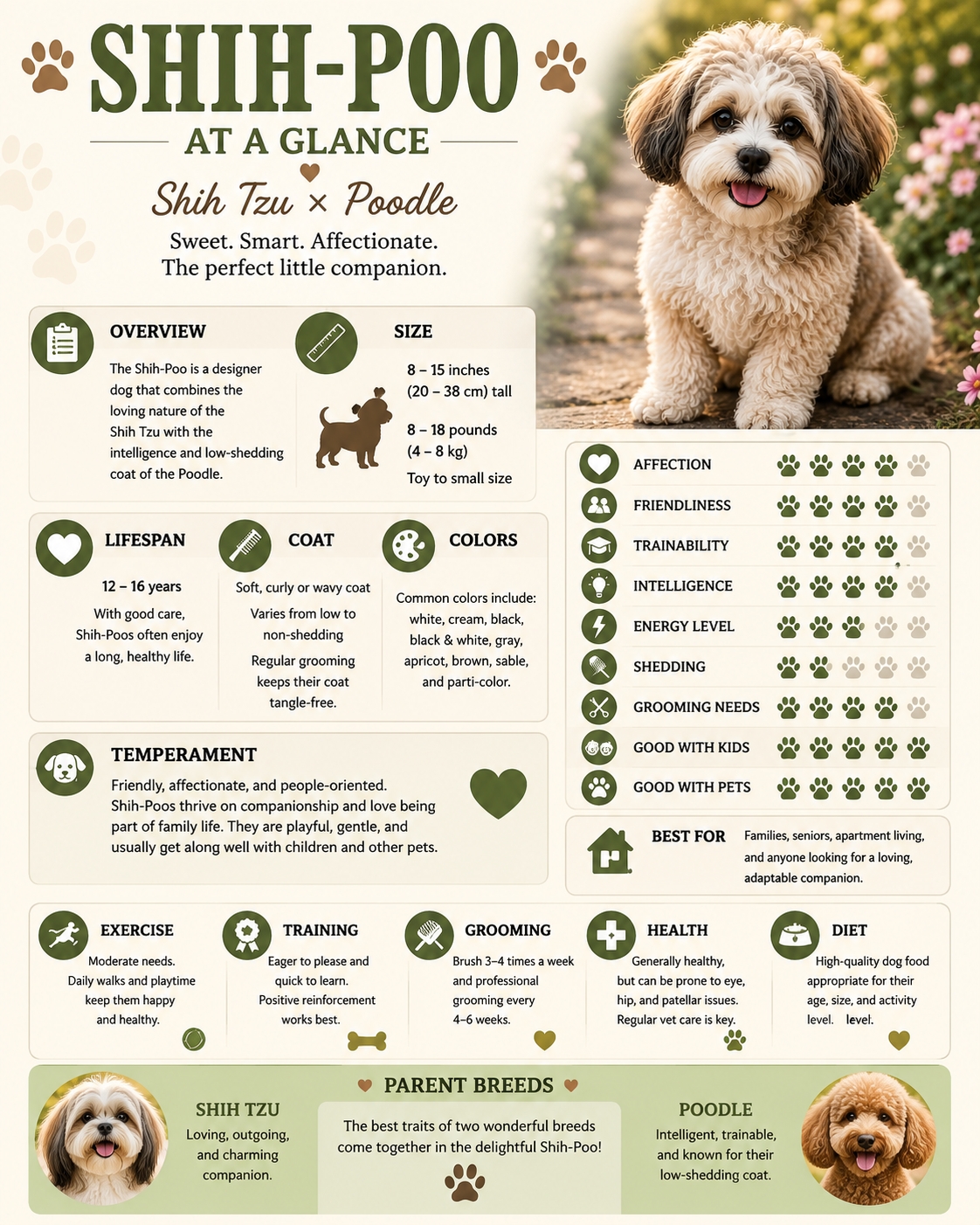
Shih-Poo at a Glance
| Other names | Shih Poo, Shihpoo, Shipoo, Shih Tzu Poodle mix, Shih Tzu and Poodle cross |
|---|---|
| Parent breeds | Shih Tzu × Toy or Miniature Poodle |
| Breed status | Designer/hybrid mixed-breed dog; not an AKC-recognized pure breed |
| Typical adult size | Usually toy to small; often around 8–18 pounds, with variation according to parent size and genetics |
| Typical height | Often roughly 8–15 inches at the shoulder; individual dogs vary |
| Coat | Straight, wavy or curly; usually continuously growing and relatively low shedding |
| Temperament | Often affectionate, playful, companionable, bright and amusing; some inherit an independent streak |
| Exercise | Low to moderate physical needs plus regular mental enrichment |
| Grooming | High; frequent brushing and regular trimming are common |
| Shedding | Often low, but not guaranteed |
| Hypoallergenic? | No dog is guaranteed allergen-free; individual Shih-Poos vary |
| Best suited to | Companion-oriented homes prepared for grooming, training, dental care and regular company |
What Is a Shih-Poo? The Shih Tzu Poodle Mix Explained
A Shih-Poo is a mixed-breed dog created from a Shih Tzu and a Poodle, most commonly a Toy Poodle or sometimes a Miniature Poodle. The supplied U.S. keyword data strongly confirms that people use both the designer name and literal descriptions such as “Shih Tzu Poodle mix” and “Shih Tzu and Poodle cross.” They are describing the same basic combination.
What they are not describing is an established pure breed with one fixed appearance, size or temperament. There is no universal Shih-Poo breed standard. A breeder can make educated predictions using the parents and related dogs, but puppies can inherit different combinations from either side.
Is a Shih-Poo a Doodle?
In ordinary modern usage, many people call Poodle crosses “doodles,” so a Shih-Poo may be included under that broad informal umbrella. The label has no power to guarantee coat type, shedding, allergies, intelligence, temperament or health.
Is a Shih-Poo Recognized by the AKC?
No. The American Kennel Club recognizes both parent breeds, but it does not recognize the Shih-Poo as a separate pure breed. Mixed-breed status does not prevent a dog from being a wonderful companion, but advertising should not imply the uniformity of an established breed where none exists.
Shih-Poo History & Parent Breeds
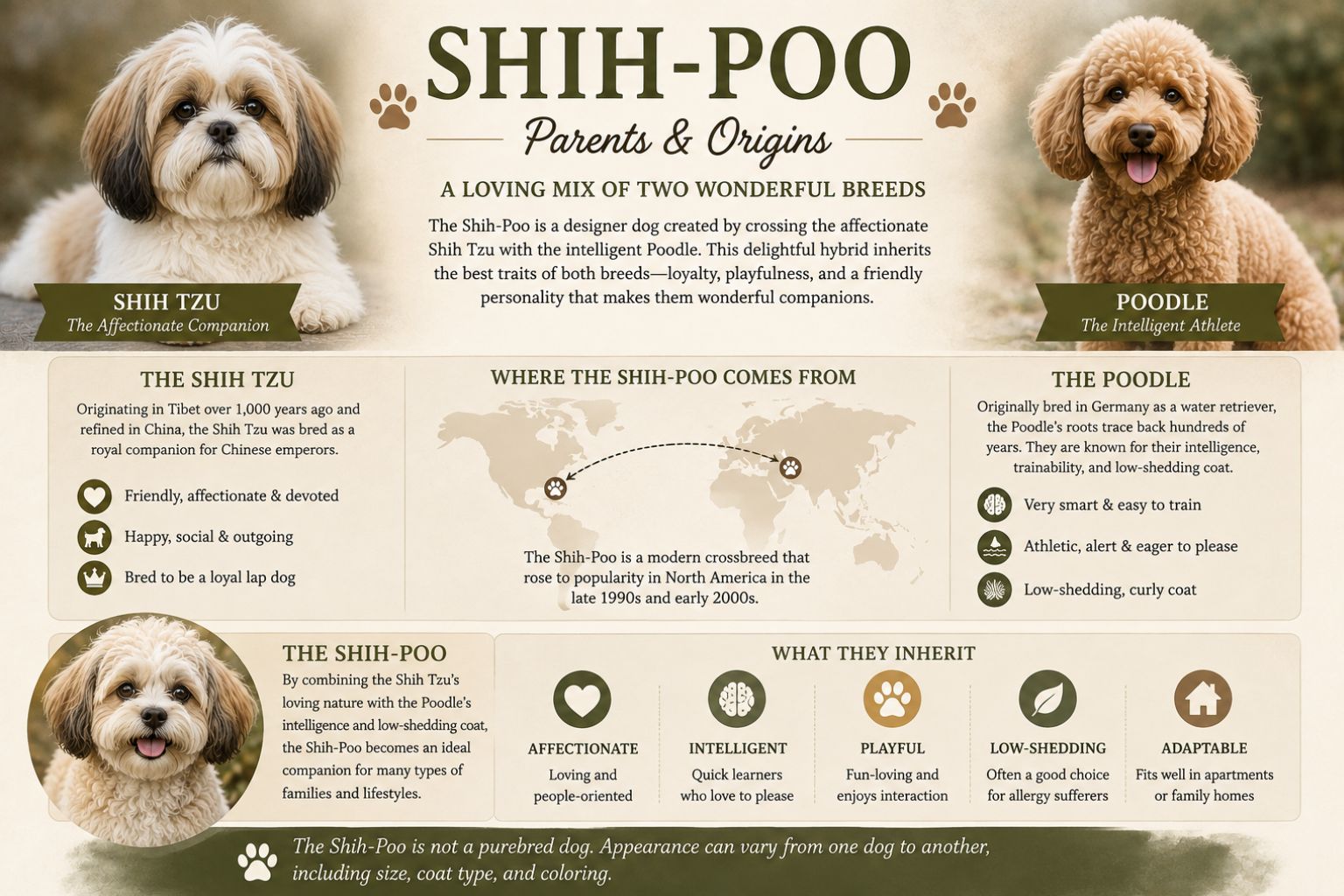
The Shih-Poo belongs to the modern designer-dog movement in which established breeds are deliberately crossed, often with the hope of combining companion qualities with the Poodle’s low-shedding coat and trainability. There is no single well-documented Shih-Poo founder or historical breed-development program comparable with those of established pure breeds.
The Shih Tzu Parent
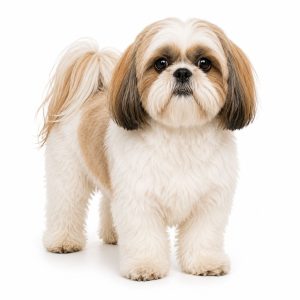 The Shih Tzu is an ancient companion breed associated with Tibet and imperial China. It was developed to live close to people rather than perform a demanding working job. That heritage helps explain the breed’s affectionate, sociable nature and its sometimes magnificently casual attitude toward doing something merely because a human suggested it.
Shih Tzu are compact, sturdy little dogs with long coats, prominent eyes and a shortened muzzle. Those physical traits matter in a cross because a Shih-Poo can inherit some degree of brachycephalic facial structure along with Shih Tzu-like eye prominence.
The Poodle Parent
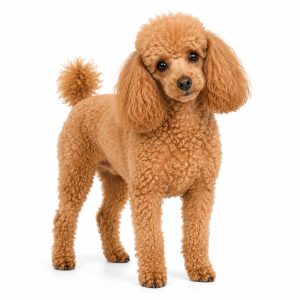 Poodles are highly intelligent, athletic dogs with a water-retrieving heritage. Toy and Miniature Poodles were developed from the larger Poodle type and retain considerable intelligence and trainability despite their smaller size.
The Poodle parent may contribute curl, athleticism, quick learning and a very low-shedding coat. But genetics is not a menu where a breeder can order “Poodle coat, Shih Tzu calmness, no health risks, eight pounds exactly.” Each puppy inherits its own combination.
F1, F1b, F2 & Multigenerational Shih-Poos
Designer-dog sellers often use generation labels. They describe ancestry, not guaranteed results.
- F1 Shih-Poo: Shih Tzu × Poodle.
- F1b Shih-Poo: an F1 Shih-Poo bred back to one parent breed, often a Poodle.
- F2 Shih-Poo: typically an F1 bred to another F1.
- Multigenerational Shih-Poo: later-generation breeding using Shih-Poos rather than a simple first-generation pairing.
An F1b backcross to a Poodle may increase the odds of a more Poodle-influenced coat, but it cannot guarantee no shedding or allergy tolerance. Nor does a later generation automatically mean healthier, calmer or more predictable puppies. The health, temperament, structure and family history of the actual breeding dogs matter far more than a generation acronym.
What Does a Shih-Poo Look Like?
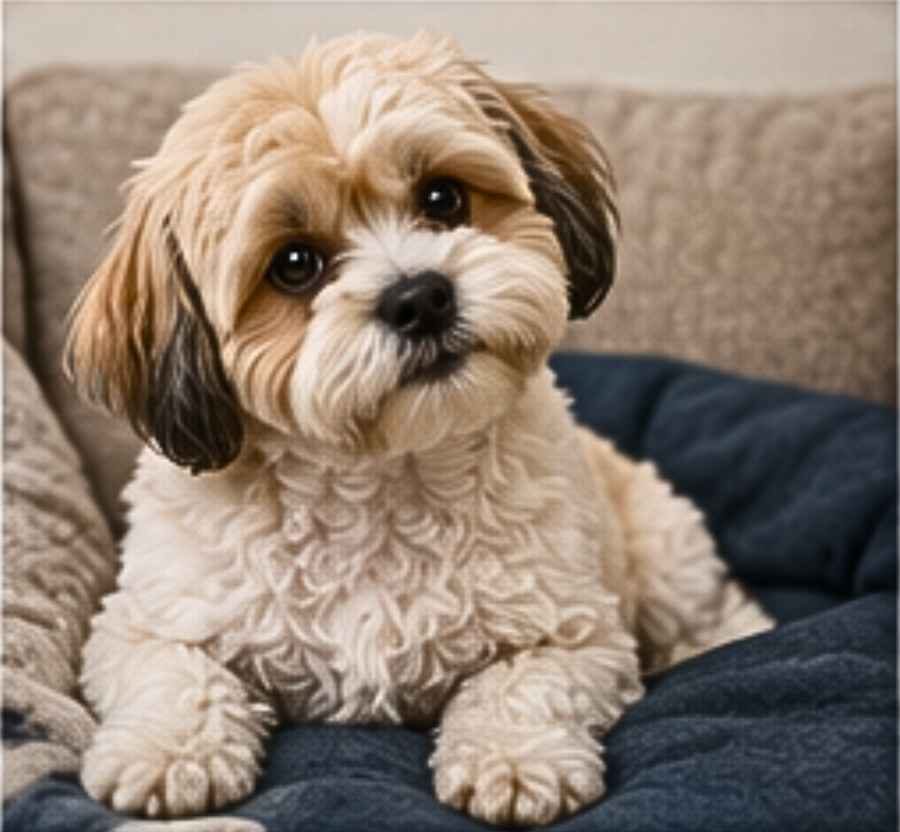
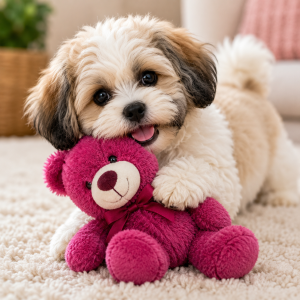
One reason “full grown Shih Poo” and picture-related searches are so common is that adult appearance can be surprisingly variable. Many Shih-Poos have a rounded, fluffy face, drop ears, dark expressive eyes and a soft coat. But the details differ.
A Poodle-influenced dog may have longer legs, a finer muzzle and distinctly curly coat. A Shih Tzu-influenced dog may be more compact, broader through the body, shorter in the face and straighter or wavier in coat texture. Grooming style changes the visual effect dramatically, which is why the same dog can look almost like two different breeds before and after a haircut.
Facial structure deserves particular attention. A moderate muzzle that allows comfortable breathing and protects the eyes is more important than achieving an exaggerated “baby face.”
How Big Does a Shih-Poo Get? Full-Grown Shih-Poo Size & Weight
Full-grown Shih-Poo is one of the strongest informational clusters in the supplied U.S. data. Many adults are approximately 8 to 18 pounds, although smaller and larger dogs occur. Height is often roughly 8 to 15 inches at the shoulder.
The single most important factor is which Poodle variety and actual parent sizes were used. A Shih Tzu crossed with a small Toy Poodle is likely to produce smaller offspring than a pairing using a substantial Miniature Poodle. Even then, littermates can finish at different weights.
When Is a Shih-Poo Full Grown?
Most small dogs achieve much of their adult height during the first year, then continue filling out physically and maturing behaviorally. Coat texture and color can also change between puppyhood and adulthood.
Can a Breeder Guarantee Adult Weight?
No breeder can guarantee an exact mature weight for a young mixed-breed puppy. The parents, grandparents and previous related litters can improve an estimate, but they do not turn genetics into arithmetic.
Mini, Toy and Teacup Shih-Poos
Searches for mini, toy and “teacup Shih Poo” are common. “Toy” may describe the Poodle parent or the dog’s general size, but the Shih-Poo does not have official toy, mini and teacup varieties. Teacup is a marketing term, not a recognized size classification.
Extremely tiny dogs can be more fragile and may be vulnerable to hypoglycemia, dental crowding, injury and other problems. A responsible breeder should prioritize health and functional structure over producing the smallest puppy possible.
Shih-Poo Coat Types & Colors
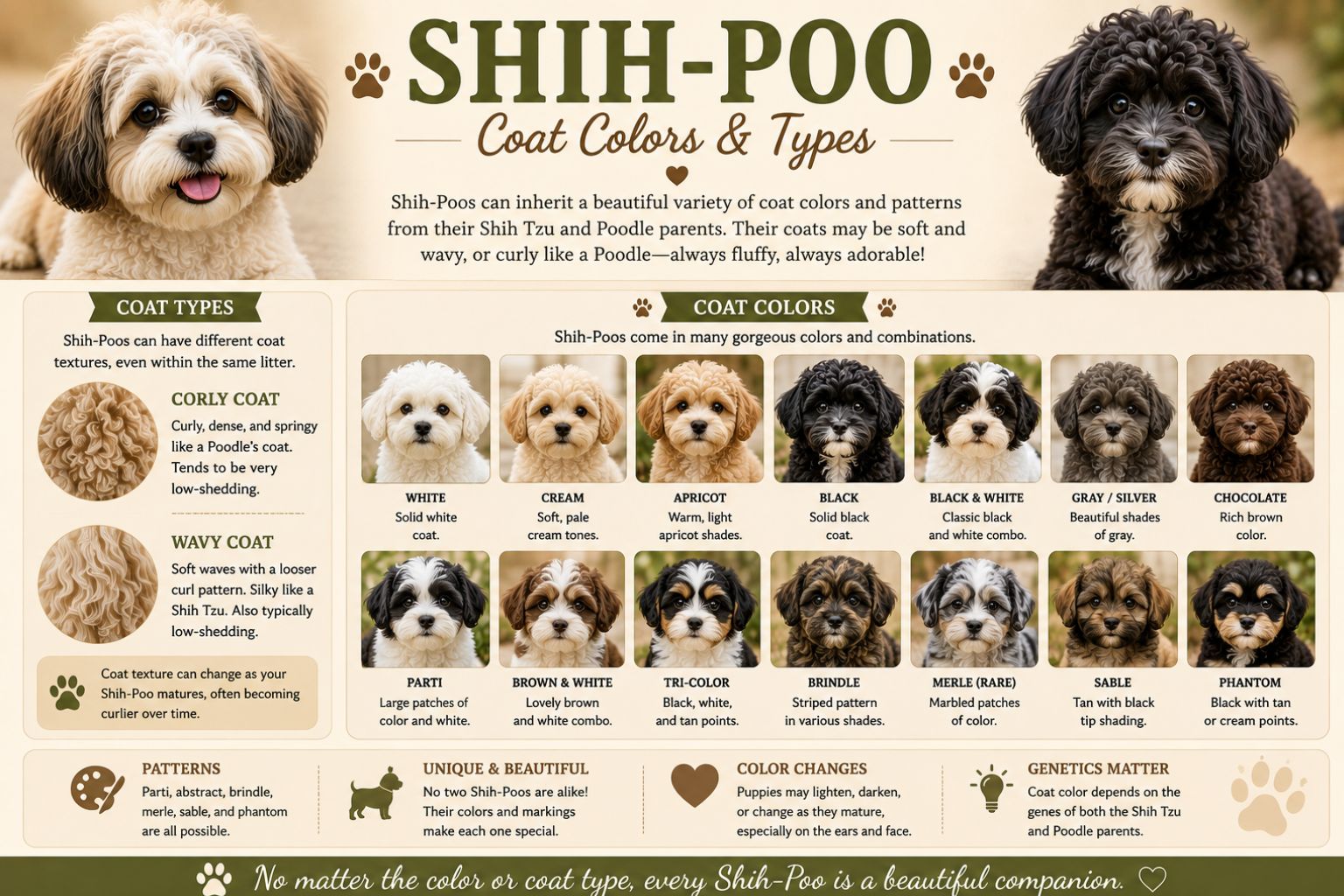
Shih-Poos can inherit a broad range of colors and patterns because both parent breeds occur in numerous shades. The keyword data shows particular interest in black Shih-Poos, white, black-and-white, brown and merle-related searches.
Common Shih-Poo Colors & Patterns
- Black
- White or cream
- Black and white
- Brown or chocolate
- Apricot
- Red or reddish shades
- Gray or silver tones
- Gold or tan
- Parti and other multi-color combinations
Coat color can change with age. Poodle coats may lighten as a dog matures, while Shih Tzu color can also evolve significantly. A dark puppy may not remain exactly the same shade as an adult.
Straight, Wavy or Curly?
Texture can range from relatively straight and silky to loose waves to dense curls. Curlier coats often trap shed hair especially effectively, while softer wavy coats can mat extremely quickly. Straighter coats may resemble the Shih Tzu more closely but still require substantial maintenance.
What About Merle Shih-Poos?
Merle searches have low difficulty in the supplied data, but unusual color should invite questions rather than automatic enthusiasm. Merle is not a standard Shih Tzu pattern. Ask exactly how the color entered the breeding line, request documented parentage and relevant genetic information, and never let a fashionable pattern take priority over health, temperament and functional structure.
Are Shih-Poos Hypoallergenic? Do Shih-Poos Shed?
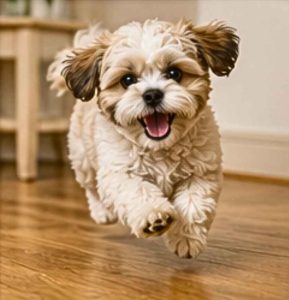 Shih-Poos are often low shedding, but no dog can be guaranteed completely hypoallergenic. Both Shih Tzu and Poodles tend to release relatively little loose hair compared with many breeds, so the cross frequently appeals to people who prefer less fur around the home.
Allergy is not simply an issue of hair. People can react to proteins associated with dander, saliva, urine and skin secretions. A low-shedding dog may spread less loose hair through a house while still producing allergens.
If allergies are important to your decision, spend meaningful time around adult dogs with similar coats before committing. Be particularly cautious about breeders charging a premium for a “100% hypoallergenic” puppy. A mixed-breed puppy cannot provide that guarantee.
The grooming trade-off is important: low shedding often means loose hair remains trapped within the coat, where it can contribute to tangles and mats. Shih-Poos may leave little hair on the sofa while requiring considerably more work with a comb.
For broader context, see our Hypoallergenic Small Dog Breeds Guide and Small Dogs That Don’t Shed Much.
Shih-Poo Temperament & Personality
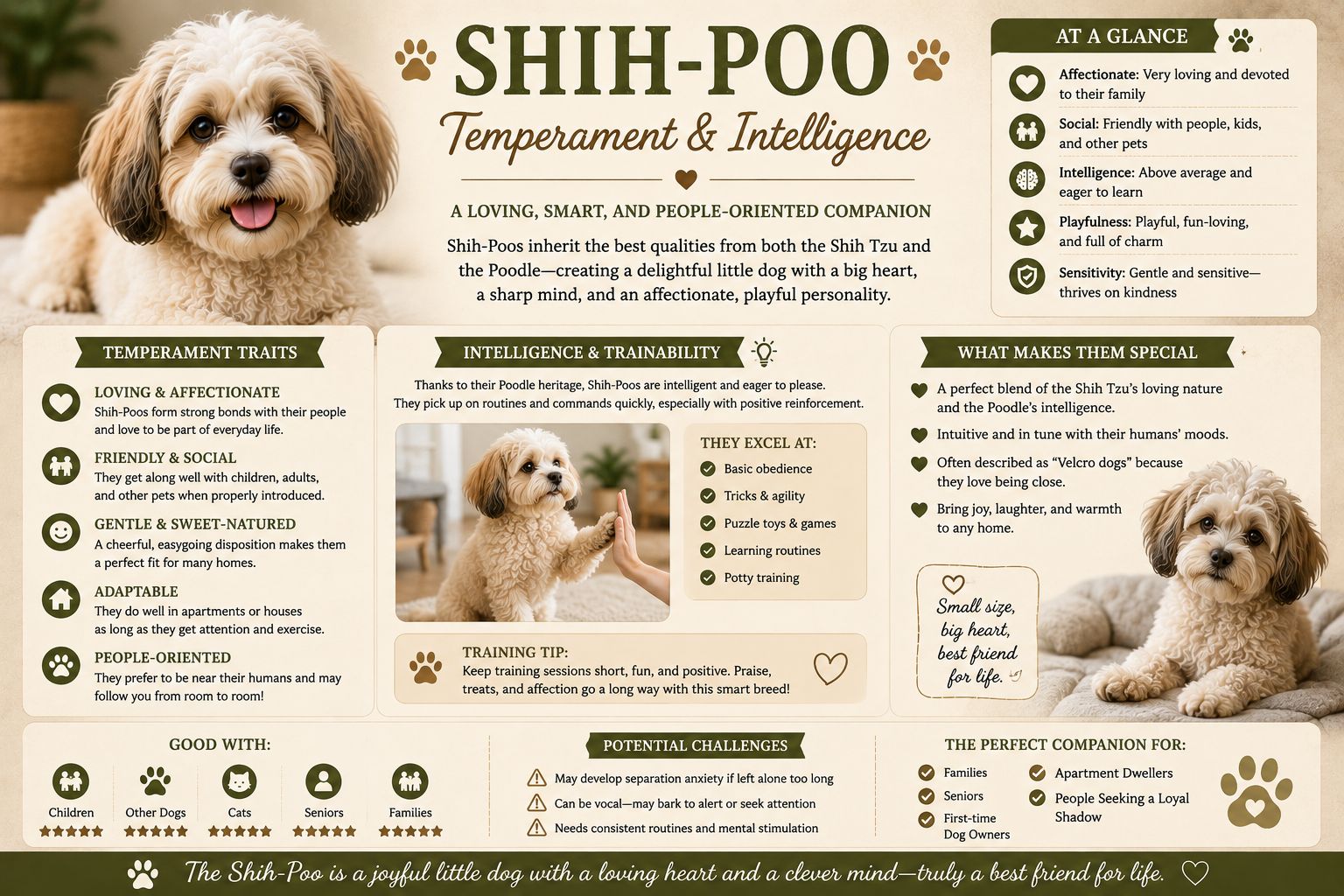
Many Shih-Poos are affectionate, amusing, playful little dogs who enjoy attention and want to participate in family routines. Both parent breeds are strongly people-oriented, but they approach life somewhat differently. Poodles tend to be quick, alert learners; Shih Tzu are often cheerful companions with more independence and less interest in repetitive exercises.
A Shih-Poo may therefore be wonderfully trainable while still having opinions. You may teach “sit” in five minutes and discover the next morning that your student has apparently opened negotiations concerning compensation.
Are Shih-Poos Affectionate?
Usually very much so. Many enjoy laps, cuddling and following favorite people through the house. They can form close bonds with one person or spread their loyalties around a family.
Are Shih-Poos Calm or Hyper?
Most fall somewhere in the lively-companion middle. They generally do not require the workload of a high-drive sporting dog, but Poodle influence can produce surprising energy and enthusiasm for games. Puppies also have the universal talent for appearing completely unhinged five minutes before falling asleep.
Individual Temperament Matters
Designer breeding does not average two parent personalities into one guaranteed result. Meet the mother, learn about the father and ask specifically about fear, reactivity, barking, handling, separation behavior and sociability in both lines.
Are Shih-Poos Smart? Intelligence & Trainability
Shih-Poos are usually intelligent dogs. The Poodle parent contributes one of the canine world’s best-known learning traditions, while Shih Tzu are perfectly capable learners who may simply be less impressed by repetition.
A good training approach is short, upbeat and rewarding. Food, toys, praise and access to things the dog wants can make learning efficient. Harsh corrections are unnecessary and can create avoidance or fear in a sensitive companion dog.
Useful Skills to Teach
- Coming when called.
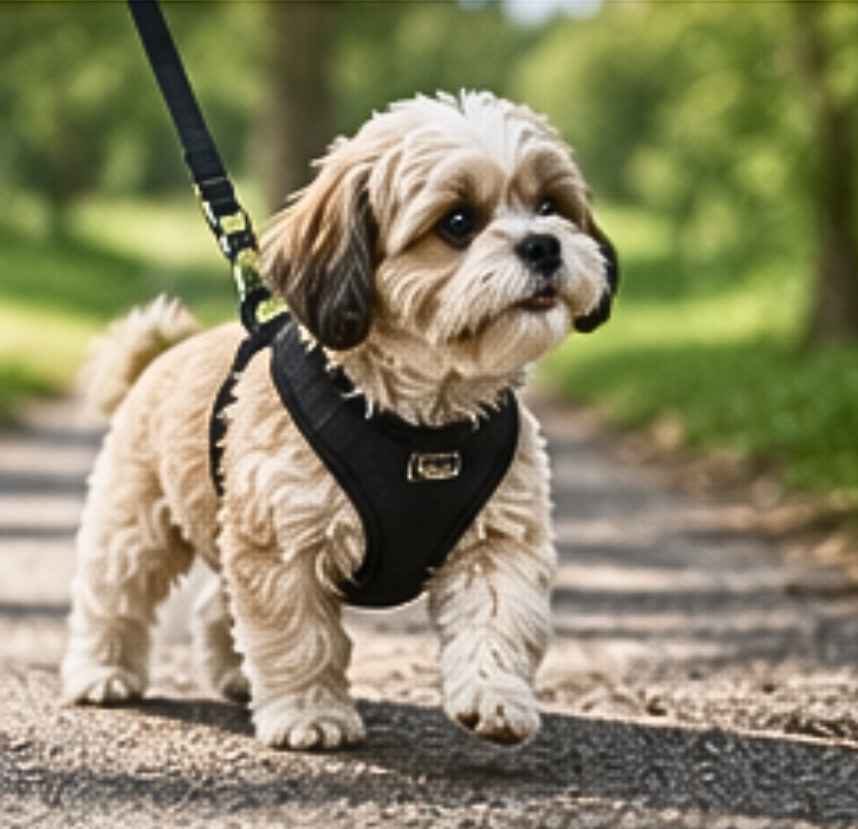
- Walking comfortably on a harness and leash.
- Settling on a bed or mat.
- Calm greetings.
- Trading objects rather than guarding or running away.
- Comfort with face, feet, ears and body handling.
- Standing calmly for brushing and combing.
- Relaxing for short periods without constant human contact.
- Quiet behavior around doors, windows and hallway noises.
Cooperative grooming deserves special emphasis. For a Shih-Poo, learning to tolerate face combing can be as valuable as learning a perfect sit.
Training & House Training a Shih-Poo
Start training immediately, not because the puppy is “bad,” but because habits form whether you intended to teach them or not. If barking brings attention, stealing socks starts a chase, and refusing dinner produces roast chicken, your Shih-Poo is learning beautifully.
House Training
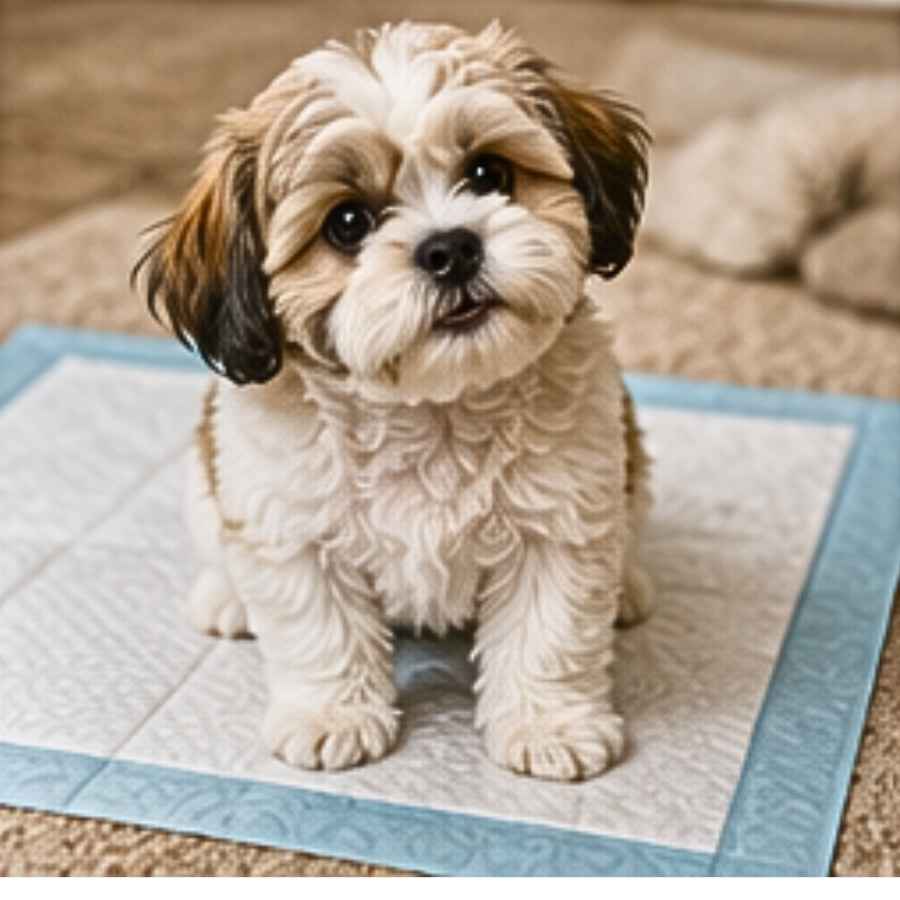
Small puppies have small bladders. Frequent outdoor opportunities, supervision and immediate rewards for success are much more effective than punishment. Take the puppy out after waking, meals, drinking, energetic play and before bedtime, plus regular trips in between.
Bad weather can complicate training for a small long-coated dog. A sheltered toilet area is enormously helpful in rain or snow. If an accident happens, clean it thoroughly and adjust supervision or timing rather than scolding the puppy.
Socialization
Expose puppies gradually to people, sounds, surfaces, handling, grooming equipment, car rides and appropriate dogs. Socialization is about creating calm confidence—not overwhelming a puppy with nonstop greetings.
Do Shih-Poos Bark a Lot?
Some can be surprisingly vocal. Shih Tzu are alert companion dogs and Poodles notice environmental changes quickly, so the combination may announce visitors, hallway sounds, delivery drivers and activities outside a window.
Barking is easier to manage before it becomes a deeply rehearsed habit. Reward quiet observation, teach a calm “thank you” or settle routine, provide enough activity and reduce visual triggers where necessary.
Do not respond to every bark by picking the dog up or rushing to investigate together; that can unintentionally turn alarm barking into a highly successful teamwork exercise.
If barking is caused by fear or true separation distress, treat the underlying emotion rather than concentrating only on stopping the sound.
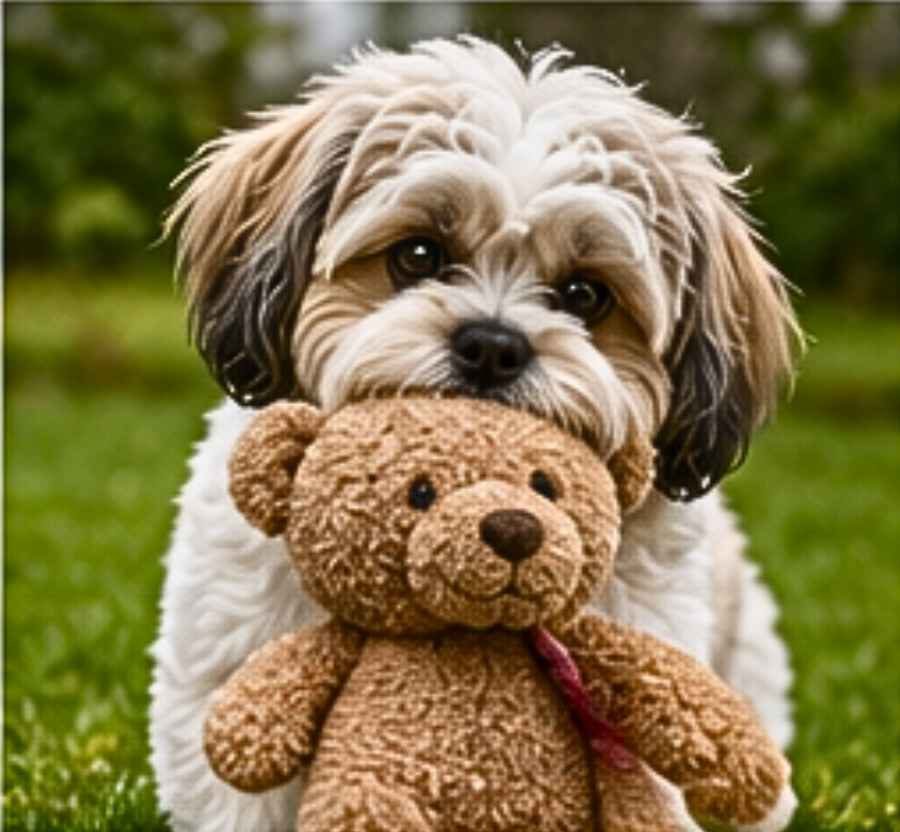
Can Shih-Poos Be Left Alone? Separation Anxiety & Independence
Shih-Poos are companion-oriented dogs and many prefer not to spend very long days alone. That does not mean they should be allowed to become incapable of functioning without their favorite person.
Teach independence gradually from puppyhood. Encourage naps in a comfortable dog bed, use food toys during short absences and let trusted family members participate in care. Begin with tiny periods of relaxed separation and increase slowly.
True separation anxiety can involve panic, persistent vocalization, destruction around exits, drooling, house-soiling specifically associated with absence or an inability to eat when alone. Severe cases deserve veterinary and qualified behavior support.
Shih-Poo Exercise Needs & Enrichment Activities
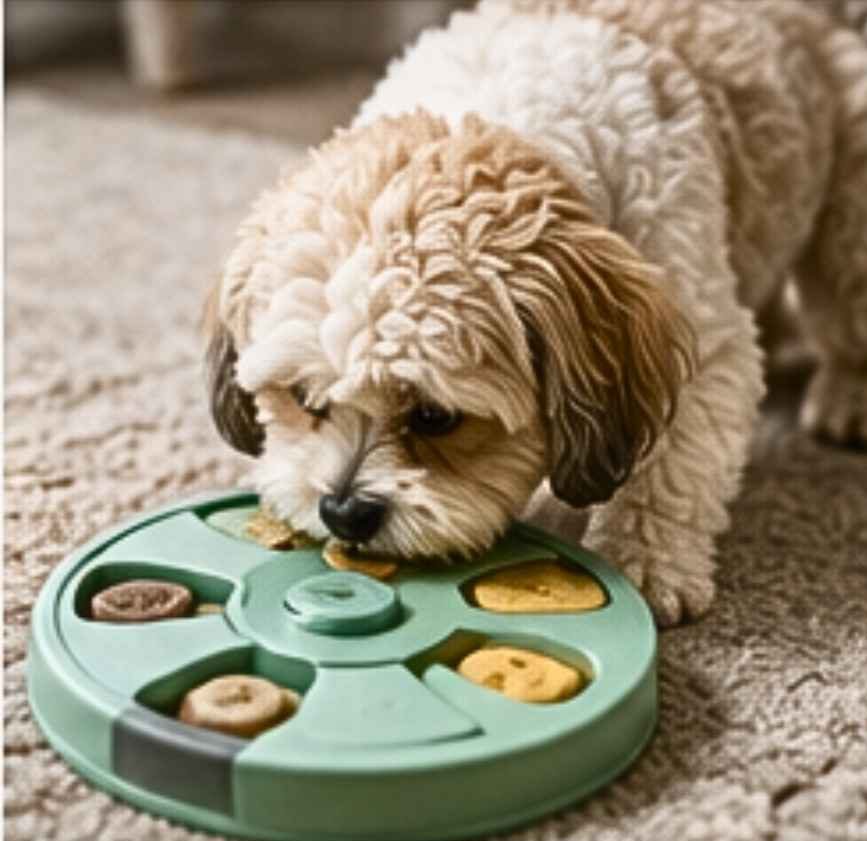
Most Shih-Poos need low-to-moderate physical exercise but still benefit enormously from daily walks, play and mental work. Their small size makes activity easy to fit into ordinary life, but “small dog” should never be interpreted as “doesn’t need to do anything.”
Good Shih-Poo Activities
- Short neighborhood walks with plenty of sniffing.
- Food puzzles and treat-dispensing toys.
- Hide-and-seek.
- Find-it scent games.
- Trick training.
- Gentle fetch.
- Safe indoor obstacle courses.
- Short training games between household routines.
Dogs with longer Poodle-like muzzles may tolerate vigorous activity better than Shih-Tzu-influenced dogs with shortened airways. Heat, humidity and breathing comfort should guide exercise decisions.
Are Shih-Poos Good Family Dogs? Children, Dogs & Cats
Shih-Poos can be excellent family companions when the dog’s temperament and the household are compatible. Their small size, affection and manageable exercise needs appeal to many families.
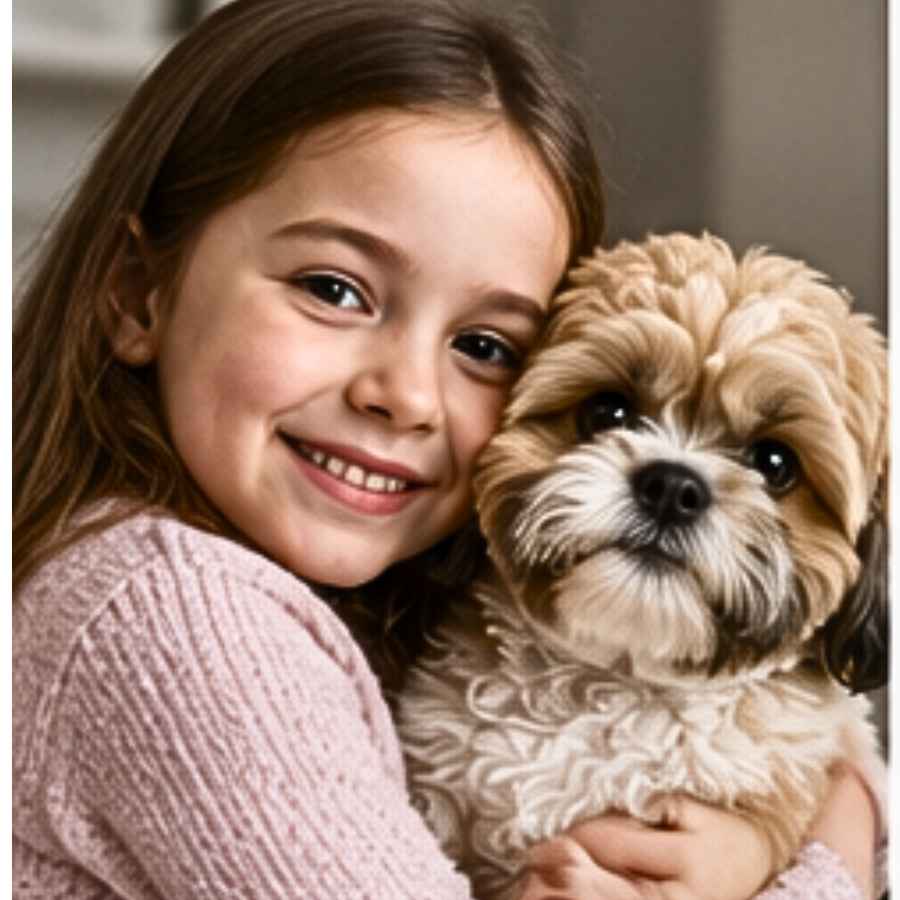
Shih-Poos and Children
Many enjoy respectful children, but toy-sized dogs are physically vulnerable. Young children need adult supervision so the dog is not dropped, squeezed, chased or accidentally stepped on. Teach children to interact on the floor and to leave the dog alone while eating, sleeping or retreating to a safe space.
Shih-Poos and Other Dogs
Many are sociable with other dogs when introductions are thoughtful. Very small individuals need protection from rough play with much larger dogs. Compatibility depends on the individuals, not simply breed labels.
Shih-Poos and Cats
Peaceful cohabitation is common when introductions are gradual. Neither parent breed was primarily developed for strong predatory work, but individuals still vary. Reward calm behavior and prevent chasing from becoming a rehearsed game.
Shih-Poos in Apartments, With Seniors & First-Time Owners
Apartment Living
The Shih-Poo’s size makes it an excellent physical fit for apartments and condominiums. Barking and separation behavior are more likely to create problems than square footage. Daily outdoor walks and enrichment are still important.
Shih-Poos for Seniors
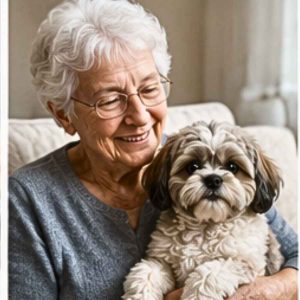
A calm adult Shih-Poo can be a wonderful companion for an older adult who wants affection without large-dog exercise requirements. Consider professional grooming costs, the ability to handle routine coat care and the tripping hazard posed by a tiny dog who enjoys walking directly behind feet.
First-Time Dog Owners
Shih-Poos can suit attentive first-time owners. Their size and companion temperament are manageable, but grooming, dental care, house training and early independence training require real consistency. The dog may be little; the maintenance schedule is not.
For more comparisons, see our guides to small dogs for seniors and the broader Small Designer Dog Breeds Guide.
Shih-Poo Grooming & Haircuts
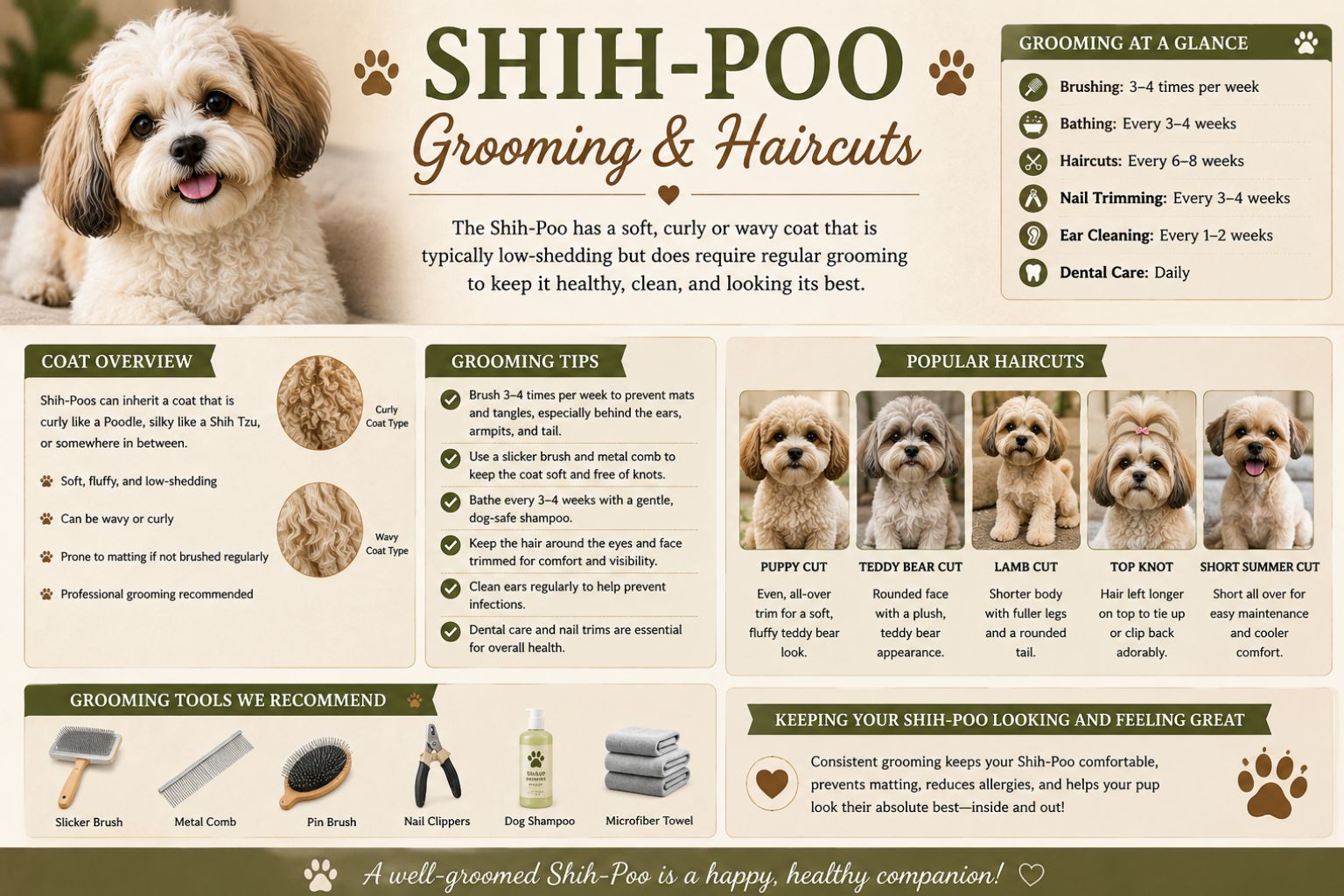
Grooming is one of the strongest Shih-Poo opportunities in the supplied U.S. keyword data. “Haircuts for Shih Poo dogs” has particularly low SEO difficulty, and the practical demand is obvious: this cross almost always requires consistent coat maintenance.
Most Shih-Poos need thorough brushing several times a week. Long or very soft coats may need daily attention. Mats often form behind the ears, under the harness, in the armpits, between the legs and around the tail. A surface brush-over can leave tight tangles hidden near the skin, so finish with an appropriate metal comb.
Popular Shih-Poo Haircuts
- Puppy cut: a practical, fairly even trim over the body that simplifies maintenance.
- Teddy-bear cut: a plush body with a rounded face, one of the most popular Shih-Poo styles.
- Short utility trim: useful for active dogs, warm climates or owners who prefer easier coat care.
- Shih Tzu-inspired longer coat: attractive on straighter coats but significantly more demanding.
- Poodle-inspired trim: particularly suitable for curlier coats and can keep the face and feet tidy.
How Often Should a Shih-Poo Be Professionally Groomed?
Many pet Shih-Poos are professionally groomed about every four to eight weeks, depending on coat texture, haircut, growth rate and home maintenance. Your groomer can recommend a schedule for the individual dog.
Face & Eye Care
Keep facial hair from rubbing the eyes. Persistent tearing, redness, squinting, discharge, cloudiness or visible discomfort deserves veterinary assessment rather than simply another wipe with a grooming cloth.
Ear, Nail & Skin Care
Check ears regularly, especially in dogs with dense hair around the ear canal. Keep nails short enough for comfortable movement and watch for skin irritation hidden beneath a thick coat.
The grooming keyword cluster is strong enough to justify a future dedicated Shih-Poo Haircuts & Grooming Styles page with photographs of different coat types and trims.
Shih-Poo Health Issues & Responsible Health Testing
 A Shih-Poo is not automatically healthier because it is mixed. A puppy can inherit genetic disease, structural vulnerabilities and health tendencies from either side of the pedigree. Responsible breeders therefore need to understand both the Shih Tzu and the Poodle.
Patellar Luxation
Slipping kneecaps are relevant in many toy and small dogs and are included in parent-club testing pathways for both sides of this cross. Signs may include skipping on a rear leg, intermittent lameness or carrying a leg for several steps.
Eye Health
Eye screening is important in both parental lines. Shih Tzu can also have physically prominent eyes that are more exposed to trauma and surface irritation. A Shih-Poo inheriting more prominent eyes needs careful monitoring for redness, squinting, discharge or injury.
Poodle-Related PRA Screening
The Poodle Club of America’s current health statement recommends that Toy Poodles receive a DNA test for PRA-prcd, an annual ACVO eye examination and patellar evaluation. Miniature Poodles have those recommendations plus hip evaluation.
Hip & Orthopedic Health
If a Miniature Poodle is used, hip screening is specifically part of the Poodle Club of America’s recommendation. Hip health may also be worth discussing in Shih Tzu family lines rather than assuming tiny size eliminates orthopedic disease.
Dental Disease
Toy-sized mouths commonly crowd teeth, increasing the importance of daily home care and veterinary dental assessment. Dental disease should be considered a predictable maintenance issue, not an optional cosmetic concern.
Other Family-Line Health Questions
Ask breeders about kidney, liver, heart, allergy, skin, neurologic and orthopedic problems known in their lines. Not every important health concern has a simple DNA test. Family history and honest record keeping remain essential.
What Should a Shih-Poo Breeder Show You?
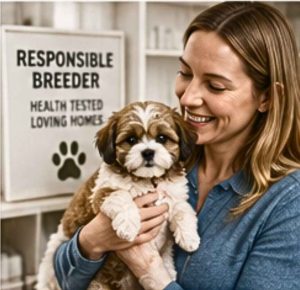 Ask for the registered names of both parents and the actual test results. “DNA tested,” “vet checked” and “health guaranteed” are not sufficient descriptions by themselves.
For a Toy Poodle parent, current Poodle Club of America recommendations include:
- PRA-prcd DNA testing from an approved laboratory.
- Annual ACVO ophthalmic examination.
- Patellar luxation evaluation.
For a Miniature Poodle parent, add:
- Hip evaluation through OFA radiographs or PennHIP.
For the Shih Tzu parent, the American Shih Tzu Club’s health statement has historically described a CHIC pathway involving eye and patellar evaluation while encouraging breeders to understand additional health concerns in their lines. Current AKC health-test tables do not list mandatory national-club tests for the breed, which is a good reason to ask detailed questions rather than assuming “nothing is required” means “nothing is worth checking.”
This guide provides general educational information and is not a substitute for diagnosis, treatment or individualized veterinary advice.
Shih-Poo Breathing & Brachycephalic Concerns
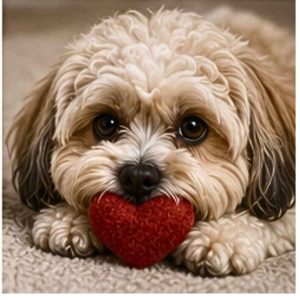 This topic deserves explicit attention because the Shih Tzu is brachycephalic, meaning the skull and muzzle are shortened. A Shih-Poo may inherit a longer Poodle-like muzzle, a shorter Shih Tzu-like face or something between the two.
Shorter facial structure can increase the risk of brachycephalic obstructive airway syndrome (BOAS). Signs can include noisy breathing, increased effort to inhale, exercise intolerance, poor heat tolerance, gagging, regurgitation, sleep disturbance or collapse in severe cases.
OFA’s Respiratory Function Grading Scheme was expanded in April 2026 to make Shih Tzu eligible for official RFGS certification. That gives breeders another objective tool for evaluating breathing function in Shih Tzu breeding stock.
When evaluating a Shih-Poo puppy, pay attention to the Shih Tzu parent’s breathing. A dog should be able to move, play and rest without obvious respiratory struggle. Snorting and noisy breathing should not automatically be dismissed as “normal for the breed.”
Functional anatomy matters more than an exaggerated flat-faced look.
Shih-Poo Lifespan: How Long Do Shih-Poos Live?
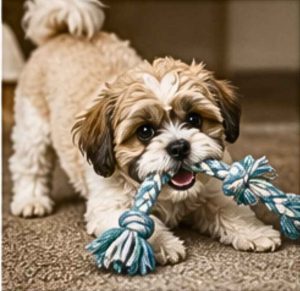
A reasonable broad planning expectation is approximately 12 to 16 years, with individuals living shorter or longer lives. Both parent breeds are small companion dogs, and small dogs often have relatively long lifespans compared with large breeds.
Healthy weight, dental care, appropriate activity, preventive veterinary care, eye monitoring, comfortable breathing, safe handling and prompt attention to illness can all contribute to more healthy years.
Shih-Poo Dental Care
Dental care should begin long before a Shih-Poo develops terrible breath or visibly loose teeth. Small mouths can crowd teeth, and periodontal disease often advances below the gumline before owners appreciate its extent.
- Introduce tooth brushing gradually with dog-safe toothpaste.
- Brush frequently; daily is ideal when practical.
- Have the mouth examined during routine veterinary appointments.
- Ask when professional dental cleaning is indicated.
- Do not assume dry kibble keeps teeth clean.
- Choose chews appropriate to the dog’s size and avoid objects hard enough to fracture teeth.
Red gums, strong odor, dropping food, chewing changes, facial swelling or pawing at the mouth deserve veterinary evaluation.
Shih-Poo Food, Feeding & Nutrition
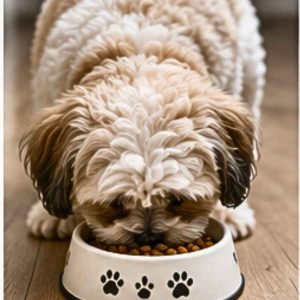 The best diet for a Shih-Poo is nutritionally complete and appropriate for the dog’s age, size, body condition, activity and medical needs. There is no universal food that becomes ideal simply because “Shih-Poo” appears on the label.
Small-breed formulations can be convenient because the pieces and calorie density suit small dogs. Portion control matters: an extra pound on a ten-pound dog is a very different proposition than an extra pound on a Great Dane.
Feeding Shih-Poo Puppies
Very young toy-sized puppies generally need several meals a day. Tiny puppies can be vulnerable if they fail to eat reliably, especially during stress or illness. Maintain the breeder’s familiar diet initially and make changes gradually unless your veterinarian advises otherwise.
Weakness, tremors, unusual sleepiness, disorientation, repeated vomiting, refusal to eat or collapse in a tiny puppy warrants prompt veterinary attention.
Life With a Shih-Poo
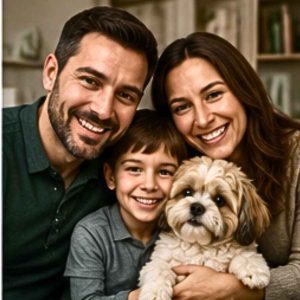 Living with a Shih-Poo often means having a small companion who regards household activity as a group project. Many want to be near their people, enjoy short walks and games, then settle happily wherever the family is relaxing.
The manageable exercise needs can make this an easy dog to fit into ordinary life, but grooming has to be part of the routine. A short pet trim can simplify coat care tremendously. Owners who want the long fluffy look need to embrace regular line brushing, combing and professional grooming.
Teach independence as deliberately as affection. Let the dog nap away from your lap, enjoy food toys without constant interaction and spend time with trusted caregivers. A close bond is lovely; panic whenever one person leaves the room is not.
Also remember that a Shih-Poo is a dog, not an accessory. Let it sniff, learn, explore and make sensible choices. Small dogs become more confident when humans allow them to use their bodies and brains.
Shih-Poo Puppies: What Prospective Owners Should Know
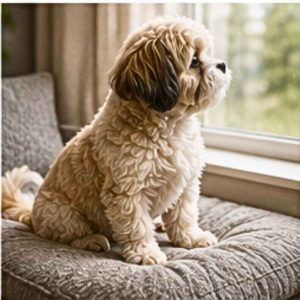 Shih-Poo puppies are heavily searched, along with “Shih Poo for sale,” puppy price and “near me” terms. Those searches deserve useful guidance rather than turning this breed profile into a sales page.
A healthy Shih-Poo puppy should come from parents selected for health, sound temperament and functional structure. Ask which Poodle variety was used, how both parents breathe and move, what health tests were performed and how the litter is being raised.
Early Socialization
Puppies should have age-appropriate experience with gentle handling, household sounds, safe people, varied surfaces, grooming, brief separations and carefully managed novelty. Because grooming will be lifelong, a breeder should begin making brushes, combs, face handling, feet handling and dryers ordinary rather than frightening.
Be Cautious About Extremely Flat Faces
If a puppy inherits a very short Shih Tzu-like muzzle, evaluate breathing and the parents’ respiratory function. An exaggerated baby-faced appearance should never outrank the ability to breathe comfortably.
Our Dedicated Shih-Poo Puppy Guide
For readers actively searching for a puppy, our Shih-Poo Puppies Guide is the place for detailed buyer education: parent health testing, socialization, contracts, scams, puppy mills, pet-store sourcing, breeder red flags, deposits and choosing a healthy puppy.
You can also explore the Shih-Poo Breeder Showcase as a starting point for breeder research. A showcase listing does not replace your own due diligence.
How Much Does a Shih-Poo Cost? Puppy Price & Lifetime Expenses
Shih-Poo puppy price is a substantial keyword opportunity, but there is no single authoritative national price for a non-standardized designer cross. Asking prices vary by region, breeder, demand, health screening, parent lines, coat marketing and size marketing.
Do not confuse price with quality. Responsible health testing and excellent puppy raising cost money, but an expensive puppy is not automatically responsibly bred. Likewise, unusually low prices can signal poor breeding or scams—but price alone does not prove either.
Budget Beyond the Purchase Price
- Professional grooming throughout the dog’s life.
- Routine veterinary care and emergencies.
- Dental care and possible professional dental procedures.
- Food and treats.
- Training classes and enrichment.
- Harness, leash, carrier, bedding, toys, brushes and combs.
- Pet insurance or emergency savings.
- Pet sitting, boarding or dog walking when needed.
A Shih-Poo may live well into its teens. The purchase price is only the admission ticket.
Shih-Poo Puppy Name Ideas
The Shih-Poo gives us plenty of naming inspiration: Tibetan and Chinese connections from the Shih Tzu side, French-flavored possibilities from Poodle culture, fluffy coats, tiny size and a generally cheerful personality.
Fun starters include Bao, Biscuit, Coco, Gigi, Lulu, Mochi, Miso, Pippa, Remy, Teddy, Tofu, Truffle, Winnie, Ziggy, Maisie, Pip, Pierre, Mei, Bean and Peaches.
For a full breed-specific collection, visit the Shih-Poo Dog Names Guide. You can also browse our Small Dog Names Guide.
Shih-Poo Adoption & Rehoming
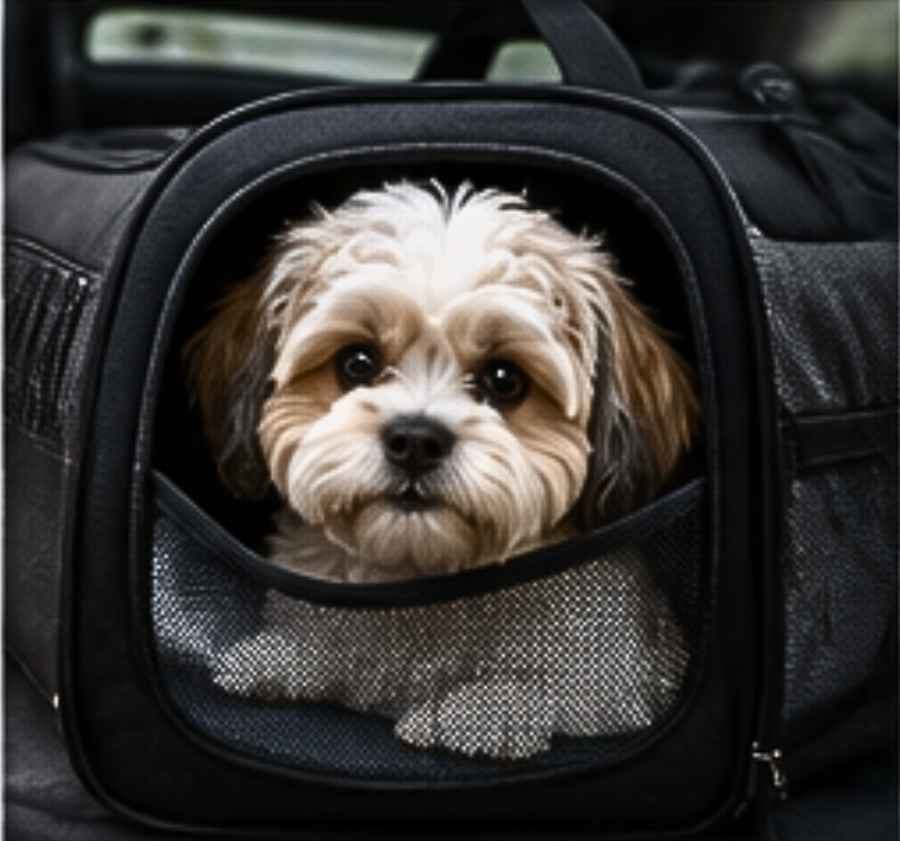
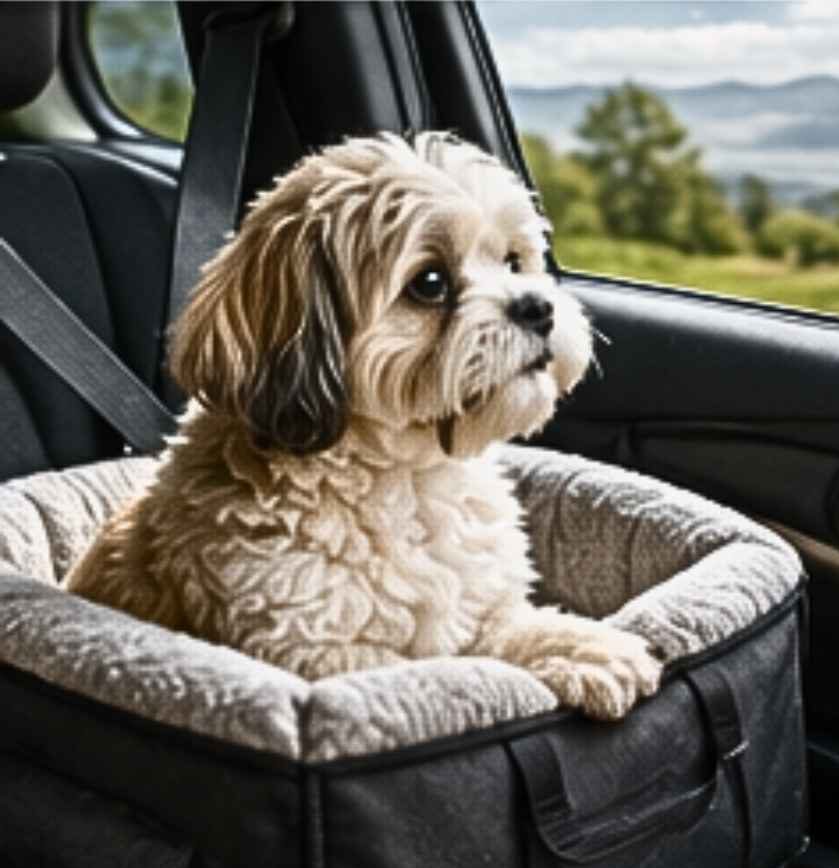
Shih-Poos sometimes need new homes because of housing changes, illness, family circumstances, financial difficulty, owner death or simply a mismatch between the dog’s needs and the original household. Responsible rehoming is not abandonment when it is handled thoughtfully and the dog’s welfare remains central.
Pet Rehoming Network already has an established breed-specific resource for this intent. Visit Shih-Poos for Adoption & Rehoming on Pet Rehoming Network to see adoptable dogs, join the adoption waiting list or learn about private Shih-Poo rehoming assistance.
If you are adopting an adult Shih-Poo, ask about health history, eye and breathing issues, dental care, grooming tolerance, house training, behavior around children and animals, medications, separation behavior and the reason for rehoming. One advantage of adopting an adult is that size, coat and much of the dog’s personality are already visible.
Shih-Poo vs. Maltipoo, Shih Tzu, Cavapoo & Shichon
The U.S. keyword data contains several comparison clusters. These are useful because a prospective owner may like the general idea of a small fluffy companion while being less certain which ancestry best fits the household.
Shih-Poo vs. Maltipoo
A Maltipoo combines Maltese and Poodle ancestry, while a Shih-Poo uses Shih Tzu and Poodle. Both can be affectionate, low-shedding, grooming-intensive companions. Shih-Poos may inherit more compact Shih Tzu structure and possibly a shorter muzzle; Maltipoos may inherit a lighter Maltese build. Individual parent dogs matter more than stereotypes.
 Shih-Poo vs. Shih Tzu
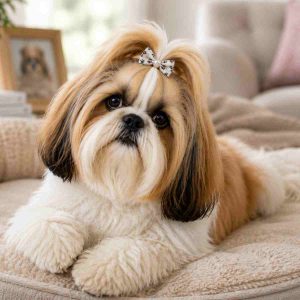
A purebred Shih Tzu offers greater predictability of adult size, coat, structure and breed type because it is bred to an established standard. The Shih-Poo introduces Poodle ancestry, which may contribute more curl, longer muzzle, athleticism and trainability—but also greater variation.
Shih-Poo vs. Cavapoo

A Cavapoo combines Cavalier King Charles Spaniel and Poodle ancestry. Both can be affectionate family companions. Cavapoos may be somewhat more spaniel-like in social style and often larger depending on the Poodle used; Shih-Poos can be particularly compact and may carry Shih-Tzu-related brachycephalic considerations.
Shih-Poo vs. Shichon
A Shichon is Shih Tzu × Bichon Frise, so both crosses share Shih Tzu ancestry. The Shih-Poo substitutes Poodle for Bichon, bringing a different athletic and learning background. Neither can be judged simply by which teddy-bear haircut you like better.
Comparison searches such as Shih-Poo vs. Maltipoo have enough distinct intent to justify dedicated supporting pages as the Shih-Poo silo grows.
Shih-Poo Pros & Cons
Reasons People Love Shih-Poos
- Small and adaptable to apartments.
- Usually affectionate and companion-oriented.
- Often bright and entertaining.
- Commonly low shedding.
- Moderate exercise requirements suit many lifestyles.
- Can be good companions for seniors and attentive first-time owners.
- Many enjoy children and other pets when appropriately socialized.
Potential Challenges
- Coat maintenance is substantial.
- Professional grooming creates an ongoing expense.
- Low shedding does not guarantee allergy tolerance.
- Some are vocal.
- Some become overly dependent without independence training.
- House training a tiny puppy can require patience.
- Dental care is important throughout life.
- Shorter-muzzled individuals may have breathing and heat-tolerance concerns.
- Eye health and patellar problems deserve attention.
- Adult size, coat and temperament are less predictable than in an established pure breed.
Is a Shih-Poo Right for You?
A Shih-Poo can be a terrific companion for someone who wants a small, affectionate dog and enjoys having a canine participant in everyday life. They can fit singles, couples, families and older adults when the individual dog matches the household.
A Shih-Poo May Suit You If You:
- Want a small, people-oriented companion.
- Prefer low-to-moderate exercise needs.
- Are prepared for regular brushing and professional grooming.
- Enjoy training games and interactive companionship.
- Can provide substantial company while still teaching healthy independence.
- Will take dental, eye, knee and breathing health seriously.
You May Prefer Another Dog If You:
- Want a wash-and-wear coat.
- Need guaranteed allergy friendliness.
- Are away for very long periods most days.
- Want exact predictability in adult size and coat.
- Do not want recurring professional grooming costs.
- Prefer a highly athletic partner for prolonged strenuous exercise.
The best Shih-Poo is not the tiniest, curliest, flattest-faced or rarest-colored puppy. It is the healthy, temperamentally sound dog whose real needs fit your real life.
Frequently Asked Questions About Shih-Poos
What is a Shih-Poo?
A Shih-Poo is a Shih Tzu crossed with a Toy or Miniature Poodle. It is also commonly called a Shih Tzu Poodle mix or Shih Tzu and Poodle cross.
Is Shipoo the same as Shih-Poo?
Usually, yes. Shipoo and Shihpoo are common alternate spellings of Shih-Poo. Context matters because similar-looking words can refer to unrelated things online.
How big is a full-grown Shih-Poo?
Many adults are roughly 8–18 pounds and 8–15 inches tall, but actual size depends heavily on the Poodle variety, both parent sizes and individual genetics.
Are Shih-Poos hypoallergenic?
No dog is completely hypoallergenic. Shih-Poos often shed little, but allergen production and individual human reactions vary.
Do Shih-Poos shed?
Many shed very little. Coat inheritance varies, so shedding cannot be guaranteed. Low-shedding coats still require frequent brushing and trimming.
What is the best haircut for a Shih-Poo?
Puppy and teddy-bear cuts are popular because they keep the coat manageable while maintaining the fluffy companion-dog look. The best trim depends on coat texture, climate, lifestyle and the amount of brushing you can maintain.
How often should a Shih-Poo be groomed?
Most need home brushing several times a week or more often, plus professional grooming approximately every four to eight weeks depending on coat and haircut.
How long do Shih-Poos live?
A broad planning estimate is around 12–16 years, although individual dogs may live shorter or longer lives.
What health problems can Shih-Poos have?
Potential concerns include patellar luxation, inherited eye disease, dental disease, Poodle-related PRA risks, orthopedic problems and, in shorter-muzzled individuals, brachycephalic airway problems. Responsible parent health screening matters.
Do Shih-Poos have breathing problems?
Some can if they inherit pronounced Shih Tzu-like brachycephalic facial structure. Favor comfortably breathing parents and puppies and take noisy or labored breathing seriously.
Are Shih-Poos smart?
Usually. Poodle ancestry can contribute very quick learning, while Shih Tzu ancestry may add an independent companion-dog style. Positive training works particularly well.
Do Shih-Poos bark a lot?
Some are vocal alert barkers while others are quieter. Training, environment, socialization and individual temperament make a substantial difference.
Are Shih-Poos good with children?
Many can be good family dogs, especially with respectful children. Very small dogs require supervision around young children to prevent accidental injury.
What is an F1b Shih-Poo?
An F1b is generally an F1 Shih-Poo bred back to one of the parent breeds, commonly a Poodle. The label describes ancestry and does not guarantee coat, health, shedding or allergy tolerance.
What is a teacup Shih-Poo?
“Teacup” is a marketing term rather than an official Shih-Poo variety. Extremely small size should never take priority over health and sound structure.
How much is a Shih-Poo puppy?
Prices vary substantially by region and breeder. Compare verifiable health screening, parent temperament, puppy raising, contracts and transparency rather than assuming the highest or lowest price indicates quality.
Where can I find Shih-Poo puppies near me?
Use our Shih-Poo Puppies Guide to learn how to evaluate breeders and avoid scams, then explore the Shih-Poo Breeder Showcase. Adoption may also be possible through Pet Rehoming Network.
Can I adopt a Shih-Poo?
Yes. Adult Shih-Poos and occasionally puppies need new homes. Pet Rehoming Network maintains an established Shih-Poo adoption and rehoming resource.
Trusted Shih-Poo Health & Breed Resources
About This Guide: Our Shih-Poo Resource Is Growing
Dogs Central is building a connected library of practical small-dog information rather than a collection of isolated breed descriptions. This Shih-Poo guide is intended to be the central educational resource in a growing Shih-Poo silo, supported by dedicated pages for puppies, names, grooming, haircuts, comparisons and other subjects owners genuinely search for.
The U.S. keyword data has already identified particularly strong opportunities around Shih-Poo grooming and haircuts, full-grown size, puppies, price, health and hypoallergenic questions. As the silo develops, those subjects can become deeper supporting guides while this page continues to provide the complete breed overview.
We can also add original photographs, full-grown Shih-Poo examples, coat-color infographics, haircut visuals, owner stories and new answers as readers’ questions evolve.
The purpose remains simple: someone researching a Shih Tzu Poodle mix should leave Dogs Central with a realistic understanding of both the delightful parts and the responsibilities involved in sharing life with one.