
The Havapoo is a small companion dog created by crossing a Havanese with a Toy or Miniature Poodle. You may also see the same basic cross described simply as a Havanese Poodle mix, Poodle Havanese mix, Havadoodle, Poovanese, or Havanoodle.
 The supplied U.S. search data makes one thing especially clear: people search heavily for both Havapoo and the literal parent-breed combination, so this guide uses both naturally.At their best, Havapoos can be wonderfully engaging little dogs: affectionate without being dull, clever without requiring marathon exercise, and small enough to fit comfortably into many homes.
The Havanese contributes a long history as a sociable companion, while the Poodle contributes intelligence, athletic ability, and a famously low-shedding coat. But a cross is not a recipe with guaranteed results. Adult size, coat texture, shedding, color, energy, and temperament can vary—even among littermates.That variability is why a good Havapoo guide needs to go beyond “cute teddy-bear dog.”
We will look closely at what a full-grown Havapoo may be like, Toy versus Miniature Poodle influence, grooming and popular haircuts, shedding and allergy claims, temperament, health testing, lifespan, puppy sourcing, “teacup” marketing, colors, F1 and F1b terminology, and the comparisons people make most often—especially Havapoo vs. Cavapoo, Havanese, and Maltipoo.
Havapoo at a Glance
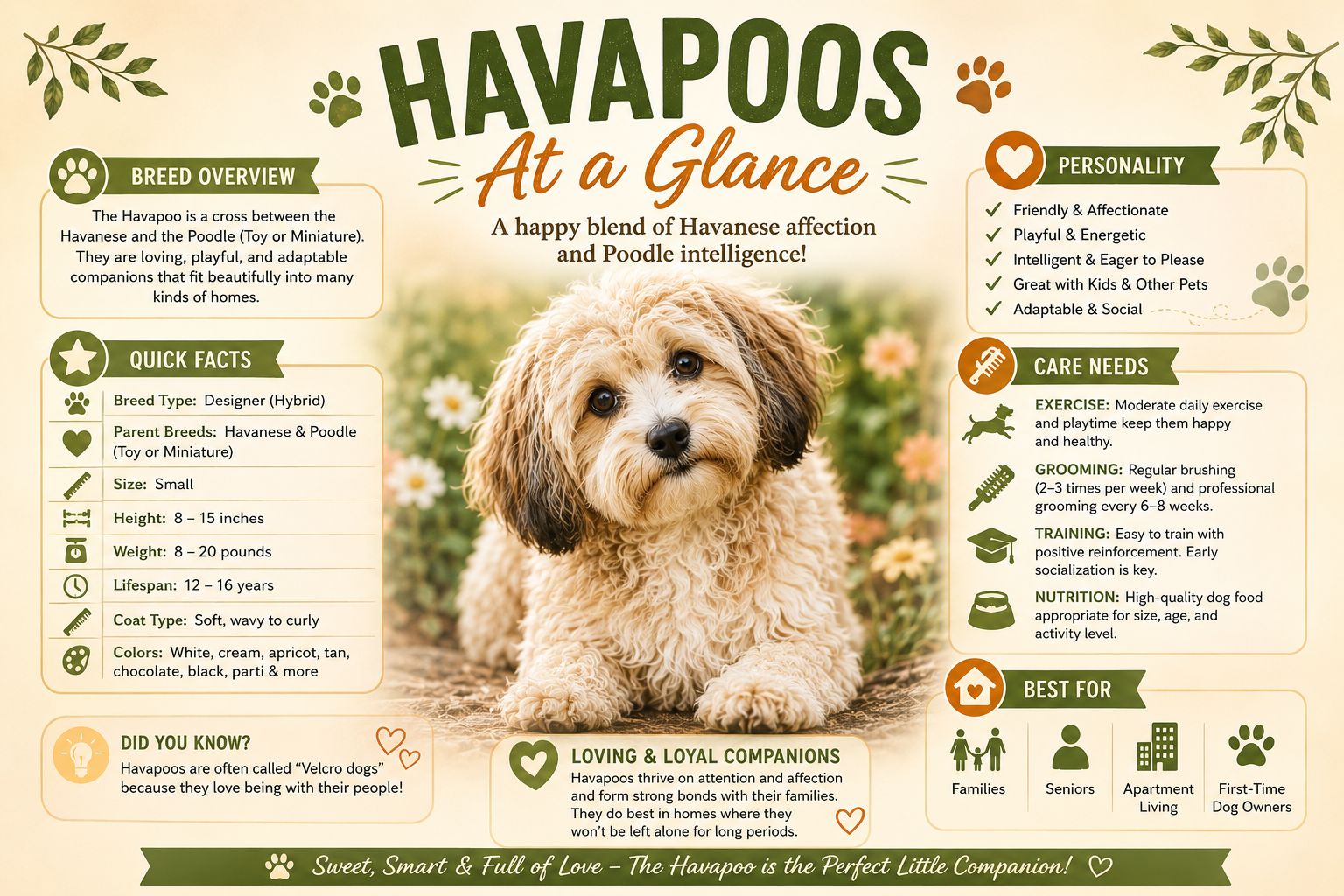
| Other names | Havanese Poodle mix, Poodle Havanese mix, Havadoodle, Poovanese, Havanoodle |
|---|---|
| Parent breeds | Havanese × Toy or Miniature Poodle |
| Breed status | Designer/hybrid mixed-breed dog; not an AKC-recognized pure breed |
| Typical adult weight | Often about 7–20 pounds, but parent size and genetics can produce dogs outside that range |
| Typical height | Often roughly 8–15 inches at the shoulder, with considerable variation |
| Coat | Soft straight-to-wavy or curly coat; often low shedding but not guaranteed |
| Common personality | Affectionate, sociable, playful, bright, responsive, and people-oriented |
| Exercise | Moderate; daily walks, play, training, and mental enrichment |
| Grooming | Moderate to high; frequent brushing and regular trimming for most coats |
| Hypoallergenic? | No dog is truly allergen-free; many Havapoos shed little, but individual reactions vary |
| Best suited to | People wanting an affectionate, trainable small companion and willing to provide grooming and company |
What Is a Havapoo? The Havanese Poodle Mix Explained
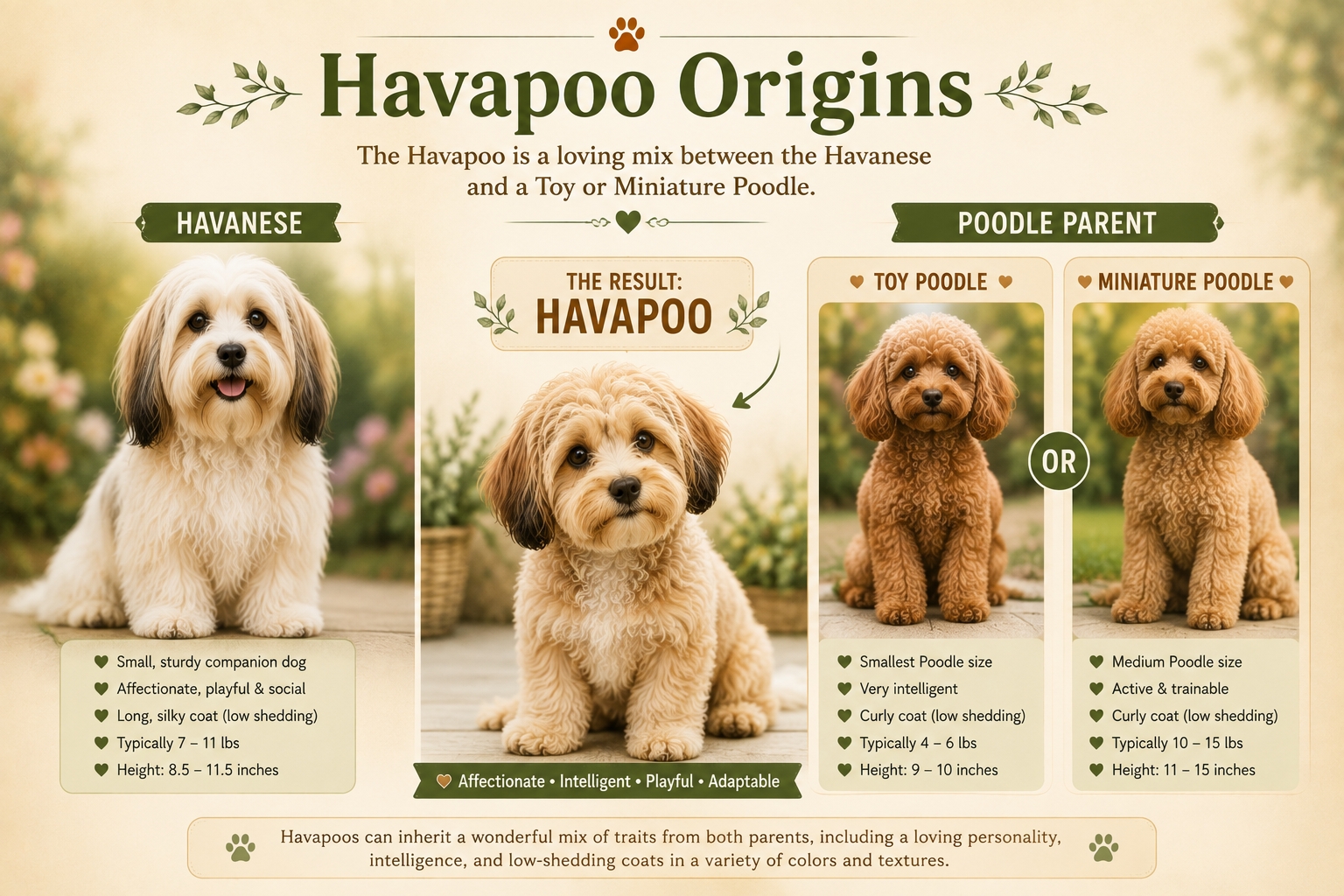
 A Havapoo is the offspring of a Havanese and a Poodle, most commonly a Toy or Miniature Poodle. It is not simply a smaller Poodle and it is not a variety of Havanese. It is a mixed-breed companion whose traits can land anywhere along the genetic spectrum between its parents.
The Havanese is Cuba’s national dog and only native breed, with a history centered on companionship. The Poodle brings a very different working history along with remarkable trainability. Put those backgrounds together and you often get a small dog that enjoys people intensely, learns quickly, and wants to participate rather than merely decorate the sofa.
Is a Havapoo a Doodle?
In everyday language, yes: many people use “doodle” as an umbrella term for Poodle crosses. It is an informal label rather than an official classification. Calling a dog a doodle does not guarantee a curly coat, low shedding, allergy friendliness, temperament, size, or health.
Is the Havapoo recognized by the AKC?
No. The American Kennel Club recognizes the Havanese and the Poodle as separate pure breeds, but not the Havapoo as a new pure breed with its own standard. That is important when evaluating advertisements that use breed-like language to imply a level of uniformity the cross does not yet have.
Havapoo History & Parent Breeds
There is no single documented founder of the Havapoo and no universally accepted breed standard. The cross became part of the modern designer-dog movement as breeders paired popular companion breeds with Poodles in hopes of combining desirable temperament and coat traits.
The Havanese Parent
The Havanese is a small, sociable companion from Cuba. Its traditional breed temperament is cheerful and outgoing, and the breed’s silky coat comes in many colors. Havanese tend to thrive on close human companionship, which helps explain why a Havapoo can become a very devoted little shadow.
The Poodle Parent
Whether the Poodle parent is Toy or Miniature Poodle matters. Both are intelligent, active, low-shedding dogs, but Miniatures are larger and can contribute more size and athleticism. Ask breeders which variety they actually use rather than assuming every Havapoo is a Toy Poodle cross.
Designer breeding cannot reliably select only the traits people want. A puppy can inherit Poodle curl but Havanese size, Havanese coat texture with Poodle energy, or any number of combinations. Responsible breeding is therefore about healthy, temperamentally sound parents and careful puppy raising—not promising a genetically impossible made-to-order dog.
F1, F1b, F2 & Multigenerational Havapoos
Generation labels appear frequently in designer-dog advertising, so it helps to know what they actually mean.
- F1 Havapoo: a Havanese crossed with a Poodle.
- F1b Havapoo: an F1 Havapoo bred back to one of the parent breeds, commonly a Poodle.
- F2 Havapoo: generally an F1 Havapoo bred to another F1 Havapoo.
- Multigenerational Havapoo: later-generation breeding involving Havapoos rather than a simple first-generation parent-breed cross.
Those labels describe ancestry; they do not guarantee outcome. An F1b puppy may have a curlier or more Poodle-influenced coat on average if the backcross is to a Poodle, but the label does not promise no shedding, no allergies, perfect health, a particular adult weight, or a particular personality.
What Does a Havapoo Look Like?
 Search interest in Havapoo pictures and full-grown Havapoo photos is substantial because puppies can change dramatically as they mature. Adult Havapoos often have expressive dark eyes, drop ears, a soft coat, and a compact but lively build. Some have a distinctly round “teddy-bear” appearance after grooming; others look more like a small Havanese with waves or a little Poodle with a softer outline.
The muzzle may be fine or moderately broad, the legs may be relatively short or more Poodle-like, and coat texture ranges from straighter and silky to loose curls or denser curls. The absence of a breed standard means there is no one correct Havapoo appearance.
How Big Does a Havapoo Get? Full-Grown Havapoo Size & Weight
Full-grown Havapoo is one of the strongest informational searches in the supplied data. The sensible answer is a range, not a promise. Many adults are approximately 7–20 pounds and around 8–15 inches at the shoulder, but dogs can fall outside those figures depending on the Poodle variety, the actual sizes of the parents, and the genetic combination inherited by the puppy.
A Havanese bred to a small Toy Poodle is generally expected to produce smaller offspring than a Havanese bred to a substantial Miniature Poodle. Yet even littermates can finish at different sizes. If adult size matters—for airline travel, housing rules, physical handling, or simply preference—ask for the measured adult weights and heights of both parents and, ideally, information about previous litters.
Mini Havapoo, Toy Havapoo and Teacup Havapoo
“Mini Havapoo” and “Toy Havapoo” are commonly used descriptions, usually referring to the Poodle parent or expected size. They are not standardized Havapoo varieties. Teacup Havapoo is likewise a marketing term, not an official breed size.
Be particularly careful with sellers promising extremely tiny adults. Very small puppies can be physically fragile and may be more vulnerable to hypoglycemia, injury, dental crowding, and other problems. A breeder should be selecting for health and soundness, not trying to produce the smallest dog that can be advertised at a premium.
Can a Havapoo Puppy Weight Calculator Predict Adult Size?
Online calculators can offer a rough guess based on age and current weight, but mixed-breed growth is not perfectly linear. Parent size, skeletal maturity, nutrition, sex, and individual genetics all influence the result. The parents and previous related litters usually provide more useful context than a generic calculator.
Havapoo Colors: Black, Black & White, Brown, Apricot, White & More
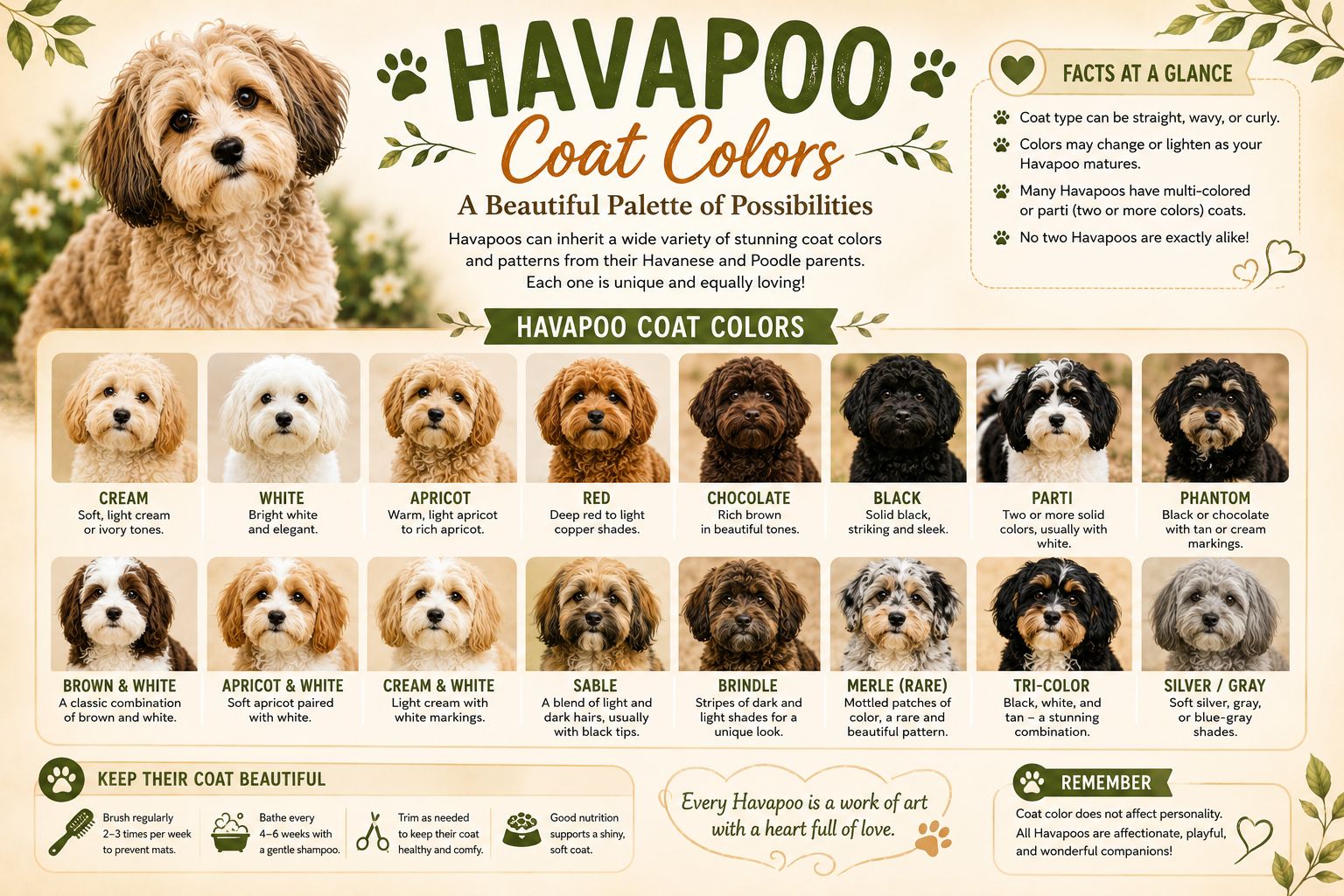
Havapoos can occur in a delightful variety of colors because both parent breeds have broad color palettes. The search data shows especially strong interest in black Havapoos, followed by black-and-white, white, brown, chocolate, apricot, parti, and merle-related searches.
Colors You May See
- Black
- Black and white
- Brown or chocolate
- White or cream
- Apricot
- Red or reddish shades
- Silver or gray tones
- Parti and other multi-color patterns
Color can change as the puppy matures. Poodles can lighten considerably with age, and Havanese coats can also change. If a precise shade is your main reason for choosing a puppy, it is worth remembering that color is one of the least important predictors of the dog’s future health and compatibility with your household.
What About Merle Havapoos?
Merle deserves special scrutiny rather than being treated simply as a fashionable premium color. Merle is not a standard Havanese pattern, and buyers should ask exactly where the merle gene came from, request verifiable parentage and genetic information, and understand the health risks associated with breeding two merle-pattern dogs together. Never let an unusual color distract from health testing, temperament, structure, and humane breeding practices.
Are Havapoos Hypoallergenic? Do Havapoos Shed?
Havapoos are frequently marketed as hypoallergenic because both Havanese and Poodles are relatively low-shedding breeds. But no dog is guaranteed to be completely hypoallergenic. Dog allergens come from proteins associated with dander, saliva, urine, and skin secretions—not simply loose fur.
Many Havapoos do shed very little, particularly those with curlier Poodle-influenced coats. Others may shed somewhat more. Coat texture can vary even within one litter, and an allergy sufferer’s reaction to one dog does not guarantee the same reaction to another.
If allergies are important to your decision, spend substantial time with adult dogs from the breeder’s lines if possible. Do not rely on a seller’s “100% hypoallergenic” guarantee. And remember the trade-off: low shedding often means more coat maintenance because loose hair remains trapped and contributes to mats.
Havapoo Temperament, Personality & Characteristics
 A well-socialized Havapoo is often cheerful, affectionate, playful, bright, and intensely interested in people. Havanese were developed as companion dogs, and Poodles are famously responsive learners. That combination can make a Havapoo feel less like a pet who happens to live in the house and more like a tiny committee member who expects to be consulted about everything.
Many are friendly and outgoing, but temperament is not guaranteed by the cross. Genetics, early handling, socialization, training, frightening experiences, and the individual temperaments of both parents matter. Meet the mother whenever possible and ask candid questions about both parents: Are they confident around strangers? Comfortable with handling? Noisy? Anxious when left? Reactive around dogs?
Are Havapoos cuddly?
Often, yes. Many enjoy lap time and physical closeness, and some will follow their favorite person from room to room. That affection is lovely, but puppies should still learn to relax independently so attachment does not become distress whenever a person leaves the room.
Are Havapoos hyper?
They are usually lively rather than relentlessly high-energy. A Havapoo still needs walks, play, training, and mental work. A dog with more Miniature Poodle influence may be especially athletic and busy. Restlessness that owners describe as “hyper” can also be boredom, overtired puppy behavior, or a lack of training in how to settle.
Havapoo Intelligence, Training & Potty Training
Havapoos are generally bright, trainable dogs. Both parent breeds are capable learners, and many Havapoos enjoy the interaction involved in training. Positive reinforcement—food, toys, praise, play, and access to things the dog values—usually produces much better results than intimidation or physical corrections.
Skills Worth Teaching Early
- Coming when called.
- Walking comfortably on a harness and leash.
- Settling on a bed or mat.
- Polite greetings without frantic jumping.
- Comfort with brushing, combing, nail care, ear handling, and face handling.
- Trading objects rather than guarding or running away with them.
- Short, calm periods alone.
- Quiet behavior around doors, windows, and hallway sounds.
Havapoo Potty Training
Small puppies have small bladders, so house training requires frequent trips outside, close supervision, and a predictable routine. Take the puppy out after waking, eating, drinking, vigorous play, and before bedtime, and reward outdoor success immediately.
Do not punish accidents. Punishment can teach a puppy to hide when toileting rather than teaching where to go. In severe winter weather, a sheltered outdoor toilet area can make consistency much easier for a tiny dog.
Do Havapoos Bark? Separation Anxiety & Time Alone
Havapoos can be alert barkers. Havanese are sociable watchdogs and Poodles notice changes in their environment quickly, so some Havapoos announce visitors, hallway sounds, delivery drivers, dogs outside, and occasionally objects whose intentions remain unclear.
Early training can prevent barking from becoming the household soundtrack. Reward calm observation, teach a cue for settling after an alert, provide sufficient enrichment, and manage visual triggers when necessary.
Can a Havapoo Be Left Alone?
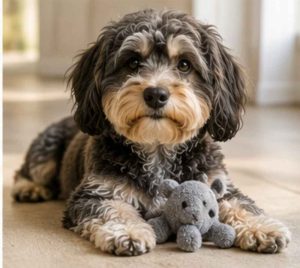 They can learn to spend reasonable periods alone, but this is not a mix to choose if you want a dog that routinely spends most of the day isolated. Both parent breeds are strongly people-oriented. Begin with very short absences, pair alone time with safe enrichment, and increase duration gradually.
True separation anxiety is more than boredom or a little protesting. Panic, destructive escape attempts, persistent vocalization, drooling, house-soiling linked specifically to absence, or inability to eat when alone deserves professional help from a veterinarian and qualified behavior professional.
Havapoo Exercise Needs & Enrichment Activities
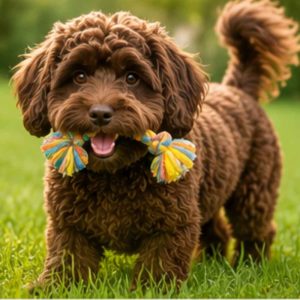 Most Havapoos need moderate daily exercise rather than hours of hard running. A couple of enjoyable walks, active play, and mental enrichment often suit an adult, adjusted for size, age, health, and energy. Puppies should not be pushed through repetitive forced exercise while their bodies are developing.
Good Enrichment for a Havapoo
- Sniff-focused walks.
- Food puzzles and treat-dispensing toys.
- Hide-and-seek.
- “Find it” scent games.
- Short trick-training sessions.
- Gentle fetch.
- Beginner agility-style games using safe, low obstacles.
- Interactive toys that encourage problem solving.
- Grooming practice turned into a reward-based training game.
Poodle ancestry can produce a dog who genuinely enjoys learning for its own sake. Ten minutes teaching a new trick may tire a clever Havapoo more pleasantly than another ten minutes marching around the same block.
Are Havapoos Good Family Dogs? Children, Dogs & Cats
Havapoos often make affectionate family companions because both parent breeds are strongly people-oriented. Their suitability for a particular household depends on the dog’s temperament, size, socialization, and the family’s expectations.
Havapoos and Children
Many enjoy respectful children and can be playful little companions. Very small Havapoos are physically vulnerable, however. A toddler can injure a tiny dog by falling on it, dropping it, squeezing it, or trying to carry it. Adults should supervise interactions and teach children to play with the dog on the floor and leave it alone while sleeping or eating.
Havapoos and Other Dogs
Many are sociable with dogs when properly introduced. Protect tiny individuals from rough play with much larger dogs. Good socialization means teaching a puppy to feel safe and behave appropriately around other dogs—not forcing greetings with every dog encountered.
Havapoos and Cats
Havapoos can live very successfully with cats, particularly when introductions are gradual and calm behavior is rewarded. Individual chase drive varies, so supervise until you know how the animals interact.
Havapoos in Apartments, With Seniors & First-Time Owners
Apartment Living
Havapoos are physically well suited to apartments because they are small and can receive much of their activity through walks and indoor play. Barking and inability to cope with alone time are more likely to create apartment problems than lack of square footage.
Havapoos for Seniors
A well-matched adult Havapoo can be a lovely companion for an older person who wants an affectionate dog and can manage regular grooming. Consider energy level, grooming cost, bending/lifting ability, and the tripping risk posed by a very small dog underfoot. A settled adult may sometimes suit better than a demanding puppy.
First-Time Dog Owners
Havapoos can be good first dogs for owners willing to learn. They are often responsive and forgiving learners, but grooming, dental care, house training, socialization, and alone-time training still require consistency. “Small” should never be mistaken for “self-maintaining.”
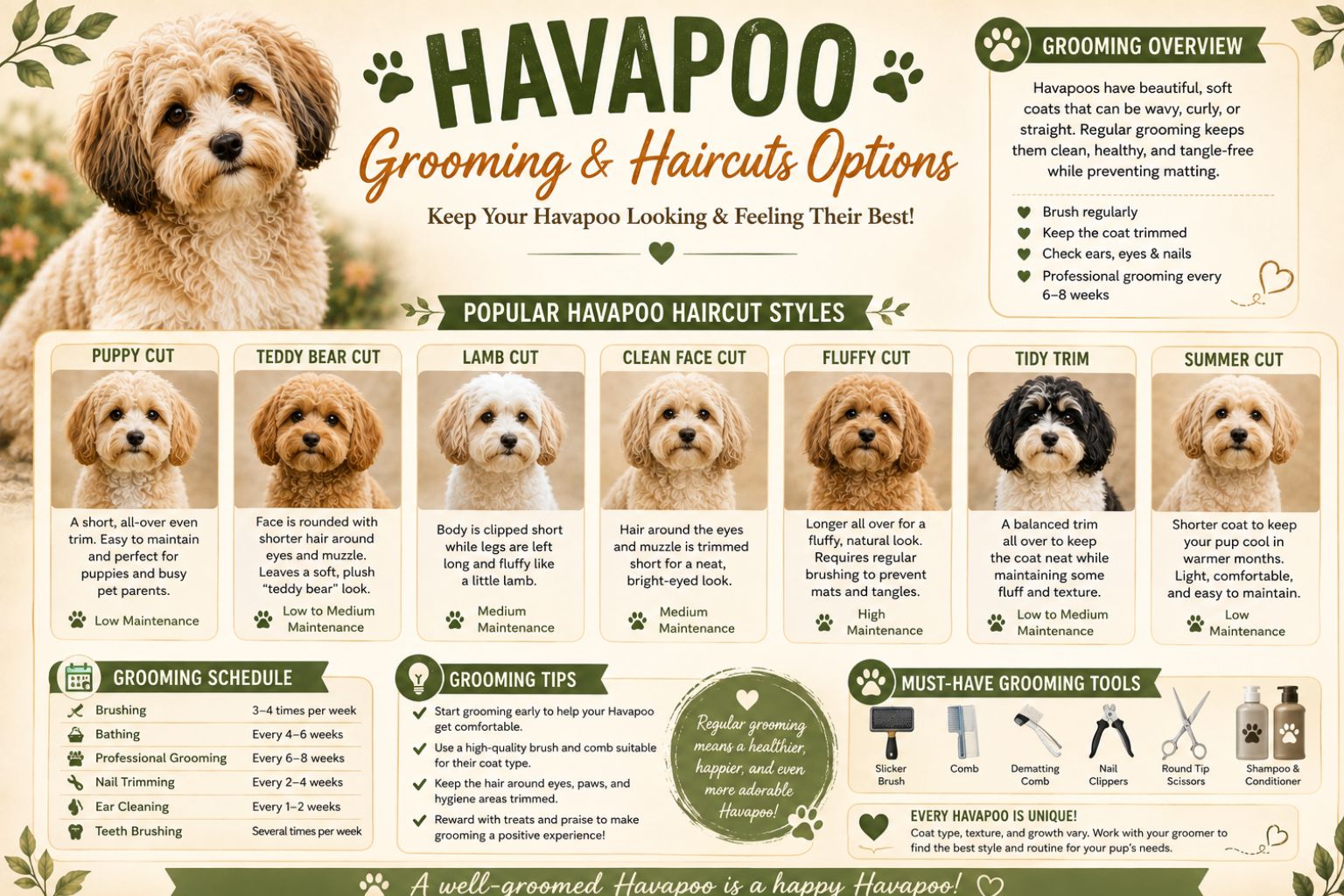
Havapoo Grooming Styles, Haircuts, Puppy Cuts & Teddy-Bear Cuts
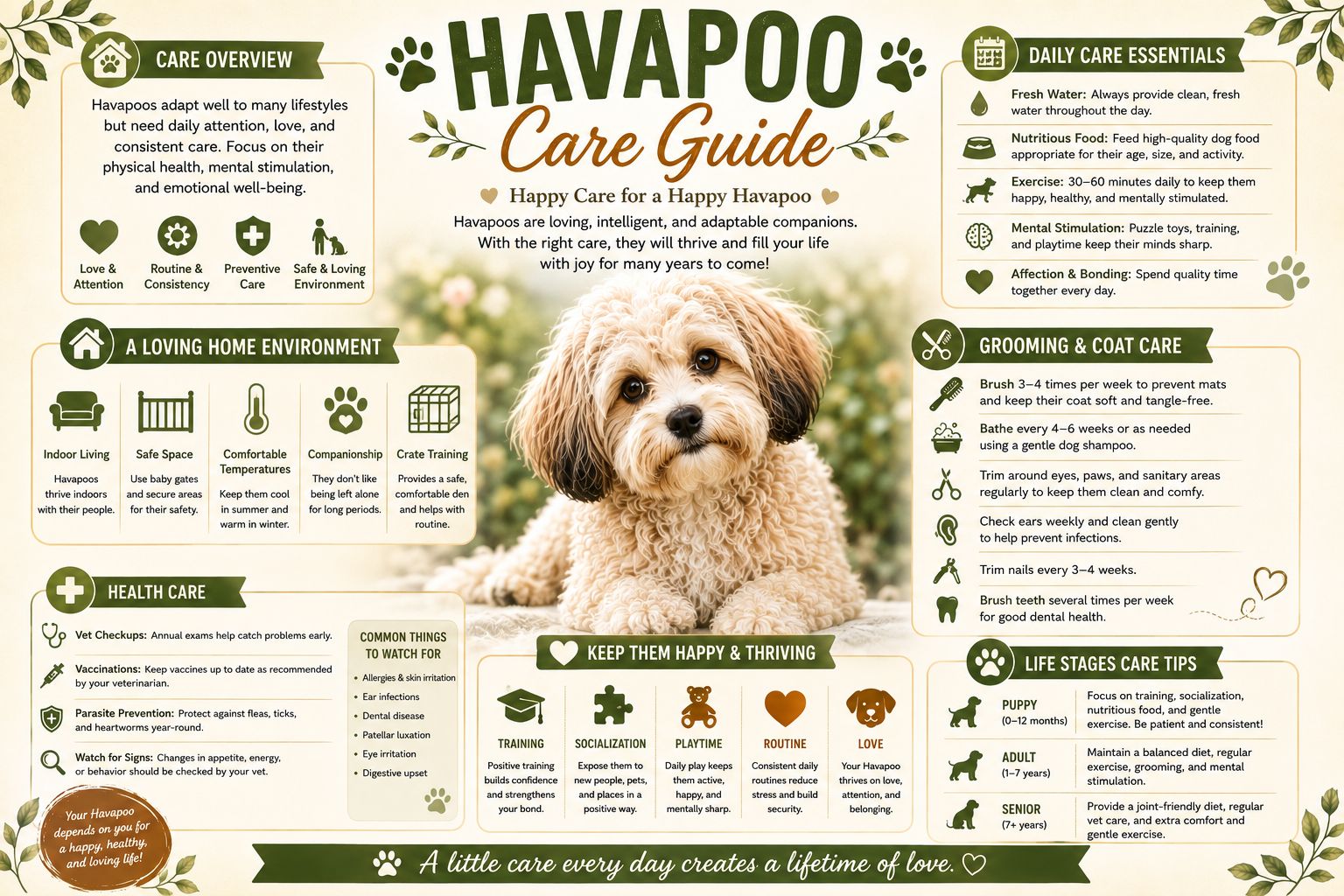
Grooming is one of the clearest Havapoo content opportunities in the U.S. data. These dogs often have soft coats that look effortless right up until the moment a groomer discovers a felted mat behind each ear. Low shedding does not mean low maintenance.
Most Havapoos need thorough brushing several times a week, and curlier or longer coats may need daily attention. Many owners schedule professional grooming roughly every four to eight weeks depending on coat, trim, lifestyle, and how much maintenance they do at home.
Popular Havapoo Haircuts
- Puppy cut: a practical, relatively even length that makes brushing easier.
- Teddy-bear cut: a rounded face and plush body outline; extremely popular in Havapoo searches.
- Short utility trim: helpful for active dogs or owners who prefer easier coat maintenance.
- Longer Havanese-inspired trim: attractive on straighter, silkier coats but requires much more brushing.
- Poodle-inspired styling: works particularly well on curlier coats and can keep feet and face tidy.
How Often Should You Groom a Havapoo?
Brush often enough that a metal comb can pass through the coat to the skin without snagging. Pay special attention behind the ears, under the collar or harness, armpits, chest, legs, tail, and anywhere friction creates tangles. Check ears, trim nails, keep the eye area clean, and make dental care part of the grooming routine.
Begin handling practice while the dog is young. A puppy who learns that feet, ears, face, combs, dryers, and clippers predict treats is far easier—and safer—for both owner and professional groomer.
Havapoo Food, Feeding & Nutrition
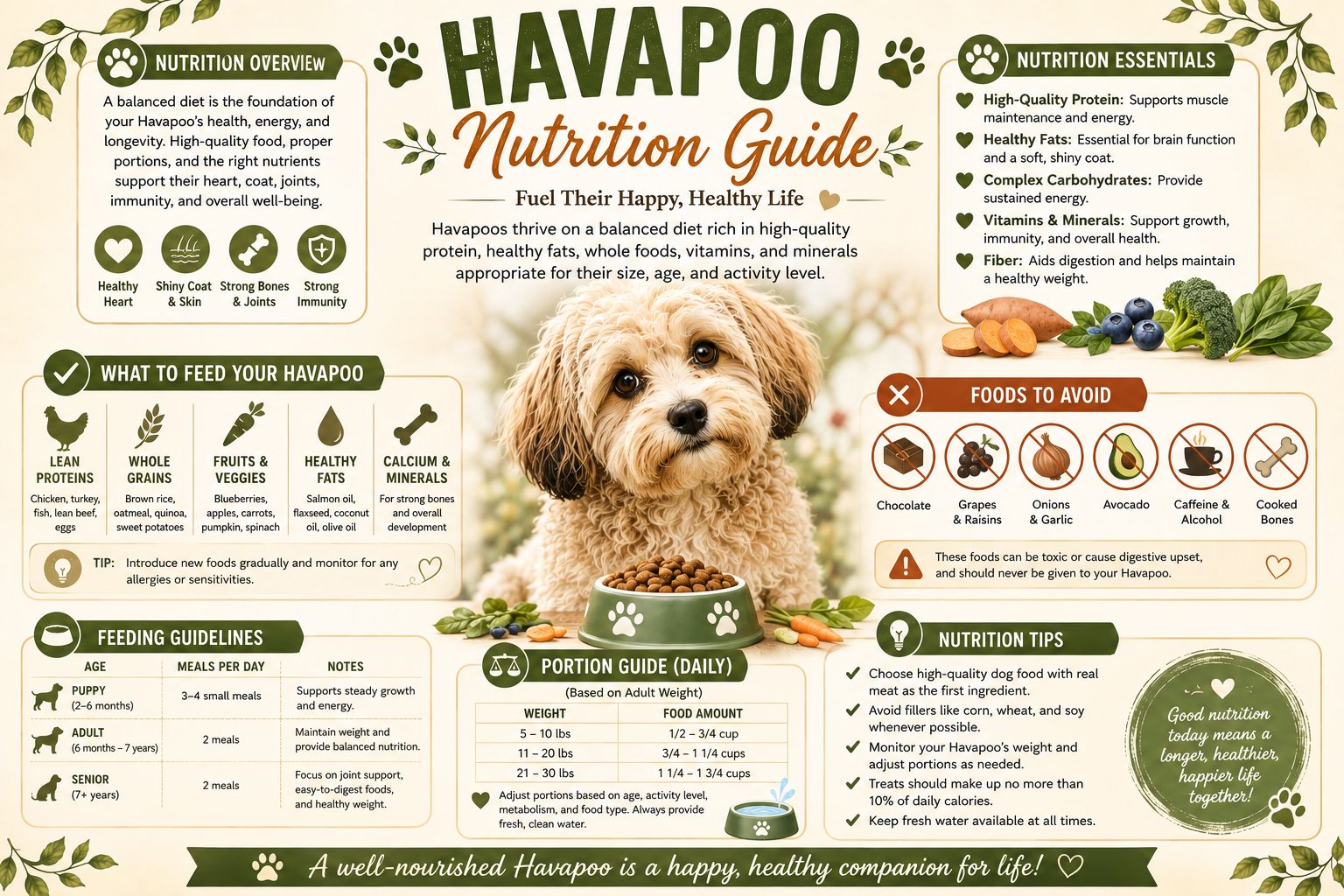
A healthy Havapoo generally needs a complete and balanced diet appropriate for age, size, activity, body condition, and medical needs. Small-breed formulations can be convenient because the pieces are appropriately sized and calorie density is designed with smaller dogs in mind, but the breed name on the package matters less than nutritional adequacy and suitability for the individual dog.
Keep an eye on portions. An extra ounce of body fat means much more to a ten-pound dog than to a seventy-pound dog. Count training treats as part of the daily calorie intake and use body condition—not pleading eyes—as the final judge.
Feeding a Havapoo Puppy
Very young, very small puppies may need several meals a day. Tiny puppies can be vulnerable to low blood sugar if they go too long without eating, particularly during stress or illness. Follow the puppy’s established feeding schedule at first and ask your veterinarian about meal frequency and growth.
Sudden weakness, tremors, disorientation, unusual sleepiness, collapse, repeated vomiting, or refusal to eat in a tiny puppy deserves prompt veterinary attention.
Havapoo Health Issues & Health Testing
Crossing two breeds does not erase inherited disease. A Havapoo can potentially inherit health problems found in Havanese, Toy Poodles, or Miniature Poodles, so a responsible breeder needs to understand and test both sides of the pedigree.
Health Concerns to Know About
- Patellar luxation: kneecap instability is an important concern in many small dogs and is included in health-testing recommendations for both parent breeds.
- Hip disorders: Havanese health recommendations include hip evaluation, and Miniature Poodle recommendations include hip evaluation as well.
- Inherited eye disease: current ophthalmic screening is important in both parental lines; Toy and Miniature Poodles also have breed-relevant PRA testing.
- Legg-Calvé-Perthes disease: a disorder of the femoral head seen in toy and small dogs, including Poodle lines.
- Dental disease: small mouths can crowd teeth and periodontal disease can become serious without preventive care.
- Cardiac, thyroid, hearing, skin and other conditions: individual family lines may warrant additional screening beyond minimum requirements.
What Testing Should a Havapoo Breeder Show You?
For the Havanese parent, the Havanese Club of America’s current CHIC requirements include hips, patellas, and annual CAER eye examinations. For a Toy Poodle parent, Poodle Club of America guidance includes PRA-prcd DNA testing, an eye examination by a veterinary ophthalmologist, and patellar evaluation. Miniature Poodles add hip evaluation to those core tests.
Ask for the registered names of the parents and look up publicly available OFA results where applicable. “DNA tested,” “health checked,” “vet checked,” or a one-year health guarantee are not substitutes for the breed-relevant screening of adult breeding dogs.
A CHIC number also means the required tests were performed and results disclosed; it does not necessarily mean every result was normal. Learn to read the actual results rather than treating a logo or number as a magic stamp.
This guide is general educational information and does not replace individualized veterinary diagnosis, treatment, or preventive-care advice.
Havapoo Lifespan & Life Expectancy
A Havapoo will often live well into its teens. A practical broad estimate is approximately 12–16 years, although there is no large standardized Havapoo registry that can give us the kind of precise population data available for some established breeds.
Parentage supports the expectation of a relatively long-lived small companion. Individual longevity still depends on inherited health, body condition, dental health, preventive veterinary care, accidents, nutrition, exercise, and simple biological luck.
The goal should not be to chase an exact number but to maximize healthy years: keep the dog lean, maintain teeth, provide appropriate activity, keep preventive care current, and investigate changes in appetite, thirst, breathing, mobility, behavior, vision, or energy promptly as the dog ages.
Havapoo Dental Care
Dental care is especially important for small dogs. Crowded teeth can trap plaque and debris, and periodontal disease can progress below the gumline long before an owner sees dramatic symptoms.
- Introduce daily or frequent tooth brushing gradually with dog-safe toothpaste.
- Have the mouth examined during routine veterinary visits.
- Ask your veterinarian when a professional dental cleaning is indicated.
- Do not rely on dry kibble alone to clean teeth.
- Use dental chews and products appropriate to the dog’s size; extremely hard objects can fracture teeth.
- Watch for bad breath, red gums, chewing changes, pawing at the mouth, loose teeth, or reluctance to eat hard food.
Life With a Havapoo
 Life with a Havapoo is often highly interactive. This is the sort of little dog who may accompany you from desk to kitchen to laundry room as though supervising a complicated international operation. They tend to enjoy being included, and their size makes inclusion easy.
A typical good day might include a morning walk with plenty of sniffing, breakfast in a puzzle feeder, a nap near your workspace, a short training game, another walk or play session, grooming practice, and considerable evening sofa involvement. They do not need a ranch, but they do need a life.
Teach independence along with companionship. A dog who can relax in another room, nap in its own bed, stay with a trusted caregiver, and cope with ordinary absences is more emotionally resilient than one who has never spent three minutes without being attached to a human ankle.
Havapoo Puppies, Puppies for Sale & Responsible Breeders
The U.S. keyword data is dominated by puppy acquisition: Havapoo puppies, Havapoo puppies for sale, breeders, “near me,” state searches, price, and inexpensive puppies. That makes buyer education especially important. Dogs Central does not list puppies for sale on this breed guide; our job is to help you avoid scams, irresponsible breeding, puppy mills, brokers, and pet-store sourcing.
The dedicated Havapoo Puppies Guide should be your next stop if you are actively looking. It covers how to evaluate the puppy and the person selling it, what health testing to request, early socialization, contracts, deposits, warning signs, and the animal-welfare issues behind high-volume commercial breeding.
Finding Reputable Havapoo Breeders
A responsible breeder should be able to explain why the pairing was chosen, provide verifiable health results for both parents, discuss temperament honestly, show how puppies are raised, and remain interested in the puppy for life. Expect the breeder to ask questions about your household too. Someone willing to sell a puppy to absolutely anyone with a credit card is not demonstrating much concern about where that puppy ends up.
For the Havanese parent, ask specifically about hips, patellas, and current eye screening. For the Poodle parent, ask which Poodle variety is involved and request the testing appropriate to that variety. Ask for registered names so results can be verified rather than accepting screenshots or vague claims.
Puppy Mills, Pet Stores & Online Brokers
Puppy mills are not merely a consumer-quality problem; they are an animal-welfare problem. High-volume breeding can involve adult dogs repeatedly bred while living with inadequate socialization, veterinary care, exercise, or normal family life. Puppies may then be moved through brokers, pet stores, or polished websites that conceal where they were actually born.
Be wary if you cannot see where the puppy was raised, cannot learn about or meet the mother when circumstances reasonably allow, are pushed to meet in a parking lot, see many breeds constantly available, or are pressured to send money quickly. A professional-looking website proves remarkably little.
Havapoo Puppies Under $500 or $1,000
Low-price searches appear in the data, but price should never outrank welfare and health. Proper health testing, quality veterinary care, responsible puppy raising, food, socialization, and breeder support cost money. An unusually cheap puppy can be a scam or come from a source cutting important corners. Conversely, an expensive puppy is not automatically well bred.
Teacup Havapoo Puppies
Treat “teacup” as marketing, not a breed credential. Ask for the actual adult weights of the parents and focus on soundness rather than extreme miniaturization.
You can also begin breeder research through the Dogs Central Havapoo Breeder Showcase. A showcase listing is a starting point; use the evaluation skills in the puppy guide before making a commitment.
How Much Is a Havapoo? Puppy Price & Lifetime Cost
There is no single national Havapoo price. Asking prices vary by region, parent lines, breeder practices, health testing, demand, generation, size marketing, and color marketing. The supplied data contains substantial interest in both “Havapoo price” and “Havanese Poodle price,” but a dollar figure without context is not particularly useful.
Compare breeders by what they do, not simply what they charge. A higher price can reflect responsible health testing and excellent puppy raising—or clever marketing. A lower price can reflect a modest breeder—or serious shortcuts. Verify the evidence.
Remember the Ongoing Costs
- Professional grooming throughout the dog’s life.
- Veterinary preventive care and emergencies.
- Dental care and possible professional dental procedures.
- Food and training treats.
- Training classes and enrichment.
- Harnesses, leash, carrier, crate, bedding, toys, brushes, and combs.
- Pet insurance or a dedicated emergency fund.
- Boarding, pet sitting, or dog walking when needed.
A Havapoo can live into its teens, so the purchase price is only a small portion of the financial commitment.
Havapoo Puppy Name Ideas
The Havapoo gives us unusually good material for breed-specific names: Cuban/Havana connections from the Havanese, French-flavored possibilities from Poodle culture, fluffy teddy-bear looks, coffee-and-chocolate coat colors, and a personality that often seems far larger than the dog.
Some fun starters: Coco, Havana, Mambo, Rumba, Mojito, Biscuit, Teddy, Truffle, Mochi, Churro, Gigi, Lulu, Pippa, Maisie, Remy, Pierre, Bean, Pip, Winnie, and Ziggy.
For the full collection, visit the Havapoo Names Guide, or browse the broader Small Dog Names Guide.
Havapoo Adoption, Rescue & Rehoming
 Searches for Havapoo rescue, adoption, and puppies for adoption show that not everyone wants to buy a puppy—and that is good news for dogs needing another chance. Designer dogs do enter rescue and private rehoming for the same reasons other dogs do: housing changes, illness, divorce, financial difficulty, owner death, incompatibility with children or pets, or needs the original household did not anticipate.
Pet Rehoming Network is the home for our comprehensive breed-specific adoption and rehoming resource. The intended Havapoo destination is Havapoo Adoption & Rehoming on Pet Rehoming Network. If that page is not yet live, it should be created there rather than creating a competing Havapoo adoption page on Dogs Central.
When adopting, ask for veterinary records and candid information about house training, grooming tolerance, separation behavior, barking, children, cats, dogs, medications, bite history, and the reason for rehoming. A thoughtful match matters more than getting the first available fluffy dog.
Owners who must rehome should not be shamed. Responsible home-to-home rehoming can keep a dog out of an overwhelming shelter environment while allowing careful screening and a gentler transition to the next family.
Havapoo vs. Cavapoo, Havanese, Maltipoo & Other Small Poodle Mixes
Havapoo vs. Cavapoo is by far the strongest comparison query in the supplied Havapoo data, with Havapoo vs. Havanese and Havapoo vs. Maltipoo also prominent. These comparisons deserve more than “they’re all cute.”
Havapoo vs. Cavapoo
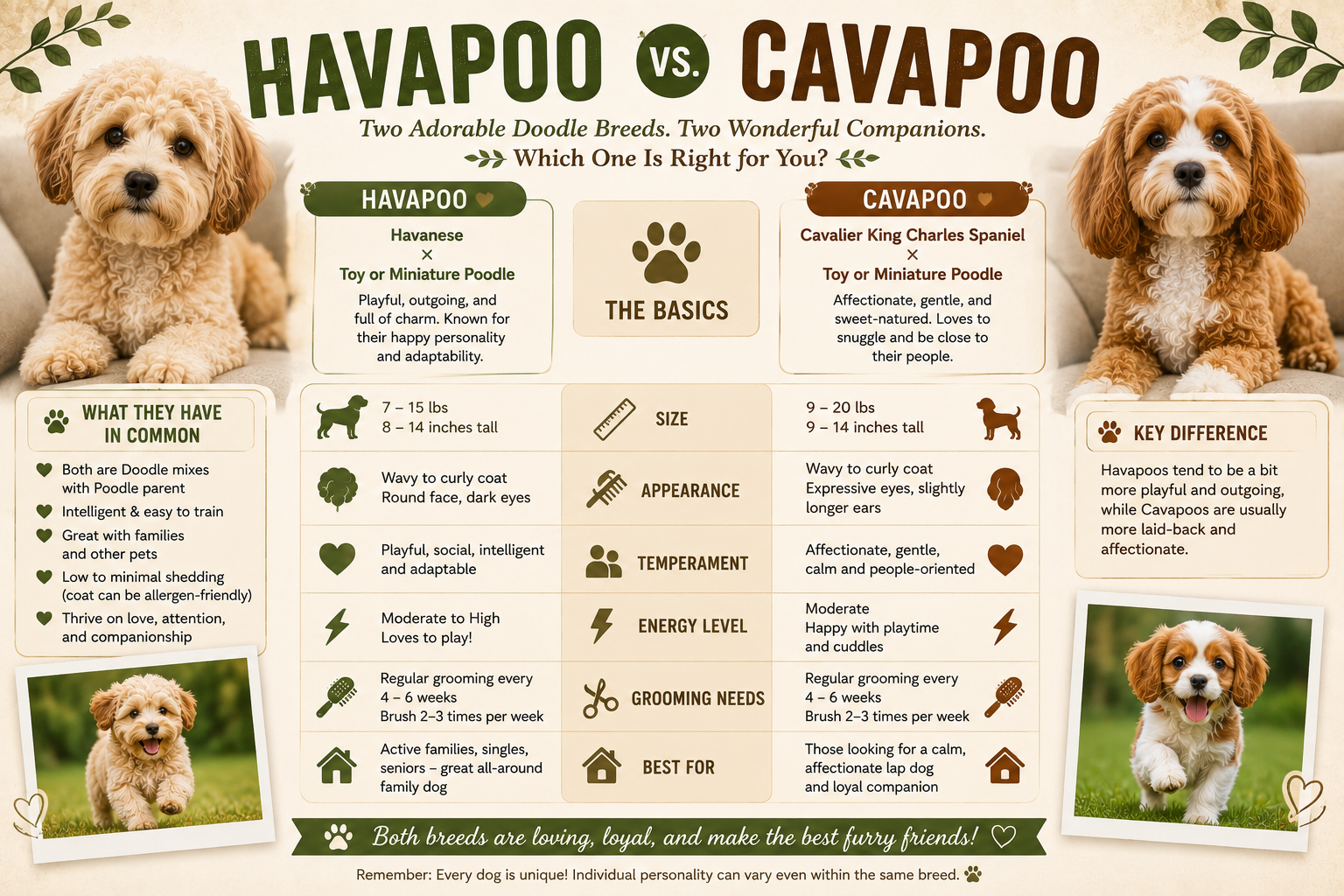
The Cavapoo combines Cavalier King Charles Spaniel and Poodle ancestry; the Havapoo combines Havanese and Poodle. Both are affectionate companion crosses that can have wavy or curly low-shedding coats and require regular grooming.
A Havapoo may be somewhat smaller on average depending on the parents and may reflect the Havanese’s lively, sociable companion temperament. Cavapoos can inherit the Cavalier’s gentle spaniel character and also bring Cavalier-specific health concerns into the equation. Neither cross is automatically healthier, calmer, more hypoallergenic, or “better.” The quality and temperament of the parents matter enormously.
Havapoo vs. Havanese
A purebred Havanese offers greater predictability in adult size, coat, structure, and breed temperament because generations are bred to an established standard. A Havapoo adds Poodle ancestry and therefore more variability. If you love the Havanese but mainly want a Havapoo because you assume it will be more hypoallergenic, remember that Havanese themselves are already low-shedding and no dog is allergen-free.
Havapoo vs. Maltipoo
The Maltipoo uses Maltese rather than Havanese ancestry. Both are small companion Poodle crosses with substantial grooming needs. The Havanese is generally a little sturdier and larger than the Maltese, but the actual parents used in either cross determine much of the resulting puppy’s size.
Havapoo vs. Cockapoo
A Cockapoo combines Cocker Spaniel and Poodle and is often larger and more sporting-influenced than a Havapoo. Someone wanting a very compact companion may lean Havapoo; someone wanting a sturdier, potentially more active dog may want to explore the Cockapoo.
Havapoo vs. Poochon, Shih-Poo, Yorkiepoo & Pomapoo
The same principle applies across designer Poodle mixes: look beyond the Poodle half. The non-Poodle parent changes the likely size, instincts, sociability, coat, health risks, and behavior. Compare the Poochon, Shih-Poo, Yorkiepoo, and Pomapoo by studying their parent breeds—not by choosing the cutest portmanteau.
The Havapoo vs. Cavapoo and Havapoo vs. Maltipoo clusters are strong enough to justify dedicated comparison pages later, with the main guide providing this useful overview and sending readers deeper when those pages are created.
Havapoo Pros & Cons
Reasons People Love Havapoos
- Affectionate and highly companionable.
- Usually bright and responsive to training.
- Small enough for apartments and easy travel.
- Often low shedding.
- Playful without usually requiring extreme exercise.
- Can fit many family structures, including attentive seniors and first-time owners.
- Plenty of personality in a compact package.
Potential Challenges
- Regular grooming is not optional.
- Adult size and coat are less predictable than in an established pure breed.
- Low shedding does not mean allergy-proof.
- Some become overly dependent or struggle with being alone.
- Barking can become a habit.
- Small dogs need serious dental care.
- Popularity attracts puppy mills, brokers, scammers, and exaggerated “teacup” or rare-color marketing.
- Health risks from both parent breeds still require responsible screening.
Is a Havapoo Right for You?
 A Havapoo can be a terrific choice for someone who wants an affectionate, clever small dog and enjoys having a canine companion woven into daily life. They suit many apartments, houses, families, singles, and older adults when the individual dog’s needs match the household.
A Havapoo May Be a Good Match If You:
- Want a people-oriented companion rather than an independent dog.
- Enjoy training and interactive play.
- Accept the cost and time involved in professional grooming.
- Can provide daily walks and mental enrichment.
- Will teach the dog to cope calmly with reasonable alone time.
- Understand that a mixed-breed puppy’s final size and coat cannot be ordered from a catalog.
You May Prefer Another Dog If You:
- Want a wash-and-wear coat.
- Need a dog guaranteed not to trigger allergies.
- Are away for very long hours every day.
- Want exact predictability in adult size, coat, and appearance.
- Do not want to manage barking or close attachment.
- Have very young children who cannot yet interact safely with a small dog.
The best Havapoo is not the tiniest, curliest, rarest-colored, or most expensive puppy. It is the healthy, temperamentally sound dog whose needs fit your real life.
Frequently Asked Questions About Havapoos
What is a Havapoo mixed with?
A Havapoo is a Havanese crossed with a Poodle, usually a Toy or Miniature Poodle.
Is a Havanese Poodle mix the same as a Havapoo?
Yes. Havanese Poodle mix and Poodle Havanese mix are literal descriptions of the cross commonly called a Havapoo.
How big does a Havapoo get?
Many full-grown Havapoos are roughly 7–20 pounds and 8–15 inches tall, but parent size and genetics can produce adults outside that range.
What does a full-grown Havapoo look like?
Adults vary. Coats can be wavy or curly, and some are more Havanese-like while others look distinctly Poodle-influenced. Grooming style also changes the appearance dramatically.
Are Havapoos hypoallergenic?
No dog is completely hypoallergenic. Many Havapoos shed very little, but coat type and individual allergy reactions vary.
Do Havapoos shed?
Usually very little, although shedding cannot be guaranteed. Low-shedding coats often require substantial brushing and trimming.
How often should a Havapoo be groomed?
Most need brushing several times a week or more often, plus regular trimming. Many owners use professional grooming every four to eight weeks depending on coat and haircut.
What is a Havapoo teddy-bear cut?
It is a grooming style that leaves a plush body and rounds the facial furnishings for a soft teddy-bear appearance. It is a haircut, not a distinct coat type.
What is the Havapoo lifespan?
A broad expectation is approximately 12–16 years, although individual longevity varies.
What health problems can Havapoos have?
Potential concerns include patellar luxation, inherited eye disease, hip problems, Legg-Calvé-Perthes disease, dental disease, and other conditions found in Havanese and Poodle family lines. Responsible health testing of both parents matters.
Is an F1b Havapoo more hypoallergenic?
An F1b backcross to a Poodle may be more likely to have a Poodle-like coat, but the generation label cannot guarantee allergy tolerance or zero shedding.
What is a teacup Havapoo?
“Teacup” is a marketing term for an exceptionally small dog, not a recognized Havapoo variety. Prioritize health and soundness over extreme size.
How much is a Havapoo?
Prices vary widely by region and seller. Judge a breeder by verifiable health testing, temperament, puppy-raising practices, transparency, and lifetime support—not price alone.
Where can I find Havapoo puppies near me?
Start with the Dogs Central Havapoo Puppies Guide so you know how to evaluate breeders and avoid scams, then explore the Havapoo Breeder Showcase. Adoption may also be possible through Pet Rehoming Network.
Which is better, a Havapoo or Cavapoo?
Neither is universally better. The right choice depends on the actual parents, health testing, temperament, adult size, your grooming tolerance, and household needs. The Havapoo has Havanese ancestry; the Cavapoo has Cavalier King Charles Spaniel ancestry.
Havapoo or Havanese—which should I choose?
Choose a Havanese if the predictability of an established breed is important to you. Consider a Havapoo if you specifically like the combination of Havanese and Poodle traits and are comfortable with greater variation.
Trusted Havapoo, Health & Puppy-Buyer Resources
- American Kennel Club — Havanese
- Havanese Club of America — Health & Testing Guide
- Havanese Club of America — Questions to Ask Breeders
- Poodle Club of America — Poodle Health Testing
- Humane World for Animals — Puppy Mills FAQ
- Humane World for Animals — Stopping Puppy Mills
Our Havapoo Guide Is Growing
Dogs Central is building a connected small-dog library rather than a collection of isolated profiles. This Havapoo guide is designed to grow alongside dedicated Havapoo puppy and names resources, parent-breed guides, grooming content, health information, and comparison pages such as Havapoo vs. Cavapoo and Havapoo vs. Maltipoo.
As new questions emerge, we can add photographs of adult Havapoos, coat-color and grooming infographics, owner stories, puppy-development resources, and deeper supporting articles while keeping this main guide useful and readable.