
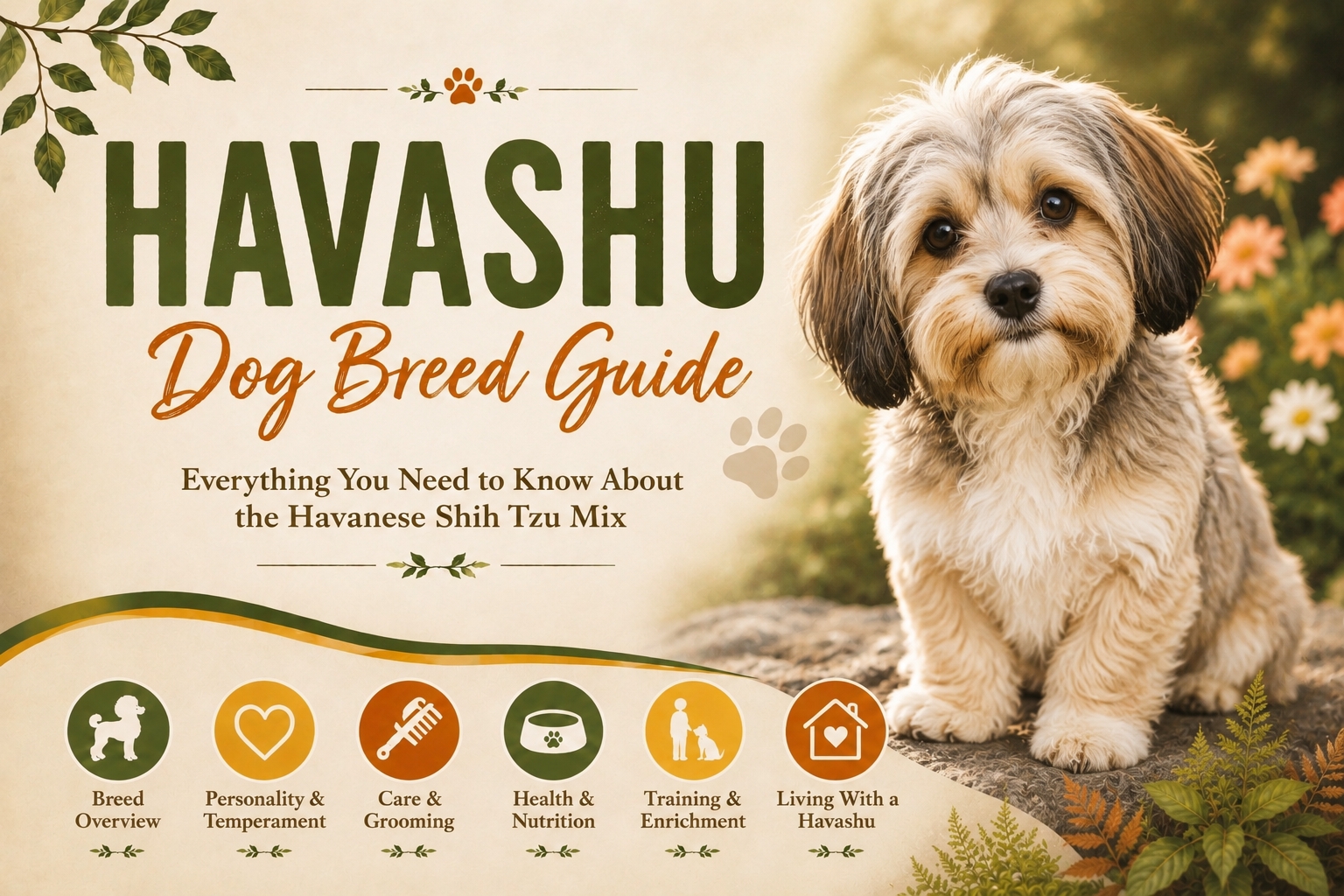
Havashu Dog Breed Guide: Havanese Shih Tzu Mix Size, Temperament, Grooming, Health & More
The Havashu is a small companion dog produced by crossing a Havanese with a Shih Tzu. Just as importantly for anyone trying to research one, this dog is frequently called a Havanese Shih Tzu mix or Shih Tzu Havanese mix. In fact, the U.S. search data supplied for this guide shows that many people search for the literal parent-breed combination rather than the designer name. Throughout this guide, those terms refer to the same basic cross.
On paper, the pairing makes considerable sense. Both parent breeds are small, affectionate companion dogs with long coats, strong attachments to people, and personalities that can be downright entertaining. But a Havashu is not a standardized pure breed, and crossing two breeds does not create a perfectly predictable midpoint between them. One puppy may be more Havanese-like in build and liveliness; another may inherit more of the Shih Tzu’s compact structure, shorter muzzle, and laid-back streak.
That variation is important. Prospective owners should look beyond the teddy-bear face and learn about grooming, dental care, eye and knee health, possible breathing concerns in shorter-muzzled individuals, early socialization, house training, time alone, and responsible breeding. This guide covers the Havashu from puppyhood through the senior years—including full-grown Havashu size, temperament, coat colors, haircuts, health, lifespan, price, adoption, and how the Havashu compares with the Havapoo.
Havashu at a Glance
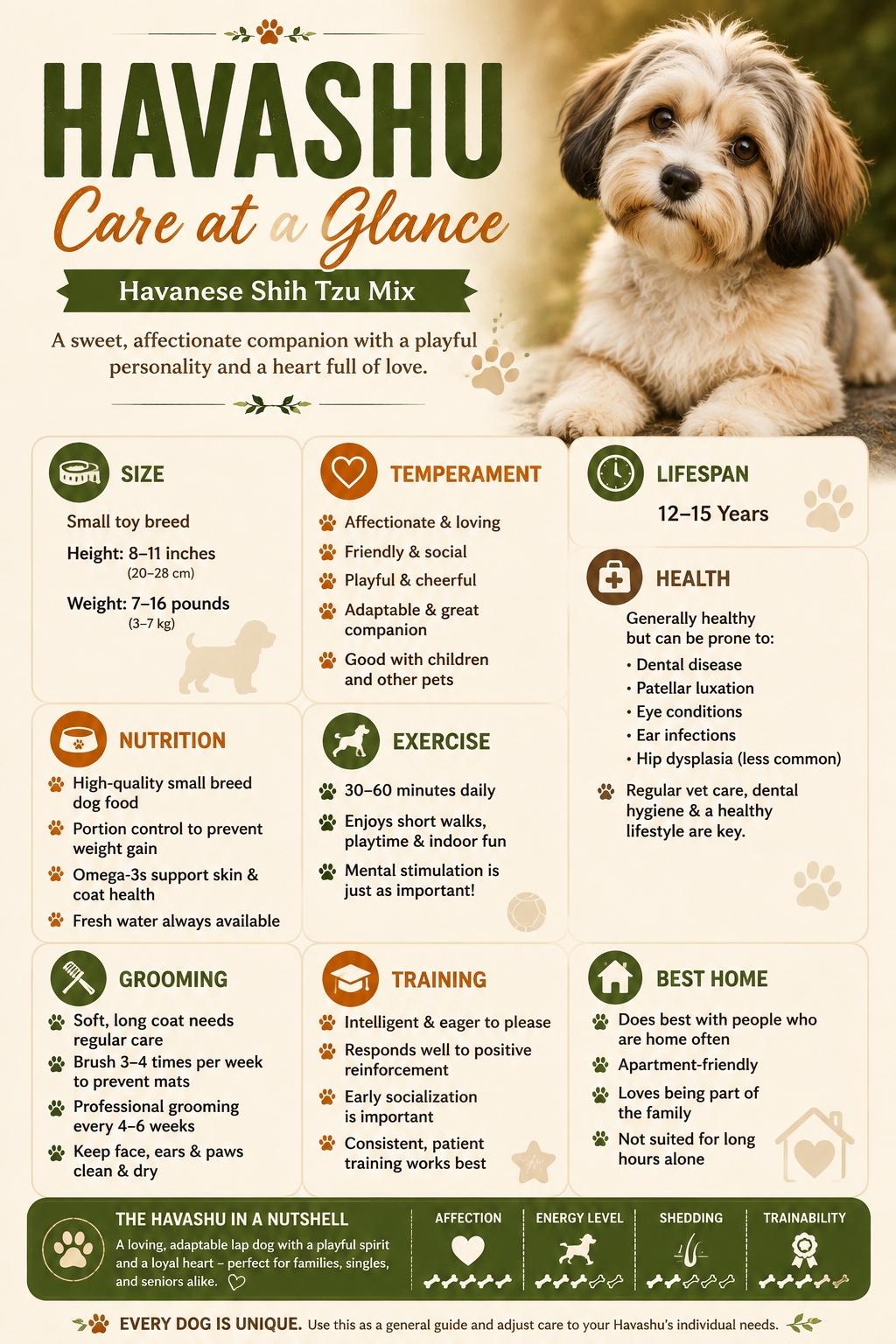
| Also called | Havanese Shih Tzu mix, Shih Tzu Havanese mix |
|---|---|
| Parent breeds | Havanese × Shih Tzu |
| Breed status | Designer/hybrid mixed-breed companion dog; not an AKC-recognized pure breed |
| Typical adult weight | Often roughly 7–16 pounds; individual dogs may fall outside this range |
| Typical height | Usually a compact toy-to-small companion, often roughly 8–12 inches at the shoulder |
| Coat | Long or medium, soft, straight to wavy; sometimes somewhat denser or curlier |
| Shedding | Usually low, but not guaranteed |
| Temperament | Often affectionate, cheerful, sociable, playful, alert, and people-oriented |
| Exercise | Moderate; daily walks, play, and mental enrichment |
| Grooming | High if kept long; regular brushing and professional trimming are common |
| Best suited to | People wanting a close small companion and prepared for coat care, training, and plenty of company |
What Is a Havashu? The Havanese Shih Tzu Mix Explained
A Havashu is a cross between a Havanese and a Shih Tzu. The name combines parts of the parent-breed names, but it does not describe a separate pure breed with a closed stud book or universally accepted breed standard.
That distinction matters because a designer name can make a cross sound more uniform than it really is. A Havashu puppy can inherit different combinations of coat texture, muzzle length, body proportions, energy, confidence, trainability, and sociability. Even littermates may grow into noticeably different adults.
Is a Havashu the Same as a Havanese Shih Tzu Mix?
Yes. “Havanese Shih Tzu mix” and “Shih Tzu Havanese mix” are descriptive names for the cross commonly called a Havashu. The parent-breed wording is particularly important here because U.S. searchers use it heavily.
Is the Havashu Recognized by the AKC?
No. The American Kennel Club recognizes Havanese and Shih Tzu as individual pure breeds, but it does not recognize the Havashu as a separate pure breed. Mixed-breed dogs may still participate in many canine activities through programs designed for mixed dogs.
Havashu History & Parent Breeds
The Havashu belongs to the modern group of deliberately bred small companion crosses often called designer dogs. There is no well-documented single founder or precise creation date for the cross, so claims about an elaborate Havashu “breed history” should be treated cautiously. The meaningful history comes from its two established parent breeds.
The Havanese Side
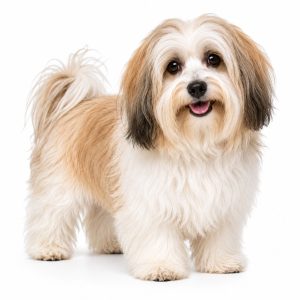 The Havanese is Cuba’s national dog and was developed primarily as a companion. Havanese are known for their sociable nature, springy movement, expressive personality, and long, soft coat. They tend to enjoy close involvement with their families and often combine cuddly companionship with a surprisingly playful, busy side.
The Shih Tzu Side
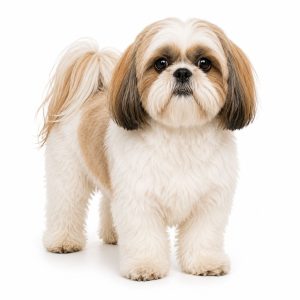 The Shih Tzu has ancient Asian companion-dog roots and was prized as a house and palace companion. The breed is compact and sturdy for its size, with a broad head, large expressive eyes, a long coat, and a shortened muzzle. Shih Tzu tend to be affectionate, charming, and companionable, often with an independent little streak that reminds owners that cooperation and obedience are not quite the same thing.
What Happens When You Cross Them?
Often you get a small, affectionate dog who likes being close to people and has a substantial grooming requirement. Beyond that, prediction becomes less precise. The Havashu may have a longer muzzle and lighter build than many Shih Tzu, or may inherit a more compact Shih Tzu-like head and body. Temperament can range from exuberantly social to comparatively mellow.
Responsible breeders should be trying to produce healthy, stable companions—not simply combining two cute dogs and inventing a price tag. The quality, health, and temperament of both parents matter more than the designer label.
What Does a Havashu Look Like?
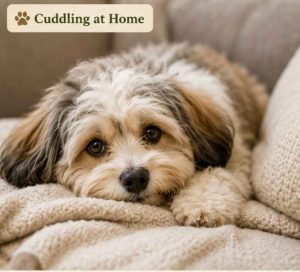 A Havashu is generally a small, attractive companion with drop ears, expressive eyes, a plumed tail, and a soft coat that can give the dog a teddy-bear appearance when trimmed. The face may be round and Shih Tzu-like or somewhat longer and more Havanese-like. The body may be compact and sturdy or slightly lighter and more athletic.
This variation explains the search interest in Havanese Shih Tzu mix pictures and full-grown dogs. Puppy photos do not tell the entire story. Coat color can change, facial furnishings become fuller, and adult proportions may move the dog visually toward one parent or the other.
A shorter muzzle deserves more than cosmetic consideration. If a Havashu inherits pronounced Shih Tzu-style brachycephalic features, breathing comfort and heat tolerance become important health and lifestyle issues. A dramatically flat face should never be marketed as inherently “cuter” without considering function.
Havashu Full Grown: Adult Size & Weight
A full-grown Havashu is normally a toy-to-small companion dog. Many adults land somewhere around 7 to 16 pounds and roughly 8 to 12 inches at the shoulder, although mixed-breed dogs can fall outside any estimated range.
Those numbers make sense when you look at the parents. Both Havanese and Shih Tzu are small breeds, so Havashu size is somewhat more predictable than a cross involving parents with dramatically different sizes. Still, the actual adult size of the mother, father, grandparents, and previous offspring is more useful than a seller’s generic chart.
When Is a Havashu Full Grown?
Most of the dog’s height is generally established during the first year, with smaller dogs maturing physically sooner than large breeds. The body can continue filling out, the coat can mature, and adolescent behavior can continue evolving after the dog looks nearly adult.
A breeder promising an exact adult weight for a very young puppy is offering an estimate, whether or not it is presented that way. Ask for the actual weights of both parents and previous adult offspring if size is important to you.
Havashu Coat Types & Colors
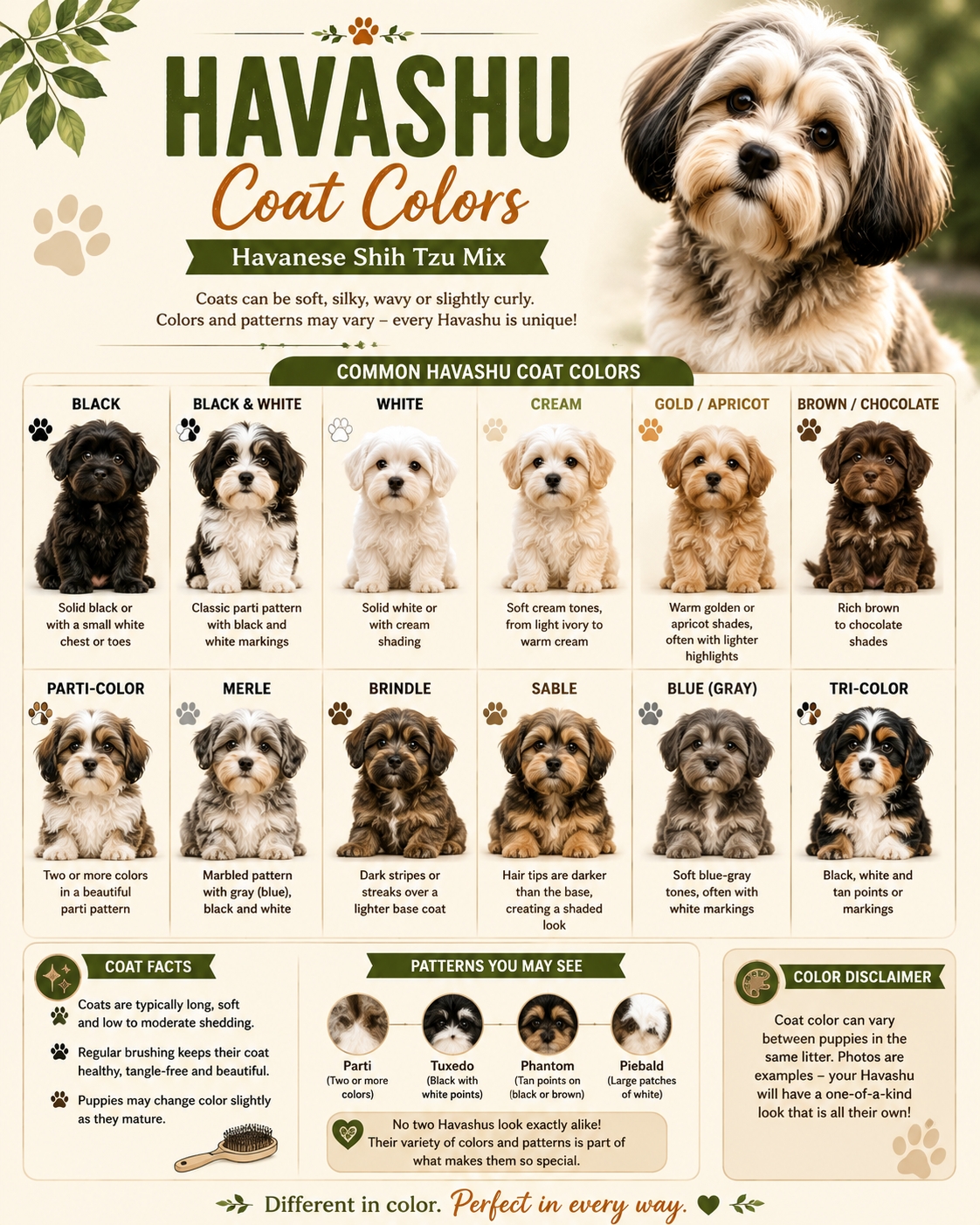
Both parent breeds carry long coats, so Havashus commonly have abundant hair rather than a short wash-and-wear coat. Texture may be silky, soft and wavy, relatively straight, or somewhat fluffy and dense. Some coats tangle much more readily than others.
Havashu Colors
Havanese and Shih Tzu both occur in numerous colors and patterns, so Havashus can be quite varied. You may see:
- Black
- Black and white
- White or cream
- Gold
- Brown or chocolate shades
- Gray or silver
- Red or reddish shades
- Brindle or sable influences
- Parti-colored and other multi-color combinations
Black-and-White Havanese Shih Tzu Mixes
Black-and-white Havashus receive specific search interest. The pattern can be striking, but color should remain well down the puppy-selection checklist. Temperament, health, structure, breathing, eye comfort, and the quality of the puppy’s early life are much more important than markings.
Coats may also change shade with maturity. Havanese in particular can lighten or change considerably, so the exact puppy color may not be the permanent adult color.
Are Havanese Shih Tzu Mixes Hypoallergenic? Do Havashus Shed?
Havashus are usually low-shedding dogs, but they should not be described as guaranteed hypoallergenic. Both parent breeds have coats that tend to release relatively little hair compared with many dogs, which can make a Havashu appealing to people who dislike fur around the house.
Allergy is more complicated. People react to proteins associated with dander, saliva, and other secretions, not simply to loose hair. One person may tolerate an individual Havashu reasonably well and react strongly to another.
If allergies are a major concern, spend meaningful time around the individual dog and similar adult dogs before making a commitment. Be skeptical of anyone promising a “100% hypoallergenic” puppy.
There is also an important trade-off: hair that does not readily fall out can remain in the coat and contribute to tangles and mats. Low shedding does not mean low grooming—quite the opposite with many Havashus.
Havashu Temperament & Personality
The typical Havashu is expected to be an affectionate, cheerful companion who enjoys people and likes being part of household life. Both parent breeds were developed primarily for companionship, so this is not a cross in which strong herding, guarding, or hunting instincts are the central feature.
Many Havashus are playful, funny, cuddly, and sociable. They may greet familiar people enthusiastically, follow family members from room to room, and settle happily on a lap after play. The Havanese side can contribute lively curiosity and an outgoing style; the Shih Tzu side may contribute a calmer, self-possessed quality and a dash of charming stubbornness.
Affectionate Does Not Mean Identical
Mixed-breed temperament cannot be guaranteed. Meet the mother whenever possible and learn about the father. A breeder should be able to discuss whether the parents are confident with strangers, tolerant of handling, comfortable around other dogs, excessively vocal, fearful, or distressed when alone.
Early socialization matters enormously. Puppies should experience gentle handling, household sounds, different surfaces, age-appropriate visitors, grooming, short car rides, and carefully managed exposure to the wider world without being overwhelmed.
Can Havashus Be Stubborn?
They can certainly have opinions. Shih Tzu were not developed to execute complex working commands all day, and companion breeds often ask, in effect, “What’s in this for me?” That is not low intelligence. Use food, play, praise, and short enjoyable sessions rather than turning training into a contest of wills.
Are Havashus Smart? Intelligence & Trainability
Havashus are generally intelligent enough to learn household manners, tricks, basic obedience, grooming routines, and useful life skills very well. Their trainability depends less on whether they can understand a task and more on whether training is clear, rewarding, and consistent.
The Havanese is often eager to interact and learn, while the Shih Tzu can be clever but more independent about repetition. A Havashu may therefore learn a cue quickly and then wonder why everyone keeps requesting the same performance when the matter was clearly settled yesterday.
Useful Skills for a Havashu
- Reliable recall indoors and in safely enclosed areas.
- Comfortable harness and leash walking.
- Settling quietly on a bed or mat.
- Polite greetings.
- Waiting briefly at doors.
- Trading found objects for rewards.
- Comfort with face, feet, ears, and body handling.
- Standing calmly for brushing and combing.
- Relaxing during short periods apart from family members.
Because grooming is a lifelong necessity, cooperative-care training is arguably as important for this cross as “sit.” A dog who willingly offers a chin rest for face combing or calmly presents a paw for handling has learned something genuinely valuable.
Training & House Training a Havashu
Use positive reinforcement and begin immediately. Small dogs are sometimes allowed behaviors that would be addressed quickly in a larger dog—jumping, frantic barking, guarding laps, refusing to walk, or snapping during handling. Being tiny should not mean living without helpful boundaries.
House Training
Toy-sized puppies need frequent toilet opportunities because their bladders are small. Take a Havashu puppy outside after waking, eating, drinking, active play, and before bedtime. Supervise closely indoors and reward successful outdoor toileting immediately.
Bad weather can complicate matters. A puppy with a long belly coat may consider rain, snow, or wet grass a personal insult. A sheltered outdoor toilet area and a predictable routine can help. Punishing accidents is counterproductive; it can teach a puppy to hide rather than teaching where to toilet.
Socialization
Good socialization is not simply letting every stranger touch the puppy or allowing every dog to rush over. The goal is calm confidence. Pair new experiences with safety and rewards, allow the puppy to observe at a comfortable distance, and protect it from frightening or physically rough encounters.
Havashu Barking, Common Behavior Traits & Time Alone
A Havashu may be a useful little alert dog, announcing visitors, hallway noises, delivery drivers, or activities outside the window. Some individuals are quiet; others discover that barking is an extraordinarily efficient way to summon human attention.
Reward quiet behavior before barking becomes a deeply practiced habit. Provide enough activity, block visual triggers when necessary, teach a settle routine, and avoid accidentally paying for demand barking with attention every time it occurs.
Can a Havashu Be Left Alone?
Both parent breeds are strongly oriented toward human companionship, so Havashus are not ideal for households wanting a dog to spend very long days alone. That does not mean the dog should be attached to its person every waking minute. Quite the opposite: gentle independence training is important.
Start with seconds and minutes of relaxed separation while the puppy has something pleasant to do, then increase gradually. Teach naps in a safe resting area and allow other trusted people to provide care. A dog who has never learned to be alone may struggle badly when life inevitably requires it.
Persistent panic, destructive escape attempts, continuous howling, drooling, or other severe distress when alone warrants veterinary and qualified behavioral help.
Havashu Exercise Needs & Enrichment Activities
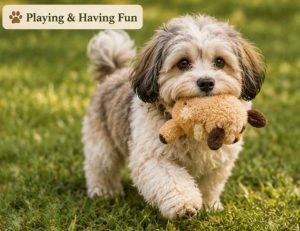 Havashus generally need moderate exercise. Their small bodies do not require marathon mileage, but they are still dogs with noses, brains, muscles, and a need to explore. Daily walks plus play and mental activity are a much better recipe than treating the dog as a decorative lap accessory.
Adjust exercise to the individual. A Havanese-influenced dog may be surprisingly lively, while a more Shih Tzu-like individual may prefer shorter outings. Shorter-muzzled Havashus require extra caution in hot, humid weather because inefficient breathing can make cooling more difficult.
Fun Havashu Enrichment
- Sniff walks with time to investigate.
- Food puzzles and stuffed food toys.
- Hide-and-seek with family members.
- “Find it” games with tiny treats.
- Short trick-training sessions.
- Gentle fetch and toy games.
- Simple indoor obstacle courses using safe, low objects.
- Grooming practice paired with rewards.
A ten-minute scent game can be wonderfully satisfying for a small dog, especially on days when weather makes a long walk unpleasant.
Are Havashus Good Family Dogs? Children, Dogs, Cats & Other Pets
Havashus can make excellent family companions when the dog’s temperament and the household are a good match. Both parent breeds have long histories as companion dogs, and many individuals enjoy having several people to adore.
Havashus and Children
 They can be affectionate with children, but small size requires common sense. Young children can accidentally injure a toy-sized dog by dropping it, stepping on it, squeezing it, or falling on it. Adults should supervise and teach children to interact on the floor rather than carrying the dog around.
The dog also deserves boundaries. Children should leave it alone while eating, sleeping, or retreating to a safe bed. A small dog should not have to tolerate behavior that would obviously be considered inappropriate with a large dog.
Havashus and Other Dogs
Many are sociable with dogs, especially when carefully socialized. Protect a tiny Havashu from rough play with much larger dogs. Compatibility depends on individual temperament more than breed labels.
Havashus and Cats
Both parent breeds are primarily companions rather than high-drive hunting dogs, so many Havashus can live peacefully with cats. Introduce animals gradually, give the cat escape routes and elevated spaces, and reward the puppy for calm behavior rather than allowing chasing to become a game.
Havashus in Apartments, With Seniors & First-Time Owners
Apartment Living
The Havashu’s compact size makes it physically well suited to apartments and condos. A yard is convenient, not essential. More important are daily walks, mental stimulation, house training, and sensible barking management so every sound in the corridor does not become a neighborhood announcement.
Havashus for Seniors
A calm adult Havashu can be an excellent older-adult companion: affectionate, portable, and manageable on ordinary walks. Consider grooming costs and physical tasks such as bathing, brushing, lifting, and bending. Tiny dogs can also become a tripping hazard when they habitually walk directly underfoot.
First-Time Dog Owners
Havashus can suit committed first-time owners. Their companion temperament and manageable exercise requirements are appealing, but the coat is demanding, house training requires consistency, and small-dog dental care is a serious responsibility. Owners also need to resist the temptation to excuse poor manners simply because the dog weighs ten pounds.
Havashu Grooming & Haircuts
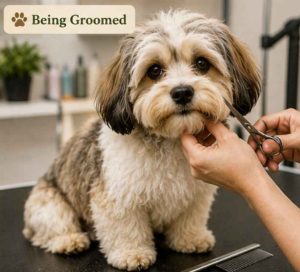 Havashu haircuts are one of the notable supporting searches in the U.S. data, and grooming deserves serious attention. Both parent breeds can grow long coats, so this is not a low-maintenance cross even when shedding is minimal.
A long Havashu coat may need daily or near-daily brushing and combing. Shorter pet trims reduce the workload but do not eliminate it. Mats commonly develop behind the ears, under the harness, in the armpits, around the legs and feet, and anywhere dampness or friction causes hair to tangle.
Popular Havashu Haircuts
- Puppy cut: a practical, fairly even trim that keeps the coat manageable.
- Teddy-bear cut: a rounded face with a soft, plush outline.
- Short utility trim: useful for active dogs or owners who want easier maintenance.
- Long companion coat: beautiful but demanding; requires diligent combing all the way to the skin.
- Topknot or tidy-face styling: useful when longer facial hair would otherwise fall into the eyes.
Face and Eye Care
Facial grooming is particularly important in dogs with Shih Tzu influence. Keep hair from rubbing the eyes and have persistent tearing, squinting, redness, cloudiness, or eye discomfort assessed by a veterinarian. Prominent eyes can be more vulnerable to injury.
How Often Does a Havashu Need Professional Grooming?
Many pet-trimmed Havashus benefit from professional grooming roughly every four to eight weeks, depending on coat growth, chosen length, lifestyle, and the owner’s home maintenance. Your groomer can help establish a schedule for the individual coat.
Introduce grooming early and positively. Brushing a puppy for thirty seconds while feeding tiny treats is far more productive than waiting until the adolescent dog is badly matted and must endure a long, uncomfortable first grooming session.
Havashu Health Issues & Responsible Health Testing
A Havashu is not automatically healthier simply because it is mixed. Puppies can inherit disease risks and structural traits from both sides of the pedigree. Responsible breeding therefore means understanding the Havanese and Shih Tzu separately and screening the parents appropriately.
Patellar Luxation
Slipping kneecaps are a concern in many toy breeds and are relevant to both sides of this cross. Signs can include intermittent skipping on a rear leg, sudden carrying of the leg, or persistent lameness. Breeding dogs should receive appropriate patellar evaluation.
Eye Problems
Both parent breeds warrant attention to eye health. The Havanese Club of America includes annual CAER eye examinations in its CHIC requirements. For Shih Tzu, the American Shih Tzu Club’s 2024 health statement says the breed’s optional CHIC pathway requires an ACVO eye exam and patellar evaluation registered with OFA.
A Havashu who inherits prominent Shih Tzu-like eyes may also be more physically vulnerable to corneal injury. Squinting, rubbing, redness, discharge, cloudiness, or sudden eye pain deserves prompt veterinary attention.
Hips and Orthopedic Health
Havanese CHIC requirements include hip evaluation as well as patellas and annual eye exams. The American Shih Tzu Club lists hip evaluation among optional testing and identifies hip dysplasia among conditions breeders should consider in their lines. Ask what was actually tested in both parents rather than accepting the phrase “health tested.”
Breathing & Heat Tolerance
The Shih Tzu is brachycephalic, meaning the skull and muzzle are shortened. A Havashu with a noticeably shortened muzzle may inherit some degree of airway compromise. Noisy breathing, difficulty exercising, gagging, collapse, poor heat tolerance, or obvious respiratory effort should not be dismissed as “normal for the breed.”
When choosing a puppy, favor parents who breathe comfortably, move freely, and can participate in ordinary activity without respiratory distress. Functional anatomy matters more than an exaggerated flat-faced appearance.
Dental Disease
Both parent breeds are small, and crowded mouths can predispose toy dogs to periodontal problems. Preventive dental care should begin early rather than waiting until middle age.
What Health Testing Should a Havashu Breeder Provide?
For the Havanese parent, the Havanese Club of America currently requires OFA hips, OFA patellas, and annual CAER eye exams for a CHIC certificate. For Shih Tzu, the American Shih Tzu Club does not mandate testing for all breeders, but its CHIC pathway requires an ACVO eye examination and veterinary patellar evaluation registered with OFA; hip and cardiac evaluations are optional. The club also asks breeders to be aware of problems including renal dysplasia, portosystemic shunt, patellar luxation, hip dysplasia, genetic eye problems, and cardiac issues.
Ask for registered names and actual reports. “Vet checked” usually describes an examination of the puppy; it does not mean the parents completed breed-relevant screening. Likewise, a commercial DNA panel cannot evaluate everything that requires a physical examination, ophthalmic exam, or radiograph.
This guide provides general educational information and is not a substitute for diagnosis, treatment, or individualized advice from your veterinarian.
Havashu Lifespan: How Long Do Havanese Shih Tzu Mixes Live?
There is not enough robust population data on Havashus to give a scientifically precise cross-specific lifespan. Both parent breeds are generally long-lived small companion dogs, so a Havashu can reasonably be expected to have the potential for a life extending well into the teen years when genetics, health, and circumstances cooperate.
A practical planning expectation is roughly 12 to 16 years, while recognizing that individuals may live shorter or longer lives. The Havanese Club of America describes Havanese life expectancy as approximately 12–15 years or more; Shih Tzu are likewise known as a long-lived toy breed.
Healthy body weight, appropriate exercise, dental care, preventive veterinary medicine, prompt attention to eye or breathing symptoms, good nutrition, and avoiding preventable accidents all help maximize healthy years.
Havashu Dental Care
Dental care is not a cosmetic extra for a small dog. Toy-sized mouths can have crowded teeth, and periodontal disease may progress beneath the gumline even when the visible teeth do not initially look terrible.
- Introduce tooth brushing gradually with dog-safe toothpaste.
- Aim for frequent brushing; daily is ideal when the dog tolerates it.
- Have the mouth checked during routine veterinary examinations.
- Ask when professional dental cleaning is appropriate.
- Do not assume dry kibble alone cleans the teeth.
- Use appropriately sized dental products and avoid extremely hard objects capable of fracturing teeth.
Bad breath, red or bleeding gums, loose teeth, chewing on one side, dropping food, facial swelling, or reluctance to eat hard food should prompt veterinary evaluation.
Havashu Food, Feeding & Nutrition
Feed a complete and balanced diet appropriate for the dog’s age, size, activity, body condition, and health. Small-breed foods can be convenient because the kibble size and calorie density suit small mouths and bodies, but there is no special ingredient that every Havashu requires simply because of the cross.
Portion control matters. A few extra ounces of fat represent a meaningful percentage of a ten-pound dog’s body weight. Keep your Havashu lean enough that ribs can be felt under a light covering and a waist is visible from above.
Feeding a Havashu Puppy
Young toy-sized puppies generally need several meals spread through the day. Very small puppies can become vulnerable if they do not eat adequately, particularly during illness or stressful transitions. Initially maintain the breeder’s feeding routine and make diet changes gradually.
If a tiny puppy becomes weak, trembly, unusually sleepy, disoriented, repeatedly vomits, refuses food, or collapses, seek veterinary advice promptly rather than assuming the puppy is merely tired.
Life With a Havashu
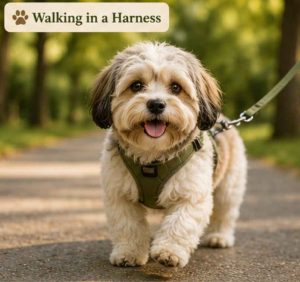 A Havashu is likely to be happiest living with you rather than merely living in the same building. These dogs often want involvement: a morning walk, commentary on breakfast, supervision of household chores, a game in the afternoon, perhaps a spirited objection to the doorbell, and a prime evening position somewhere near a human.
The manageable exercise requirement makes Havashus attractive to many households, but the grooming commitment is real. A short pet trim simplifies life considerably. Owners who dream of a flowing coat should also dream of combs, brushes, conditioner, face care, and a remarkably intimate relationship with their groomer.
Because both parent breeds are companions, independence should be deliberately taught. Encourage the puppy to nap in its own comfortable spot, enjoy food toys without constant human involvement, and spend short periods with trusted caregivers. Close attachment is wonderful; inability to function without one particular person is not.
Havashu Puppies: Development, Socialization & Early Care
Havashu puppies are small, appealing, and easy to spoil—which is precisely why thoughtful early training matters. The first months should establish confidence with grooming, handling, household routines, safe exploration, different people, appropriate dogs, car travel, veterinary care, and brief periods alone.
Look for a puppy raised in a clean, stimulating environment where people interact with the litter regularly. Puppies should appear curious and responsive rather than chronically shut down or frantic. The mother should appear comfortable and well cared for, and the breeder should know each puppy as an individual rather than treating the litter as interchangeable merchandise.
Grooming Socialization Starts Now
A Havashu will need coat care for life. Introduce a soft brush, comb, face handling, feet handling, nail care, and the sounds associated with grooming while sessions are extremely short and rewarding. This small investment can prevent years of grooming battles.
Protect the Puppy Without Isolating It
Follow your veterinarian’s advice about disease risk and vaccination while still providing safe socialization. A puppy kept completely isolated during its important developmental period can miss experiences that are difficult to recreate later.
For our full buyer-education resource, see the Havashu Puppies Guide.
Finding Havashu Puppies for Sale Near You & Choosing a Breeder
Searches for Havashu puppies for sale, puppies near me, breeders, and Havanese Shih Tzu mixes for sale make up an important part of the keyword data. Dogs Central’s role is not to turn this page into a classified ad. It is to help readers find a healthy, well-socialized puppy without supporting puppy mills, irresponsible breeding, brokers, or scams.
Start with our Havashu Puppies Guide, which is designed specifically to teach puppy buyers how to evaluate a breeder and puppy. You can also explore the Dogs Central Havashu Breeder Showcase as a starting point for breeder research.
Questions Worth Asking
- What are the registered names and ages of both parents?
- What health screening was completed for the Havanese parent?
- What eye and patellar screening was completed for the Shih Tzu parent, and were hips or cardiac health evaluated?
- How do both parents breathe during normal exercise and warm weather?
- What are their temperaments around strangers, children, dogs, grooming, and time alone?
- Where are the puppies raised?
- What socialization and grooming preparation do they receive?
- Can you meet the mother and see the puppy-raising environment?
- What does the contract say about returning the dog if you cannot keep it?
Red Flags
Be cautious with sellers offering numerous breeds or mixes continuously, refusing to identify the parents, making unverifiable health claims, pushing immediate electronic payment, arranging handoffs in parking lots, or offering shipping with virtually no questions about you. A beautiful website and adorable puppy photographs are marketing—not proof of responsible breeding.
Never assume that a very high price means quality, or that a low price means a bargain. Look at what the breeder actually does.
Havashu Price: How Much Does a Havanese Shih Tzu Mix Cost?
Havashu price and Havanese Shih Tzu price appear in the search data, but there is no authoritative national price for a non-standardized designer cross. Asking prices vary by region, breeder, demand, parental lines, health screening, and sometimes coat color.
Instead of choosing by sticker price, compare value in terms of responsible breeding. Proper health screening, excellent veterinary care, quality nutrition, early socialization, grooming preparation, and lifelong breeder support all cost money. On the other hand, an expensive puppy accompanied by fancy color terminology and no verifiable health records is still an expensive poorly documented puppy.
Budget for the Dog, Not Just the Puppy
- Professional grooming every several weeks for many pet trims.
- Veterinary preventive care and emergencies.
- Dental care and professional cleaning when required.
- Food and training treats.
- Harness, leash, carrier, bedding, crate or safe area, toys, brushes, and combs.
- Training classes.
- Pet insurance or an emergency veterinary fund.
- Pet sitting, boarding, or dog walking when needed.
A puppy purchase is one transaction. A Havashu may be part of the household for well over a decade.
Havashu Puppy Name Ideas
The Havashu gives us wonderful naming territory. We can borrow inspiration from the Havanese’s Cuban heritage, the Shih Tzu’s Tibetan and Chinese history, the dog’s fluffy appearance, small size, and generally sunny companion personality.
Fun starters include Havana, Coco, Mambo, Rumba, Bao, Mei, Lulu, Mochi, Teddy, Biscuit, Tofu, Pippa, Pip, Miso, Sunny, Churro, Bean, Ziggy, Winnie, and Peaches.
Our full collection belongs at Havashu Dog Names. For even more ideas, browse the Small Dog Names Guide.
Havashu Adoption & Rehoming
Havashu puppies for adoption appear in the search data, and adult Havanese-Shih Tzu mixes can certainly need new homes. Because Havashu is not a common standardized breed, adoptable dogs may be listed simply as Havanese mixes, Shih Tzu mixes, or small mixed-breed dogs rather than under the designer name.
Pet Rehoming Network owns Dogs Central’s breed-specific adoption and rehoming intent. The intended resource is Havashu Adoption & Rehoming on Pet Rehoming Network. Our search did not surface an established Havashu page there, so this resource should be created or confirmed rather than duplicating it on Dogs Central.
If you are adopting, ask about veterinary history, eye and breathing issues, house training, grooming tolerance, behavior around children and animals, separation behavior, medications, bite history, and why the dog needs a new home. A careful match protects both the dog and adopter.
If you need to rehome a beloved Havashu, changing circumstances do not make you a bad owner. Illness, housing, finances, family changes, and other realities can make keeping a dog impossible. Thoughtful home-to-home rehoming with honest disclosure and careful adopter screening can give the dog a safe transition and a genuinely suitable new family.
Havanese Shih Tzu Poodle Mixes & Other Havashu Mixes
The U.S. data includes searches for a Havanese Shih Tzu Poodle mix and even Havanese-Shih Tzu-Yorkie combinations. These are not additional Havashu varieties in any standardized sense. They are multi-breed mixes.
A dog with Havanese, Shih Tzu, and Poodle ancestry may sometimes be advertised with an invented designer name or as a Havashu-Poodle mix. Adding a third breed makes predictions about size, coat, shedding, temperament, and health less certain, not more. Ask for documented parentage and evaluate the actual dog rather than relying on a creative label.
If Poodle ancestry is specifically what appeals to you, compare the Havashu with established two-breed designer crosses such as the Havapoo, which combines Havanese and Poodle.
Havashu vs. Havapoo: What’s the Difference?
The Havashu vs. Havapoo query is particularly useful because both crosses share a Havanese parent but differ on the other side. A Havashu is Havanese × Shih Tzu; a Havapoo is Havanese × Poodle.
| Trait | Havashu | Havapoo |
|---|---|---|
| Parents | Havanese × Shih Tzu | Havanese × Toy/Miniature Poodle |
| Coat tendency | Often long, soft, straight/wavy | Often wavy to curly |
| Grooming | High | Moderate to high |
| Training style | Bright; may show more companion-breed independence | Often highly responsive, with Poodle learning influence |
| Muzzle | May inherit a shortened Shih Tzu-like muzzle | Usually longer-muzzled |
| Size predictability | Both parents are small | Varies more depending on Toy vs. Miniature Poodle parent |
Neither is automatically the better dog. Someone who likes the Shih Tzu’s sturdy companion character may be drawn to the Havashu. Someone specifically attracted to Poodle intelligence, curls, or athleticism may lean Havapoo. In both cases, the individual parents and breeder matter enormously.
The comparison has enough distinct reader intent to make a useful dedicated Havashu vs. Havapoo supporting page later.
Havashu Pros & Cons
Reasons People Love Havashus
- Small and adaptable to many homes.
- Usually affectionate and strongly companion-oriented.
- Often playful and entertaining without extreme exercise needs.
- Usually low shedding.
- Can be excellent apartment companions.
- Often sociable with considerate children and other pets.
- Both parent breeds have long companion-dog histories.
Potential Challenges
- Coat care can be substantial and professionally expensive.
- Low shedding does not mean allergy-proof.
- Some individuals bark readily.
- Strong attachment can turn into difficulty being alone without early independence training.
- House training a tiny puppy requires patience and frequent trips outside.
- Dental care is especially important.
- Shorter-muzzled individuals may have breathing and heat-tolerance concerns.
- Eye and orthopedic health deserve careful breeder attention.
- As a mixed breed, adult appearance and temperament are less standardized.
Is a Havashu Right for You?
A Havashu can be a delightful choice for someone who wants a small, affectionate house companion and genuinely enjoys having a dog involved in everyday life. The best owners accept the grooming commitment, teach manners despite the dog’s tiny size, and provide both companionship and healthy independence.
A Havashu May Suit You If You:
- Want a small, people-oriented companion.
- Prefer moderate rather than extreme exercise needs.
- Are prepared to brush and pay for professional grooming.
- Enjoy positive training and interactive games.
- Can provide substantial companionship.
- Will take dental, eye, orthopedic, and breathing health seriously.
You May Prefer Another Dog If You:
- Want a low-maintenance coat.
- Need a dog guaranteed not to trigger allergies.
- Expect the dog to be alone for very long periods most days.
- Do not want to manage facial hair, tear staining, or regular grooming.
- Want exact predictability in adult appearance and temperament.
- Prefer a highly athletic dog for long-distance outdoor activities.
The right Havashu should be chosen for health, temperament, and compatibility—not simply because it is fluffy, unusual, or currently available nearby.
Frequently Asked Questions About Havashus
What is a Havashu?
A Havashu is a Havanese crossed with a Shih Tzu. It is also commonly described as a Havanese Shih Tzu mix or Shih Tzu Havanese mix.
How big is a full-grown Havashu?
Many adults are roughly 7–16 pounds and around 8–12 inches tall, although mixed-breed size varies. The adult sizes of the actual parents are the best practical guide.
What does a Havanese Shih Tzu mix look like full grown?
Most are small, long- or fluffy-coated dogs with drop ears and expressive faces. Some look more Havanese-like, while others inherit a more compact Shih Tzu build and shorter muzzle.
Are Havanese Shih Tzu mixes hypoallergenic?
No dog is guaranteed hypoallergenic. Havashus are usually low shedding, but people can react to allergens from dander, saliva, and other proteins regardless of how much hair the dog sheds.
Do Havashus need haircuts?
Not necessarily if the coat is maintained long, but many pet owners choose regular haircuts because shorter coats are easier to brush and keep clean. Puppy and teddy-bear cuts are practical popular choices.
Are Havashus good with children?
Many are affectionate with respectful children. Because the dogs are small, young children need close supervision to prevent accidental injury and to ensure the dog is treated gently.
Do Havashus bark a lot?
Some are alert and vocal, while others are quieter. Early training, adequate enrichment, and avoiding accidental reinforcement of demand barking can make a significant difference.
Can a Havashu be left alone?
They can learn to tolerate reasonable periods alone, but both parent breeds are companion-oriented. Gradual independence training from puppyhood is important.
How long do Havashus live?
There is limited cross-specific population data, but a broad planning estimate is about 12–16 years, with individual dogs living shorter or longer lives.
What health problems can Havashus have?
Relevant concerns include patellar luxation, eye disease and injury, dental disease, hip problems, and—when a dog inherits a shortened Shih Tzu-like muzzle—possible airway and heat-tolerance problems. Risks from both parent breeds should be considered.
How much does a Havashu cost?
Prices vary substantially by seller and region. Evaluate health screening, parent temperament, puppy raising, transparency, and breeder support rather than treating price as a measure of quality.
Where can I find Havashu puppies for sale near me?
Use the Havashu Puppies Guide to learn how to evaluate a breeder and avoid puppy mills and scams, then explore the Havashu Breeder Showcase. Adoption or private rehoming may also be possible.
What is the difference between a Havashu and Havapoo?
Both have a Havanese parent. A Havashu’s other parent is a Shih Tzu; a Havapoo’s other parent is a Poodle. See our Havapoo Breed Guide for the Poodle cross.
Is a Havanese Shih Tzu Poodle mix a Havashu?
Not exactly. A dog with all three breeds has Havanese, Shih Tzu, and Poodle ancestry rather than being the simple two-breed cross usually meant by Havashu.
Trusted Havashu Health & Puppy-Buyer Resources
About This Guide: Our Havashu Resource Is Growing
Dogs Central is building an expanding library devoted to small dogs, including the less-common designer crosses that are often poorly covered elsewhere. This Havashu guide is intended to be the central educational page in a growing Havashu silo, supported by dedicated puppy-buying guidance, breed-specific names, grooming information, parent-breed resources, adoption and rehoming help through Pet Rehoming Network, and useful comparisons such as Havashu vs. Havapoo.
As the resource grows, we can add full-grown Havashu photographs, coat-color and haircut infographics, owner stories, puppy-development information, and new answers to the questions real Havashu owners and prospective owners are asking. The goal is simple: when someone is trying to understand a Havanese Shih Tzu mix, we want them to find enough useful, candid information here to make a thoughtful decision.